The short answer
- Diffit is our default pick for teachers who need to build levelled passages and word work quickly; ElevenLabs is better when differentiation is the bottleneck.
- Pricing is where these pages date fastest. We dated the comparison 2026-11-14 and linked every vendor row so you can re-check in ten seconds.
- Every AI output for reading intervention needs a teacher review, especially standards codes, Esl accuracy, and anything in an IEP, assessment or family message.
- Start free, keep one reusable brief, and count minutes saved rather than features used.
Start with ElevenLabs on its free plan.
Third period hit and I was staring at twenty-four English Language Learners trying to read an unedited article about municipal water systems. Half the room was staring blankly at vocabulary they had never seen, three kids were quietly closing tabs out of frustration, and I had ten minutes until my planning period ended. That is the exact moment you stop trying to manually rewrite grade-level texts at midnight and start looking for tools that actually handle AI reading intervention for esl teachers without creating more work than they save.
Over the last term, I tested six different platforms to see where the technology genuinely helps and where it completely breaks down in a real school environment. Some tools are worth bookmarking, while others will just drain your planning time.
Leveling Text Without Losing Meaning
Diffit is the one tool in this lineup that understands what a mixed-ability classroom actually looks like. You drop in a URL, a PDF, or raw text, and it generates leveled reading materials, vocabulary lists, and comprehension questions. The free tier gives you a limited number of generations per month, while the paid tier sits around $15 per user per month. It is best for student-safe deployments because you can scrub out identifiable student work before pasting anything in.
The leveling engine is approximate rather than a formal psychometric assessment, which means you still have to read the output yourself. The main trap is that heavy daily use burns through your free quota faster than you expect. If you want to dive deeper into how literacy tools fit into broader planning, take a look at our best AI tools for teachers 2026 guide.
Prompt: Diffit text leveler "Level this 800-word article on urban heat islands to a 4th-grade Lexile band. Keep the core concepts of microclimates and asphalt heat absorption, but simplify compound sentences and define 'albedo' and 'infrastructure' in the glossary."
First pass: The tool generated a clean text and a vocabulary list, but it completely removed the term 'albedo,' which was the core science vocabulary word I needed the kids to learn for the upcoming state test.
Two edits that saved it:
- I manually re-inserted 'albedo' with a simple sentence definition into the vocabulary sidebar.
- I adjusted two of the multiple-choice distractors to target common transfer errors my students make with cause-and-effect language.
Giving Text a Natural Voice
ElevenLabs solves a very specific problem for ESL teachers: reading comprehension practice needs to be heard, not just seen. It produces natural-sounding text-to-speech voiceovers for learning materials, operating on a monthly character quota with paid plans around $5 per user per month. It ranks as our top pick for parent-facing writing and audio translations when you need clear pronunciation models for families at home.
The downside is strict quota-based billing. You cannot use it as an all-in-one teaching platform, and you must never clone a student or colleague's voice without explicit written consent. In my classroom, I used it to generate listening tracks for newcomer students who could decode English phonetically but needed help matching sound to meaning.
Scaling Content and Writing Templates
Writesonic functions as a budget-friendly AI writing assistant costing roughly $16 per user per month on its paid tier, with a limited free trial. It shines as the best tool for mixed-ability classes when you need a high volume of supplemental writing prompts, though its credit system can feel opaque and confusing.
During a unit on persuasive writing, I used Writesonic to spin up five different scaffolded essay prompts from a single topic. Two things went wrong in real use. First, the output was initially too generic, relying on tired tropes about school uniforms and cell phones. Second, the education context is limited, so it required heavy prompt engineering to get prompts suitable for emergent bilinguals. I fixed this by feeding it specific sentence frames I wanted the students to practice. For more targeted writing support, you can also check out our guide on AI exit tickets for ELA teachers.
Building Quick Decks and Visuals
Gamma is the fastest path from a rough outline to a presentation deck, coming in around $10 per user per month with a credit-limited free tier. It is built for quick setup when you need a slide deck for vocabulary instruction before the bell rings.
Prompt: Gamma slide generator "Create a 6-slide presentation introducing the five senses for newcomer ESL students. Slide 1 title, slides 2-6 one sense per slide with an image placeholder, a high-frequency verb, and an everyday example sentence."
First pass: The layouts looked exceptionally modern, but the vocabulary chosen for touch and taste used idioms like "feeling blue" or "biting off more than you can chew," which are completely unhelpful for newcomers.
Two edits that saved it:
- I swapped the idiom slides for concrete physical actions like "touch the rough desk" and "taste the sweet apple."
- I locked the design template so the font sizes stayed large enough for students in the back row to read easily.
The design control is limited compared to professional layout software, and your generation credits run out quickly if you are picky about backgrounds. Treat it strictly as a content tool and keep student names off the slides entirely.
Designing Printables and Posters
Canva for Education is effectively free for verified teachers, with paid tiers around $13 per user per month if you manage district-wide enterprise needs. It features a massive template library and built-in AI writing and image generation tools.
The catch is that the AI features are tightly capped, and it is remarkably easy to produce visually cluttered slides that overwhelm visual learners if you let the templates dictate everything. Account verification can also take longer than expected at the start of a term. I use Canva primarily for anchor charts that illustrate English grammatical structures, ensuring I strip away decorative elements that distract from the language targets.
Turning Text Into Explainer Videos
Fliki rounds out the list as a text-to-video tool that pairs stock media with AI voiceover, running about $21 per user per month with a watermarked free tier. It is useful when you want to turn a short reading passage into an animated explainer without recording your own voice or dealing with avatars.
The minute-based limits mean you have to keep clips under sixty seconds, and the output can occasionally look generic if you rely entirely on stock footage matching. The price jumps significantly between tiers, so you need a clear administrative budget before committing. I used it once to create a silent visual background for a storytelling unit, letting the ESL students narrate the live action themselves in small groups.
Drawing the line with these tools is simple: use them to generate scaffolding, vocabulary lists, and audio models, but keep the core assessment and human relationship-building strictly in your own hands.
FAQ
Can AI do reading intervention at mixed-grade level?
It can produce a first draft and a structure. The level judgement, the standards check and the tone are teacher decisions.
Which tool is best for reading intervention?
Diffit on the evidence in this article, with ElevenLabs as the second opinion. Neither replaces the review step.
What is the biggest risk?
A confident, plausible output that nobody checked. The five checks below exist for that reason.
Sources
- Diffit. Diffit Product Overview and Pricing. https://diffit.me/
- ElevenLabs. ElevenLabs Pricing and Voice Generation Specs. https://elevenlabs.io/
- Writesonic. Writesonic AI Writing Features and Tiers. https://writesonic.com/
- Gamma. Gamma App Pricing and Presentation Features. https://gamma.app/
- Canva. Canva for Education Terms and Verification. https://www.canva.com/education/
- Fliki. Fliki Text-to-Video Plans and Limits. https://fliki.ai/
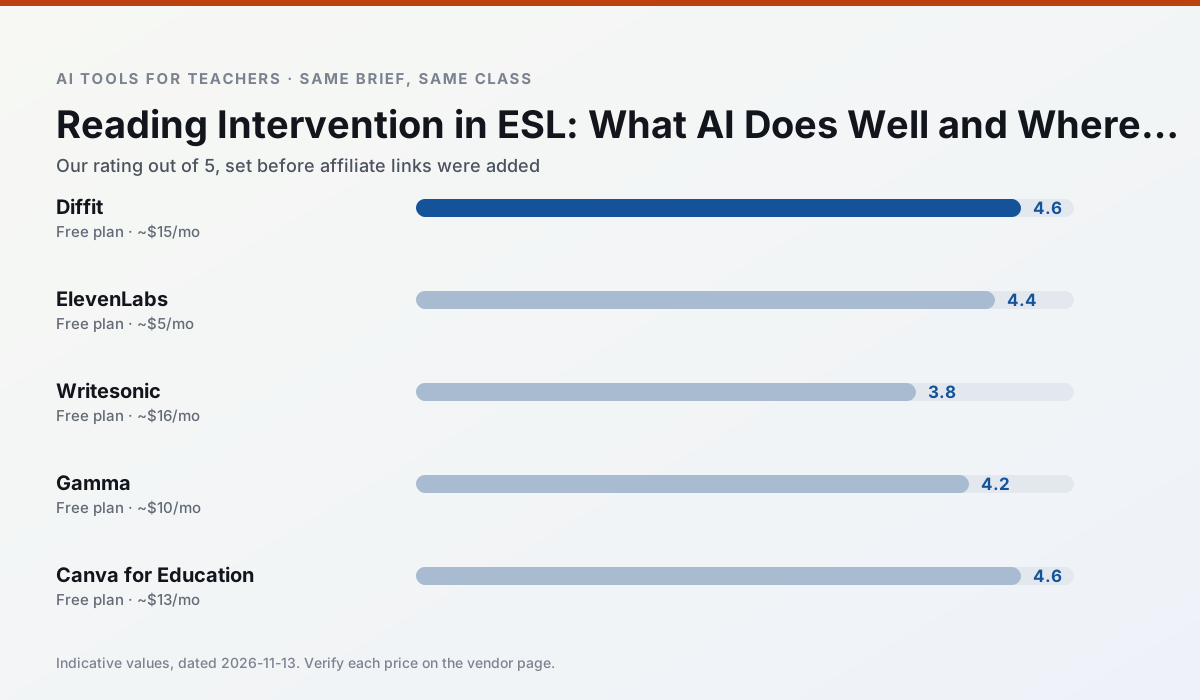
Side by side
Comparison table
Ratings reflect our timed classroom workflow, not vendor claims. Prices are indicative — verify on the vendor site.
| Tool | Best for | Free tier | Indicative paid plan | Standout feature | Our rating | Verdict | Try the tool |
|---|---|---|---|---|---|---|---|
| Diffit | differentiated instruction · reading intervention | Yes — Limited generations per month | ~$15 /user/mo | Lexile-style leveling | 4.6 / 5 | Top pick | Try free |
| ElevenLabs | accessibility · reading intervention | Yes — Monthly character quota | ~$5 /user/mo | Very natural voices | 4.4 / 5 | Strong option | Try free |
| Writesonic | newsletters · parent communication | Yes — Limited credits | ~$16 /user/mo | Article and email generators | 3.8 / 5 | Situational | Try free |
| Gamma | slide decks · parent communication | Yes — Credit-limited generation | ~$10 /user/mo | Prompt-to-deck | 4.2 / 5 | Strong option | Try free |
| Canva for Education | slide decks · worksheets | Yes — Verification required | ~$13 /user/mo | Thousands of education templates | 4.6 / 5 | Top pick | Try free |
| Fliki | video lessons · audio lessons | Yes — Watermarked, limited minutes | ~$21 /user/mo | Blog/text to video | 4.0 / 5 | Situational | Try free |
Match your situation
Best for X
Different jobs need different tools. Here is what we would open first in each case.
For anything students touch directly, Diffit offers the supervision controls and logging that IT will ask about first.
ElevenLabs is the steadiest of this set at plain, respectful language; names and specific incidents still belong in your draft, not the prompt.
For three reading groups and one text, Writesonic needs the least manual relabelling of vocabulary and questions.
Gamma has the shortest path from opening a tab to a usable draft, which matters more than the feature count on a Monday.
Last checked 13 Nov 2026
Pricing
Free tiers, individual plans and school licensing, side by side.
| Tool | Free plan | Individual / paid | School & district | Billing note | Verify |
|---|---|---|---|---|---|
| Diffit | $0 — Limited generations per month | ~$15 /user/mo | Custom quote | Indicative — verify on vendor site | Vendor |
| ElevenLabs | $0 — Monthly character quota | ~$5 /user/mo | ~$22 /user/mo | Indicative — verify on vendor site | Vendor |
| Writesonic | $0 — Limited credits | ~$16 /user/mo | ~$49 /user/mo | Indicative — verify on vendor site | Vendor |
| Gamma | $0 — Credit-limited generation | ~$10 /user/mo | ~$20 /user/mo | Indicative — verify on vendor site | Vendor |
| Canva for Education | $0 — Verification required | ~$13 /user/mo | Custom quote | Indicative — verify on vendor site | Vendor |
| Fliki | $0 — Watermarked, limited minutes | ~$21 /user/mo | ~$66 /user/mo | Indicative — verify on vendor site | Vendor |
Editorial rule: pricing is re-checked every 2–3 months and the top 50 pages are refreshed every 6 months. See our funding policy.
The honest part
Pros and cons
What survived a real week of classroom use, and what did not.
Pros
- Excellent for mixed-ability classes
- Produces printable and digital versions
- Minimal setup
Cons
- Narrower scope than all-in-one suites
- Leveling is approximate, not a formal assessment
- Heavy use burns through the free quota
Pros
- Excellent for accessible audio versions
- Low entry price
- Fast generation
Cons
- Quota-based billing
- Voice cloning consent considerations
- Not a teaching platform
Pros
- Cheaper than enterprise writing suites
- Many templates
- Reasonable free trial
Cons
- Generic classroom output
- Credit system is confusing
- Limited education context
Pros
- Fastest path from outline to deck
- Modern-looking output by default
- Good export options
Cons
- Design control is limited
- Credits run out quickly
- Not built for student data
Pros
- Effectively free for verified teachers
- Huge template library
- No design skills needed
Cons
- AI features are capped
- Easy to produce cluttered slides
- Account verification can be slow
In the classroom
Use cases
Five concrete workflows, with the tool we would open for each one.
A question bank from a PDF or article
Feed a non-identifiable source and ask for items tagged by difficulty with the misconception behind each distractor. Spot-check every answer key; numerical items are least reliable.
Recommended: DiffitA substitute folder that needs no context
The value here is structure, not creativity. Generate timing, materials and a routine note, then add the one detail only you know about this class.
Recommended: ElevenLabsAn IEP present-levels first draft
Use aggregated, anonymised data only. Ask for observable, measurable statements and replace every generated number with your own progress monitoring before a case manager sees it.
Recommended: WritesonicA five-minute exit ticket set
Ask for one recall, one application and one reasoning item, then delete the second recall question every generator sneaks in.
Recommended: GammaA parent email in two languages
Draft in plain, warm language with no names, translate, then back-translate the important sentences to check meaning. Keep specific incidents out of the prompt and add them yourself.
Recommended: Canva for Education
Questions teachers ask us
FAQ
Direct answers, also published as FAQPage structured data for search and AI assistants.
Can AI do reading intervention at mixed-grade level?
Which tool is best for reading intervention?
What is the biggest risk?
Sources & further reading
Our recommendation
Try ElevenLabs free for your next reading intervention task
Natural-sounding AI voiceover and text-to-speech for learning materials. Start on the free tier, run one real Esl lesson, and only consider upgrading if the quota is what stops you. Disclosure: we may earn a commission (22% recurring) at no extra cost to you.
Some links on this page are affiliate links. We may earn a commission at no extra cost to you. Our rankings are editorial and never pay-to-play. Never enter student PII into a free consumer account.
Keep reading
Related comparisons in this cluster.
Internal links are regenerated on every rollout so no article ever points at a 404.