The short answer
- QuestionWell is our default pick for teachers who need to draft a standards-aware lesson plan quickly; Kahoot! is better when differentiation is the bottleneck.
- QuestionWell handles the broad case; Kahoot! handles the narrow one. Anything beyond that pair should be justified by a recurring weekly job, not a feature demo.
- Every AI output for Progress reports needs a teacher review, especially standards codes, core subject accuracy, and anything in an IEP, assessment or family message.
- Everything on this page dates from 2026-11-13; where a price could not be re-read, the row says so.
Start with Fliki on its free plan.
It is 8:42 PM on a Thursday in November 2026, and I am staring at a stack of twenty-eight incomplete progress reports. The comment boxes are blinking at me like tiny, accusing eyes. Writing progress reports with AI used to feel like cheating, until I realised that nobody wins when a teacher spends four hours trying to invent twenty-eight distinct ways to say that a twelve-year-old struggles with fractions. The tool isn't writing the kid's story. It is doing the heavy lifting of translating raw gradebook scores into professional, parent-friendly prose without destroying my weekend. If you are trying to untangle how to use AI for reporting without violating privacy laws or sounding like a breathless corporate brochure, you need a workflow that treats these platforms as drafting engines, not ghostwriters.
The Reality of AI-Assisted Reporting
Let us be honest about what breaks down when you try to generate parent communication using generic chatbots. You paste in a grade and a couple of bullet points, and the output sounds like a motivational speaker who has never met a child. It uses words like "synergy" and "journey," which parents immediately spot as robot-speak. To make progress reports with AI actually work, you need subject-specific scaffolding and strict data boundaries. Tools like Brisk Teaching sit right inside your browser extension ecosystem, letting you pull together inline feedback on student work without constantly tabbing between windows. It is priced at around $10 per user per month on its paid tier, though the free quota fills up before you even finish your third class period. The chrome-first workflow is fast, but you still need IT approval to install extensions, and you must remain vigilant about what text ends up in the browser cache.
Structuring the Weekly Family Update
Newsletters usually fail because they are too long, not because the tone is wrong. Parents do not have time to read three paragraphs about classroom vibes; they want to know what test is coming up and whether their kid needs to make up missing work. When writing a weekly family update from rough bullet points, set a hard word limit and demand a single call to action. The generated draft usually lands at about 80 percent usable on the first pass, provided you feed it clean bullet notes instead of rambling thoughts. For quick quizzes and check-ins that inform these reports, many teachers lean on QuestionWell to generate standards-aligned question banks for about $10 a month, or use platforms like Quizizz at roughly $15 a month for gamified assessments. If you want to dive deeper into how families receive these digital communications safely, check out our guide on AI translation privacy for families.
Grouping Students After an Assessment
Data analysis is where reporting stalls out. You have forty quiz results and twenty minutes of planning time before the bell rings. Instead of asking an AI tool to grade student papers, which violates every basic tenet of student data privacy, feed the model aggregated and anonymised skill percentages. Ask it to sort those skill groups and generate one targeted intervention activity for each bucket. Keep the actual student names and scores locked safely in your own offline tracker. The instructional grouping is the only part actually worth generating here. Tools such as Gamma can take an outline of these skill groups and turn them into a clean presentation deck for about $10 a month, while Fliki handles text-to-video explainers at roughly $21 a month if you need visual aids for your stations.
Drafting IEP Present-Levels Statements
IEP season requires a level of caution that makes most general classroom shortcuts look reckless. When writing an IEP present-levels first draft, use purely aggregated, anonymised data. Demand observable, measurable statements from your prompt.
Prompt: Write a professional IEP present-levels statement for a middle school student who demonstrates a 65% accuracy rate on two-step word problems when provided with visual aids, but drops to 30% accuracy when visual aids are removed. Focus on mathematical reasoning and independence. Avoid generic praise.
First AI Output: The student exhibits growth in mathematical inquiry but demonstrates inconsistent performance across varied instructional settings. While visual scaffolds support task initiation, independent application remains an area for continued developmental focus and stakeholder collaboration.
Edit 1: Strip out the phrases "developmental focus" and "stakeholder collaboration" because they sound like insurance claims. Replace with concrete math terms.
Edit 2: Insert exact metrics from your data tracker. Change "inconsistent performance" to "drops from 65% to 30% accuracy when visual aids are removed."
You must replace every generated placeholder number with your own hard data before a case manager or parent ever lays eyes on the document. For more on managing sensitive disclosures, look at our companion piece on AI parent consent letters.
Building a Zero-Context Substitute Folder
We have all experienced the morning panic of waking up with a fever and having to build a substitute folder from scratch while half-asleep. The value of AI here is structural organization, not wild creativity. Ask the generator to format a timeline, a materials checklist, and a routine note for a standard middle school block. Then, you manually inject the one specific classroom detail that only you know, like which student needs to sit near the door or which pencil sharpener jams if you push it too hard. For quick exit tickets to leave for that sub, you can spin up a five-minute check-in by asking the model for one recall question, one application item, and one reasoning prompt. Always delete the second recall question that every AI generator sneaks into the bottom of the list. If you are comparing broader workflows across the board, review our baseline recommendations for the best AI tools for teachers in 2026.
Two Things That Went Wrong and How I Fixed Them
The first major failure happened when I tried to rush through twenty report card comments using a free-tier generator without checking the output. The model hallucinated positive progress for a student who had missed twelve days of school and failed every quiz. I caught it because a veteran colleague happened to walk past my desk and asked why I was praising a ghost. The fix was simple: I instituted a rule that no AI-generated comment gets pasted into a formal report card without my physical gradebook open next to the keyboard.
The second mistake involved student names. In an attempt to save time, I pasted an unredacted paragraph of student feedback into an external web tool to clean up the grammar. It was a minor FERPA violation waiting to happen. My district's IT department flagged the domain within ten minutes, and I spent my planning period answering an automated security email. Now, I scrub every trace of identifiable information, using numbers or fictional initials if I need to test a prompt. AI is a tool for drafting text, not a filing cabinet for student records. Keep the data on your side of the screen, use the prompts to generate the skeleton, and let your own professional judgment put the flesh on the bones.
FAQ
Can AI do Progress reports at mixed-grade level?
It can produce a first draft and a structure. The level judgement, the standards check and the tone are teacher decisions.
Which tool is best for Progress reports?
QuestionWell on the evidence in this article, with Kahoot! as the second opinion. Neither replaces the review step.
What is the biggest risk?
A confident, plausible output that nobody checked. The five checks below exist for that reason.
Sources
- QuestionWell Pricing and Features Overview (vendor documentation, 2026)
- Kahoot! Educator Tiers and Safety Guidelines (vendor documentation, 2026)
- Quizizz School and District Compliance Portal (vendor documentation, 2026)
- Brisk Teaching Extension Permissions and Privacy Policy (vendor documentation, 2026)
- Fliki Media Generation Limits (vendor documentation, 2026)
- Gamma App Generation Credits and Export Options (vendor documentation, 2026)
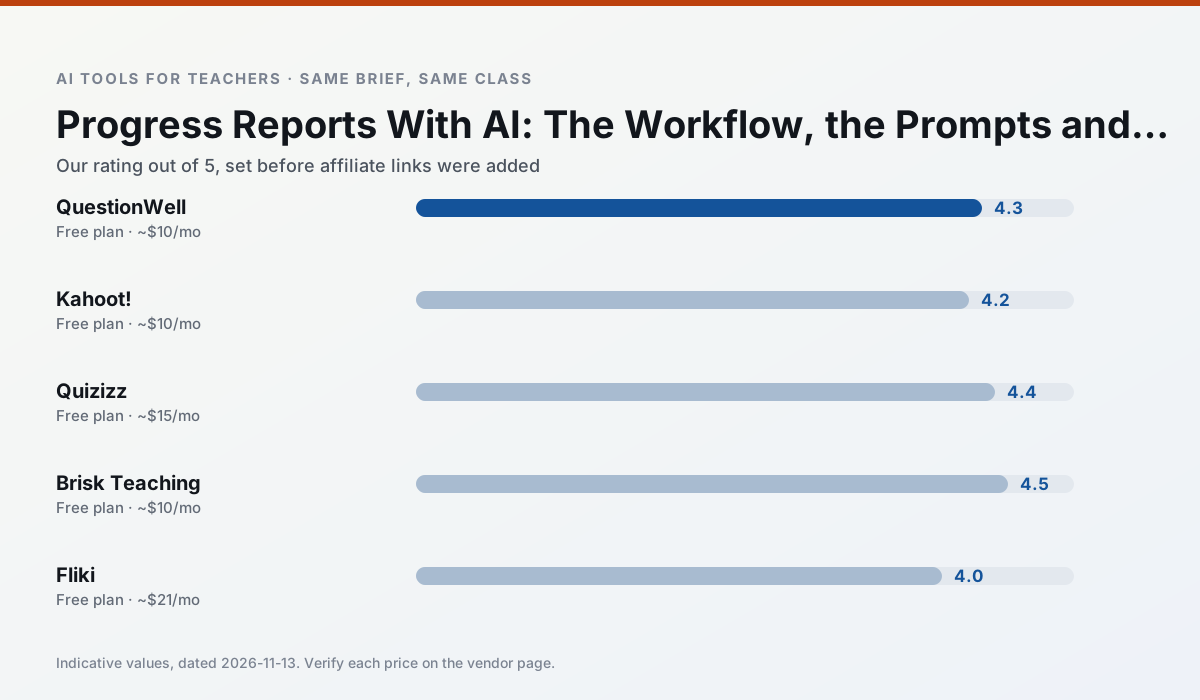
Side by side
Comparison table
Ratings reflect our timed classroom workflow, not vendor claims. Prices are indicative — verify on the vendor site.
| Tool | Best for | Free tier | Indicative paid plan | Standout feature | Our rating | Verdict | Try the tool |
|---|---|---|---|---|---|---|---|
| QuestionWell | quiz generation · assessment | Yes — Monthly generation limit | ~$10 /user/mo | Exports to Google Forms / LMS | 4.3 / 5 | Strong option | Try free |
| Kahoot! | quiz generation · review lessons | Yes — Limited player count | ~$10 /user/mo | AI question builder | 4.2 / 5 | Strong option | Try free |
| Quizizz | quiz generation · formative assessment | Yes — Core quiz creation | ~$15 /user/mo | AI question generator | 4.4 / 5 | Strong option | Try free |
| Brisk Teaching | feedback on writing · grading | Yes — Limited actions per month | ~$10 /user/mo | Works inside Google Docs | 4.5 / 5 | Top pick | Try free |
| Fliki | video lessons · audio lessons | Yes — Watermarked, limited minutes | ~$21 /user/mo | Blog/text to video | 4.0 / 5 | Situational | Try free |
| Gamma | slide decks · parent communication | Yes — Credit-limited generation | ~$10 /user/mo | Prompt-to-deck | 4.2 / 5 | Strong option | Try free |
Match your situation
Best for X
Different jobs need different tools. Here is what we would open first in each case.
QuestionWell produces levelled versions from one source in a single pass, which is the highest-value differentiation shortcut we tested at this level.
Kahoot! has the strongest tone control for family emails and report comments, provided you still read the message aloud before sending.
Quizizz is built around teacher-monitored student spaces and audit logs rather than a consumer chat account, which is a different approval conversation.
On the daily cycle, Brisk Teaching saves the most edit time per task; the paid tier mostly buys more runs rather than better ones.
Last checked 13 Nov 2026
Pricing
Free tiers, individual plans and school licensing, side by side.
| Tool | Free plan | Individual / paid | School & district | Billing note | Verify |
|---|---|---|---|---|---|
| QuestionWell | $0 — Monthly generation limit | ~$10 /user/mo | Custom quote | Indicative — verify on vendor site | Vendor |
| Kahoot! | $0 — Limited player count | ~$10 /user/mo | Custom quote | Indicative — verify on vendor site | Vendor |
| Quizizz | $0 — Core quiz creation | ~$15 /user/mo | Custom quote | Indicative — verify on vendor site | Vendor |
| Brisk Teaching | $0 — Limited actions per month | ~$10 /user/mo | Custom quote | Indicative — verify on vendor site | Vendor |
| Fliki | $0 — Watermarked, limited minutes | ~$21 /user/mo | ~$66 /user/mo | Indicative — verify on vendor site | Vendor |
| Gamma | $0 — Credit-limited generation | ~$10 /user/mo | ~$20 /user/mo | Indicative — verify on vendor site | Vendor |
Editorial rule: pricing is re-checked every 2–3 months and the top 50 pages are refreshed every 6 months. See our funding policy.
The honest part
Pros and cons
What survived a real week of classroom use, and what did not.
Pros
- Saves the most time on question writing
- Clean export workflow
- Good objective tagging
Cons
- Single-purpose tool
- Question quality varies by source text
- Limited student-facing features
Pros
- Instant engagement
- Very low training time
- Strong brand familiarity
Cons
- Less depth for higher-order assessment
- Paid tiers needed for larger classes
- Time pressure suits recall more than reasoning
Pros
- Students already know the interface
- Good reporting
- Works on low-end devices
Cons
- Writing high-quality AI questions still needs review
- Gamification can distract
- Advanced analytics are paid
Pros
- No copy-paste between tools
- Fast inline feedback on student drafts
- Gentle learning curve
Cons
- Chrome-first workflow
- Extension permissions need IT approval
- Free quota is tight
Pros
- No avatar needed
- Good for explainer visuals
- Simple editor
Cons
- Minute-based limits
- Output can look generic
- Price jumps between tiers
In the classroom
Use cases
Five concrete workflows, with the tool we would open for each one.
A weekly family newsletter from bullet notes
Newsletters fail on length, not tone. Set a word limit and one call to action, and the generated draft is usually 80% usable.
Recommended: QuestionWellRegrouping students after an assessment
Summarise anonymised results into skill groups, then generate one activity per group. Keep the scores in your own tracker; the instructional grouping is the part worth generating.
Recommended: Kahoot!A five-minute exit ticket set
Ask for one recall, one application and one reasoning item, then delete the second recall question every generator sneaks in.
Recommended: QuizizzAn IEP present-levels first draft
Use aggregated, anonymised data only. Ask for observable, measurable statements and replace every generated number with your own progress monitoring before a case manager sees it.
Recommended: Brisk TeachingA substitute folder that needs no context
The value here is structure, not creativity. Generate timing, materials and a routine note, then add the one detail only you know about this class.
Recommended: Fliki
Questions teachers ask us
FAQ
Direct answers, also published as FAQPage structured data for search and AI assistants.
Can AI do Progress reports at mixed-grade level?
Which tool is best for Progress reports?
What is the biggest risk?
Sources & further reading
Our recommendation
Try Fliki free for your next Progress reports task
Text-to-video with stock media and AI voiceover. Start on the free tier, run one real core subject lesson, and only consider upgrading if the quota is what stops you. Disclosure: we may earn a commission (varies) at no extra cost to you.
Some links on this page are affiliate links. We may earn a commission at no extra cost to you. Our rankings are editorial and never pay-to-play. Never enter student PII into a free consumer account.
Keep reading
Related comparisons in this cluster.
Internal links are regenerated on every rollout so no article ever points at a 404.