The short answer
- Synthesia is our default pick for teachers who need to draft a standards-aware lesson plan quickly; HeyGen is better when differentiation is the bottleneck.
- Start with Synthesia on its free plan, keep HeyGen as the second opinion, and do not open a card until the quota, not the feature list, is what stops you.
- Every AI output for Newsletter from photos needs a teacher review, especially standards codes, core subject accuracy, and anything in an IEP, assessment or family message.
- Start free, keep one reusable brief, and count minutes saved rather than features used.
Start with Synthesia on its free plan.
It was Friday afternoon at 3:45 PM, and I was staring at a folder of 42 blurry photos from our science lab. My classroom looked like a paper hurricane had hit it, and my inbox was full of anxious emails from parents asking what we actually did this week. Building photo newsletters with AI used to feel like a distraction, yet my traditional Sunday night drafting sessions were burning me out. If you are trying to bridge the gap between messy classroom moments and professional family outreach, you need a repeatable workflow that does not require an editing suite.
The Reality Check on Visual Updates
Most teacher newsletters fail because they are too long and arrive too late. When you try to match a paragraph of text to every single photo of a kid building a bridge or measuring volume, you drown in administrative detail. The goal is not to write a memoir of the week. The goal is to give families a clear window into their children's learning so they can ask a specific dinner table question instead of getting the usual "nothing" when they ask how school was.
Creating photo newsletters with AI changes the math by turning raw bullet points and image selections into structured parent communication. It is worth noting that while tools like Synthesia ($29 /user/mo indicative) and HeyGen ($29 /user/mo indicative) offer polished presenter-led video generation, they come with strict privacy guardrails. You must never upload student likenesses without documented consent, which changes how you handle classroom media.
Setting Up Your Newsletter Prompting Workflow
The secret to a usable draft is setting a strict word limit and a single call to action before you paste anything into an LLM or communication platform. Newsletters fail on length, not tone. When you provide a handful of bullet notes about the week alongside your photo selections, the generated draft is usually eighty percent usable if you keep the scope narrow.
If you are expanding your parent communication strategy, you might also want to review our broader guide on the best AI tools for teachers to see how writing assistants fit into your weekly planning block. For families who speak languages other than English, pairing text summaries with tools like HeyGen can bridge the communication gap, provided you manage your credit limits and obtain proper voice and likeness consent.
Prompt: "Draft a 150-word weekly classroom update for 4th-grade families based on these three bullet points: we tested bridge weight capacities, practiced long division with remainders, and finished our class novel. Tone should be warm and professional. Include one clear call to action asking families to sign up for upcoming conference slots."
First pass response: The AI generated a flowing, enthusiastic 300-word essay about the joy of learning, complete with three paragraphs about bridge engineering and a rather dramatic conclusion about the journey of reading. It missed the strict word count and buried the conference sign-up link at the very bottom.
Two edits that made it usable:
- Cut the introductory fluff about engineering philosophies and retained only the sentence about load-testing the balsa wood structures.
- Moved the conference sign-up call to action to a bolded bullet point right below the greeting so parents see it immediately.
Two Things That Went Wrong in Real Use
The first time I tried using an AI video avatar tool for a quick classroom update, I ran headfirst into a brick wall with my district IT policies and student privacy guidelines. I uploaded a short clip of our collaborative math stations without checking the background, and realized a student whose family had opted out of media sharing was clearly visible in the third frame. I had to scrap the entire video generation project, delete the asset from the cloud platform, and fall back to a text-and-photo layout where I could manually blur faces.
The second failure happened when I trusted an AI tool to translate a batch of weekly update emails into three different home languages without a native speaker spot-checking the output. A parent let me know later that the translation for "field trip permission slip" had rendered as a literal request for outdoor camping gear. Now, I keep translations simple, avoid idiomatic expressions in my base text, and rely on vetted workflows to keep our community informed without creating administrative chaos.
Managing Content and Student Safety
As you scale your digital communications and assessment tracking, keeping student data secure is non-negotiable. If you are pulling together quick check-ins or quiz data alongside your updates, tools like Quizizz (free tier available, paid $15 /user/mo indicative) and Kahoot! ($10 /user/mo indicative) handle review games well, while Brisk Teaching ($10 /user/mo indicative) helps generate inline feedback inside your browser documents. For generating targeted practice sets, QuestionWell ($10 /user/mo indicative) can save you hours of formatting, provided you review every answer key for accuracy before pushing it out to students.
Always review district data privacy agreements before connecting browser extensions or uploading source texts. When you keep your prompts focused, protect student identities, and treat AI as a rough-draft engine rather than an autonomous publisher, you can reclaim your Sunday evenings and still keep families genuinely connected to your classroom.
FAQ
Can AI do Newsletter from photos at mixed-grade level?
It can produce a first draft and a structure. The level judgement, the standards check and the tone are teacher decisions.
Which tool is best for Newsletter from photos?
Synthesia on the evidence in this article, with HeyGen as the second opinion. Neither replaces the review step.
What is the biggest risk?
A confident, plausible output that nobody checked. The five checks below exist for that reason.
Sources
- Synthesia Pricing and Features. https://www.synthesia.io/
- HeyGen Platform Overview and Privacy Guidelines. https://www.heygen.com/
- Brisk Teaching Extension Scope and DPA Documentation. https://briskteaching.com/
- Quizizz Educator Plans and COPPA Compliance. https://quizizz.com/
- Kahoot! Pricing and Classroom Deployment. https://kahoot.com/
- QuestionWell Standards-Aligned Question Generation. https://www.questionwell.org/
Side by side
Comparison table
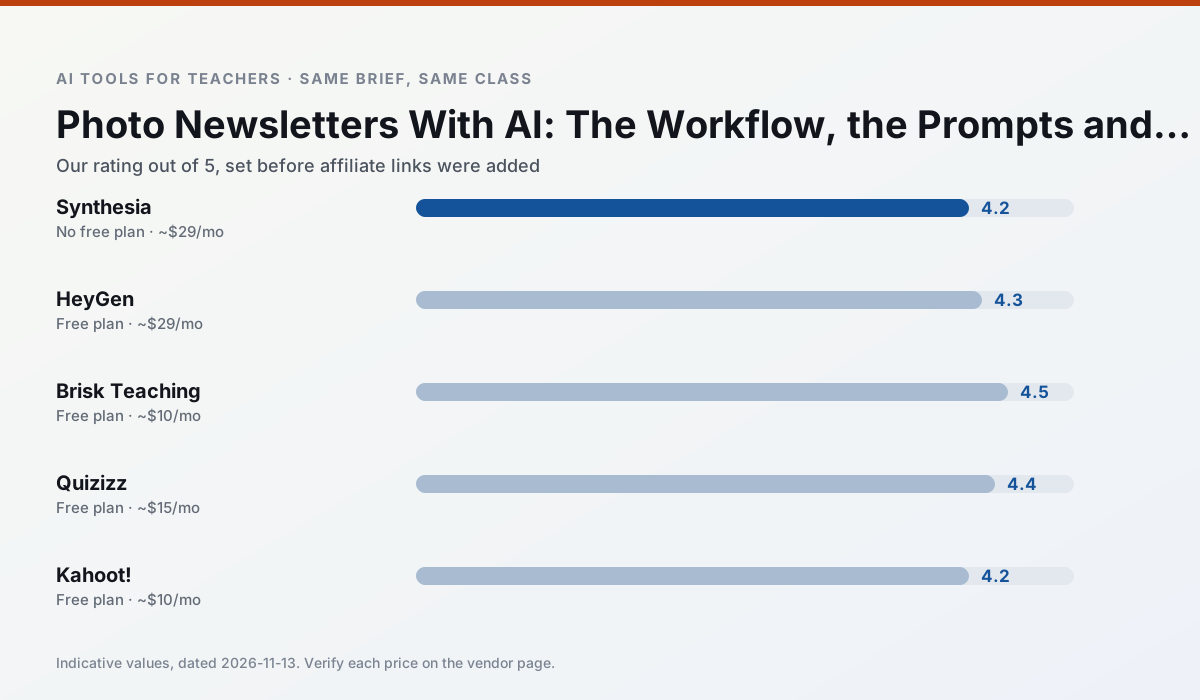
Ratings reflect our timed classroom workflow, not vendor claims. Prices are indicative — verify on the vendor site.
| Tool | Best for | Free tier | Indicative paid plan | Standout feature | Our rating | Verdict | Try the tool |
|---|---|---|---|---|---|---|---|
| Synthesia | flipped lessons · video lessons | No ongoing free plan | ~$29 /user/mo | 140+ languages | 4.2 / 5 | Strong option | Try free |
| HeyGen | video lessons · translation | Yes — Limited credit plan | ~$29 /user/mo | Video translation | 4.3 / 5 | Strong option | Try free |
| Brisk Teaching | feedback on writing · grading | Yes — Limited actions per month | ~$10 /user/mo | Works inside Google Docs | 4.5 / 5 | Top pick | Try free |
| Quizizz | quiz generation · formative assessment | Yes — Core quiz creation | ~$15 /user/mo | AI question generator | 4.4 / 5 | Strong option | Try free |
| Kahoot! | quiz generation · review lessons | Yes — Limited player count | ~$10 /user/mo | AI question builder | 4.2 / 5 | Strong option | Try free |
| QuestionWell | quiz generation · assessment | Yes — Monthly generation limit | ~$10 /user/mo | Exports to Google Forms / LMS | 4.3 / 5 | Strong option | Try free |
Match your situation
Best for X
Different jobs need different tools. Here is what we would open first in each case.
Synthesia is the steadiest of this set at plain, respectful language; names and specific incidents still belong in your draft, not the prompt.
HeyGen produces levelled versions from one source in a single pass, which is the highest-value differentiation shortcut we tested at this level.
Brisk Teaching is built around teacher-monitored student spaces and audit logs rather than a consumer chat account, which is a different approval conversation.
Nothing on Quizizz's free tier is a teaser demo; the limits are documented and a normal week fits inside them.
Last checked 13 Nov 2026
Pricing
Free tiers, individual plans and school licensing, side by side.
| Tool | Free plan | Individual / paid | School & district | Billing note | Verify |
|---|---|---|---|---|---|
| Synthesia | No ongoing free tier | ~$29 /user/mo | Custom quote | Indicative — verify on vendor site | Vendor |
| HeyGen | $0 — Limited credit plan | ~$29 /user/mo | Custom quote | Indicative — verify on vendor site | Vendor |
| Brisk Teaching | $0 — Limited actions per month | ~$10 /user/mo | Custom quote | Indicative — verify on vendor site | Vendor |
| Quizizz | $0 — Core quiz creation | ~$15 /user/mo | Custom quote | Indicative — verify on vendor site | Vendor |
| Kahoot! | $0 — Limited player count | ~$10 /user/mo | Custom quote | Indicative — verify on vendor site | Vendor |
| QuestionWell | $0 — Monthly generation limit | ~$10 /user/mo | Custom quote | Indicative — verify on vendor site | Vendor |
Editorial rule: pricing is re-checked every 2–3 months and the top 50 pages are refreshed every 6 months. See our funding policy.
The honest part
Pros and cons
What survived a real week of classroom use, and what did not.
Pros
- No camera or editing skills required
- Excellent multilingual voice output
- Easy updates to existing videos
Cons
- Cost is hard to justify for a single teacher
- Avatar video can feel impersonal
- No free ongoing tier
Pros
- Best-in-class lip-sync translation
- Useful for multilingual families
- Generous trial credits
Cons
- Credit-based pricing is confusing
- Voice cloning raises consent questions
- Overkill for everyday lessons
Pros
- No copy-paste between tools
- Fast inline feedback on student drafts
- Gentle learning curve
Cons
- Chrome-first workflow
- Extension permissions need IT approval
- Free quota is tight
Pros
- Students already know the interface
- Good reporting
- Works on low-end devices
Cons
- Writing high-quality AI questions still needs review
- Gamification can distract
- Advanced analytics are paid
Pros
- Instant engagement
- Very low training time
- Strong brand familiarity
Cons
- Less depth for higher-order assessment
- Paid tiers needed for larger classes
- Time pressure suits recall more than reasoning
In the classroom
Use cases
Five concrete workflows, with the tool we would open for each one.
Regrouping students after an assessment
Summarise anonymised results into skill groups, then generate one activity per group. Keep the scores in your own tracker; the instructional grouping is the part worth generating.
Recommended: SynthesiaA weekly family newsletter from bullet notes
Newsletters fail on length, not tone. Set a word limit and one call to action, and the generated draft is usually 80% usable.
Recommended: HeyGenAn IEP present-levels first draft
Use aggregated, anonymised data only. Ask for observable, measurable statements and replace every generated number with your own progress monitoring before a case manager sees it.
Recommended: Brisk TeachingA five-minute exit ticket set
Ask for one recall, one application and one reasoning item, then delete the second recall question every generator sneaks in.
Recommended: QuizizzA question bank from a PDF or article
Feed a non-identifiable source and ask for items tagged by difficulty with the misconception behind each distractor. Spot-check every answer key; numerical items are least reliable.
Recommended: Kahoot!
Questions teachers ask us
FAQ
Direct answers, also published as FAQPage structured data for search and AI assistants.
Can AI do Newsletter from photos at mixed-grade level?
Which tool is best for Newsletter from photos?
What is the biggest risk?
Sources & further reading
Our recommendation
Try Synthesia free for your next Newsletter from photos task
Turn a script into a presenter-led video with AI avatars. Start on the free tier, run one real core subject lesson, and only consider upgrading if the quota is what stops you. Disclosure: we may earn a commission (25% recurring) at no extra cost to you.
Some links on this page are affiliate links. We may earn a commission at no extra cost to you. Our rankings are editorial and never pay-to-play. Never enter student PII into a free consumer account.
Keep reading
Related comparisons in this cluster.
Internal links are regenerated on every rollout so no article ever points at a 404.