The short answer
- Surfer SEO is our default pick for teachers who need to draft a standards-aware lesson plan quickly; OpusClip is better when differentiation is the bottleneck.
- Start with Surfer SEO on its free plan, keep OpusClip as the second opinion, and do not open a card until the quota, not the feature list, is what stops you.
- Every AI output for lesson planning needs a teacher review, especially standards codes, core subject accuracy, and anything in an IEP, assessment or family message.
- Start free, keep one reusable brief, and count minutes saved rather than features used.
Start with Surfer SEO on its free plan.
Last Tuesday, I sat at my desk with thirty-four permission slips scattered across my keyboard. Ten of them were missing signatures, five had parents asking if AI meant their kid was getting a robot teacher, and one mother wanted to know if her third-grader's voice was going to be cloned by a server in Ohio. The standard district boilerplate we sent home in 2024 about "digital learning tools" simply did not cover what happens when we use Notion AI for curriculum planning or run an audio article through ElevenLabs to help our struggling readers. If you are trying to write a policy that makes sense to actual human parents without inducing a panic attack, you need a clear template. More importantly, you need to know which platforms are safe to mention by name and which ones should stay locked in your professional toolkit.
Why generic tech waivers fail families
Parents do not care about server architectures or API endpoints. They care about what their child types into a box and who owns the output. When we talk about AI in schools, our communication usually falls into two traps. We either drown families in legal disclaimers or we pretend nothing has changed since the advent of the overhead projector. A proper consent letter has to draw a sharp line between administrative tools and student-facing tools. For instance, if you are using Surfer SEO to optimize teacher resource shop content or polish professional blog posts, that is staff work. It never touches a child. But if you are experimenting with Notion AI for tracking long-term curriculum records or generating text-to-speech audio with ElevenLabs for accessible reading materials, families deserve to know how those systems handle data. The key is separating backend teacher productivity from classroom implementation.
Structuring the letter around actual classroom workflows
When drafting your notification letter, group your AI usage by what it actually does for instruction rather than listing software brands like a tech catalog. Explain that you might use tools like OpusClip to turn a recorded lesson into short review clips for absent students, provided you never upload recordings containing identifiable children. Mention that text-to-speech generators such as ElevenLabs, which starts around $5 a month for basic tiers, help create audio versions of complex reading passages for English language learners. Keep the tone practical.
Prompt: Write a brief parent notification paragraph explaining that text-to-speech software will be used to generate audio versions of reading assignments, keeping the reading level accessible for dyslexic students while noting that no student voices are ever recorded or cloned.
First draft output: "Dear Parents, we are utilizing advanced neural audio synthesis via ElevenLabs to democratize textual consumption for all learners. This ensures equity in cognitive load across diverse learning profiles without infringing upon vocal PII."
Teacher Edit 1: Translate the jargon into plain English so a tired parent reading it at 9 PM can understand it.
Teacher Edit 2: Add a direct opt-out sentence and a link to our broader digital citizenship hub, similar to the guidance we share in resources like the best AI tools for teachers 2026 and our breakdown of AI translation privacy families.
Navigating institutional detection and similarity checking
Parents also worry about how their children's writing is judged. Some secondary schools rely on platforms like Turnitin Clarity and Feedback Studio to provide detailed revision histories and institutional similarity checks. While Turnitin features custom quotes for districts and fits neatly into existing LMS setups, its AI detection features remain heavily contested by staff and students alike. The same caution applies to standalone scanners like Originality.ai, which costs roughly $12 per user monthly and handles bulk publishing QA.
Never use detector scores as a sole disciplinary decision for suspected student misconduct. False positives happen, and relying on a percentage score to accuse a teenager of academic dishonesty is a fast track to destroying trust. Make sure your consent letter clarifies that AI detection tools are internal diagnostic guides, not infallible judges of student effort.
What went wrong when I tried to automate permissions
My first attempt at an AI consent form was a complete disaster because I tried to cover every single micro-application I tested during my planning periods. I listed twelve different platforms, including Notion AI for organizing my curriculum notes and various niche content helpers. Parents understandably assumed their kids were going to be guinea pigs for a dozen experimental software companies. Half the class was opted out by Friday.
I had to pull the letter back, strip out the developer names that didn't involve direct student interaction, and focus solely on the student-facing experience. If a tool like Surfer SEO is just helping me format teacher resources online for around $79 a month, it does not belong on a parent letter about classroom software. Keep the focus narrow. Tell parents what data stays local, what data gets processed externally, and how they can request an alternative non-digital format if they prefer paper packets.
Establishing a sustainable communication rhythm
Once you get the initial consent letter signed and filed, you have to maintain transparency without drowning in paperwork. Parents appreciate brief, honest updates rather than sudden shifts in your pedagogical approach. If you are reshaping your weekly family updates or trying to keep communication clear, borrowing strategies from workflows like our guide on behavior updates with AI teacher workflow can save your sanity.
The goal of an AI consent letter is not to sell families on the brilliance of machine learning. The goal is to build an explicit contract of trust. When parents know you are using tools thoughtfully, keeping student personally identifiable information off public servers, and maintaining final editorial control over every assignment, they stop worrying about the technology and start focusing on their child's actual learning.
FAQ
Is AI allowed for lesson planning in my school?
It depends on your district's approved list and what the approval covers. Ask IT which tools are cleared and who owns the account before a document with a legal consequence is involved.
Who is responsible if something goes wrong?
The school, and in practice the named teacher who reviewed the output. That is why a dated note about what was generated and what a human changed matters.
What should never go into a prompt?
Names, rosters, scans of student work and gradebook screenshots. Topic-level prompts do most of the work without any of that.
Sources
- OpenAI. (2026). Data Privacy and Educational Deployments. OpenAI Enterprise Guide.
- ElevenLabs. (2026). Pricing and Voice Cloning Safety Standards. ElevenLabs Documentation.
- Turnitin. (2026). Feedback Studio and Similarity Checking Integration. Turnitin Help Center.
- Originality.ai. (2026). AI Detection Accuracy and Publishing QA Models. Originality.ai FAQ.
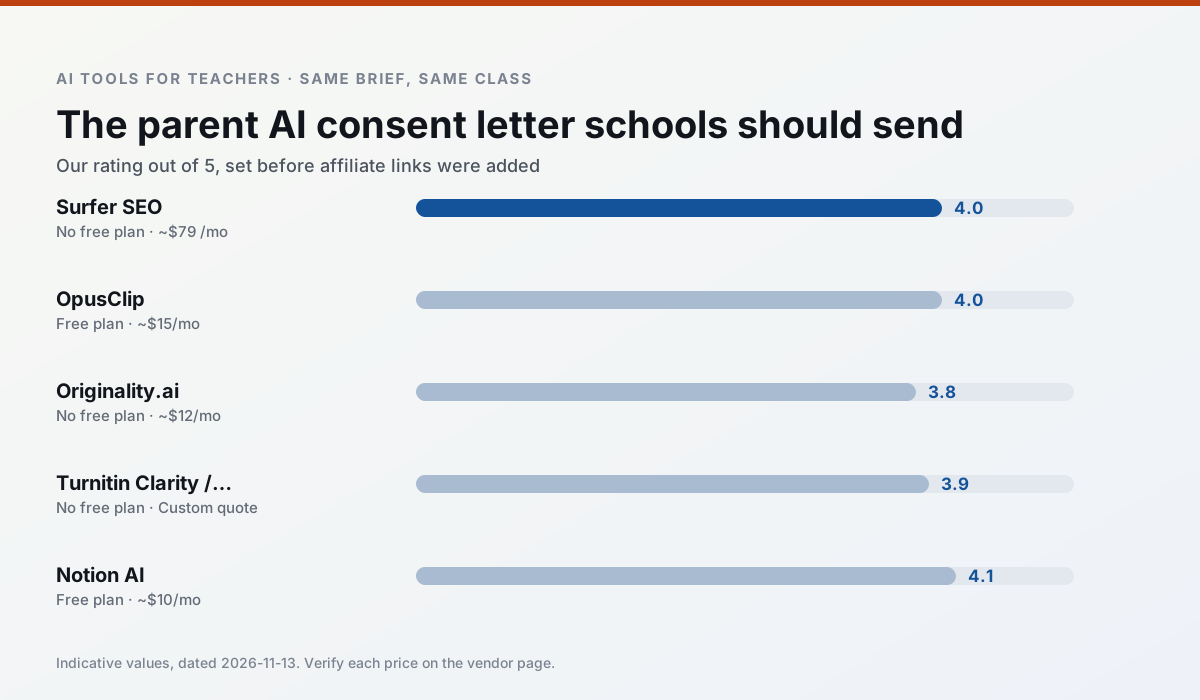
Side by side
Comparison table
Ratings reflect our timed classroom workflow, not vendor claims. Prices are indicative — verify on the vendor site.
| Tool | Best for | Free tier | Indicative paid plan | Standout feature | Our rating | Verdict | Try the tool |
|---|---|---|---|---|---|---|---|
| Surfer SEO | teacher bloggers · resource sellers | No ongoing free plan | ~$79 /mo | Content Editor | 4.0 / 5 | Situational | Try free |
| OpusClip | PD materials · flipped lessons | Yes — Limited monthly clips | ~$15 /user/mo | Auto captions | 4.0 / 5 | Situational | Try free |
| Originality.ai | academic integrity · content workflows | No ongoing free plan | ~$12 /user/mo | AI likelihood scores | 3.8 / 5 | Situational | Try free |
| Turnitin Clarity / Feedback Studio | feedback on writing · academic integrity | No ongoing free plan | Custom quote | Similarity reports | 3.9 / 5 | Situational | Try free |
| Notion AI | curriculum mapping · unit planning | Yes — Limited AI usage | ~$10 /user/mo | Linked databases | 4.1 / 5 | Situational | Try free |
| ElevenLabs | accessibility · reading intervention | Yes — Monthly character quota | ~$5 /user/mo | Very natural voices | 4.4 / 5 | Strong option | Try free |
Match your situation
Best for X
Different jobs need different tools. Here is what we would open first in each case.
Surfer SEO is built around teacher-monitored student spaces and audit logs rather than a consumer chat account, which is a different approval conversation.
OpusClip is the steadiest of this set at plain, respectful language; names and specific incidents still belong in your draft, not the prompt.
For three reading groups and one text, Originality.ai needs the least manual relabelling of vocabulary and questions.
Setup cost is one login for Turnitin Clarity / Feedback Studio; everything else can wait until you know the tool is useful.
Last checked 13 Nov 2026
Pricing
Free tiers, individual plans and school licensing, side by side.
| Tool | Free plan | Individual / paid | School & district | Billing note | Verify |
|---|---|---|---|---|---|
| Surfer SEO | No ongoing free tier | ~$79 /mo | Custom quote | Indicative — verify on vendor site | Vendor |
| OpusClip | $0 — Limited monthly clips | ~$15 /user/mo | ~$29 /user/mo | Indicative — verify on vendor site | Vendor |
| Originality.ai | No ongoing free tier | ~$12 /user/mo | Custom quote | Indicative — verify on vendor site | Vendor |
| Turnitin Clarity / Feedback Studio | No ongoing free tier | Custom quote | Custom quote | LMS-wide deployment | Vendor |
| Notion AI | $0 — Limited AI usage | ~$10 /user/mo | ~$8 /user/mo | Indicative — verify on vendor site | Vendor |
| ElevenLabs | $0 — Monthly character quota | ~$5 /user/mo | ~$22 /user/mo | Indicative — verify on vendor site | Vendor |
Editorial rule: pricing is re-checked every 2–3 months and the top 50 pages are refreshed every 6 months. See our funding policy.
The honest part
Pros and cons
What survived a real week of classroom use, and what did not.
Pros
- Best-in-class on-page guidance
- Useful for TpT / resource-shop content
- Clear scoring
Cons
- Expensive for individual teachers
- Not a classroom tool
- Requires SEO basics
Pros
- Turns a recorded lesson into review clips
- Excellent captions
- Fast
Cons
- Optimised for social formats
- Not a lesson design tool
- Free plan is restrictive
Pros
- Useful for content publishing QA
- Fast bulk scanning
- Transparent credit model
Cons
- AI detection produces false positives
- Should never be sole evidence of misconduct
- Not a teaching tool
Pros
- Already licensed at many schools
- Consistent institutional workflow
- Detailed revision history
Cons
- Individual teachers cannot buy it
- AI detection remains contested
- Heavy administrative setup
Pros
- Great for long-term curriculum records
- Strong team collaboration
- Flexible structure
Cons
- Setup time is significant
- AI add-on pricing changed more than once
- Not purpose-built for lesson generation
In the classroom
Use cases
Five concrete workflows, with the tool we would open for each one.
Regrouping students after an assessment
Summarise anonymised results into skill groups, then generate one activity per group. Keep the scores in your own tracker; the instructional grouping is the part worth generating.
Recommended: Surfer SEOA weekly family newsletter from bullet notes
Newsletters fail on length, not tone. Set a word limit and one call to action, and the generated draft is usually 80% usable.
Recommended: OpusClipA question bank from a PDF or article
Feed a non-identifiable source and ask for items tagged by difficulty with the misconception behind each distractor. Spot-check every answer key; numerical items are least reliable.
Recommended: Originality.aiA substitute folder that needs no context
The value here is structure, not creativity. Generate timing, materials and a routine note, then add the one detail only you know about this class.
Recommended: Turnitin Clarity / Feedback StudioAn IEP present-levels first draft
Use aggregated, anonymised data only. Ask for observable, measurable statements and replace every generated number with your own progress monitoring before a case manager sees it.
Recommended: Notion AI
Questions teachers ask us
FAQ
Direct answers, also published as FAQPage structured data for search and AI assistants.
Is AI allowed for lesson planning in my school?
Who is responsible if something goes wrong?
What should never go into a prompt?
Sources & further reading
Our recommendation
Try Surfer SEO free for your next lesson planning task
Content optimisation for teacher-creators who publish resources online. Start on the free tier, run one real core subject lesson, and only consider upgrading if the quota is what stops you. Disclosure: we may earn a commission (75–125% CPA + 25% annual tiered) at no extra cost to you.
Some links on this page are affiliate links. We may earn a commission at no extra cost to you. Our rankings are editorial and never pay-to-play. Never enter student PII into a free consumer account.
Keep reading
Related comparisons in this cluster.
Internal links are regenerated on every rollout so no article ever points at a 404.