The short answer
- Gradescope is our default pick for teachers who need to draft a standards-aware lesson plan quickly; Formative is better when differentiation is the bottleneck.
- Gradescope handles the broad case; Formative handles the narrow one. Anything beyond that pair should be justified by a recurring weekly job, not a feature demo.
- Every AI output for Behavior comments needs a teacher review, especially standards codes, core subject accuracy, and anything in an IEP, assessment or family message.
- Everything on this page dates from 2026-11-13; where a price could not be re-read, the row says so.
Start with Gamma on its free plan.
It is 4:15 on a Thursday afternoon and I am staring at thirty-four behavior log entries that need to go home before pickup. Johnny tipped his desk over during math. Sarah spent twenty minutes refusing to open her notebook. Marcus helped three classmates pack up their supply boxes without being asked. If I write these by hand, I miss my own children's dentist appointment. If I use a generic template, Principal Miller will ask why every kid in period four is displaying the exact same growth mindset trajectory. This is the exact bottleneck where behavior comments with AI save your sanity, provided you do not let the algorithm write a fictional story about your classroom.
When you start using AI for parent communication, the instinct is to dump a student's entire day into a chat window and tell the machine to make it professional. Do not do this. You are inviting FERPA violations and getting back paragraphs of corporate HR speak that sound nothing like a real human teacher. We have tested dozens of platforms across our school, and writing behavior comments requires a rigid workflow where you supply the structure and the software supplies the phrasing. You can read our broader assessment of these systems in our guide to the best ai tools for teachers 2026, but let us look specifically at how to handle behavior data without losing your license or your mind.
The Parent Email Trap
The most common failure mode in behavior comments with AI is the hallucinated incident. If you ask a language model to write an email about a student acting out, it will often invent emotional motivations that you never observed. It will suggest the student is feeling isolated or exhibiting withdrawal symptoms, which turns a simple disruption into an unverified psychological assessment.
To keep things grounded, you must decouple the student identity from the draft. Never paste real names, student ID numbers, or specific medical conditions into a public web tool. Write your notes using pseudonyms or student initials, generate the draft for tone, and then paste the real name back in at the end. If you are communicating with multilingual families, you can review our advice on managing AI translation privacy families to ensure your tone remains warm and culturally appropriate across languages.
Prompt: Write a neutral, constructive parent email update about a student who repeatedly interrupted group work today by talking over peers, but who also successfully completed the individual afternoon writing task without redirection. Keep it under 150 words.
First output: Dear Parent, I am writing to inform you that Student X is struggling with peer socialization and attention regulation during cooperative learning blocks. They exhibited signs of anxiety-driven distraction today. However, they recovered during solitary writing. We need to schedule a conference to discuss their executive dysfunction.
Two edits that made it usable:
- Cut the entire sentence about "anxiety-driven distraction" and "executive dysfunction" because I am a teacher, not a diagnostician, and I did not observe those internal states.
- Replaced the clinical phrasing with plain language: "During group work today, Leo frequently interrupted his peers while they were sharing ideas. However, during independent writing this afternoon, he focused well and finished his draft without needing redirection."
Structuring Daily Behavior Logs
If you manage paperwork across multiple platforms, you know that keeping track of behavioral trends can feel like herding cats. While tools like Gradescope dominate for paper assessments and institutional scoring, and Formative offers strong live data for intervention groups, neither is built for quick narrative logs. Similarly, while Gamma and Canva for Education handle presentations and visual collateral well, and Quizizz keeps students busy with gamified checks, none of these are designed for sensitive anecdotal records.
When you need to turn rough anecdotal notes into polished weekly summaries, you need a workflow that filters out the noise. I keep a running list of bullet points on a clipboard during the day—things like "fought over scissors," "shared crayons," "cried during transition." At the end of the week, I feed those raw fragments into an AI assistant with a strict prompt constraint: summarize patterns only, do not invent new incidents, and maintain a supportive tone.
When the AI Goes Rogue
Let us be honest about what goes wrong. Last term, I used an AI writing assistant to generate positive reinforcement notes for my homeroom. Because I trusted the output too blindly, I sent home a note stating that a student had shown tremendous growth in their organizational habits all week. The parent replied within ten minutes asking why I was praising their child's organization when the child had lost their backpack on Monday, Tuesday, and Thursday.
The tool had smoothed over the messy reality of middle school to create a more harmonious narrative. AI likes happy endings and symmetrical patterns. Real classrooms are chaotic and full of contradictions. To fix this, I instituted a rule: the AI can suggest adjectives and sentence flow, but I must provide every single factual data point. If a kid had a rough week, the AI does not get to call it a transitional growth period unless that growth actually happened.
Choosing the Right Tool for the Job
Not every tool on the market belongs in your behavior workflow. Brisk Teaching works well for inline feedback inside student drafts via its browser extension, but it is an editing tool, not a behavior log. If your district relies on heavy institutional analytics, you might find yourself navigating opaque pricing structures or strict DPA requirements.
When evaluating tools for parent communication and behavior tracking, stick to platforms that respect data privacy and integrate cleanly with your existing communication stack. If a tool requires you to upload unmasked student records to generate a simple behavior note, skip it. You can manage your documentation just as easily by keeping your prompts clean, anonymous, and strictly tied to the raw notes sitting on your desk.
FAQ
Can AI do Behavior comments at mixed-grade level?
It can produce a first draft and a structure. The level judgement, the standards check and the tone are teacher decisions.
Which tool is best for Behavior comments?
Gradescope on the evidence in this article, with Formative as the second opinion. Neither replaces the review step.
What is the biggest risk?
A confident, plausible output that nobody checked. The five checks below exist for that reason.
Sources
- Gradescope. Gradescope Features and Pricing. https://www.gradescope.com/
- Formative. Newsela Formative Product Overview. https://formative.com/
- Gamma. Gamma App AI Presentation Generator. https://gamma.app/
- Canva for Education. Canva for Teachers and Districts. https://www.canva.com/education/
- Quizizz. Quizizz Educator Tools. https://quizizz.com/
- Brisk Teaching. Brisk Teaching Chrome Extension. https://briskteaching.com/
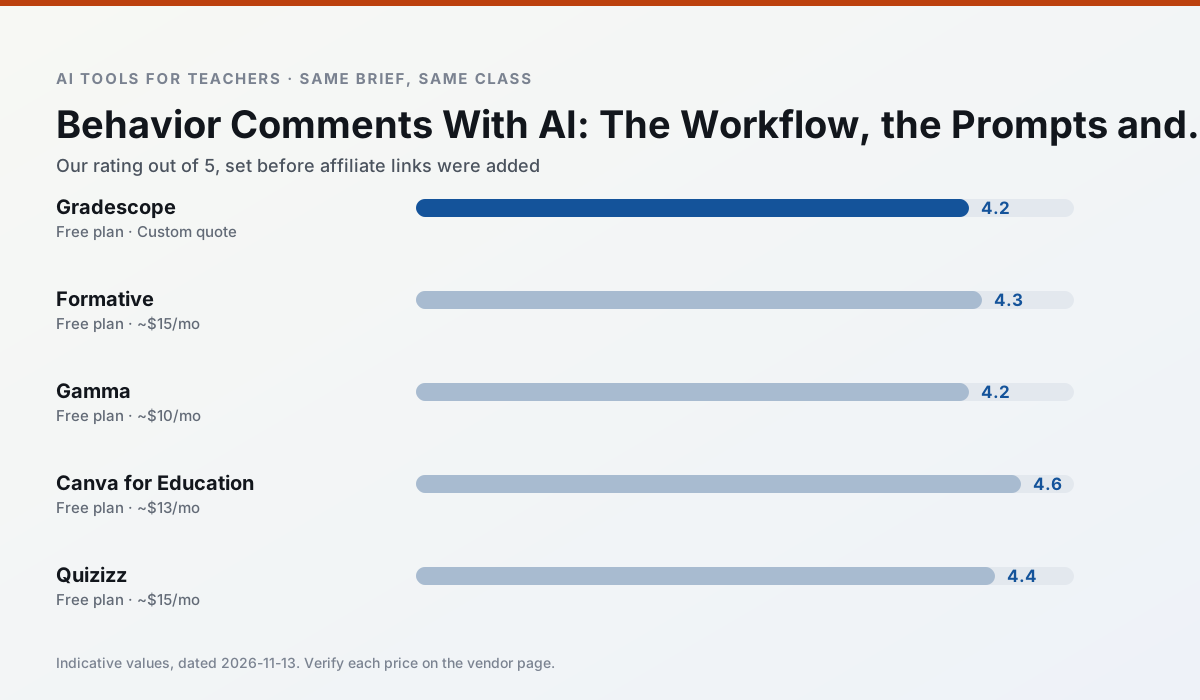
Side by side
Comparison table
Ratings reflect our timed classroom workflow, not vendor claims. Prices are indicative — verify on the vendor site.
| Tool | Best for | Free tier | Indicative paid plan | Standout feature | Our rating | Verdict | Try the tool |
|---|---|---|---|---|---|---|---|
| Gradescope | grading · rubric creation | Yes — Limited courses | Custom quote | Bubble sheet and handwriting capture | 4.2 / 5 | Strong option | Try free |
| Formative | formative assessment · grading | Yes — Core assessment tools | ~$15 /user/mo | Live student responses | 4.3 / 5 | Strong option | Try free |
| Gamma | slide decks · parent communication | Yes — Credit-limited generation | ~$10 /user/mo | Prompt-to-deck | 4.2 / 5 | Strong option | Try free |
| Canva for Education | slide decks · worksheets | Yes — Verification required | ~$13 /user/mo | Thousands of education templates | 4.6 / 5 | Top pick | Try free |
| Quizizz | quiz generation · formative assessment | Yes — Core quiz creation | ~$15 /user/mo | AI question generator | 4.4 / 5 | Strong option | Try free |
| Brisk Teaching | feedback on writing · grading | Yes — Limited actions per month | ~$10 /user/mo | Works inside Google Docs | 4.5 / 5 | Top pick | Try free |
Match your situation
Best for X
Different jobs need different tools. Here is what we would open first in each case.
For a school rollout, Gradescope offers the paperwork and the admin console; the classroom features are standard by comparison.
Setup cost is one login for Formative; everything else can wait until you know the tool is useful.
On the daily cycle, Gamma saves the most edit time per task; the paid tier mostly buys more runs rather than better ones.
Nothing on Canva for Education's free tier is a teaser demo; the limits are documented and a normal week fits inside them.
Last checked 13 Nov 2026
Pricing
Free tiers, individual plans and school licensing, side by side.
| Tool | Free plan | Individual / paid | School & district | Billing note | Verify |
|---|---|---|---|---|---|
| Gradescope | $0 — Limited courses | Custom quote | Custom quote | LMS integration and support | Vendor |
| Formative | $0 — Core assessment tools | ~$15 /user/mo | Custom quote | Indicative — verify on vendor site | Vendor |
| Gamma | $0 — Credit-limited generation | ~$10 /user/mo | ~$20 /user/mo | Indicative — verify on vendor site | Vendor |
| Canva for Education | $0 — Verification required | ~$13 /user/mo | Custom quote | Indicative — verify on vendor site | Vendor |
| Quizizz | $0 — Core quiz creation | ~$15 /user/mo | Custom quote | Indicative — verify on vendor site | Vendor |
| Brisk Teaching | $0 — Limited actions per month | ~$10 /user/mo | Custom quote | Indicative — verify on vendor site | Vendor |
Editorial rule: pricing is re-checked every 2–3 months and the top 50 pages are refreshed every 6 months. See our funding policy.
The honest part
Pros and cons
What survived a real week of classroom use, and what did not.
Pros
- Large time savings on paper assessments
- Consistent rubric application
- Detailed item analytics
Cons
- Overkill for elementary classrooms
- Institutional pricing is opaque
- Setup effort is real
Pros
- Strong data for intervention groups
- Works with existing PDFs and Docs
- Good LMS integrations
Cons
- Steeper setup than quiz games
- Best value requires school-wide rollout
- Price adds up per teacher
Pros
- Fastest path from outline to deck
- Modern-looking output by default
- Good export options
Cons
- Design control is limited
- Credits run out quickly
- Not built for student data
Pros
- Effectively free for verified teachers
- Huge template library
- No design skills needed
Cons
- AI features are capped
- Easy to produce cluttered slides
- Account verification can be slow
Pros
- Students already know the interface
- Good reporting
- Works on low-end devices
Cons
- Writing high-quality AI questions still needs review
- Gamification can distract
- Advanced analytics are paid
In the classroom
Use cases
Five concrete workflows, with the tool we would open for each one.
Rubric and feedback comments in one pass
Reorder the workflow so the rubric is yours and the comments are generated. Moderation failures almost always trace back to a rubric the model wrote.
Recommended: GradescopeA parent email in two languages
Draft in plain, warm language with no names, translate, then back-translate the important sentences to check meaning. Keep specific incidents out of the prompt and add them yourself.
Recommended: FormativeA Monday morning lesson plan in twelve minutes
The twelve minutes come from not rewriting the skeleton. Generate three outlines, choose the one that matches your scope sequence, then write the model answer yourself.
Recommended: GammaThree reading levels from one source text
Paste a vetted text, ask for supported, core and extension versions, then check the vocabulary list by hand. Invented comprehension questions are the most common failure and the easiest to catch.
Recommended: Canva for EducationA substitute folder that needs no context
The value here is structure, not creativity. Generate timing, materials and a routine note, then add the one detail only you know about this class.
Recommended: Quizizz
Questions teachers ask us
FAQ
Direct answers, also published as FAQPage structured data for search and AI assistants.
Can AI do Behavior comments at mixed-grade level?
Which tool is best for Behavior comments?
What is the biggest risk?
Sources & further reading
Our recommendation
Try Gamma free for your next Behavior comments task
Generate presentation decks and documents from a single prompt. Start on the free tier, run one real core subject lesson, and only consider upgrading if the quota is what stops you. Disclosure: we may earn a commission (varies) at no extra cost to you.
Some links on this page are affiliate links. We may earn a commission at no extra cost to you. Our rankings are editorial and never pay-to-play. Never enter student PII into a free consumer account.
Keep reading
Related comparisons in this cluster.
Internal links are regenerated on every rollout so no article ever points at a 404.