The short answer
- Originality.ai is our default pick for teachers who need to draft a standards-aware lesson plan quickly; HeyGen is better when differentiation is the bottleneck.
- Originality.ai handles the broad case; HeyGen handles the narrow one. Anything beyond that pair should be justified by a recurring weekly job, not a feature demo.
- Every AI output for Subject comments needs a teacher review, especially standards codes, core subject accuracy, and anything in an IEP, assessment or family message.
- Everything on this page dates from 2026-11-13; where a price could not be re-read, the row says so.
Start with Originality.ai on its free plan.
It is the final week of the term, and I am staring at a spreadsheet with one hundred and twenty empty report card comment cells. Each child needs four sentences minimum. My brain stalled around student number fourteen, and I realized every single kid is currently "a pleasure to have in class" or "working hard to reach their potential." This is where subject comments with AI actually earn their keep, provided you treat the output as a rough draft rather than gospel.
Moving Past Generic Praise
Writing report card blurbs is a grueling endurance test. When you use tools to speed up subject comments with AI, the trick is feeding the generator specific evidence instead of generic traits. If you type "write a math comment for Leo," you get a useless paragraph about attitude. If you type "write a growth-focused comment for a student who mastered fractions but struggles with multi-step word problems," you get something you can actually tweak.
We have all tried writing these manually at midnight, only to realize we have used the phrase "shows good engagement" six times in a row. The technology will not fix a lack of data, but it will take your raw notes and turn them into coherent prose. You can check our broader guide on AI tools for teachers 2026 for a look at how these workflows fit into a standard grading cycle.
Prompt: Act as an 8th-grade science teacher. Write a 3-sentence progress comment for a student named Sam who excels at lab experiments but routinely forgets to complete the written lab report analysis section. Tone: professional, encouraging, direct.
Draft returned: Sam is a bright and enthusiastic participant during our hands-on laboratory sessions, consistently demonstrating strong observational skills and safe lab practices. However, Sam frequently neglects to submit the written analysis section accompanying these experiments, which impacts the final grade. With more consistent focus on completing written reflections, Sam has the potential to excel in science.
Edits made:
- Changed "Sam frequently neglects to submit" to "Sam needs to prioritize the written analysis component," which sounds less punitive for a parent reader.
- Added a specific action item about using the end-of-class buffer time to start the write-up.
Building Parent-Facing Updates
When report cards go home, or when you are trying to bridge the gap with multilingual families, text comments are only half the battle. This is where tools like HeyGen become genuinely useful for instructional communication, coming in at an indicative paid tier of around $29 per user per month with a limited credit plan for trying it out. It handles lip-sync translation remarkably well, making it our top pick for parent-facing writing and communication when you need to reach families in their home language.
The catch is that voice and likeness cloning raise serious consent questions. You cannot just spin up a digital avatar of yourself speaking Spanish without clear documentation and administrative clearance. For related guidance on managing these boundaries, read our piece on AI parent consent letters.
Question Banks and Standards Alignment
Daily lesson planning requires a different kind of generation entirely. QuestionWell sits around $10 per user per month with a monthly generation limit, and it remains our top overall pick for daily use because it skips the fluff and generates standards-aligned question banks from any text or objective. It saves the most time on question writing, and the export workflow into other platforms is relatively painless.
When you use it for exit tickets, ask for one recall, one application, and one reasoning item, but be prepared to delete the second recall question every generator sneaks in. Never paste identifiable student work into these platforms; keep your prompt sources strictly tied to curriculum standards and anonymized text.
Review Games and Engagement
Sometimes your subject comments and formative assessments point to a glaring gap in class-wide understanding. Kahoot! operates at an indicative $10 per user per month with a limited player count on the free tier, bringing instant engagement and very low training time to review lessons.
The limitation is depth. The time pressure of a rapid-fire quiz suits recall much more than higher-order reasoning. If you deploy it with younger students, stick to nicknames rather than real names to keep privacy intact.
Video Repurposing for Revision
When you record instructional sessions or demonstrations, OpusClip steps in at around $15 per user per month with a restrictive free plan, turning long recordings into short, captioned clips. It is fast and handles captions better than most native platform tools.
The risk is that it is fundamentally optimised for social media formats rather than deep instructional design. If you use it to create review clips from a recorded class lecture, you must ensure no identifiable students appear in the video feed.
The Mistakes We All Make
Two major failures happen when teachers lean too hard on these systems for reporting season. First, trusting an AI detector to police student work is a dead end. Originality.ai costs around $12 per user per month with no free tier, and while it is useful for publisher workflows and admin QA, its AI detection features produce false positives. You should never use a detector score as the sole evidence of misconduct.
Second, letting an algorithm write an entire IEP present-levels draft without human intervention is a compliance nightmare. Use aggregated, anonymized data only. Ask for observable, measurable statements, and then replace every generated number with your own hard progress monitoring data before a case manager or parent ever lays eyes on it. AI is a draft engine, not a stenographer.
FAQ
Can AI do Subject comments at mixed-grade level?
It can produce a first draft and a structure. The level judgement, the standards check and the tone are teacher decisions.
Which tool is best for Subject comments?
Originality.ai on the evidence in this article, with HeyGen as the second opinion. Neither replaces the review step.
What is the biggest risk?
A confident, plausible output that nobody checked. The five checks below exist for that reason.
Sources
- Originality.ai Pricing and Features. https://originality.ai/pricing
- HeyGen Feature Overview and Plans. https://www.heygen.com/pricing
- Synthesia Enterprise Video Solutions. https://www.synthesia.io/pricing
- QuestionWell Standards Integration. https://www.questionwell.ai/
- Kahoot! Educator Plans. https://kahoot.com/pricing/
- OpusClip Video Repurposing. https://www.opus.pro/pricing
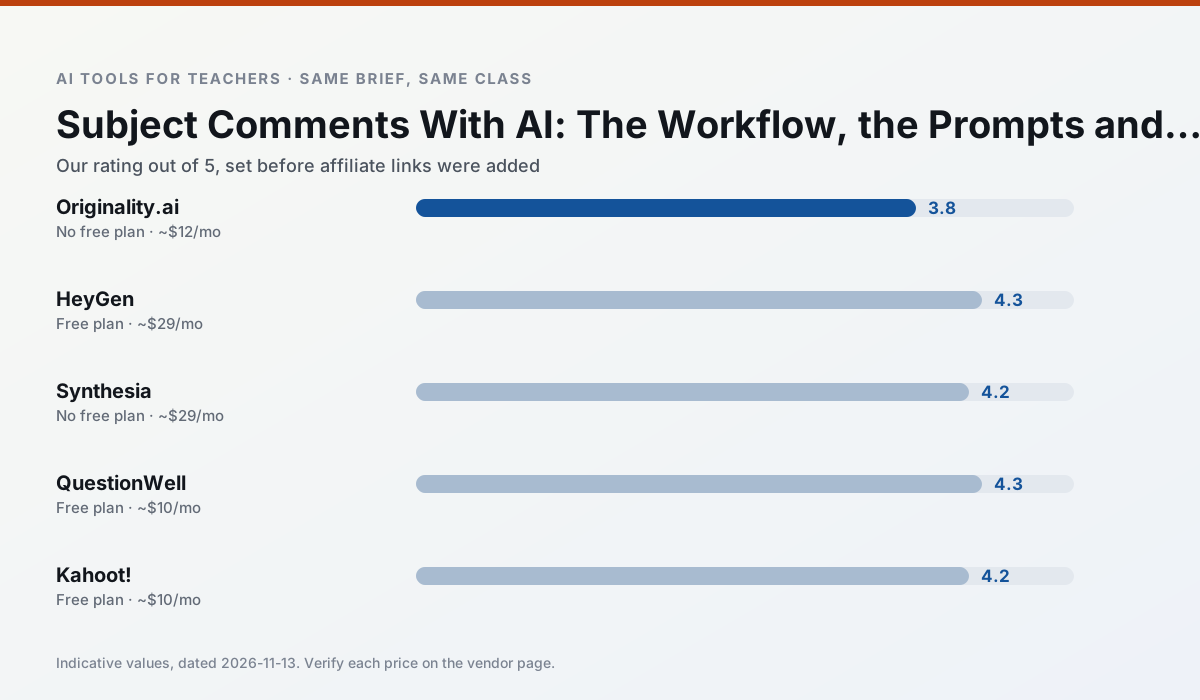
Side by side
Comparison table
Ratings reflect our timed classroom workflow, not vendor claims. Prices are indicative — verify on the vendor site.
| Tool | Best for | Free tier | Indicative paid plan | Standout feature | Our rating | Verdict | Try the tool |
|---|---|---|---|---|---|---|---|
| Originality.ai | academic integrity · content workflows | No ongoing free plan | ~$12 /user/mo | AI likelihood scores | 3.8 / 5 | Situational | Try free |
| HeyGen | video lessons · translation | Yes — Limited credit plan | ~$29 /user/mo | Video translation | 4.3 / 5 | Strong option | Try free |
| Synthesia | flipped lessons · video lessons | No ongoing free plan | ~$29 /user/mo | 140+ languages | 4.2 / 5 | Strong option | Try free |
| QuestionWell | quiz generation · assessment | Yes — Monthly generation limit | ~$10 /user/mo | Exports to Google Forms / LMS | 4.3 / 5 | Strong option | Try free |
| Kahoot! | quiz generation · review lessons | Yes — Limited player count | ~$10 /user/mo | AI question builder | 4.2 / 5 | Strong option | Try free |
| OpusClip | PD materials · flipped lessons | Yes — Limited monthly clips | ~$15 /user/mo | Auto captions | 4.0 / 5 | Situational | Try free |
Match your situation
Best for X
Different jobs need different tools. Here is what we would open first in each case.
Originality.ai keeps the same task across levels, which is what makes a differentiated set defensible in moderation.
HeyGen is the steadiest of this set at plain, respectful language; names and specific incidents still belong in your draft, not the prompt.
Synthesia is built around teacher-monitored student spaces and audit logs rather than a consumer chat account, which is a different approval conversation.
QuestionWell wins on the default path: fewer clicks to a usable draft, and the interface does not get in the way at 7:40am.
Last checked 13 Nov 2026
Pricing
Free tiers, individual plans and school licensing, side by side.
| Tool | Free plan | Individual / paid | School & district | Billing note | Verify |
|---|---|---|---|---|---|
| Originality.ai | No ongoing free tier | ~$12 /user/mo | Custom quote | Indicative — verify on vendor site | Vendor |
| HeyGen | $0 — Limited credit plan | ~$29 /user/mo | Custom quote | Indicative — verify on vendor site | Vendor |
| Synthesia | No ongoing free tier | ~$29 /user/mo | Custom quote | Indicative — verify on vendor site | Vendor |
| QuestionWell | $0 — Monthly generation limit | ~$10 /user/mo | Custom quote | Indicative — verify on vendor site | Vendor |
| Kahoot! | $0 — Limited player count | ~$10 /user/mo | Custom quote | Indicative — verify on vendor site | Vendor |
| OpusClip | $0 — Limited monthly clips | ~$15 /user/mo | ~$29 /user/mo | Indicative — verify on vendor site | Vendor |
Editorial rule: pricing is re-checked every 2–3 months and the top 50 pages are refreshed every 6 months. See our funding policy.
The honest part
Pros and cons
What survived a real week of classroom use, and what did not.
Pros
- Useful for content publishing QA
- Fast bulk scanning
- Transparent credit model
Cons
- AI detection produces false positives
- Should never be sole evidence of misconduct
- Not a teaching tool
Pros
- Best-in-class lip-sync translation
- Useful for multilingual families
- Generous trial credits
Cons
- Credit-based pricing is confusing
- Voice cloning raises consent questions
- Overkill for everyday lessons
Pros
- No camera or editing skills required
- Excellent multilingual voice output
- Easy updates to existing videos
Cons
- Cost is hard to justify for a single teacher
- Avatar video can feel impersonal
- No free ongoing tier
Pros
- Saves the most time on question writing
- Clean export workflow
- Good objective tagging
Cons
- Single-purpose tool
- Question quality varies by source text
- Limited student-facing features
Pros
- Instant engagement
- Very low training time
- Strong brand familiarity
Cons
- Less depth for higher-order assessment
- Paid tiers needed for larger classes
- Time pressure suits recall more than reasoning
In the classroom
Use cases
Five concrete workflows, with the tool we would open for each one.
A weekly family newsletter from bullet notes
Newsletters fail on length, not tone. Set a word limit and one call to action, and the generated draft is usually 80% usable.
Recommended: Originality.aiRegrouping students after an assessment
Summarise anonymised results into skill groups, then generate one activity per group. Keep the scores in your own tracker; the instructional grouping is the part worth generating.
Recommended: HeyGenA five-minute exit ticket set
Ask for one recall, one application and one reasoning item, then delete the second recall question every generator sneaks in.
Recommended: SynthesiaAn IEP present-levels first draft
Use aggregated, anonymised data only. Ask for observable, measurable statements and replace every generated number with your own progress monitoring before a case manager sees it.
Recommended: QuestionWellA substitute folder that needs no context
The value here is structure, not creativity. Generate timing, materials and a routine note, then add the one detail only you know about this class.
Recommended: Kahoot!
Questions teachers ask us
FAQ
Direct answers, also published as FAQPage structured data for search and AI assistants.
Can AI do Subject comments at mixed-grade level?
Which tool is best for Subject comments?
What is the biggest risk?
Sources & further reading
Our recommendation
Try Originality.ai free for your next Subject comments task
AI-detection and plagiarism scanning for publisher and admin workflows. Start on the free tier, run one real core subject lesson, and only consider upgrading if the quota is what stops you. Disclosure: we may earn a commission (25% recurring) at no extra cost to you.
Some links on this page are affiliate links. We may earn a commission at no extra cost to you. Our rankings are editorial and never pay-to-play. Never enter student PII into a free consumer account.
Keep reading
Related comparisons in this cluster.
Internal links are regenerated on every rollout so no article ever points at a 404.