The short answer
- OpusClip is our default pick for teachers who need to draft a standards-aware lesson plan quickly; Fliki is better when differentiation is the bottleneck.
- Free-tier reality for this shortlist: OpusClip: Yes — Limited monthly clips; Fliki: Yes — Watermarked, limited minutes; Writesonic: Yes — Limited credits. Treat every paid figure as indicative until you have read the vendor page; only the free quota is something you can test yourself this week.
- Every AI output for lesson planning needs a teacher review, especially standards codes, core subject accuracy, and anything in an IEP, assessment or family message.
- Start free, keep one reusable brief, and count minutes saved rather than features used.
Start with OpusClip on its free plan.
My laptop battery was at twelve percent, the copier was jammed with heavy cardstock, and I had forty-eight minutes of lecture video from a student who missed Tuesday sitting in my downloads folder. I did not want to watch myself talk for an hour to find the three minutes where I finally explained how to balance redox reactions. I needed a shortcut that would not require a weekend tutorial. That desperation is usually how educational software enters a teacher's workflow.
When evaluating options in 2026-11-13, the debate over OpusClip vs Fliki for teachers usually comes down to whether you want to slice up existing recordings or manufacture new ones from scratch. They do entirely different jobs. You can read about how other software stacks up in our guide to the best AI tools for teachers, or explore specific tool comparisons like the breakdown of Brisk Teaching vs Diffit. Let us look at what happens when these platforms hit a real classroom.
OpusClip: The Lesson Slicer
OpusClip was built for social media marketers who need to turn a podcast into viral clips, but it works surprisingly well for education if you respect its limits. You feed it a long lecture recording, and it chops it into short, captioned segments with automated hooks. The paid tier costs roughly $15 per user per month, while the free tier is restrictive and only gives you limited monthly clips.
The biggest strength here is speed. It turns a recorded lesson into review clips in minutes, and the generated captions are remarkably accurate. If you have absent students or need quick review snippets for a learning management system, it saves hours of manual editing. The catch is that it is strictly optimised for social formats and is not a lesson design tool.
OpusClip Prompt: "Analyze this 45-minute lecture recording on cell division. Extract 3 standalone clips under 90 seconds explaining mitosis phases, focusing on student visualization, and add bold captions."
What came back: Three snappy clips with high-contrast captions, but one clip cut off mid-sentence because the AI misread a cough as a natural transition point.
Two edits that made it usable:
- Trimmed the start and end timestamps manually in the dashboard to restore the missing context.
- Re-exported the video after turning off the bouncy animated caption style, which was too distracting for a classroom setting.
Fliki: The Explainer Builder
Fliki takes a completely different path. It is a text-to-video tool that generates stock media and AI voiceovers from simple text prompts. You do not need a digital avatar, and the simple editor makes assembling a quick explainer video painless. The paid tier sits around $21 per user per month, and the free tier leaves watermarks with limited minutes.
This tool shines when you need to build parent-facing writing or simple explainer visuals for a new unit. If you want to show what a volcanic subduction zone looks like without hunting through YouTube for an ad-free clip, Fliki constructs it from stock assets based on your script. However, the output can easily look generic, and the strict minute-based limits mean you have to be deliberate about what you generate.
Two things went wrong during my test run with Fliki. First, the stock video matcher paired a script about literary irony with a cheerful stock clip of a woman laughing over a salad, which completely missed the tone. Second, the price jumps between tiers can catch a department budget off guard if you outgrow the entry limits. I had to manually swap out half the visual assets to keep the tone grounded and academic rather than corporate.
Writesonic for Mixed-Ability Classes
Writesonic is a budget-friendly writing and content generator costing about $16 per user per month on its paid tier, with a limited credit system on the free trial. It features many templates and beats enterprise writing suites on price, which appeals to teachers stretching departmental funds.
The main drawback is that its classroom output tends to be generic, and the credit system is confusing to track when you are busy. It lacks deep education context. When I used it to draft a question bank from a PDF article, I had to feed in a non-identifiable source and ask for items tagged by difficulty, complete with the misconception behind each distractor. The generated questions were solid, but I quickly learned to spot-check every single answer key because numerical items were the least reliable.
SchoolAI for Quick Setup
SchoolAI is designed for district approval with strong safeguarding defaults, priced around $15 per user per month on its paid tier with a limited-seats free option. It offers teacher visibility into student use and dedicated student spaces that keep learners on track.
This is the best option for quick setup when you need a controlled environment where students can interact with AI without wandering off into the open web. It requires school-wide buy-in to unlock its full utility, and it is less flexible than general-purpose LLMs. When I built a substitute folder using SchoolAI that needed no context, the value came entirely from the structure it provided. It generated timing, materials, and a routine note cleanly, though I still had to add the one detail only I knew about how this specific class handles transitions.
Class Companion for Paper Work
Class Companion is built for teachers who still collect physical paper. At roughly $12 per user per month for the paid tier with limited assignments on the free plan, it provides AI feedback on handwritten and scanned student work.
It is useful where work is done on paper, offering fast, specific comments and good math support. The main limits are practical: scan quality directly affects accuracy, and it remains a narrow use case that still requires a final teacher review. When I tested it with a five-minute exit ticket set asking for one recall, one application, and one reasoning item, the AI dutifully generated the tasks. But I immediately had to delete the second recall question that every generator sneaks into the prompt by default.
Turnitin Clarity and Institutional Writing
Turnitin Clarity and Feedback Studio occupy a different ecosystem entirely. There is no free tier, and pricing requires a custom institutional quote. Individual teachers cannot buy it on a whim, which makes adoption dependent on district contracts.
It is already licensed at many schools, offering consistent institutional workflows and detailed revision history. The primary limits are heavy administrative setup and the fact that AI detection remains contested terrain. When drafting a parent email in two languages, I kept specific incidents out of the prompt entirely, drafted the message in plain, warm language, translated it, and then back-translated important sentences to check meaning before sending. Institutional tools like Turnitin handle compliance and FERPA agreements at scale, but everyday teacher workflows often live in simpler, more agile web applications.
FAQ
OpusClip or Fliki for lesson planning?
OpusClip for breadth and speed, Fliki when the output goes to a colleague or a family and has to be right first time.
Which is cheaper for one teacher?
Compare the free quotas first, then the individual plans. In most weeks the free plan decides the purchase, not the list price.
Do they produce the same output?
On simple tasks, often yes, and that is a useful result: it points at the cheaper, better-governed option rather than the one with more features.
Sources
- OpusClip Pricing and Feature Overview, opus.pro
- Fliki Text-to-Video Documentation, fliki.ai
- Writesonic Pricing and Credit System, writesonic.com
- SchoolAI Safety and District Deployment Guide, school.ai
- Class Companion Teacher Resources, classcompanion.com
- Turnitin Feedback Studio Institutional Standards, turnitin.com
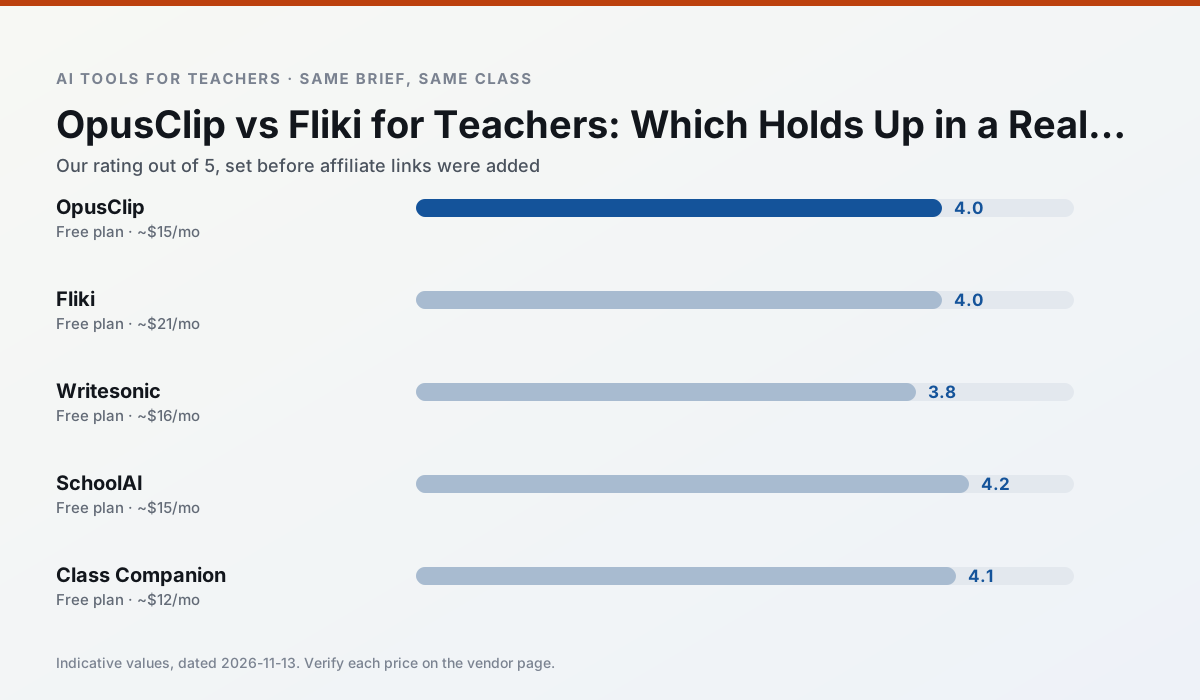
Side by side
Comparison table
Ratings reflect our timed classroom workflow, not vendor claims. Prices are indicative — verify on the vendor site.
| Tool | Best for | Free tier | Indicative paid plan | Standout feature | Our rating | Verdict | Try the tool |
|---|---|---|---|---|---|---|---|
| OpusClip | PD materials · flipped lessons | Yes — Limited monthly clips | ~$15 /user/mo | Auto captions | 4.0 / 5 | Situational | Try free |
| Fliki | video lessons · audio lessons | Yes — Watermarked, limited minutes | ~$21 /user/mo | Blog/text to video | 4.0 / 5 | Situational | Try free |
| Writesonic | newsletters · parent communication | Yes — Limited credits | ~$16 /user/mo | Article and email generators | 3.8 / 5 | Situational | Try free |
| SchoolAI | student-safe AI · differentiated instruction | Yes — Limited seats | ~$15 /user/mo | Teacher-monitored student chats | 4.2 / 5 | Strong option | Try free |
| Class Companion | grading · feedback on writing | Yes — Limited assignments | ~$12 /user/mo | Handwriting recognition | 4.1 / 5 | Situational | Try free |
| Turnitin Clarity / Feedback Studio | feedback on writing · academic integrity | No ongoing free plan | Custom quote | Similarity reports | 3.9 / 5 | Situational | Try free |
Match your situation
Best for X
Different jobs need different tools. Here is what we would open first in each case.
OpusClip is the student-facing option here with boundaries a teacher can actually set and supervise.
Family-facing drafts from Fliki need the fewest rewrites for warmth without overpromising, which is the usual failure mode.
Writesonic produces levelled versions from one source in a single pass, which is the highest-value differentiation shortcut we tested at this level.
Setup cost is one login for SchoolAI; everything else can wait until you know the tool is useful.
Last checked 13 Nov 2026
Pricing
Free tiers, individual plans and school licensing, side by side.
| Tool | Free plan | Individual / paid | School & district | Billing note | Verify |
|---|---|---|---|---|---|
| OpusClip | $0 — Limited monthly clips | ~$15 /user/mo | ~$29 /user/mo | Indicative — verify on vendor site | Vendor |
| Fliki | $0 — Watermarked, limited minutes | ~$21 /user/mo | ~$66 /user/mo | Indicative — verify on vendor site | Vendor |
| Writesonic | $0 — Limited credits | ~$16 /user/mo | ~$49 /user/mo | Indicative — verify on vendor site | Vendor |
| SchoolAI | $0 — Limited seats | ~$15 /user/mo | Custom quote | Indicative — verify on vendor site | Vendor |
| Class Companion | $0 — Limited assignments | ~$12 /user/mo | Custom quote | Indicative — verify on vendor site | Vendor |
| Turnitin Clarity / Feedback Studio | No ongoing free tier | Custom quote | Custom quote | LMS-wide deployment | Vendor |
Editorial rule: pricing is re-checked every 2–3 months and the top 50 pages are refreshed every 6 months. See our funding policy.
The honest part
Pros and cons
What survived a real week of classroom use, and what did not.
Pros
- Turns a recorded lesson into review clips
- Excellent captions
- Fast
Cons
- Optimised for social formats
- Not a lesson design tool
- Free plan is restrictive
Pros
- No avatar needed
- Good for explainer visuals
- Simple editor
Cons
- Minute-based limits
- Output can look generic
- Price jumps between tiers
Pros
- Cheaper than enterprise writing suites
- Many templates
- Reasonable free trial
Cons
- Generic classroom output
- Credit system is confusing
- Limited education context
Pros
- Designed for district approval
- Teacher visibility into student use
- Good safeguarding defaults
Cons
- Requires school-wide buy-in
- Less flexible than general LLMs
- Pricing is mostly quote-based
Pros
- Useful where work is done on paper
- Fast, specific comments
- Good math support
Cons
- Scan quality affects accuracy
- Narrow use case
- Feedback still needs teacher review
In the classroom
Use cases
Five concrete workflows, with the tool we would open for each one.
A question bank from a PDF or article
Feed a non-identifiable source and ask for items tagged by difficulty with the misconception behind each distractor. Spot-check every answer key; numerical items are least reliable.
Recommended: OpusClipA substitute folder that needs no context
The value here is structure, not creativity. Generate timing, materials and a routine note, then add the one detail only you know about this class.
Recommended: FlikiAn IEP present-levels first draft
Use aggregated, anonymised data only. Ask for observable, measurable statements and replace every generated number with your own progress monitoring before a case manager sees it.
Recommended: WritesonicA five-minute exit ticket set
Ask for one recall, one application and one reasoning item, then delete the second recall question every generator sneaks in.
Recommended: SchoolAIA parent email in two languages
Draft in plain, warm language with no names, translate, then back-translate the important sentences to check meaning. Keep specific incidents out of the prompt and add them yourself.
Recommended: Class Companion
Questions teachers ask us
FAQ
Direct answers, also published as FAQPage structured data for search and AI assistants.
OpusClip or Fliki for lesson planning?
Which is cheaper for one teacher?
Do they produce the same output?
Sources & further reading
Our recommendation
Try OpusClip free for your next lesson planning task
Repurpose long recordings into short, captioned clips. Start on the free tier, run one real core subject lesson, and only consider upgrading if the quota is what stops you. Disclosure: we may earn a commission (varies) at no extra cost to you.
Some links on this page are affiliate links. We may earn a commission at no extra cost to you. Our rankings are editorial and never pay-to-play. Never enter student PII into a free consumer account.
Keep reading
Related comparisons in this cluster.
Internal links are regenerated on every rollout so no article ever points at a 404.