The short answer
- OpusClip is our default pick for teachers who need to draft a standards-aware lesson plan quickly; Fliki is better when differentiation is the bottleneck.
- The cheapest honest test is a week of real work on the free plans: OpusClip: Yes — Limited monthly clips; Fliki: Yes — Watermarked, limited minutes; Notion AI: Yes — Limited AI usage. If a tool is still open on Friday, it has earned a paid conversation.
- Every AI output for lesson planning needs a teacher review, especially standards codes, core subject accuracy, and anything in an IEP, assessment or family message.
- Everything on this page dates from 2026-11-13; where a price could not be re-read, the row says so.
Start with OpusClip on its free plan.
It was a Tuesday afternoon when I stared at a forty-five-minute lecture on cellular respiration that I had recorded for a student who was out sick. Half the room had zoned out during the mitochondria section, and I knew nobody would re-watch the whole thing for test prep. I needed bite-sized review material, and I needed it without spending my prep period editing video files on a sluggish district laptop. That specific headache sent me down a rabbit hole comparing OpusClip vs Fliki, two video tools that promise to turn raw footage or text prompts into polished short-form content.
If you are trying to figure out which AI tools are actually worth your time this term, you might want to look at our broader review of the best AI tools for teachers 2026 before committing to a paid subscription. Both OpusClip and Fliki sit outside the usual routine of lesson plan generators, but they solve very different problems in the classroom. One chops up what you already filmed, while the other builds something entirely new from a blank text box.
What OpusClip Does Best
OpusClip is built specifically to repurpose long recordings into short, captioned clips. When I fed my droning lecture into it, the AI scanned the transcript, identified the three punchiest segments about ATP production, and spit them out as vertical videos complete with auto-generated captions. It is fast, and the captioning is remarkably accurate. The catch is right there in the design, because the tool is optimised for social formats and vertical screens. It is not a lesson design tool, and the free plan is so restrictive you will hit the monthly limit before you finish clipping a single unit.
You also have to be paranoid about student privacy. Never upload recordings containing identifiable students. If your lecture captured kids asking questions in the front row, blur them out or cut the audio before it goes anywhere near OpusClip. For teachers working within strict district guardrails, OpusClip works best for student-safe deployments where you are the only person on camera, turning direct instruction into quick revision shorts for your learning management system.
Where Fliki Shits the Bed and Shines
Fliki takes the opposite approach by using text-to-video with stock media and AI voiceover. If you need an explainer visual for a complex concept and have zero desire to stand in front of a camera or record your own voice, this is where you look. It has a simple editor, and you do not need an avatar to make it work. The downside is that minute-based limits add up fast, and the output can easily look generic if you do not override the stock imagery it picks out.
The pricing also jumps noticeably between tiers, which makes it a hard sell for an individual teacher's out-of-pocket budget. Like OpusClip, it is strictly a content tool, so you must avoid student PII at all costs. But when you have mixed-ability classes and need five different visual explanations of the same reading passage to support English language learners, Fliki shines because it lets you generate supportive media without hunting on YouTube for ten minutes.
Prompt: Create a 60-second video script and stock media cue sheet explaining photosynthesis for an 8th-grade life science class reading at a 5th-grade level.
Result: A generic voiceover about plants eating sunlight, accompanied by stock footage of a jungle and a smiling child holding a potted fern.
Two Edits: First, I replaced the voiceover script to explicitly define chlorophyll as a solar panel rather than talking about "eating sunlight." Second, I swapped the jungle stock footage for a close-up diagram of a green leaf cross-section so the visual actually matched the vocabulary words on our anchor chart.
How Notion AI Handles the Long Game
While video tools handle our media problems, Notion AI sits quietly in the background managing the paperwork. It offers AI-assisted notes, databases, and curriculum planning in a single workspace for about $10 a user per month on its paid tier, with a limited free version. It is great for long-term curriculum records and team collaboration, especially if your grade-level PLC shares a common workspace.
The setup time is significant, though. You cannot just log in and magically have a neat binder; you have to build the structure first. The AI add-on pricing has also changed more than once, which frustrates department chairs trying to set a fixed budget. Remember that it is not purpose-built for lesson generation, and you should never store student PII in personal workspaces. For parent-facing writing, however, maintaining a clean, searchable log of accommodations and progress notes in Notion keeps communication consistent across a teaching team.
Institutional Heavyweights: Turnitin Clarity
Moving away from general productivity, Turnitin Clarity and Feedback Studio handle institutional writing feedback and similarity checking at a scale individual teachers cannot buy on their own. It comes with a custom quote pricing model and requires heavy administrative setup, but many schools already license it. Its reported strengths include consistent institutional workflows and detailed revision history, while its limits involve contested AI detection claims and strict top-down control.
This is the standard for schools and districts that need defensible academic integrity policies. You cannot buy a single user seat for your classroom, but if your campus uses it, the revision tracking helps you see whether a student actually rewrote their paragraph or just fed the prompt to an external generator. Always verify your local configuration to ensure your school's FERPA agreements are properly applied.
Class Companion and SchoolAI for Daily Tasks
For day-to-day student interaction, Class Companion costs about $12 a user per month and provides AI feedback on handwritten and scanned student work. It is remarkably useful where work is done on paper, giving fast and specific comments with solid math support. Scan quality affects accuracy heavily, and the feedback still needs teacher review before it goes back to the kid.
Meanwhile, SchoolAI costs roughly $15 a user per month and acts as a school-safe AI workspace with teacher-controlled student spaces. It was designed specifically for district approval, giving teachers full visibility into student use and solid safeguarding defaults. It is less flexible than general LLMs, and pricing is mostly quote-based, but it gives you a walled garden where students can prompt safely. For a deeper look at how similar platforms compare, check out our breakdown of Brisk Teaching vs Diffit.
Using these tools effectively means understanding their friction points. Two things went wrong in my own classroom last month that forced me to change my workflow. First, I tried to let Class Companion auto-grade a stack of hastily scribbled fraction worksheets, and the poor scan quality caused the model to misread half the numerators as whole numbers. I had to pull the students back for a quick live check and adjust the scanner settings for next time.
Second, I used Notion AI to draft a set of parent notification templates for missing assignments, and the tone came out entirely too corporate and harsh for families who already felt alienated by the school. I spent twenty minutes rewriting every single email to sound like an actual human being who actually likes teenagers. AI is a shovel, not a replacement for your own judgment. Pick the tool that matches your operational bottleneck, keep your student data off public servers, and always check the math before you hand out the review packet.
FAQ
OpusClip or Fliki for lesson planning?
OpusClip for breadth and speed, Fliki when the output goes to a colleague or a family and has to be right first time.
Which is cheaper for one teacher?
Compare the free quotas first, then the individual plans. In most weeks the free plan decides the purchase, not the list price.
Do they produce the same output?
On simple tasks, often yes, and that is a useful result: it points at the cheaper, better-governed option rather than the one with more features.
Sources
- OpusClip Vendor Overview and Feature Set (opus.pro)
- Fliki Pricing and Text-to-Video Documentation (fliki.ai)
- Notion AI Workspace and Plan Details (notion.so)
- Turnitin Feedback Studio Institutional Resources (turnitin.com)
- Class Companion Teacher Guides (classcompanion.com)
- SchoolAI Safeguarding and District Deployment Documentation (school.ai)
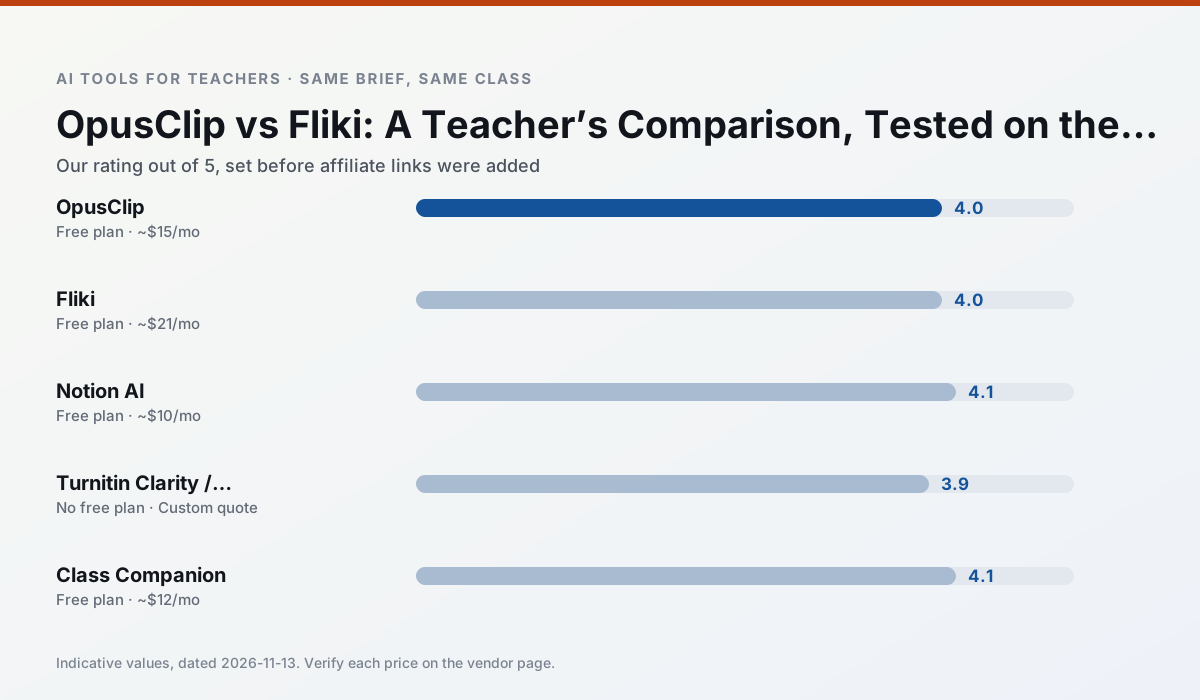
Side by side
Comparison table
Ratings reflect our timed classroom workflow, not vendor claims. Prices are indicative — verify on the vendor site.
| Tool | Best for | Free tier | Indicative paid plan | Standout feature | Our rating | Verdict | Try the tool |
|---|---|---|---|---|---|---|---|
| OpusClip | PD materials · flipped lessons | Yes — Limited monthly clips | ~$15 /user/mo | Auto captions | 4.0 / 5 | Situational | Try free |
| Fliki | video lessons · audio lessons | Yes — Watermarked, limited minutes | ~$21 /user/mo | Blog/text to video | 4.0 / 5 | Situational | Try free |
| Notion AI | curriculum mapping · unit planning | Yes — Limited AI usage | ~$10 /user/mo | Linked databases | 4.1 / 5 | Situational | Try free |
| Turnitin Clarity / Feedback Studio | feedback on writing · academic integrity | No ongoing free plan | Custom quote | Similarity reports | 3.9 / 5 | Situational | Try free |
| Class Companion | grading · feedback on writing | Yes — Limited assignments | ~$12 /user/mo | Handwriting recognition | 4.1 / 5 | Situational | Try free |
| SchoolAI | student-safe AI · differentiated instruction | Yes — Limited seats | ~$15 /user/mo | Teacher-monitored student chats | 4.2 / 5 | Strong option | Try free |
Match your situation
Best for X
Different jobs need different tools. Here is what we would open first in each case.
OpusClip is the student-facing option here with boundaries a teacher can actually set and supervise.
Fliki produces levelled versions from one source in a single pass, which is the highest-value differentiation shortcut we tested at this level.
Notion AI has the strongest tone control for family emails and report comments, provided you still read the message aloud before sending.
Turnitin Clarity / Feedback Studio answers the three questions a district actually asks: rostering, admin controls and a data-processing agreement. That is usually what decides a school purchase.
Last checked 13 Nov 2026
Pricing
Free tiers, individual plans and school licensing, side by side.
| Tool | Free plan | Individual / paid | School & district | Billing note | Verify |
|---|---|---|---|---|---|
| OpusClip | $0 — Limited monthly clips | ~$15 /user/mo | ~$29 /user/mo | Indicative — verify on vendor site | Vendor |
| Fliki | $0 — Watermarked, limited minutes | ~$21 /user/mo | ~$66 /user/mo | Indicative — verify on vendor site | Vendor |
| Notion AI | $0 — Limited AI usage | ~$10 /user/mo | ~$8 /user/mo | Indicative — verify on vendor site | Vendor |
| Turnitin Clarity / Feedback Studio | No ongoing free tier | Custom quote | Custom quote | LMS-wide deployment | Vendor |
| Class Companion | $0 — Limited assignments | ~$12 /user/mo | Custom quote | Indicative — verify on vendor site | Vendor |
| SchoolAI | $0 — Limited seats | ~$15 /user/mo | Custom quote | Indicative — verify on vendor site | Vendor |
Editorial rule: pricing is re-checked every 2–3 months and the top 50 pages are refreshed every 6 months. See our funding policy.
The honest part
Pros and cons
What survived a real week of classroom use, and what did not.
Pros
- Turns a recorded lesson into review clips
- Excellent captions
- Fast
Cons
- Optimised for social formats
- Not a lesson design tool
- Free plan is restrictive
Pros
- No avatar needed
- Good for explainer visuals
- Simple editor
Cons
- Minute-based limits
- Output can look generic
- Price jumps between tiers
Pros
- Great for long-term curriculum records
- Strong team collaboration
- Flexible structure
Cons
- Setup time is significant
- AI add-on pricing changed more than once
- Not purpose-built for lesson generation
Pros
- Already licensed at many schools
- Consistent institutional workflow
- Detailed revision history
Cons
- Individual teachers cannot buy it
- AI detection remains contested
- Heavy administrative setup
Pros
- Useful where work is done on paper
- Fast, specific comments
- Good math support
Cons
- Scan quality affects accuracy
- Narrow use case
- Feedback still needs teacher review
In the classroom
Use cases
Five concrete workflows, with the tool we would open for each one.
A substitute folder that needs no context
The value here is structure, not creativity. Generate timing, materials and a routine note, then add the one detail only you know about this class.
Recommended: OpusClipA question bank from a PDF or article
Feed a non-identifiable source and ask for items tagged by difficulty with the misconception behind each distractor. Spot-check every answer key; numerical items are least reliable.
Recommended: FlikiA five-minute exit ticket set
Ask for one recall, one application and one reasoning item, then delete the second recall question every generator sneaks in.
Recommended: Notion AIAn IEP present-levels first draft
Use aggregated, anonymised data only. Ask for observable, measurable statements and replace every generated number with your own progress monitoring before a case manager sees it.
Recommended: Turnitin Clarity / Feedback StudioRubric and feedback comments in one pass
Reorder the workflow so the rubric is yours and the comments are generated. Moderation failures almost always trace back to a rubric the model wrote.
Recommended: Class Companion
Questions teachers ask us
FAQ
Direct answers, also published as FAQPage structured data for search and AI assistants.
OpusClip or Fliki for lesson planning?
Which is cheaper for one teacher?
Do they produce the same output?
Sources & further reading
Our recommendation
Try OpusClip free for your next lesson planning task
Repurpose long recordings into short, captioned clips. Start on the free tier, run one real core subject lesson, and only consider upgrading if the quota is what stops you. Disclosure: we may earn a commission (varies) at no extra cost to you.
Some links on this page are affiliate links. We may earn a commission at no extra cost to you. Our rankings are editorial and never pay-to-play. Never enter student PII into a free consumer account.
Keep reading
Related comparisons in this cluster.
Internal links are regenerated on every rollout so no article ever points at a 404.