The short answer
- Class Companion is our default pick for teachers who need to draft a standards-aware lesson plan quickly; Brisk Teaching is better when differentiation is the bottleneck.
- Pricing is where these pages date fastest. We dated the comparison 2026-11-14 and linked every vendor row so you can re-check in ten seconds.
- Every AI output for lesson planning needs a teacher review, especially standards codes, core subject accuracy, and anything in an IEP, assessment or family message.
- Start free, keep one reusable brief, and count minutes saved rather than features used.
Start with Jasper on its free plan.
Thirty-four stackable plastic trays sat on my counter at 4:15 PM last Tuesday, each one holding a wedge of handwritten trigonometry proofs. My coffee had gone cold hours ago, and I still had to figure out why half the room forgot the chain rule. If you teach in a high school building with locked-down Chromebooks or a department that still swears by pencil and paper, you spend half your contract hours moving information between physical desks and digital screens. That friction is precisely why looking at a comparison like Class Companion vs Brisk Teaching for teachers matters so much when you are trying to reclaim your evenings.
These two applications solve completely different parts of the instructional day. One lives in your physical stack of papers, while the other lives directly inside your browser tabs. Evaluating them requires looking past the glossy landing pages and seeing how they survive a Tuesday morning when the school Wi-Fi drops three minutes before first period. Other software packages in the broader ecosystem, such as Eduaide.Ai for generation and Curipod for interactive delivery, handle planning and engagement, but grading and feedback remain the ultimate time sinks. If you are building out a wider tech stack this year, you can read our broad overview of the best AI tools for teachers 2026 to see how these pieces fit together.
The Paper-to-Screen Reality of Class Companion
Class Companion targets the eternal truth of secondary education: kids still prefer writing on paper, but teachers hate lugging thirty notebooks home. You scan or upload handwritten student work, and the platform delivers AI feedback on those scans. In practice, it shines where work is done on paper and you need fast, specific comments on math support or structured paragraphs. The reported strengths are real when the lighting is good and students write with dark pencils.
The limits show up the moment a teenager uses a dull No. 2 pencil on recycled cream-colored paper. Scan quality directly affects accuracy, and the use case is narrow compared to sprawling suite tools. Furthermore, the feedback still desperately needs teacher review before it goes back to the student. You are looking at an indicative price of around $12 per user per month for the paid tier, with a limited assignments free tier to test the waters. Because student work is uploaded directly to their servers, your district will require a signed Data Processing Agreement before you scan a single roster.
Browser-First Workflows with Brisk Teaching
Brisk Teaching takes the opposite approach by operating as a browser extension that brings AI feedback directly into Google Docs, Slides, and web articles. For teachers tired of copying and pasting prompts into separate chat windows, this extension eliminates the administrative ping-pong. It is best for parent-facing writing and quick inline feedback on student drafts, featuring a gentle learning curve that even your most tech-hesitant department chair can master in ten minutes. For a deeper look at how it compares to planning-heavy alternatives, check out this Brisk Teaching vs Diffit teacher comparison.
Prompt:
"Review this student draft in a Google Doc for narrative pacing. Add three inline comments that point out where tension drops, without rewriting the student's sentences for them."

Initial AI Output:
(Generated three generic comments telling the student to 'show, don't tell' and praising the intro, but missed the chronological jump in paragraph four.)

Teacher Edits:
1. Pinned the comment specifically to paragraph four to address the abrupt time skip.
2. Added a prompt constraint to ask the student an open-ended question about what happened during the missing afternoon.
The friction points with Brisk are practical. It is a Chrome-first workflow, meaning your district IT department must approve the extension permissions before it will install on managed student devices. The free tier quota is tight, and the paid version runs at an indicative $10 per user per month. Because the extension reads document content as you work, review the data privacy scope carefully to ensure student identifiers are handled according to your local policies.
Expanding the Toolkit: Planning, Comms, and Verification
While grading student work consumes your evenings, lesson design and school communications fill the remaining hours. Eduaide.Ai provides a clean, uncluttered user interface for generating worksheets, rubrics, and lesson plans at an indicative $10 per user per month, though its template set is smaller than competitors like MagicSchool. For direct instruction, Curipod turns topics into interactive student-response lessons at around $12 per user per month, letting you run quick checks for understanding without requiring student accounts for basic use.
When you need to step outside the classroom and look at district-level workflows, other tools enter the picture. Jasper acts as a brand-voice writing assistant priced around $39 per user per month, making it ideal for school communications teams writing district newsletters, though it is complete overkill for a single classroom and lacks education-specific features. On the administrative side, Originality.ai offers AI detection and plagiarism scanning for publisher workflows at roughly $12 per user per month. It is useful for content publishing quality assurance, but its AI-detection scores produce false positives and should never serve as the sole evidence of student academic misconduct.
Where These Tools Break Down in Practice
No matter which platform you choose, real classrooms will test their limits in unexpected ways. Last month, I tried using Brisk to generate a quick question bank from a complex PDF article on marine biology. The AI dutifully produced ten multiple-choice items, but the answer key contained a fundamental factual error on question seven because the source text included a nuanced counter-argument that the model flattened into a wrong distractor. The fix was simple: I spot-checked every single answer key before printing, treating the output as a rough first draft rather than an infallible authority.
Class Companion presented a different headache during a Friday algebra check. Three students turned in work written in faint erasable pen on crumpled notebook paper. The scanning algorithm failed to read the exponents correctly, generating bizarre feedback that told students they were factoring polynomials when they were actually solving linear equations. I had to pull those three students aside for a manual check, proving that automated feedback works best when you enforce formatting rules before the assignment leaves the room. AI tools accelerate routine tasks, but they do not replace the final professional judgment of a teacher who knows their kids.
FAQ
Class Companion or Brisk Teaching for lesson planning?
Class Companion for breadth and speed, Brisk Teaching when the output goes to a colleague or a family and has to be right first time.
Which is cheaper for one teacher?
Compare the free quotas first, then the individual plans. In most weeks the free plan decides the purchase, not the list price.
Do they produce the same output?
On simple tasks, often yes, and that is a useful result: it points at the cheaper, better-governed option rather than the one with more features.
Sources
- Class Companion vendor features and pricing structure (classcompanion.com)
- Brisk Teaching browser extension documentation and privacy scope (briskteaching.com)
- Eduaide.Ai resource library and generation limits (eduaide.ai)
- Curipod interactive lesson delivery specifications (curipod.com)
- Jasper brand-voice writing assistant overview (jasper.ai)
- Originality.ai content verification and detection parameters (originality.ai)
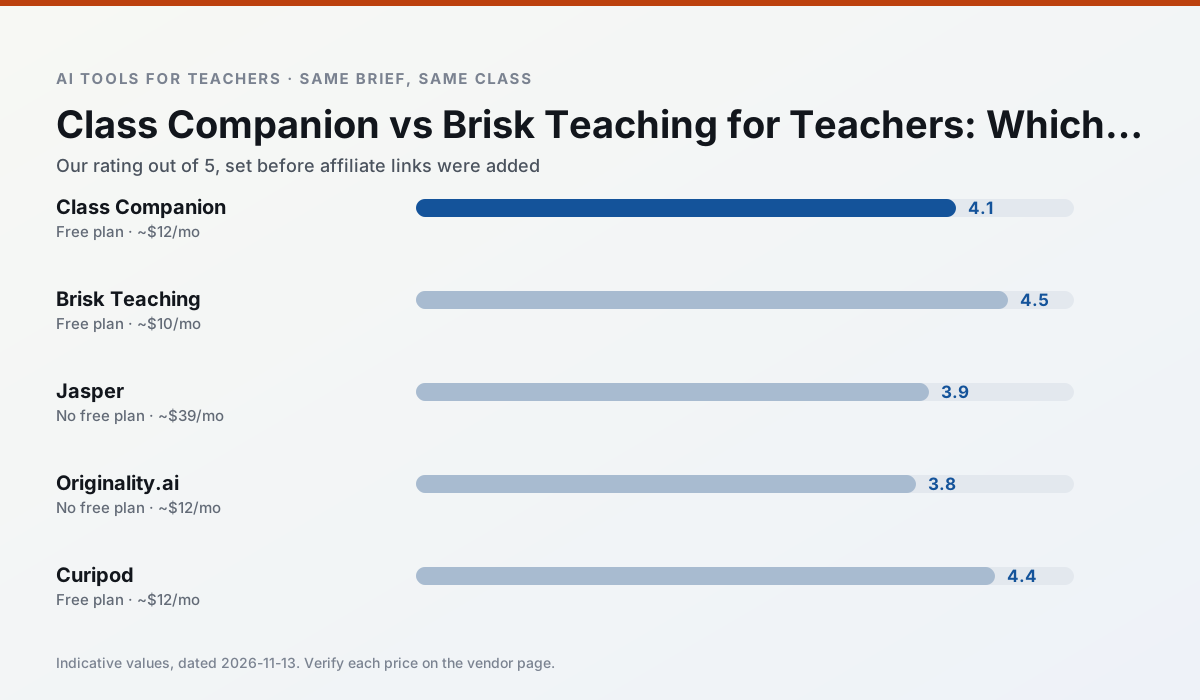
Side by side
Comparison table
Ratings reflect our timed classroom workflow, not vendor claims. Prices are indicative — verify on the vendor site.
| Tool | Best for | Free tier | Indicative paid plan | Standout feature | Our rating | Verdict | Try the tool |
|---|---|---|---|---|---|---|---|
| Class Companion | grading · feedback on writing | Yes — Limited assignments | ~$12 /user/mo | Handwriting recognition | 4.1 / 5 | Situational | Try free |
| Brisk Teaching | feedback on writing · grading | Yes — Limited actions per month | ~$10 /user/mo | Works inside Google Docs | 4.5 / 5 | Top pick | Try free |
| Jasper | newsletters · parent communication | No ongoing free plan | ~$39 /user/mo | Brand voice profiles | 3.9 / 5 | Situational | Try free |
| Originality.ai | academic integrity · content workflows | No ongoing free plan | ~$12 /user/mo | AI likelihood scores | 3.8 / 5 | Situational | Try free |
| Curipod | formative assessment · exit tickets | Yes — Limited lessons per month | ~$12 /user/mo | Live polls and word clouds | 4.4 / 5 | Strong option | Try free |
| Eduaide.Ai | lesson planning · rubric creation | Yes — Daily generation cap | ~$10 /user/mo | Resource library | 4.3 / 5 | Strong option | Try free |
Match your situation
Best for X
Different jobs need different tools. Here is what we would open first in each case.
For anything students touch directly, Class Companion offers the supervision controls and logging that IT will ask about first.
Family-facing drafts from Brisk Teaching need the fewest rewrites for warmth without overpromising, which is the usual failure mode.
For three reading groups and one text, Jasper needs the least manual relabelling of vocabulary and questions.
Originality.ai runs in a browser tab with no extension, no student accounts and no onboarding call, so you can test it in a free period.
Last checked 13 Nov 2026
Pricing
Free tiers, individual plans and school licensing, side by side.
| Tool | Free plan | Individual / paid | School & district | Billing note | Verify |
|---|---|---|---|---|---|
| Class Companion | $0 — Limited assignments | ~$12 /user/mo | Custom quote | Indicative — verify on vendor site | Vendor |
| Brisk Teaching | $0 — Limited actions per month | ~$10 /user/mo | Custom quote | Indicative — verify on vendor site | Vendor |
| Jasper | No ongoing free tier | ~$39 /user/mo | ~$59+ /user/mo | Indicative — verify on vendor site | Vendor |
| Originality.ai | No ongoing free tier | ~$12 /user/mo | Custom quote | Indicative — verify on vendor site | Vendor |
| Curipod | $0 — Limited lessons per month | ~$12 /user/mo | Custom quote | Indicative — verify on vendor site | Vendor |
| Eduaide.Ai | $0 — Daily generation cap | ~$10 /user/mo | Custom quote | Indicative — verify on vendor site | Vendor |
Editorial rule: pricing is re-checked every 2–3 months and the top 50 pages are refreshed every 6 months. See our funding policy.
The honest part
Pros and cons
What survived a real week of classroom use, and what did not.
Pros
- Useful where work is done on paper
- Fast, specific comments
- Good math support
Cons
- Scan quality affects accuracy
- Narrow use case
- Feedback still needs teacher review
Pros
- No copy-paste between tools
- Fast inline feedback on student drafts
- Gentle learning curve
Cons
- Chrome-first workflow
- Extension permissions need IT approval
- Free quota is tight
Pros
- Consistent tone across communications
- Strong long-form editor
- Good for district comms teams
Cons
- Priced for marketing teams
- Overkill for one classroom
- No education-specific features
Pros
- Useful for content publishing QA
- Fast bulk scanning
- Transparent credit model
Cons
- AI detection produces false positives
- Should never be sole evidence of misconduct
- Not a teaching tool
Pros
- High student engagement out of the box
- Great for quick checks for understanding
- No student accounts required for basic use
Cons
- Focused on delivery, not planning
- Requires reliable classroom devices
- Free tier is restrictive
In the classroom
Use cases
Five concrete workflows, with the tool we would open for each one.
Regrouping students after an assessment
Summarise anonymised results into skill groups, then generate one activity per group. Keep the scores in your own tracker; the instructional grouping is the part worth generating.
Recommended: Class CompanionA weekly family newsletter from bullet notes
Newsletters fail on length, not tone. Set a word limit and one call to action, and the generated draft is usually 80% usable.
Recommended: Brisk TeachingA question bank from a PDF or article
Feed a non-identifiable source and ask for items tagged by difficulty with the misconception behind each distractor. Spot-check every answer key; numerical items are least reliable.
Recommended: JasperA substitute folder that needs no context
The value here is structure, not creativity. Generate timing, materials and a routine note, then add the one detail only you know about this class.
Recommended: Originality.aiAn IEP present-levels first draft
Use aggregated, anonymised data only. Ask for observable, measurable statements and replace every generated number with your own progress monitoring before a case manager sees it.
Recommended: Curipod
Questions teachers ask us
FAQ
Direct answers, also published as FAQPage structured data for search and AI assistants.
Class Companion or Brisk Teaching for lesson planning?
Which is cheaper for one teacher?
Do they produce the same output?
Sources & further reading
Our recommendation
Try Jasper free for your next lesson planning task
Brand-voice writing assistant for school communications teams. Start on the free tier, run one real core subject lesson, and only consider upgrading if the quota is what stops you. Disclosure: we may earn a commission (varies) at no extra cost to you.
Some links on this page are affiliate links. We may earn a commission at no extra cost to you. Our rankings are editorial and never pay-to-play. Never enter student PII into a free consumer account.
Keep reading
Related comparisons in this cluster.
Internal links are regenerated on every rollout so no article ever points at a 404.