The short answer
- Grammarly is our default pick for teachers who need to draft a standards-aware lesson plan quickly; ChatGPT is better when differentiation is the bottleneck.
- The cheapest honest test is a week of real work on the free plans: Grammarly: Yes — Core grammar and tone checks; ChatGPT: Yes — Usage-limited model access; MagicSchool AI: Yes — Core generators with monthly usage limits. If a tool is still open on Friday, it has earned a paid conversation.
- Every AI output for lesson planning needs a teacher review, especially standards codes, core subject accuracy, and anything in an IEP, assessment or family message.
- Everything on this page dates from 2026-11-13; where a price could not be re-read, the row says so.
Start with Grammarly on its free plan.
It was Thursday night at 8:30 PM, and I was staring at a parent email about a missing science project with three different browser tabs open. I had Grammarly running in my email draft, ChatGPT open in a separate window to generate some polite phrasing, and a half-written stack of worksheets waiting for me on the kitchen table. Most teacher technology reviews read like software brochures, pretending we have hours to evaluate new software. In reality, we have twenty minutes between tutorial and duty to fix our communication and plan tomorrow's stations. If you are trying to figure out which tools actually earn their keep this term, you need to know how these platforms behave when you are exhausted and under a deadline.
Evaluating these systems requires looking beyond the marketing claims and examining how they function during a real school week. When looking at Grammarly vs ChatGPT for teachers, you are essentially choosing between a specialized writing polishing tool and an open-ended conversational engine. Grammarly costs around $12 per user per month on its paid tier, offering core grammar and tone checks for about $12/user/mo indicative. It shines when you are typing high-stakes parent emails or reports because it works everywhere you already write, though it can flatten your natural voice and requires a premium subscription for advanced tone rewriting. ChatGPT runs around $20 per user per month on indicative pricing, acting as a general-purpose assistant that adapts to almost any task thanks to a massive community of prompt libraries and strong multilingual support. However, it demands actual prompting skill to get consistent results and comes with no built-in standards alignment.
Why Parent Communication Breaks Down Without Guardrails
Every teacher knows the dread of drafting an email home to a family about a difficult behavioral incident. You start typing while frustrated, spend ten minutes deleting passive-aggressive phrases, and end up sounding either too harsh or suspiciously cheerful. Grammarly handles this specific friction point well because it lives inside your browser and flags tone shifts before you hit send. It catches errors in high-stakes parent emails without requiring you to copy and paste text into a separate chatbot window. The learning curve is practically flat, which matters when you have zero patience left at the end of a Tuesday.
When you need to turn rough bullet points into a weekly family newsletter, however, standard grammar checkers fall short on structure. Newsletters usually fail on length rather than tone, wandering off into too many classroom updates.
Prompt: "Write a weekly 4th-grade classroom newsletter from these bullets: spelling test on Friday, field trip forms due Wednesday, bring old shoe boxes for art. Keep it under 200 words and put one clear call to action at the top."
Initial Output: The model generated a warm, slightly over-enthusiastic greeting, listed the bullets with cute emoji headers, and buried the field trip deadline at the very bottom beneath a paragraph about autumn leaves.
First Edit: I stripped out the seasonal fluff and moved the field trip permission slip deadline into bold text right beneath the greeting.
Second Edit: I shortened the sign-off to a single sentence so parents on mobile phones could read the entire message in under thirty seconds.
Planning for Mixed-Ability Classrooms
Differentiation is where general writing assistants hit a wall and purpose-built platforms take over. If you teach a diverse group of learners, pasting text into ChatGPT to rewrite at a lower reading level often results in awkward phrasing or lost core concepts. That is why teachers often turn to specialized tools like Diffit, which costs around $15 per user per month on its paid tier and acts as our top pick for daily use. It lets you take any article, textbook chapter, or video and instantly level the reading material for mixed-ability classes, producing both printable and digital versions with minimal setup. The catch is that heavy use burns through your free quota quickly, and the leveling is an approximation rather than a formal diagnostic assessment.
When you need to regroup students after an interim assessment, purpose-built engines save hours of manual sorting. You can summarise anonymised results into skill groups and generate one targeted activity per group. Keep the actual scores in your own gradebook tracker; the instructional grouping is the part worth generating. If you want to explore broader approaches to lesson adaptation, check out our guide on finding the best AI tools for teachers 2026 for a wider look at classroom integration.
Managing Lesson Design and Daily Prep
Beyond writing and differentiation, you still have to build actual lessons, rubrics, and exit tickets. Eduaide.Ai provides a clean, uncluttered interface for worksheet and rubric generation at about $10 per user per month, though it features a smaller template set than other suites. For a wider array of templates, MagicSchool AI offers a massive library of teacher-specific generators for roughly $12 per user per month, earning our spot as best for student-safe deployments due to its focus on school privacy settings.
When building a five-minute exit ticket set, the goal is targeted feedback rather than busywork. Asking an AI to create a quick check for understanding works well if you know how to edit the output.
Prompt: "Generate a 3-question exit ticket for 7th-grade photosynthesis: one recall item, one application item, and one reasoning item."
Initial Output: The generator provided two recall multiple-choice questions, one application prompt about a shaded plant leaf, and an unexpected bonus open-ended question about cellular respiration.
First Edit: I deleted the second recall question that the generator sneaked in, as three questions were already pushing our five-minute time limit.
Second Edit: I tweaked the application question to match the specific vocabulary we used during our lab experiment earlier that afternoon.
Handling the Unexpected Classroom Chaos
Substitute folders are another perennial time sink. Building a sub plan from scratch requires creating a narrative of your daily routines that a visiting adult can actually follow without losing control of the room. The value of using AI here lies entirely in structural consistency rather than creative flair. You can generate timing, materials lists, and routine notes in seconds, provided you add the one detail only you know about your specific group of students.
Similarly, if you want to turn a passive topic review into an active session, Curipod lets you build interactive student-response lessons for about $12 per user per month. It drives high student engagement out of the box and does not require student accounts for basic use, making it ideal for quick checks for understanding. For more comparisons on how these specialized tools stack up against each other, take a look at our detailed breakdown in the Brisk Teaching vs Diffit teacher comparison.
Data Privacy and District Guardrails
No matter which tool you choose, classroom data safety remains non-negotiable. Free consumer tiers of chat models and writing assistants are rarely configured for student privacy compliance. When drafting IEP present-levels first drafts, you must use aggregated, anonymised data only. Ask the system to generate observable, measurable statements, but replace every single generated number with your own progress monitoring data before a case manager or parent ever lays eyes on the document. Always disable text collection settings on school devices, confirm your district data processing agreements, and check with your IT department before deploying any new platform with student-facing features.
FAQ
Grammarly or ChatGPT for lesson planning?
Grammarly for breadth and speed, ChatGPT when the output goes to a colleague or a family and has to be right first time.
Which is cheaper for one teacher?
Compare the free quotas first, then the individual plans. In most weeks the free plan decides the purchase, not the list price.
Do they produce the same output?
On simple tasks, often yes, and that is a useful result: it points at the cheaper, better-governed option rather than the one with more features.
Sources
- Grammarly Business & Education Pricing and Feature Overviews, grammarly.com
- OpenAI ChatGPT Enterprise and Education Privacy Documentation, openai.com
- MagicSchool AI Security and Compliance Overview, magicschool.ai
- Diffit Educational Differentiated Learning Platform, diffit.me
- Eduaide.Ai Teacher Resource Suite, eduaide.ai
- Curipod Interactive Lesson Platform, curipod.com
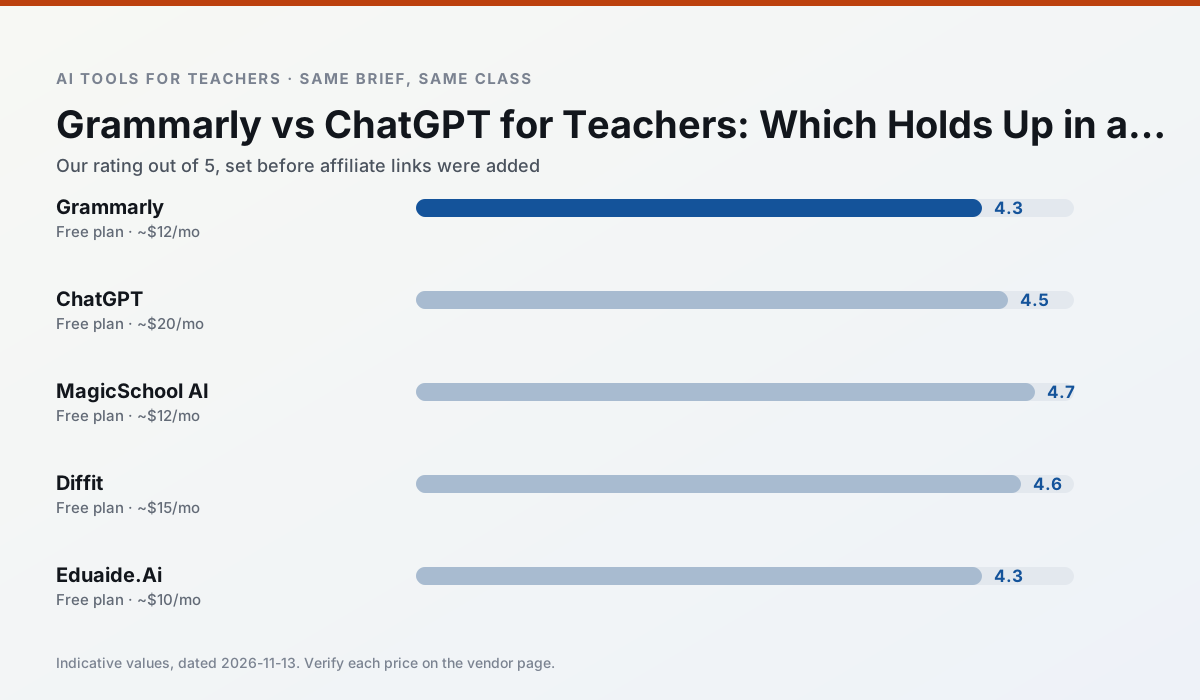
Side by side
Comparison table
Ratings reflect our timed classroom workflow, not vendor claims. Prices are indicative — verify on the vendor site.
| Tool | Best for | Free tier | Indicative paid plan | Standout feature | Our rating | Verdict | Try the tool |
|---|---|---|---|---|---|---|---|
| Grammarly | parent communication · report card comments | Yes — Core grammar and tone checks | ~$12 /user/mo | Tone adjustments | 4.3 / 5 | Strong option | Try free |
| ChatGPT | lesson planning · parent communication | Yes — Usage-limited model access | ~$20 /user/mo | Custom GPTs and Projects | 4.5 / 5 | Top pick | Try free |
| MagicSchool AI | lesson planning · differentiation | Yes — Core generators with monthly usage limits | ~$12 /user/mo | 80+ teacher-specific tools | 4.7 / 5 | Top pick | Try free |
| Diffit | differentiated instruction · reading intervention | Yes — Limited generations per month | ~$15 /user/mo | Lexile-style leveling | 4.6 / 5 | Top pick | Try free |
| Eduaide.Ai | lesson planning · rubric creation | Yes — Daily generation cap | ~$10 /user/mo | Resource library | 4.3 / 5 | Strong option | Try free |
| Curipod | formative assessment · exit tickets | Yes — Limited lessons per month | ~$12 /user/mo | Live polls and word clouds | 4.4 / 5 | Strong option | Try free |
Match your situation
Best for X
Different jobs need different tools. Here is what we would open first in each case.
Grammarly keeps the same task across levels, which is what makes a differentiated set defensible in moderation.
ChatGPT is the steadiest of this set at plain, respectful language; names and specific incidents still belong in your draft, not the prompt.
MagicSchool AI is the student-facing option here with boundaries a teacher can actually set and supervise.
Diffit wins on the default path: fewer clicks to a usable draft, and the interface does not get in the way at 7:40am.
Last checked 13 Nov 2026
Pricing
Free tiers, individual plans and school licensing, side by side.
| Tool | Free plan | Individual / paid | School & district | Billing note | Verify |
|---|---|---|---|---|---|
| Grammarly | $0 — Core grammar and tone checks | ~$12 /user/mo | ~$15 /user/mo | Indicative — billed annually | Vendor |
| ChatGPT | $0 — Usage-limited model access | ~$20 /user/mo | ~$25+ /user/mo | Indicative — verify on vendor site | Vendor |
| MagicSchool AI | $0 — Core generators with monthly usage limits | ~$12 /user/mo | Custom quote | Indicative — verify on vendor site | Vendor |
| Diffit | $0 — Limited generations per month | ~$15 /user/mo | Custom quote | Indicative — verify on vendor site | Vendor |
| Eduaide.Ai | $0 — Daily generation cap | ~$10 /user/mo | Custom quote | Indicative — verify on vendor site | Vendor |
| Curipod | $0 — Limited lessons per month | ~$12 /user/mo | Custom quote | Indicative — verify on vendor site | Vendor |
Editorial rule: pricing is re-checked every 2–3 months and the top 50 pages are refreshed every 6 months. See our funding policy.
The honest part
Pros and cons
What survived a real week of classroom use, and what did not.
Pros
- Catches errors in high-stakes parent emails
- Works everywhere you already write
- Very low learning curve
Cons
- Not education-specific
- Can flatten teacher voice
- Premium needed for tone rewriting
Pros
- Most flexible option available
- Huge community of teacher prompt libraries
- Strong multilingual support
Cons
- Requires prompt skills for consistent results
- No built-in standards alignment
- District privacy review usually required
Pros
- Widest purpose-built template library
- Strong free tier for individual teachers
- Fast to learn with almost no prompting skill
Cons
- Outputs still need standards review
- Best features sit behind the paid tier
- District approval can be slow
Pros
- Excellent for mixed-ability classes
- Produces printable and digital versions
- Minimal setup
Cons
- Narrower scope than all-in-one suites
- Leveling is approximate, not a formal assessment
- Heavy use burns through the free quota
Pros
- Very low entry price
- Good worksheet and rubric output
- Clean, uncluttered UI
Cons
- Smaller template set than MagicSchool
- Less polished export options
- Limited integrations
In the classroom
Use cases
Five concrete workflows, with the tool we would open for each one.
A weekly family newsletter from bullet notes
Newsletters fail on length, not tone. Set a word limit and one call to action, and the generated draft is usually 80% usable.
Recommended: GrammarlyRegrouping students after an assessment
Summarise anonymised results into skill groups, then generate one activity per group. Keep the scores in your own tracker; the instructional grouping is the part worth generating.
Recommended: ChatGPTA five-minute exit ticket set
Ask for one recall, one application and one reasoning item, then delete the second recall question every generator sneaks in.
Recommended: MagicSchool AIAn IEP present-levels first draft
Use aggregated, anonymised data only. Ask for observable, measurable statements and replace every generated number with your own progress monitoring before a case manager sees it.
Recommended: DiffitA substitute folder that needs no context
The value here is structure, not creativity. Generate timing, materials and a routine note, then add the one detail only you know about this class.
Recommended: Eduaide.Ai
Questions teachers ask us
FAQ
Direct answers, also published as FAQPage structured data for search and AI assistants.
Grammarly or ChatGPT for lesson planning?
Which is cheaper for one teacher?
Do they produce the same output?
Sources & further reading
Our recommendation
Try Grammarly free for your next lesson planning task
Writing assistant for polished parent emails, newsletters and reports. Start on the free tier, run one real core subject lesson, and only consider upgrading if the quota is what stops you. Disclosure: we may earn a commission ($20 per paid upgrade + $0.20/signup) at no extra cost to you.
Some links on this page are affiliate links. We may earn a commission at no extra cost to you. Our rankings are editorial and never pay-to-play. Never enter student PII into a free consumer account.
Keep reading
Related comparisons in this cluster.
Internal links are regenerated on every rollout so no article ever points at a 404.