The short answer
- Diffit is our default pick for teachers who need to draft a standards-aware lesson plan quickly; Eduaide.Ai is better when differentiation is the bottleneck.
- Diffit handles the broad case; Eduaide.Ai handles the narrow one. Anything beyond that pair should be justified by a recurring weekly job, not a feature demo.
- Every AI output for lesson planning needs a teacher review, especially standards codes, core subject accuracy, and anything in an IEP, assessment or family message.
- Everything on this page dates from 2026-11-13; where a price could not be re-read, the row says so.
Start with MagicSchool AI on its free plan.
It is fourth period on a rainy Tuesday, and my seventh-grade life science class has a reading spread that spans four Lexile levels. Half the room is staring blankly at a dense article on cellular respiration, while the other half finished it in four minutes and is currently testing the acoustic properties of their pencils. This is the exact moment when teachers search for a shortcut. When evaluating Diffit vs Eduaide.Ai for teachers, you are not looking for a piece of software to win an industry award. You want a tool that stops the panic when you realize your planned lesson will alienate both your struggling readers and your advanced kids.
Both platforms promise to take the heavy lifting out of differentiation, but they approach the messy reality of lesson prep from entirely different angles. If you are trying to figure out which subscription deserves a spot on your credit card by the end of this term, you need to know how they hold up under actual classroom conditions, alongside heavy hitters like MagicSchool AI and Curipod. Let us look at what happens when these tools hit the floor.
The Reading Level Problem and Diffit
Diffit built its reputation on a single, highly specific trick: taking any web link, PDF, or YouTube video and leveling it down or up for your students. If you teach mixed-ability classes, this feels like magic the first three times you use it. You paste an article about plate tectonics, select a target reading level, and out pops a leveled text complete with vocabulary definitions, a summary, and comprehension questions.
The catch is that leveling is approximate, not a formal psychometric assessment. If you rely on it blindly, you will occasionally find that a simplified text has stripped out the conceptual nuance your students actually need to understand the standard. Heavy use will also burn through the free tier faster than you expect, pushing you toward the paid tier at roughly $15 per user per month. For a deeper look at how it matches up against other reading-heavy tools, check out our broader look at the best AI tools for teachers 2026.
Prompt: Level this article on the nitrogen cycle for a 5th-grade reading level. Include four vocabulary words with student-friendly definitions and three multiple-choice questions with answer keys.
Result: The tool returned a clean, readable text with accurate definitions. However, two of the multiple-choice questions had obvious distractors that made guessing trivial, and the reading level was slightly high for true 5th-grade struggling readers.
Edits:
- Rewrote the distractors to target common misconceptions about bacteria in soil.
- Swapped one complex sentence in the second paragraph for a simpler declarative statement.
The Worksheet Builder's Dilemma with Eduaide.Ai
Eduaide.Ai is less about transforming existing text and more about building instructional materials from scratch. It features a teaching-resource library that generates lesson plans, worksheets, and rubrics with a clean, uncluttered user interface. At roughly $10 per user per month, its entry price is slightly lower than Diffit, making it attractive if you are paying out of pocket.
The limitation here is scope. While it handles standard worksheet creation well, its template set is smaller than all-in-one suites like MagicSchool AI, and its export options can feel a bit rigid. When you use Eduaide.Ai to spin up a question bank from an article, you have to watch out for numerical items and answer keys.
Prompt: Create five multiple-choice questions based on this text about the water cycle, tagged by difficulty, with the misconception explained for each incorrect distractor.
Result: The questions generated quickly. The difficulty tags were mostly accurate, and the explanations for the distractors were surprisingly insightful for teaching purposes.
Edits:
- Deleted a redundant recall question that the generator sneaked in at the end.
- Verified the answer key manually, as the third question contained a factual error regarding condensation points.
Broader Ecosystems: MagicSchool, Curipod, and Khanmigo
When you step outside the direct comparison of Diffit and Eduaide.Ai, you run into platforms designed to solve entirely different classroom bottlenecks. MagicSchool AI remains the heavy favorite for schools and districts because its purpose-built template library is massive. It costs around $12 per user per month and offers a strong free tier, though district approval can drag on if your IT department is cautious.
Curipod tackles student engagement during live delivery rather than offline planning. At roughly $12 per user per month, it turns static slides into interactive polls, drawings, and open-ended questions without requiring student accounts for basic use. It is brilliant for quick checks for understanding, though it depends entirely on having reliable classroom devices in front of every kid.
Khanmigo takes a different path entirely as a tutor-style AI from a nonprofit education platform. Priced around $4 per learner per month, it focuses on student-facing scaffolding, particularly in math, rather than generating teacher admin paperwork. If you want a companion piece on how these planning assistants stack up against grading platforms, read our breakdown of Brisk Teaching vs Gradescope for teachers.
Workspace Management with Notion AI
If your primary pain point is not daily worksheets but long-term curriculum tracking, Notion AI offers a different workflow entirely. At roughly $10 per user per month, it acts as an AI-assisted notes and database system where you can build sprawling curriculum maps and team collaboration spaces.
The downside is setup time. Notion is a blank slate, which means you have to build your own filing cabinets before the AI can help you organize your units. It is not purpose-built for lesson generation, meaning you will do more upfront configuration than you would in Eduaide or MagicSchool.
+------------------+-------------------+--------------------+--------------------+
| Tool             | Indicative Price  | Primary Strength   | Main Limitation    |
+------------------+-------------------+--------------------+--------------------+
| Diffit           | $15 /user/mo      | Text & video level | Free tier burns fast|
| Eduaide.Ai       | $10 /user/mo      | Worksheets/rubrics | Smaller template set|
| MagicSchool AI   | $12 /user/mo      | Massive template   | Standards need     |
|                  |                   | library            | review             |
| Curipod          | $12 /user/mo      | Live engagement    | Needs reliable     |
|                  |                   |                    | devices            |
| Khanmigo         | $4 /learner/mo    | Scaffolding & math | Less admin utility |
| Notion AI        | $10 /user/mo      | Curriculum records | High setup time    |
+------------------+-------------------+--------------------+--------------------+
Making Your Final Choice
Choosing between these options comes down to where you spend most of your prep time. If your desk is piled with articles and videos that need immediate leveling for an inclusive classroom, Diffit is the most direct path to getting materials into kids' hands. If you need a broad toolkit for generating worksheets, lesson outlines, and rubrics without breaking your personal budget, Eduaide.Ai gives you steady output in a clean interface.
Keep your data privacy protocols in mind regardless of which tool you choose. Never paste identifiable student work into these systems, and always check your district's digital policy before rolling a new subscription out to your classes. The AI is there to cut your prep time in half, not to replace your professional judgment on what your students actually need to learn.
FAQ
Diffit or Eduaide.Ai for lesson planning?
Diffit for breadth and speed, Eduaide.Ai when the output goes to a colleague or a family and has to be right first time.
Which is cheaper for one teacher?
Compare the free quotas first, then the individual plans. In most weeks the free plan decides the purchase, not the list price.
Do they produce the same output?
On simple tasks, often yes, and that is a useful result: it points at the cheaper, better-governed option rather than the one with more features.
Sources
- Diffit Vendor Pricing and Features. https://diffit.me
- Eduaide.Ai Platform Overview and Resource Library. https://eduaide.ai
- Curipod Interactive Lesson Delivery. https://curipod.com
- MagicSchool AI Teacher Tools and Security Statements. https://magicschool.ai
- Khanmigo Education Platform Specifications. https://khanacademy.org/khanmigo
- Notion AI Workspace and Subscription Plans. https://notion.so
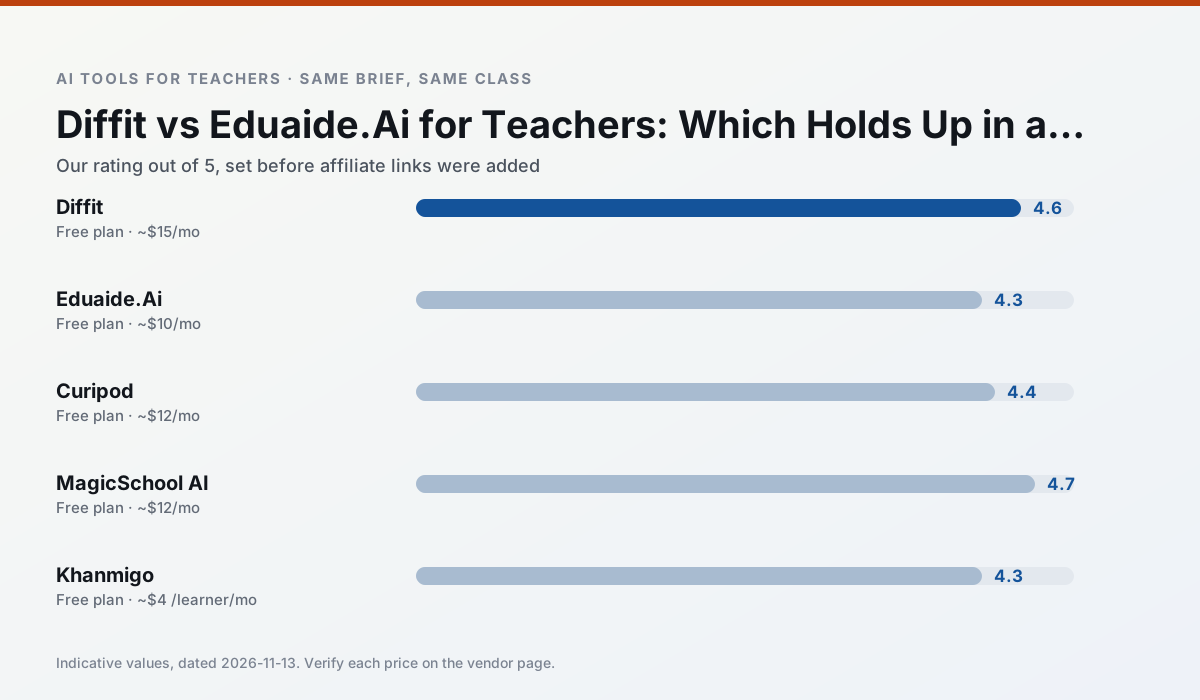
Side by side
Comparison table
Ratings reflect our timed classroom workflow, not vendor claims. Prices are indicative — verify on the vendor site.
| Tool | Best for | Free tier | Indicative paid plan | Standout feature | Our rating | Verdict | Try the tool |
|---|---|---|---|---|---|---|---|
| Diffit | differentiated instruction · reading intervention | Yes — Limited generations per month | ~$15 /user/mo | Lexile-style leveling | 4.6 / 5 | Top pick | Try free |
| Eduaide.Ai | lesson planning · rubric creation | Yes — Daily generation cap | ~$10 /user/mo | Resource library | 4.3 / 5 | Strong option | Try free |
| Curipod | formative assessment · exit tickets | Yes — Limited lessons per month | ~$12 /user/mo | Live polls and word clouds | 4.4 / 5 | Strong option | Try free |
| MagicSchool AI | lesson planning · differentiation | Yes — Core generators with monthly usage limits | ~$12 /user/mo | 80+ teacher-specific tools | 4.7 / 5 | Top pick | Try free |
| Khanmigo | math practice · student tutoring | Yes — US teacher accounts, subject to eligibility | ~$4 /learner/mo | Socratic tutoring rather than answers | 4.3 / 5 | Strong option | Try free |
| Notion AI | curriculum mapping · unit planning | Yes — Limited AI usage | ~$10 /user/mo | Linked databases | 4.1 / 5 | Situational | Try free |
Match your situation
Best for X
Different jobs need different tools. Here is what we would open first in each case.
Diffit is the student-facing option here with boundaries a teacher can actually set and supervise.
For three reading groups and one text, Eduaide.Ai needs the least manual relabelling of vocabulary and questions.
Curipod has the strongest tone control for family emails and report comments, provided you still read the message aloud before sending.
MagicSchool AI answers the three questions a district actually asks: rostering, admin controls and a data-processing agreement. That is usually what decides a school purchase.
Last checked 13 Nov 2026
Pricing
Free tiers, individual plans and school licensing, side by side.
| Tool | Free plan | Individual / paid | School & district | Billing note | Verify |
|---|---|---|---|---|---|
| Diffit | $0 — Limited generations per month | ~$15 /user/mo | Custom quote | Indicative — verify on vendor site | Vendor |
| Eduaide.Ai | $0 — Daily generation cap | ~$10 /user/mo | Custom quote | Indicative — verify on vendor site | Vendor |
| Curipod | $0 — Limited lessons per month | ~$12 /user/mo | Custom quote | Indicative — verify on vendor site | Vendor |
| MagicSchool AI | $0 — Core generators with monthly usage limits | ~$12 /user/mo | Custom quote | Indicative — verify on vendor site | Vendor |
| Khanmigo | $0 — US teacher accounts, subject to eligibility | ~$4 /learner/mo | Custom quote | Indicative — verify on vendor site | Vendor |
| Notion AI | $0 — Limited AI usage | ~$10 /user/mo | ~$8 /user/mo | Indicative — verify on vendor site | Vendor |
Editorial rule: pricing is re-checked every 2–3 months and the top 50 pages are refreshed every 6 months. See our funding policy.
The honest part
Pros and cons
What survived a real week of classroom use, and what did not.
Pros
- Excellent for mixed-ability classes
- Produces printable and digital versions
- Minimal setup
Cons
- Narrower scope than all-in-one suites
- Leveling is approximate, not a formal assessment
- Heavy use burns through the free quota
Pros
- Very low entry price
- Good worksheet and rubric output
- Clean, uncluttered UI
Cons
- Smaller template set than MagicSchool
- Less polished export options
- Limited integrations
Pros
- High student engagement out of the box
- Great for quick checks for understanding
- No student accounts required for basic use
Cons
- Focused on delivery, not planning
- Requires reliable classroom devices
- Free tier is restrictive
Pros
- Widest purpose-built template library
- Strong free tier for individual teachers
- Fast to learn with almost no prompting skill
Cons
- Outputs still need standards review
- Best features sit behind the paid tier
- District approval can be slow
Pros
- Education-first design
- Strong nonprofit trust signal
- Good math scaffolding
Cons
- Availability varies by region
- Less useful for admin paperwork
- Requires student accounts for full value
In the classroom
Use cases
Five concrete workflows, with the tool we would open for each one.
A substitute folder that needs no context
The value here is structure, not creativity. Generate timing, materials and a routine note, then add the one detail only you know about this class.
Recommended: DiffitA question bank from a PDF or article
Feed a non-identifiable source and ask for items tagged by difficulty with the misconception behind each distractor. Spot-check every answer key; numerical items are least reliable.
Recommended: Eduaide.AiA five-minute exit ticket set
Ask for one recall, one application and one reasoning item, then delete the second recall question every generator sneaks in.
Recommended: CuripodAn IEP present-levels first draft
Use aggregated, anonymised data only. Ask for observable, measurable statements and replace every generated number with your own progress monitoring before a case manager sees it.
Recommended: MagicSchool AIRubric and feedback comments in one pass
Reorder the workflow so the rubric is yours and the comments are generated. Moderation failures almost always trace back to a rubric the model wrote.
Recommended: Khanmigo
Questions teachers ask us
FAQ
Direct answers, also published as FAQPage structured data for search and AI assistants.
Diffit or Eduaide.Ai for lesson planning?
Which is cheaper for one teacher?
Do they produce the same output?
Sources & further reading
Our recommendation
Try MagicSchool AI free for your next lesson planning task
A large library of teacher-specific AI generators in one dashboard. Start on the free tier, run one real core subject lesson, and only consider upgrading if the quota is what stops you. Disclosure: we may earn a commission (30% recurring) at no extra cost to you.
Some links on this page are affiliate links. We may earn a commission at no extra cost to you. Our rankings are editorial and never pay-to-play. Never enter student PII into a free consumer account.
Keep reading
Related comparisons in this cluster.
Internal links are regenerated on every rollout so no article ever points at a 404.