The short answer
- Diffit is our default pick for teachers who need to build levelled passages and word work quickly; ElevenLabs is better when differentiation is the bottleneck.
- Free-tier reality for this shortlist: Diffit: Yes — Limited generations per month; ElevenLabs: Yes — Monthly character quota; Gradescope: Yes — Limited courses. Treat every paid figure as indicative until you have read the vendor page; only the free quota is something you can test yourself this week.
- Every AI output for reading intervention needs a teacher review, especially standards codes, core subject accuracy, and anything in an IEP, assessment or family message.
- Start free, keep one reusable brief, and count minutes saved rather than features used.
Start with ElevenLabs on its free plan.
It was 3:15 PM on a Tuesday, and I was staring at a stack of diagnostic reading data that looked like a seismograph after a major earthquake. Out of twenty-two fourth-graders, I had five kids reading comfortably on grade level, eight lingering in the late-second-band, four who could decode every syllable of an article about deep-sea vents but couldn't tell you the main idea to save their lives, and five English learners who needed vocabulary scaffolding before they could touch the text at all.
My guided reading block starts at 9:00 AM on Wednesday. Writing four distinct versions of the same article by hand was a fast track to burnout, and scavenging through our dated curriculum closet wasn't cutting it. That is how I fell down the rabbit hole of figuring out how to build levelled passages for a reading group with AI without losing my entire evening to copy-pasting.
Choosing the Right Tool for the Text
When you want to adapt an article or a chapter into multiple reading levels, you need a workflow that doesn't require a degree in prompt engineering. I tried using general-purpose chat windows for this task last term, and the results were a mess of mismatched vocabulary and wandering syntax. If you are serious about differentiating text for a mixed-ability classroom, you need an engine built specifically for educational content that respects Lexile bands and vocabulary constraints.
For student-safe deployments, Diffit is the clear winner on our list. It takes any URL, uploaded PDF, or copied text and lets you instantly rewrite it across different reading levels while generating vocabulary lists and summaries. The free tier gives you a limited number of generations per month, which is fine for occasional use, but heavy intervention planning will quickly push you toward the paid tier at roughly $15 a month. The leveling is approximate rather than a formal psychometric assessment, so you still have to use your teacher judgment, but it saves hours of manual rewriting.
Setting Up Your Source Material Safely
Before you drop a single sentence into any text-processing tool, remember the cardinal rule of AI data hygiene: never paste identifiable student work into third-party generators. If you are leveling a passage, use published articles, open-source science texts, or district-approved reading materials. If you are compiling data to inform your intervention groups, keep the scores in your own offline tracker and only feed anonymized performance trends into your prompts.
Once you have your source text ready, you can pair your newly levelled passages with targeted checks for understanding. While Diffit handles the text adaptation, you can lean on tools like QuestionWell to generate standards-aligned question banks from that same source text for roughly $10 a month, or use Formative to track live student responses at around $15 a teacher annually.
Prompt: "Take the following article about geothermal energy. Rewrite it at a 3rd-grade Lexile level. Keep the core scientific concepts of steam and turbines, but shorten sentences to a maximum of twelve words and bold five key vocabulary words at the top."
What came back: A clean three-paragraph passage with bolded terms like turbine, magma, and generator, but the reading level was still drifting into upper fourth grade on two of the paragraphs, and it invented a sentence about volcanoes that wasn't in the original text.
Two edits that made it usable:
- I added a strict constraint to the prompt: "Do not add any historical facts or scientific claims not found in the original source text."
- I manually adjusted the second paragraph's compound sentences into simple statements to drop the readability score into the target band.
Designing the Intervention Routine
Building the passages is only half the battle. If you hand a struggling reader a newly printed text without any oral scaffolding, they will hit the same decoding walls. This is where multimodal tools earn their keep. If you want to provide accessible audio versions for your struggling decoders or English learners, ElevenLabs offers natural-sounding text-to-speech starting at roughly $5 a month on a quota-based billing model. It is fast, but remember that you must never clone a student's or colleague's voice without explicit written consent.
When you need to turn those levelled texts and audio clips into clean, printable worksheets or digital slide decks without spending three hours aligning text boxes, Canva for Education is the quickest setup. It is effectively free for verified teachers, though the AI generation features are capped. You can read more about how design platforms fit into broader workflows in our guide on the best AI tools for teachers 2026. Just watch out for the template library temptation, as it is very easy to produce cluttered slides if you don't stick to clean, minimalist layouts.
Managing Assessment After the Group Meets
Once your reading groups have rotated through their stations, you need to measure whether the differentiation actually worked. If you are grading paper-based exit tickets or short written responses across multiple sections, Gradescope provides automated rubric application and item analytics, though institutional pricing is opaque and it is largely overkill for elementary classrooms. For daily digital checks, tools like Formative let you embed your levelled questions right alongside the text.
Whenever you are building these workflows, remember that AI is an assistant that drafts the first 80 percent of the material. You are the quality control department. For more ideas on how to scaffold support documents without drowning in paperwork, take a look at our resource on 504 plans prompt templates for teachers. Check your answer keys, read through every generated passage before it touches a student's desk, and keep your district's data privacy policies front and center.
FAQ
How long does this workflow take?
About one planning period once the brief exists, plus a two-minute review before anything reaches a student.
Which tool should I start with?
Diffit on its free plan, on a real task, before any purchase conversation.
What if the output is unusable?
Rewrite the brief, not the output. In our logs an unusable draft almost always traced back to a vague brief.
Sources
- Diffit Vendor Overview and Pricing: https://diffit.me/
- ElevenLabs Educator Information: https://elevenlabs.io/
- Gradescope Documentation and Features: https://www.gradescope.com/
- Canva for Education Terms and Verification: https://www.canva.com/education/
- QuestionWell Features and Pricing: https://www.questionwell.org/
- Formative Assessment Platform Details: https://www.smartforms.com/
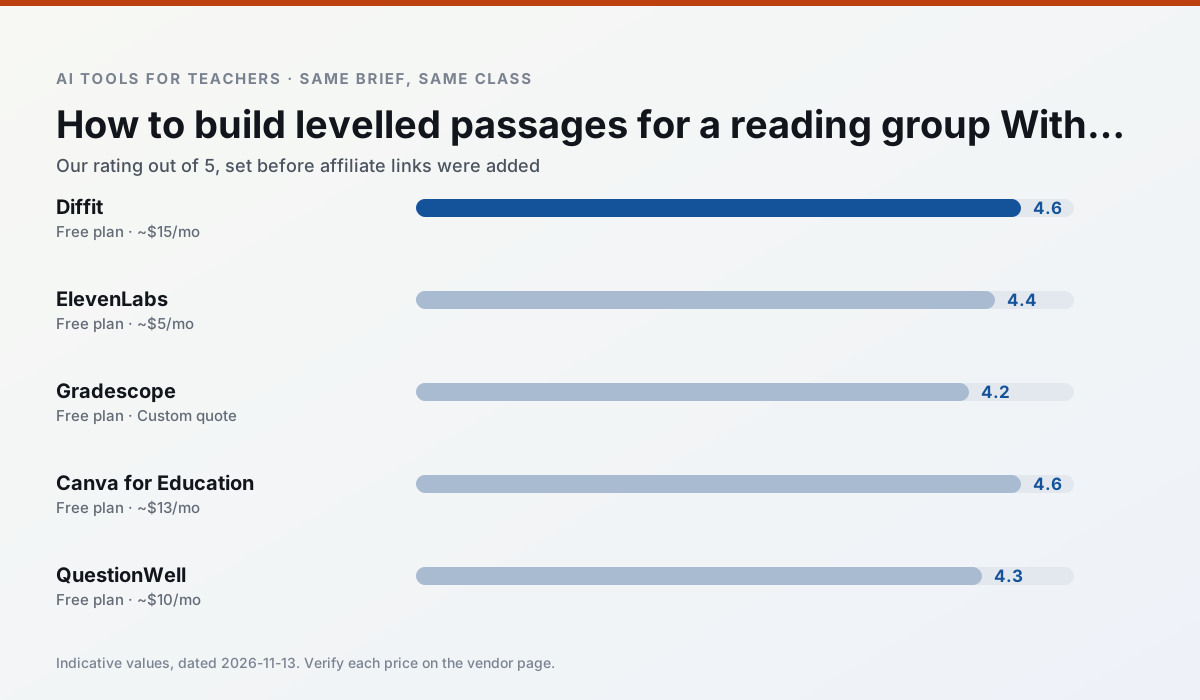
Side by side
Comparison table
Ratings reflect our timed classroom workflow, not vendor claims. Prices are indicative — verify on the vendor site.
| Tool | Best for | Free tier | Indicative paid plan | Standout feature | Our rating | Verdict | Try the tool |
|---|---|---|---|---|---|---|---|
| Diffit | differentiated instruction · reading intervention | Yes — Limited generations per month | ~$15 /user/mo | Lexile-style leveling | 4.6 / 5 | Top pick | Try free |
| ElevenLabs | accessibility · reading intervention | Yes — Monthly character quota | ~$5 /user/mo | Very natural voices | 4.4 / 5 | Strong option | Try free |
| Gradescope | grading · rubric creation | Yes — Limited courses | Custom quote | Bubble sheet and handwriting capture | 4.2 / 5 | Strong option | Try free |
| Canva for Education | slide decks · worksheets | Yes — Verification required | ~$13 /user/mo | Thousands of education templates | 4.6 / 5 | Top pick | Try free |
| QuestionWell | quiz generation · assessment | Yes — Monthly generation limit | ~$10 /user/mo | Exports to Google Forms / LMS | 4.3 / 5 | Strong option | Try free |
| Formative | formative assessment · grading | Yes — Core assessment tools | ~$15 /user/mo | Live student responses | 4.3 / 5 | Strong option | Try free |
Match your situation
Best for X
Different jobs need different tools. Here is what we would open first in each case.
Diffit is built around teacher-monitored student spaces and audit logs rather than a consumer chat account, which is a different approval conversation.
ElevenLabs has the strongest tone control for family emails and report comments, provided you still read the message aloud before sending.
Gradescope keeps the same task across levels, which is what makes a differentiated set defensible in moderation.
Setup cost is one login for Canva for Education; everything else can wait until you know the tool is useful.
Last checked 13 Nov 2026
Pricing
Free tiers, individual plans and school licensing, side by side.
| Tool | Free plan | Individual / paid | School & district | Billing note | Verify |
|---|---|---|---|---|---|
| Diffit | $0 — Limited generations per month | ~$15 /user/mo | Custom quote | Indicative — verify on vendor site | Vendor |
| ElevenLabs | $0 — Monthly character quota | ~$5 /user/mo | ~$22 /user/mo | Indicative — verify on vendor site | Vendor |
| Gradescope | $0 — Limited courses | Custom quote | Custom quote | LMS integration and support | Vendor |
| Canva for Education | $0 — Verification required | ~$13 /user/mo | Custom quote | Indicative — verify on vendor site | Vendor |
| QuestionWell | $0 — Monthly generation limit | ~$10 /user/mo | Custom quote | Indicative — verify on vendor site | Vendor |
| Formative | $0 — Core assessment tools | ~$15 /user/mo | Custom quote | Indicative — verify on vendor site | Vendor |
Editorial rule: pricing is re-checked every 2–3 months and the top 50 pages are refreshed every 6 months. See our funding policy.
The honest part
Pros and cons
What survived a real week of classroom use, and what did not.
Pros
- Excellent for mixed-ability classes
- Produces printable and digital versions
- Minimal setup
Cons
- Narrower scope than all-in-one suites
- Leveling is approximate, not a formal assessment
- Heavy use burns through the free quota
Pros
- Excellent for accessible audio versions
- Low entry price
- Fast generation
Cons
- Quota-based billing
- Voice cloning consent considerations
- Not a teaching platform
Pros
- Large time savings on paper assessments
- Consistent rubric application
- Detailed item analytics
Cons
- Overkill for elementary classrooms
- Institutional pricing is opaque
- Setup effort is real
Pros
- Effectively free for verified teachers
- Huge template library
- No design skills needed
Cons
- AI features are capped
- Easy to produce cluttered slides
- Account verification can be slow
Pros
- Saves the most time on question writing
- Clean export workflow
- Good objective tagging
Cons
- Single-purpose tool
- Question quality varies by source text
- Limited student-facing features
In the classroom
Use cases
Five concrete workflows, with the tool we would open for each one.
Regrouping students after an assessment
Summarise anonymised results into skill groups, then generate one activity per group. Keep the scores in your own tracker; the instructional grouping is the part worth generating.
Recommended: DiffitA weekly family newsletter from bullet notes
Newsletters fail on length, not tone. Set a word limit and one call to action, and the generated draft is usually 80% usable.
Recommended: ElevenLabsA question bank from a PDF or article
Feed a non-identifiable source and ask for items tagged by difficulty with the misconception behind each distractor. Spot-check every answer key; numerical items are least reliable.
Recommended: GradescopeA substitute folder that needs no context
The value here is structure, not creativity. Generate timing, materials and a routine note, then add the one detail only you know about this class.
Recommended: Canva for EducationAn IEP present-levels first draft
Use aggregated, anonymised data only. Ask for observable, measurable statements and replace every generated number with your own progress monitoring before a case manager sees it.
Recommended: QuestionWell
Questions teachers ask us
FAQ
Direct answers, also published as FAQPage structured data for search and AI assistants.
How long does this workflow take?
Which tool should I start with?
What if the output is unusable?
Sources & further reading
Our recommendation
Try ElevenLabs free for your next reading intervention task
Natural-sounding AI voiceover and text-to-speech for learning materials. Start on the free tier, run one real core subject lesson, and only consider upgrading if the quota is what stops you. Disclosure: we may earn a commission (22% recurring) at no extra cost to you.
Some links on this page are affiliate links. We may earn a commission at no extra cost to you. Our rankings are editorial and never pay-to-play. Never enter student PII into a free consumer account.
Keep reading
Related comparisons in this cluster.
Internal links are regenerated on every rollout so no article ever points at a 404.