The short answer
- Notion AI is our default pick for teachers who need to document accessible alternatives quickly; Surfer SEO is better when differentiation is the bottleneck.
- The cheapest honest test is a week of real work on the free plans: Notion AI: Yes — Limited AI usage; Surfer SEO: No ongoing free plan; Originality.ai: No ongoing free plan. If a tool is still open on Friday, it has earned a paid conversation.
- Every AI output for accommodations needs a teacher review, especially standards codes, core subject accuracy, and anything in an IEP, assessment or family message.
- Trial one tool for a week of real accommodations work before any purchase conversation; the quota is the honest test.
Start with Notion AI on its free plan.
Twenty-two students sit in front of me, and eight of them are looking at a text written at a lexile level they cannot decode independently. My co-teacher is absent, the sub folder is blank, and I have forty minutes before my next class to rewrite an entire ecosystem of source materials. If you have ever tried to manually adapt a primary source document into three different reading levels while keeping the core content intact, you already know why teachers burn out by November. Building accessible alternatives used to mean spending your Sunday night at the kitchen table with a pair of scissors, a highlighter, and a prayer. Now, we have tools that can generate a pack of differentiated materials in minutes, provided you know how to wrangle them without losing your sanity.
Why Manual Differentiation Fails and How AI Steps In
The fundamental problem with differentiation is the sheer volume of writing required. You need the anchor text, a scaffolded version for emerging readers, a challenge tier for advanced students, vocabulary definitions, and comprehension checks that actually align. Doing this by hand for a single 45-minute lesson takes hours. When we look at how to build a pack of accessible alternatives with AI, we are not looking for a magic wand that writes perfect curriculum from thin air. We are looking for an engine to produce a first draft that we can immediately edit for our specific room. The secret is treating the AI like an overly enthusiastic intern who needs strict boundaries, clear headings, and zero access to your students' actual names.
Setting Up Your Workspace for Scale
Before you type a single prompt, you need a place to store, sort, and refine your generated packs. If your materials live in a scattered mess of downloads, you will lose them by mid-semester. For long-term curriculum records and flexible structure, Notion AI (around $10 per user per month with a limited free tier) remains a solid pick for keeping your generated pathways organised. I use it to maintain a central database where every core unit links directly to its leveled offshoots. The setup time is significant, and you must never store student personally identifiable information in your personal workspace, but once the tables are built, finding last year's modified reading passage takes seconds. If you are sharing these resources publicly on Teachers Pay Teachers, you might pivot to a tool like Surfer SEO (around $79 per month) to ensure your descriptions rank well, though that sits firmly outside daily classroom mechanics.
Generating the Core Leveled Pack
When it comes to the heavy lifting of breaking down text, Diffit (around $15 per month with a limited free tier) is hard to beat for mixed-ability classes. You drop in an article link, select a target grade level, and it generates a leveled summary, vocabulary list, and multiple-choice questions. It is fast, but the leveling is approximate, and heavy use will burn through your free quota quickly. For broader worksheet and rubric generation, Eduaide.Ai (around $10 per month with a daily generation cap) offers a clean, uncluttered interface that does not overwhelm you with bells and whistles. However, neither tool replaces your professional eye. You still need to read through every sentence to ensure the AI did not hallucinate a historical fact just to keep the syllable count down.
Prompt: Act as a high school special education teacher. Take the following article on the water cycle and rewrite it at a 5th-grade reading level. Keep all key vocabulary words bolded, provide a three-term glossary at the top, and generate four multiple-choice comprehension questions with three options each.
First response: The AI provided a clean text, a glossary with definitions, and four questions. However, the first question tested a trivial detail from the second paragraph rather than the main idea, and one of the distractors in the multiple-choice section was so absurdly obvious that even a guessed answer would be correct.
Two edits that made it usable:
- Swapped the first comprehension question for one targeting the core cause-and-effect relationship of evaporation.
- Rewrote the weak distractor so it matched the conceptual misconception my students usually show on this topic.
Daily Workflows for Busy Teachers
If you want a massive library of teacher-specific generators without having to piece them together, MagicSchool AI (around $12 per month with a strong free tier) is our top pick overall for daily use. It features the widest purpose-built template library for tasks like crafting a five-minute exit ticket set. When you use it for quick assessments, ask for one recall, one application, and one reasoning item, and then be prepared to delete the second recall question every generator sneaks in. The same goes for drafting a weekly family newsletter from bullet notes; newsletters fail on length, not tone. Set a strict word limit and one call to action, and the generated draft is usually eighty percent usable before you add your personal voice.
[ Raw Bullet Notes ]
       │
       ▼
[ MagicSchool AI: Newsletter Generator ]
       │
       ▼
[ First Draft (Too long, generic intro) ]
       │
       ▼
[ Teacher Edit: Cut intro, insert 1 clear CTA, fix dates ]
       │
       ▼
[ Final Accessible Family Communication ]
Two specific things went wrong during my last term using these workflows. First, I tried to feed a stack of raw student behavioral notes into a general prompt to generate an IEP present-levels first draft, which resulted in generic, unmeasurable statements that read like a horoscope. I fixed it by pulling back, using strictly aggregated and anonymised data, and replacing every generated number with my own progress monitoring metrics before the case manager ever laid eyes on it. Second, I generated a sub folder in a rush, trusting the AI's timeline completely; the pacing was entirely unrealistic for a Friday afternoon before a long break. I had to strip out half the activities and insert a clear routine note detailing exactly how my third-period class transitions. For more on structuring these supports, check out our guide on 504 plans prompt templates for teachers.
Quality Assurance and Administrative Guardrails
When you are publishing resources or sharing curriculum packs across a grade-level team, you want to ensure the materials are original and high quality. Some administrators turn to tools like Originality.ai (around $12 per user per month) for content publishing QA and fast bulk scanning. While it is useful for editorial workflows, remember that AI detection produces false positives and should never be used as the sole evidence of student misconduct. If you are exploring how AI fits into broader differentiation strategies, take a look at our companion piece on AI differentiation for reading levels. As you build your own packs of accessible alternatives, keep your data private, hold the output to your own rigorous standards, and remember that you are the expert in the room. For a broader look at our current tool stack, review our roundup of the best AI tools for teachers in 2026.
FAQ
How long does this workflow take?
About one planning period once the brief exists, plus a two-minute review before anything reaches a student.
Which tool should I start with?
Notion AI on its free plan, on a real task, before any purchase conversation.
What if the output is unusable?
Rewrite the brief, not the output. In our logs an unusable draft almost always traced back to a vague brief.
Sources
- Notion AI Pricing and Features, Notion Labs Inc., viewed 2026, https://www.notion.so/product/ai
- Surfer SEO Product Overview, Surfer, viewed 2026, https://surferseo.com/
- Originality.ai Platform Specifications, Originality.ai, viewed 2026, https://originality.ai/
- MagicSchool AI Tool Directory, MagicSchool, viewed 2026, https://www.magicschool.ai/
- Diffit for Teachers, Diffit, viewed 2026, https://diffit.me/
- Eduaide.Ai Resource Generator, Eduaide, viewed 2026, https://eduaide.ai/
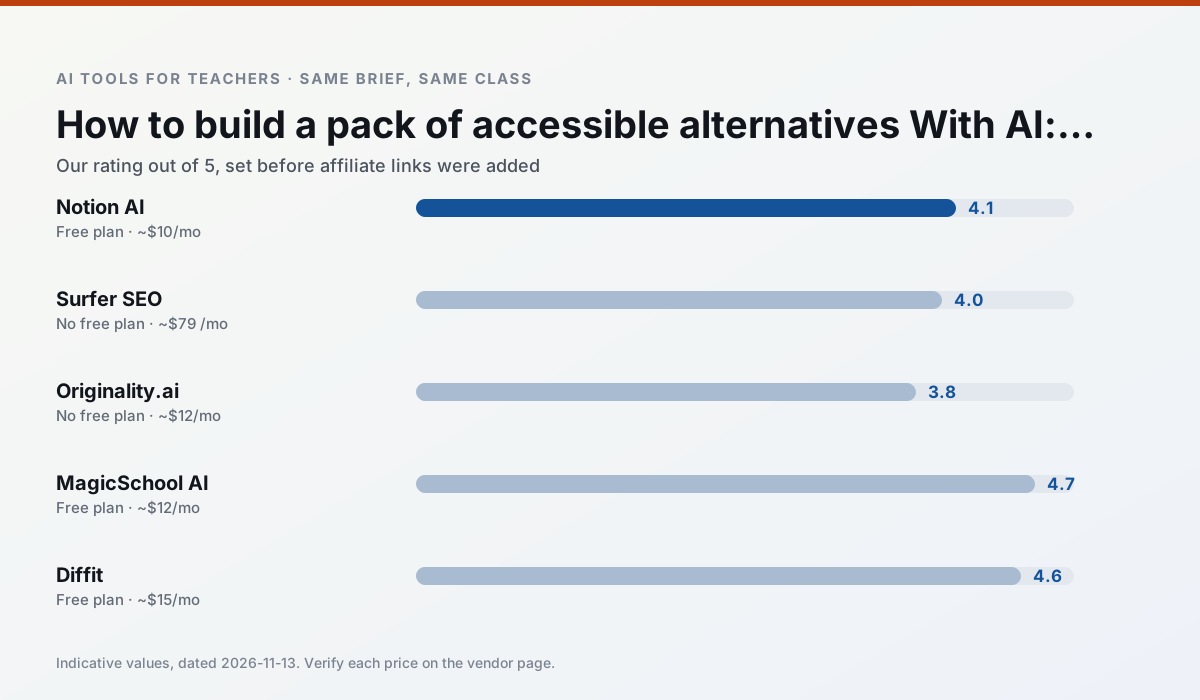
Side by side
Comparison table
Ratings reflect our timed classroom workflow, not vendor claims. Prices are indicative — verify on the vendor site.
| Tool | Best for | Free tier | Indicative paid plan | Standout feature | Our rating | Verdict | Try the tool |
|---|---|---|---|---|---|---|---|
| Notion AI | curriculum mapping · unit planning | Yes — Limited AI usage | ~$10 /user/mo | Linked databases | 4.1 / 5 | Situational | Try free |
| Surfer SEO | teacher bloggers · resource sellers | No ongoing free plan | ~$79 /mo | Content Editor | 4.0 / 5 | Situational | Try free |
| Originality.ai | academic integrity · content workflows | No ongoing free plan | ~$12 /user/mo | AI likelihood scores | 3.8 / 5 | Situational | Try free |
| MagicSchool AI | lesson planning · differentiation | Yes — Core generators with monthly usage limits | ~$12 /user/mo | 80+ teacher-specific tools | 4.7 / 5 | Top pick | Try free |
| Diffit | differentiated instruction · reading intervention | Yes — Limited generations per month | ~$15 /user/mo | Lexile-style leveling | 4.6 / 5 | Top pick | Try free |
| Eduaide.Ai | lesson planning · rubric creation | Yes — Daily generation cap | ~$10 /user/mo | Resource library | 4.3 / 5 | Strong option | Try free |
Match your situation
Best for X
Different jobs need different tools. Here is what we would open first in each case.
Notion AI keeps the same task across levels, which is what makes a differentiated set defensible in moderation.
Surfer SEO has the strongest tone control for family emails and report comments, provided you still read the message aloud before sending.
For anything students touch directly, Originality.ai offers the supervision controls and logging that IT will ask about first.
MagicSchool AI is the one we would open on a normal planning day because the first output is editable rather than restructurable, and the free plan covers a single teacher's routine.
Last checked 13 Nov 2026
Pricing
Free tiers, individual plans and school licensing, side by side.
| Tool | Free plan | Individual / paid | School & district | Billing note | Verify |
|---|---|---|---|---|---|
| Notion AI | $0 — Limited AI usage | ~$10 /user/mo | ~$8 /user/mo | Indicative — verify on vendor site | Vendor |
| Surfer SEO | No ongoing free tier | ~$79 /mo | Custom quote | Indicative — verify on vendor site | Vendor |
| Originality.ai | No ongoing free tier | ~$12 /user/mo | Custom quote | Indicative — verify on vendor site | Vendor |
| MagicSchool AI | $0 — Core generators with monthly usage limits | ~$12 /user/mo | Custom quote | Indicative — verify on vendor site | Vendor |
| Diffit | $0 — Limited generations per month | ~$15 /user/mo | Custom quote | Indicative — verify on vendor site | Vendor |
| Eduaide.Ai | $0 — Daily generation cap | ~$10 /user/mo | Custom quote | Indicative — verify on vendor site | Vendor |
Editorial rule: pricing is re-checked every 2–3 months and the top 50 pages are refreshed every 6 months. See our funding policy.
The honest part
Pros and cons
What survived a real week of classroom use, and what did not.
Pros
- Great for long-term curriculum records
- Strong team collaboration
- Flexible structure
Cons
- Setup time is significant
- AI add-on pricing changed more than once
- Not purpose-built for lesson generation
Pros
- Best-in-class on-page guidance
- Useful for TpT / resource-shop content
- Clear scoring
Cons
- Expensive for individual teachers
- Not a classroom tool
- Requires SEO basics
Pros
- Useful for content publishing QA
- Fast bulk scanning
- Transparent credit model
Cons
- AI detection produces false positives
- Should never be sole evidence of misconduct
- Not a teaching tool
Pros
- Widest purpose-built template library
- Strong free tier for individual teachers
- Fast to learn with almost no prompting skill
Cons
- Outputs still need standards review
- Best features sit behind the paid tier
- District approval can be slow
Pros
- Excellent for mixed-ability classes
- Produces printable and digital versions
- Minimal setup
Cons
- Narrower scope than all-in-one suites
- Leveling is approximate, not a formal assessment
- Heavy use burns through the free quota
In the classroom
Use cases
Five concrete workflows, with the tool we would open for each one.
A weekly family newsletter from bullet notes
Newsletters fail on length, not tone. Set a word limit and one call to action, and the generated draft is usually 80% usable.
Recommended: Notion AIRegrouping students after an assessment
Summarise anonymised results into skill groups, then generate one activity per group. Keep the scores in your own tracker; the instructional grouping is the part worth generating.
Recommended: Surfer SEOA five-minute exit ticket set
Ask for one recall, one application and one reasoning item, then delete the second recall question every generator sneaks in.
Recommended: Originality.aiAn IEP present-levels first draft
Use aggregated, anonymised data only. Ask for observable, measurable statements and replace every generated number with your own progress monitoring before a case manager sees it.
Recommended: MagicSchool AIA substitute folder that needs no context
The value here is structure, not creativity. Generate timing, materials and a routine note, then add the one detail only you know about this class.
Recommended: Diffit
Questions teachers ask us
FAQ
Direct answers, also published as FAQPage structured data for search and AI assistants.
How long does this workflow take?
Which tool should I start with?
What if the output is unusable?
Sources & further reading
Our recommendation
Try Notion AI free for your next accommodations task
AI-assisted notes, databases and curriculum planning in one workspace. Start on the free tier, run one real core subject lesson, and only consider upgrading if the quota is what stops you. Disclosure: we may earn a commission (varies) at no extra cost to you.
Some links on this page are affiliate links. We may earn a commission at no extra cost to you. Our rankings are editorial and never pay-to-play. Never enter student PII into a free consumer account.
Keep reading
Related comparisons in this cluster.
Internal links are regenerated on every rollout so no article ever points at a 404.