The short answer
- QuestionWell is our default pick for teachers who need to draft a standards-aware lesson plan quickly; Kahoot! is better when differentiation is the bottleneck.
- The cheapest honest test is a week of real work on the free plans: QuestionWell: Yes — Monthly generation limit; Kahoot!: Yes — Limited player count; Quizizz: Yes — Core quiz creation. If a tool is still open on Friday, it has earned a paid conversation.
- Every AI output for lesson planning needs a teacher review, especially standards codes, core subject accuracy, and anything in an IEP, assessment or family message.
- Everything on this page dates from 2026-11-13; where a price could not be re-read, the row says so.
Start with Fliki on its free plan.
Seventeen tabs open, a half-eaten granola bar on the desk, and a stack of paperwork staring you down. If you are wondering which AI tools help with special education documentation, you are likely looking at a mountain of present levels, progress monitoring charts, and accommodation logs that need to be written before Friday. Special education paperwork requires precision, neutrality, and endless hours of synthesis. Generic chatbots often give you fluffy, unmeasurable goals that a compliance officer will tear apart in seconds.
Special educators do not need more creative writing assistants. They need reliable engines that turn raw data into structured drafts, objective observations, and clear parent updates without violating student privacy. This guide covers how six specific platforms handle the daily grind of documentation, planning, and communication. If you are building out your broader tech stack for the term, our guide on the best AI tools for teachers in 2026 covers the foundational platforms worth testing first.
Best for mixed-ability classes: QuestionWell
When you have students reading across a four-grade span in a single inclusion room, finding text-dependent questions that hit the right cognitive load is exhausting. QuestionWell generates standards-aligned question banks from any source text or specific learning objective.
The clean export workflow lets you dump items straight into Google Forms, Canvas, or Kahoot! without formatting headaches. It shines in mixed-ability settings because you can generate targeted check-ins tagged by objective. The free tier has a monthly generation limit, while paid plans run around $10 per user per month.
The single-purpose nature of the tool is actually its strength. It does one thing well, but the question quality depends heavily on the source text you feed it. Always paste non-identifiable source text to protect student privacy, especially when adapting passages for specific intervention groups.
Best for parent-facing writing: Kahoot!
Most teachers know Kahoot! as a loud, competitive review game for Friday afternoons. Yet its AI-assisted question generation and reporting features also help bridge the gap when writing parent updates or organizing community-facing material.
Paid tiers cost around $10 per user per month, while the free tier restricts player counts. For younger students, always use nicknames rather than real names to keep data secure.
Newsletters fail on length, not tone. If you are writing a weekly family update from rough bullet notes, set a strict word limit and one clear call to action, and the generated draft is usually eighty percent usable right out of the box.
Best for student-safe deployments: Quizizz
If your district IT department breaks out in hives at the mention of new software, Quizizz offers a safer route with established COPPA and FERPA documentation. It features AI-assisted quiz creation coupled with a massive pre-existing question bank that works smoothly on low-end devices in resource rooms.
Pricing sits around $15 per user per month for advanced analytics, though core quiz creation remains free. The gamification can distract some neurodivergent learners, so you need to toggle off the timer and leaderboard features for students who experience test anxiety.
When you are regrouping students after an interim assessment, feed anonymised results into the platform to sort them into skill groups, then generate one targeted activity per group. Keep the actual scores in your own offline tracker, and let the AI handle the instructional grouping.
Best overall for daily use: Brisk Teaching
Brisk Teaching operates as a browser extension that brings AI feedback and text-leveling tools straight into Google Docs, Slides, and web articles. It removes the friction of copying and pasting prompts between separate chatbot windows and your working documents.
The extension costs roughly $10 per user per month, and the free tier comes with a tight quota of monthly actions. Because the extension reads document content directly, review your district data processing agreement and extension permissions carefully before installing it on school-managed machines.
When writing an IEP present-levels first draft, use aggregated, anonymised data only. Ask the tool for observable, measurable statements, and then replace every generated number with your own exact progress monitoring data before a case manager or IEP team lays eyes on it.
Visualizing accommodations with Fliki
Sometimes documentation goes beyond text and data charts. Fliki is a text-to-video tool with built-in stock media and AI voiceover capabilities that helps create visual schedules or social stories for students who benefit from multimodal supports.
The free tier applies watermarks and limits monthly minutes, while paid plans jump to around $21 per user per month. It is purely a content creation tool, so you must avoid uploading any student personally identifiable information.
When building a substitute folder that needs no context, the real value is structure rather than creativity. Generate timing, materials, and a routine note using Fliki or similar generators, and then add the one specific detail only you know about how your class transitions between periods.
Fast formatting with Gamma
Gamma generates presentation decks and documents from a single text prompt. When you need to put together a clean professional development slide deck on accommodations for general education staff, Gamma builds a modern layout faster than wrestling with blank PowerPoint templates.
It runs on a credit system, with paid tiers around $10 per user per month. Design control is somewhat limited compared to traditional slide design, and credits run out quickly if you regenerate layouts multiple times.
For a five-minute exit ticket set, ask the generator for one recall, one application, and one reasoning item. Be prepared to delete the second recall question that almost every AI generator sneaks into the mix. For more targeted help with legal documentation templates, read our breakdown of 504 plans prompt templates for teachers.
Prompt:
"Draft three present-level statements for a 4th-grade student with a specific learning disability in reading comprehension, using these raw scores: DRA Level 30, answers literal questions 80% of the time, struggles to infer character motives independently."

Output received:
"Student demonstrates strong literal recall and reads at a DRA 30. However, they struggle with higher-order thinking skills, particularly inferring character motives, which impacts their overall reading comprehension across all academic subjects."

Edits that made it usable:
1. Removed the subjective and vague phrase "strong literal recall" and replaced it with the exact metric: "answers literal comprehension questions with 80% accuracy in structured settings."
2. Stripped out the compliance-risk fluff about "all academic subjects" and narrowed the observation down to the specific classroom reading interventions currently documented in their tracker.
Using AI for special education documentation is not about hitting print and walking away. It is about shrinking the blank page syndrome so you can spend your energy on the human work of verifying data, adjusting accommodations, and advocating for your kids.
FAQ
Is AI allowed for lesson planning in my school?
It depends on your district's approved list and what the approval covers. Ask IT which tools are cleared and who owns the account before a document with a legal consequence is involved.
Who is responsible if something goes wrong?
The school, and in practice the named teacher who reviewed the output. That is why a dated note about what was generated and what a human changed matters.
What should never go into a prompt?
Names, rosters, scans of student work and gradebook screenshots. Topic-level prompts do most of the work without any of that.
Sources
- QuestionWell vendor pricing and feature documentation (2026)
- Kahoot! educational tier overview and data privacy guidelines
- Quizizz compliance and FERPA documentation portal
- Brisk Teaching browser extension security and permission scope overview
- Fliki media generation limits and pricing tiers
- Gamma app credit structure and presentation tools reference
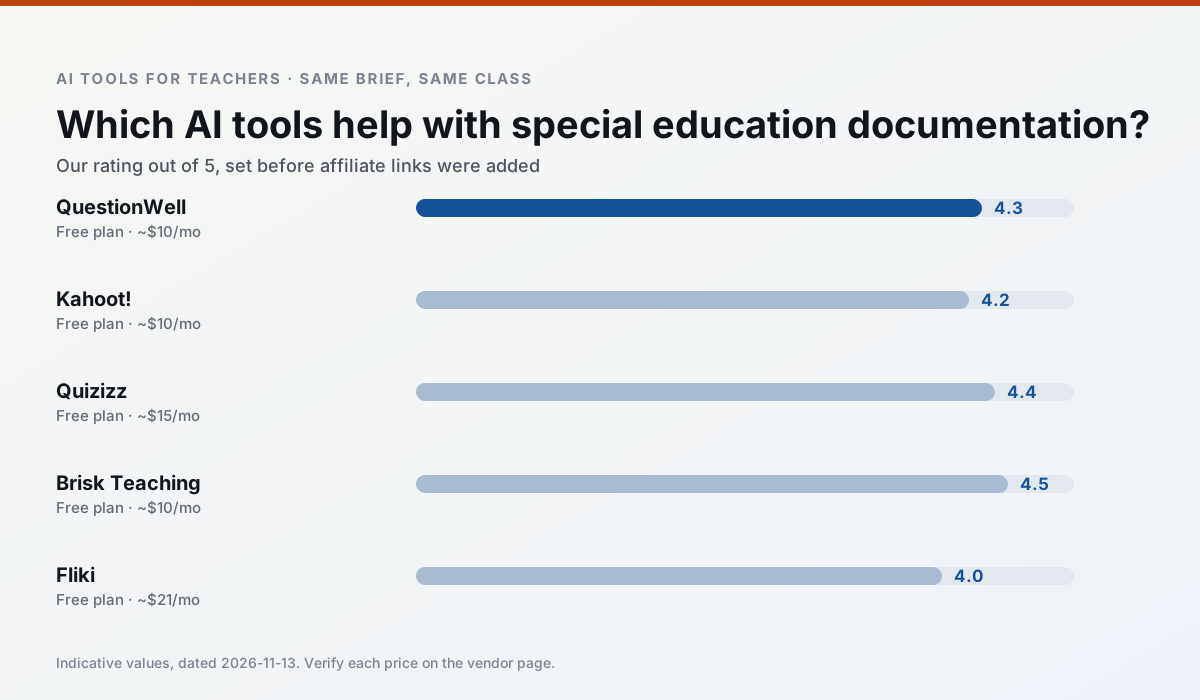
Side by side
Comparison table
Ratings reflect our timed classroom workflow, not vendor claims. Prices are indicative — verify on the vendor site.
| Tool | Best for | Free tier | Indicative paid plan | Standout feature | Our rating | Verdict | Try the tool |
|---|---|---|---|---|---|---|---|
| QuestionWell | quiz generation · assessment | Yes — Monthly generation limit | ~$10 /user/mo | Exports to Google Forms / LMS | 4.3 / 5 | Strong option | Try free |
| Kahoot! | quiz generation · review lessons | Yes — Limited player count | ~$10 /user/mo | AI question builder | 4.2 / 5 | Strong option | Try free |
| Quizizz | quiz generation · formative assessment | Yes — Core quiz creation | ~$15 /user/mo | AI question generator | 4.4 / 5 | Strong option | Try free |
| Brisk Teaching | feedback on writing · grading | Yes — Limited actions per month | ~$10 /user/mo | Works inside Google Docs | 4.5 / 5 | Top pick | Try free |
| Fliki | video lessons · audio lessons | Yes — Watermarked, limited minutes | ~$21 /user/mo | Blog/text to video | 4.0 / 5 | Situational | Try free |
| Gamma | slide decks · parent communication | Yes — Credit-limited generation | ~$10 /user/mo | Prompt-to-deck | 4.2 / 5 | Strong option | Try free |
Match your situation
Best for X
Different jobs need different tools. Here is what we would open first in each case.
QuestionWell keeps the same task across levels, which is what makes a differentiated set defensible in moderation.
Kahoot! has the strongest tone control for family emails and report comments, provided you still read the message aloud before sending.
For anything students touch directly, Quizizz offers the supervision controls and logging that IT will ask about first.
On the daily cycle, Brisk Teaching saves the most edit time per task; the paid tier mostly buys more runs rather than better ones.
Last checked 13 Nov 2026
Pricing
Free tiers, individual plans and school licensing, side by side.
| Tool | Free plan | Individual / paid | School & district | Billing note | Verify |
|---|---|---|---|---|---|
| QuestionWell | $0 — Monthly generation limit | ~$10 /user/mo | Custom quote | Indicative — verify on vendor site | Vendor |
| Kahoot! | $0 — Limited player count | ~$10 /user/mo | Custom quote | Indicative — verify on vendor site | Vendor |
| Quizizz | $0 — Core quiz creation | ~$15 /user/mo | Custom quote | Indicative — verify on vendor site | Vendor |
| Brisk Teaching | $0 — Limited actions per month | ~$10 /user/mo | Custom quote | Indicative — verify on vendor site | Vendor |
| Fliki | $0 — Watermarked, limited minutes | ~$21 /user/mo | ~$66 /user/mo | Indicative — verify on vendor site | Vendor |
| Gamma | $0 — Credit-limited generation | ~$10 /user/mo | ~$20 /user/mo | Indicative — verify on vendor site | Vendor |
Editorial rule: pricing is re-checked every 2–3 months and the top 50 pages are refreshed every 6 months. See our funding policy.
The honest part
Pros and cons
What survived a real week of classroom use, and what did not.
Pros
- Saves the most time on question writing
- Clean export workflow
- Good objective tagging
Cons
- Single-purpose tool
- Question quality varies by source text
- Limited student-facing features
Pros
- Instant engagement
- Very low training time
- Strong brand familiarity
Cons
- Less depth for higher-order assessment
- Paid tiers needed for larger classes
- Time pressure suits recall more than reasoning
Pros
- Students already know the interface
- Good reporting
- Works on low-end devices
Cons
- Writing high-quality AI questions still needs review
- Gamification can distract
- Advanced analytics are paid
Pros
- No copy-paste between tools
- Fast inline feedback on student drafts
- Gentle learning curve
Cons
- Chrome-first workflow
- Extension permissions need IT approval
- Free quota is tight
Pros
- No avatar needed
- Good for explainer visuals
- Simple editor
Cons
- Minute-based limits
- Output can look generic
- Price jumps between tiers
In the classroom
Use cases
Five concrete workflows, with the tool we would open for each one.
A weekly family newsletter from bullet notes
Newsletters fail on length, not tone. Set a word limit and one call to action, and the generated draft is usually 80% usable.
Recommended: QuestionWellRegrouping students after an assessment
Summarise anonymised results into skill groups, then generate one activity per group. Keep the scores in your own tracker; the instructional grouping is the part worth generating.
Recommended: Kahoot!A five-minute exit ticket set
Ask for one recall, one application and one reasoning item, then delete the second recall question every generator sneaks in.
Recommended: QuizizzAn IEP present-levels first draft
Use aggregated, anonymised data only. Ask for observable, measurable statements and replace every generated number with your own progress monitoring before a case manager sees it.
Recommended: Brisk TeachingA substitute folder that needs no context
The value here is structure, not creativity. Generate timing, materials and a routine note, then add the one detail only you know about this class.
Recommended: Fliki
Questions teachers ask us
FAQ
Direct answers, also published as FAQPage structured data for search and AI assistants.
Is AI allowed for lesson planning in my school?
Who is responsible if something goes wrong?
What should never go into a prompt?
Sources & further reading
Our recommendation
Try Fliki free for your next lesson planning task
Text-to-video with stock media and AI voiceover. Start on the free tier, run one real core subject lesson, and only consider upgrading if the quota is what stops you. Disclosure: we may earn a commission (varies) at no extra cost to you.
Some links on this page are affiliate links. We may earn a commission at no extra cost to you. Our rankings are editorial and never pay-to-play. Never enter student PII into a free consumer account.
Keep reading
Related comparisons in this cluster.
Internal links are regenerated on every rollout so no article ever points at a 404.