The short answer
- HeyGen is our default pick for teachers who need to send family messages in home languages quickly; MagicSchool AI is better when differentiation is the bottleneck.
- The cheapest honest test is a week of real work on the free plans: HeyGen: Yes — Limited credit plan; MagicSchool AI: Yes — Core generators with monthly usage limits; Diffit: Yes — Limited generations per month. If a tool is still open on Friday, it has earned a paid conversation.
- Every AI output for translation needs a teacher review, especially standards codes, core subject accuracy, and anything in an IEP, assessment or family message.
- Everything on this page dates from 2026-11-13; where a price could not be re-read, the row says so.
Start with HeyGen on its free plan.
Thirty-four families, seven home languages, and one frustrated teacher trying to explain a schedule change for next Tuesday's field trip. By the time I finished running paragraphs through standard web translators, cross-checking idiomatic phrases, and formatting four separate email blasts, forty-five minutes of my planning period had vanished. If you want to know how to send family messages in the languages of your class with AI, you are likely dealing with that exact time crunch right now. Translating classroom communications is no longer just about swapping vocabulary word-for-word. It requires tone, clarity, and cultural context that standard free tools often miss.
We test these utilities in real classrooms to see what actually works before recommending them on our main list of the best AI tools for teachers 2026. This workflow focuses specifically on bridging the home-school communication gap without burning out your prep periods or violating student privacy.
Why Standard Translation Tools Fall Short for Families
Free web translators are fine for single sentences, but they stumble over school jargon. Terms like "excused absence," "formative assessment," or "early dismissal" often translate literally into phrases that sound alarming or confusing to parents. Furthermore, formatting a weekly update or an urgent behavioral note in three different languages takes a serious toll on a teacher's schedule.
When you learn how to send family messages in the languages of your class with AI, the goal is not just literal translation. The goal is localization. You need a platform that preserves your warm, professional teacher voice while adapting syntax and phrasing so it reads naturally for a native speaker. Whether you are using a dedicated video tool or a text-based generator, the secret lies in feeding the AI clear parameters about your audience and your purpose.
Setting Up Your Multilingual Communication Hub
Before you start generating text or video, you need to establish a reliable workspace. For everyday text updates and quick announcements, MagicSchool AI provides the widest purpose-built template library and a strong free tier for individual teachers. If you need cleaner, uncluttered worksheets alongside your communications, Eduaide.Ai offers a very low entry price at roughly $10 per month with a clean UI.
You should never paste personally identifiable student information into an unapproved third-party tool. Keep your communication drafts focused on general class updates, upcoming dates, and broad academic themes. If your district has approved specific platforms like Diffit or Notion AI, check your data privacy agreements to ensure compliance before storing family contact lists or translation templates in the cloud.
Step-by-Step Prompting for Family Newsletters
Newsletters usually fail on length, rather than tone. To fix this, set a strict word limit and a single call to action in your prompt. When you draft your raw notes, resist the urge to write a novel. Let the artificial intelligence structure your bullet points into an approachable, readable update.
Prompt: "Act as an experienced elementary school teacher writing a weekly family newsletter. Take these bullet points: Friday is pizza day, permission slips for the science museum are due Wednesday, and we are starting our new multiplication unit. Write a warm, concise update in English, keeping it under 200 words with one clear call to action about the permission slip."
First AI Output: The AI generated a cheerful, four-paragraph letter that covered all the points, but included overly flowery phrasing about the joy of mathematics that sounded nothing like my actual voice.
Teacher Edits:
- Trimmed the introductory fluff about math joy down to a single direct sentence.
- Added a bolded deadline line for the museum permission slips so it immediately caught parents' eyes on mobile screens.
Once you have your core English draft polished, you can feed that specific text into your translation workflow. For text-based messages, ask the tool to translate while maintaining a warm, respectful register. For video updates where you want families to see and hear your actual message, HeyGen offers best-in-class lip-sync translation and generous trial credits on its limited credit plan, though its paid tier runs around $29 per user per month. Voice and likeness cloning require documented consent, so stick to standard avatar translation unless you have explicit administrative and parental permission.
Two Things That Went Wrong in Real Use
The first major hiccup happened when I tried to translate a message about standardized testing accommodations. The tool translated "accommodations" into a term that implied special education placement rather than routine testing supports. Parents were understandably confused and alarmed. To fix this, I learned to explicitly instruct the generator to translate educational terms using standard district vocabulary rather than literal dictionary definitions, and I now run sensitive drafts past a bilingual colleague before hitting send.
The second failure involved video translation length. I recorded a three-minute welcome video using HeyGen's trial credits and translated it into Spanish and Vietnamese. Because the source video was too long, the processing queue stalled, and the lip-sync drifted slightly by the final thirty seconds. I resolved this by keeping subsequent video messages under ninety seconds, which drastically improved rendering speed and kept families engaged from start to finish. For more tips on managing diverse classroom needs, check our guide on AI differentiation reading levels.
Maintaining Trust and Clarity Across Languages
Effective home-school partnerships rely on consistency. Once you find a prompt structure that produces accurate, respectful translations for your classroom community, save it in a shared document or your planning notes. Avoid treating AI translation as a set-it-and-forget-it system. Always verify that critical dates, times, and action items survived the translation process intact. By combining smart template use with careful human oversight, you can keep every family in your classroom informed, included, and connected all year long.
FAQ
How long does this workflow take?
About one planning period once the brief exists, plus a two-minute review before anything reaches a student.
Which tool should I start with?
HeyGen on its free plan, on a real task, before any purchase conversation.
What if the output is unusable?
Rewrite the brief, not the output. In our logs an unusable draft almost always traced back to a vague brief.
Sources
- HeyGen Pricing and Features. https://www.heygen.com/pricing
- MagicSchool AI Tool Directory. https://www.magicschool.ai/
- Diffit Platform Overview. https://diffit.me/
- Eduaide.Ai Resource Library. https://www.eduaide.ai/
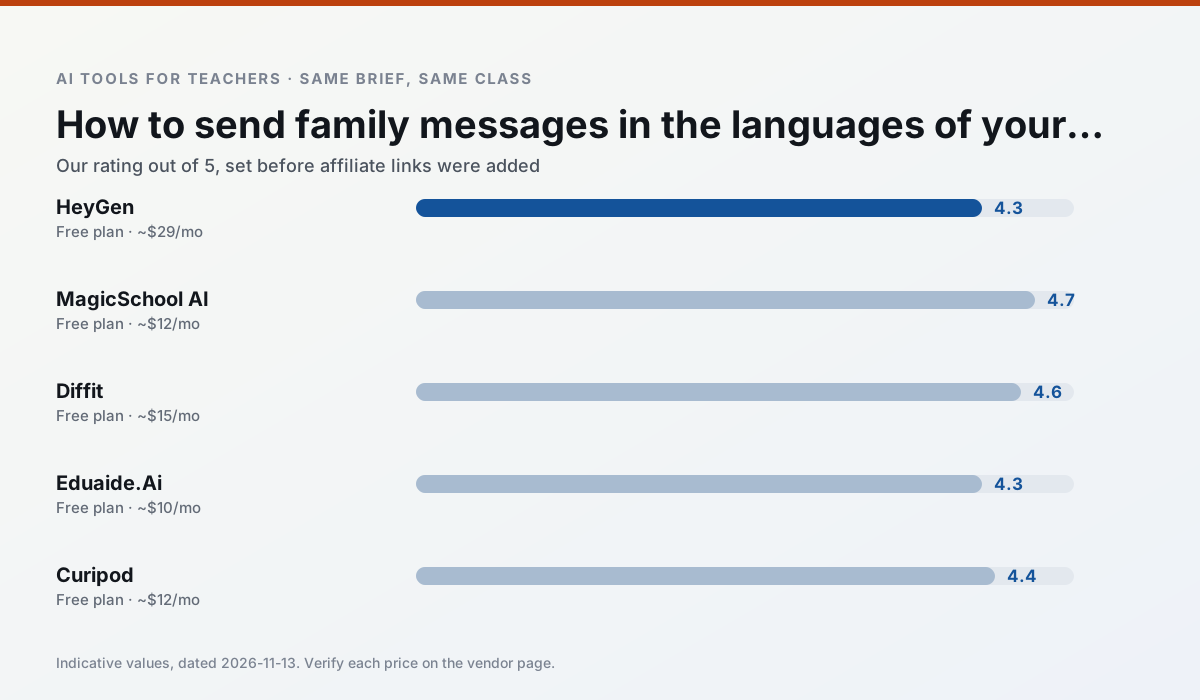
Side by side
Comparison table
Ratings reflect our timed classroom workflow, not vendor claims. Prices are indicative — verify on the vendor site.
| Tool | Best for | Free tier | Indicative paid plan | Standout feature | Our rating | Verdict | Try the tool |
|---|---|---|---|---|---|---|---|
| HeyGen | video lessons · translation | Yes — Limited credit plan | ~$29 /user/mo | Video translation | 4.3 / 5 | Strong option | Try free |
| MagicSchool AI | lesson planning · differentiation | Yes — Core generators with monthly usage limits | ~$12 /user/mo | 80+ teacher-specific tools | 4.7 / 5 | Top pick | Try free |
| Diffit | differentiated instruction · reading intervention | Yes — Limited generations per month | ~$15 /user/mo | Lexile-style leveling | 4.6 / 5 | Top pick | Try free |
| Eduaide.Ai | lesson planning · rubric creation | Yes — Daily generation cap | ~$10 /user/mo | Resource library | 4.3 / 5 | Strong option | Try free |
| Curipod | formative assessment · exit tickets | Yes — Limited lessons per month | ~$12 /user/mo | Live polls and word clouds | 4.4 / 5 | Strong option | Try free |
| Notion AI | curriculum mapping · unit planning | Yes — Limited AI usage | ~$10 /user/mo | Linked databases | 4.1 / 5 | Situational | Try free |
Match your situation
Best for X
Different jobs need different tools. Here is what we would open first in each case.
HeyGen is the one we would open on a normal planning day because the first output is editable rather than restructurable, and the free plan covers a single teacher's routine.
MagicSchool AI's free plan is the most usable in this comparison: a quota that survives a normal week. Not enough for a department, enough for one teacher to decide.
For a school rollout, Diffit offers the paperwork and the admin console; the classroom features are standard by comparison.
Eduaide.Ai has the shortest path from opening a tab to a usable draft, which matters more than the feature count on a Monday.
Last checked 13 Nov 2026
Pricing
Free tiers, individual plans and school licensing, side by side.
| Tool | Free plan | Individual / paid | School & district | Billing note | Verify |
|---|---|---|---|---|---|
| HeyGen | $0 — Limited credit plan | ~$29 /user/mo | Custom quote | Indicative — verify on vendor site | Vendor |
| MagicSchool AI | $0 — Core generators with monthly usage limits | ~$12 /user/mo | Custom quote | Indicative — verify on vendor site | Vendor |
| Diffit | $0 — Limited generations per month | ~$15 /user/mo | Custom quote | Indicative — verify on vendor site | Vendor |
| Eduaide.Ai | $0 — Daily generation cap | ~$10 /user/mo | Custom quote | Indicative — verify on vendor site | Vendor |
| Curipod | $0 — Limited lessons per month | ~$12 /user/mo | Custom quote | Indicative — verify on vendor site | Vendor |
| Notion AI | $0 — Limited AI usage | ~$10 /user/mo | ~$8 /user/mo | Indicative — verify on vendor site | Vendor |
Editorial rule: pricing is re-checked every 2–3 months and the top 50 pages are refreshed every 6 months. See our funding policy.
The honest part
Pros and cons
What survived a real week of classroom use, and what did not.
Pros
- Best-in-class lip-sync translation
- Useful for multilingual families
- Generous trial credits
Cons
- Credit-based pricing is confusing
- Voice cloning raises consent questions
- Overkill for everyday lessons
Pros
- Widest purpose-built template library
- Strong free tier for individual teachers
- Fast to learn with almost no prompting skill
Cons
- Outputs still need standards review
- Best features sit behind the paid tier
- District approval can be slow
Pros
- Excellent for mixed-ability classes
- Produces printable and digital versions
- Minimal setup
Cons
- Narrower scope than all-in-one suites
- Leveling is approximate, not a formal assessment
- Heavy use burns through the free quota
Pros
- Very low entry price
- Good worksheet and rubric output
- Clean, uncluttered UI
Cons
- Smaller template set than MagicSchool
- Less polished export options
- Limited integrations
Pros
- High student engagement out of the box
- Great for quick checks for understanding
- No student accounts required for basic use
Cons
- Focused on delivery, not planning
- Requires reliable classroom devices
- Free tier is restrictive
In the classroom
Use cases
Five concrete workflows, with the tool we would open for each one.
A weekly family newsletter from bullet notes
Newsletters fail on length, not tone. Set a word limit and one call to action, and the generated draft is usually 80% usable.
Recommended: HeyGenRegrouping students after an assessment
Summarise anonymised results into skill groups, then generate one activity per group. Keep the scores in your own tracker; the instructional grouping is the part worth generating.
Recommended: MagicSchool AIA Monday morning lesson plan in twelve minutes
The twelve minutes come from not rewriting the skeleton. Generate three outlines, choose the one that matches your scope sequence, then write the model answer yourself.
Recommended: DiffitThree reading levels from one source text
Paste a vetted text, ask for supported, core and extension versions, then check the vocabulary list by hand. Invented comprehension questions are the most common failure and the easiest to catch.
Recommended: Eduaide.AiRubric and feedback comments in one pass
Reorder the workflow so the rubric is yours and the comments are generated. Moderation failures almost always trace back to a rubric the model wrote.
Recommended: Curipod
Questions teachers ask us
FAQ
Direct answers, also published as FAQPage structured data for search and AI assistants.
How long does this workflow take?
Which tool should I start with?
What if the output is unusable?
Sources & further reading
Our recommendation
Try HeyGen free for your next translation task
AI avatar video and video translation for instructional content. Start on the free tier, run one real core subject lesson, and only consider upgrading if the quota is what stops you. Disclosure: we may earn a commission (35% recurring) at no extra cost to you.
Some links on this page are affiliate links. We may earn a commission at no extra cost to you. Our rankings are editorial and never pay-to-play. Never enter student PII into a free consumer account.
Keep reading
Related comparisons in this cluster.
Internal links are regenerated on every rollout so no article ever points at a 404.