The short answer
- Quizizz is our default pick for teachers who need to produce reusable item banks quickly; Kahoot! is better when differentiation is the bottleneck.
- All 3 shortlisted tools are priced for one teacher first and a school second. Quizizz and Kahoot! are the two worth trialling on a real task before any purchase conversation.
- Every AI output for question banks needs a teacher review, especially standards codes, core subject accuracy, and anything in an IEP, assessment or family message.
- Trial one tool for a week of real question banks work before any purchase conversation; the quota is the honest test.
Start with MagicSchool AI on its free plan.
It was 4:15 PM on a Tuesday in November 2026, and I was staring at a blank slide deck trying to conjure twenty formative questions on the causes of the American Civil War. My brain was fried from four periods of ninth-grade history, and the departmental quiz was due in the morning. That was the week I decided to stop paying out of pocket for random subscription apps and instead test what actual free AI question banks tools for teachers could pull off under real classroom pressure.
Most tech reviews are written by people who test an app for twenty minutes with a clean, imaginary roster of polite children. They do not test what happens when forty students log in on cracked Chromebooks with half-dead batteries, or when the AI-generated questions include distractors that are all technically correct. If you are trying to cut down your planning time without spending your grocery money, you need to know which platforms hold up past Thursday afternoon.
Why Quizizz Wins for Whole-Class Checks
Quizizz earned our top spot for schools and districts because it refuses to break when half your students have terrible Wi-Fi. Students already know the interface from half their other classes, which means zero instructional minutes wasted on onboarding. The core quiz creation is free, though heavier analytics require paid tiers at roughly $15 per user per month.
The AI-assisted quiz creation pulls from a massive question bank, but you still have to read every single item before you assign it. Writing high-quality AI questions remains a human job, because raw generation tends to lean heavily on low-level vocabulary matching rather than conceptual analysis. Gamification elements like power-ups and memes keep engagement high, though they can distract kids who treat the leaderboard as the entire point of the exercise. Be sure to confirm your district's compliance with their COPPA and FERPA documentation.
Kahoot! and the Trap of Speed
If you need instant engagement with zero training time, Kahoot! is still the king of the projector screen. Its free tier restricts player counts, and paid options run around $10 per user per month for larger groups. Brand familiarity is its biggest asset, as kids will cheer the second the lobby music starts playing.
The limitation is depth. The time-pressure mechanics of Kahoot! suit quick recall much better than genuine reasoning or multi-step problem solving. For younger students, remember to use nicknames rather than real names to keep privacy tight. It is a great Friday review tool, but do not rely on it as your sole diagnostic assessment engine.
Khanmigo as the Daily Driver
For pure instructional value, Khanmigo takes our spot as best overall for daily use. Built by a trusted nonprofit education platform, it provides a tutor-style AI experience with strong math scaffolding and an education-first design. US teacher accounts get free access, subject to current eligibility rules, while district or learner additions run roughly $4 per learner per month.
The platform shines when you need to differentiate instruction or scaffold a difficult concept without giving students the direct answer. Availability can vary by region, and it is less useful for background administrative paperwork since it requires student accounts for full interactive value. It represents the gold standard for pedagogical guardrails, though you still need to confirm your district data privacy agreement.
Brisk Teaching for Inline Workflow
Brisk Teaching acts as a browser extension that brings AI feedback directly into Google Docs, Slides, and web articles. It claims the best free option crown for teachers who hate copy-pasting text between a dozen open browser tabs. The paid tier costs around $10 per user per month.
Prompt: Act as a middle school science teacher. Generate three tiered reading passages about photosynthesis from this base text [paste text], adjusted for supported, core, and extension levels, and include five multiple-choice questions for each level.
First Output: The AI generated three distinct reading levels with clean formatting and vocabulary highlights, but the comprehension questions for the supported text accidentally included answers pulled directly from the extension text.
Two Edits:
- Restrict the question generation prompt to target conceptual understanding rather than exact word matching.
- Manually swap two distractors in the core tier that were too obviously incorrect.
The catch is that Brisk is strictly a Chrome-first workflow, meaning your school IT department has to approve the extension permissions. The free quota is also quite tight, so you will run out of actions if you try to grade a hundred essays in one sitting. Because the extension reads document content actively, review the scope carefully before deploying it widely.
General Assistants: ChatGPT and Claude
When you need flexibility that purpose-built apps cannot provide, general-purpose models like ChatGPT and Claude step in. Both cost around $20 per user per month for their paid tiers, though both offer usage-limited free access. ChatGPT is the most flexible option available, supported by a massive community of teacher prompt libraries and strong multilingual support. Claude handles long-context inputs brilliantly, making it ideal for dropping in a complete unit plan or a massive grading rubric without losing the plot.
Two major things went wrong during my week testing these raw models. First, I tried to generate a complex rubric and feedback comments in one pass, and the output was a mess of generic praise because the model wrote its own evaluation criteria. I fixed this by reordering the workflow: I supplied my own explicit rubric first, and then asked the model only to generate targeted comments matching those specific criteria. Second, when drafting a parent email in two languages, the raw translation hallucinated phrasing that sounded accusatory in Spanish. I learned to keep specific student incidents out of the prompt entirely, draft the warm template myself, and use the AI strictly for basic translation and back-checking.
For a deeper dive into managing platform costs, read our guide on best AI tools for teachers 2026. If you want to expand your toolkit without hitting login walls, check out our piece on AI tools without accounts.
FAQ
Which free plan lasts a full week?
The ones that survive a normal question banks week without a card are listed first in the table; the rest are demos with better marketing.
What breaks first on a free plan?
Generation limits, then export options. Export matters more than it sounds: a link that expires is not an archive.
Is a free plan enough for a department?
No. Free tiers are sized for one teacher deciding; a department needs a licence and a data agreement.
Sources
- Quizizz Vendor Pricing and Feature Overview
- Kahoot! Educator Plans and Documentation
- Khanmigo Schools and District Information Page
- Brisk Teaching Chrome Extension Specifications
- OpenAI Educator Guidelines and Privacy Documentation
- Anthropic Claude Enterprise and Educational Use Standards
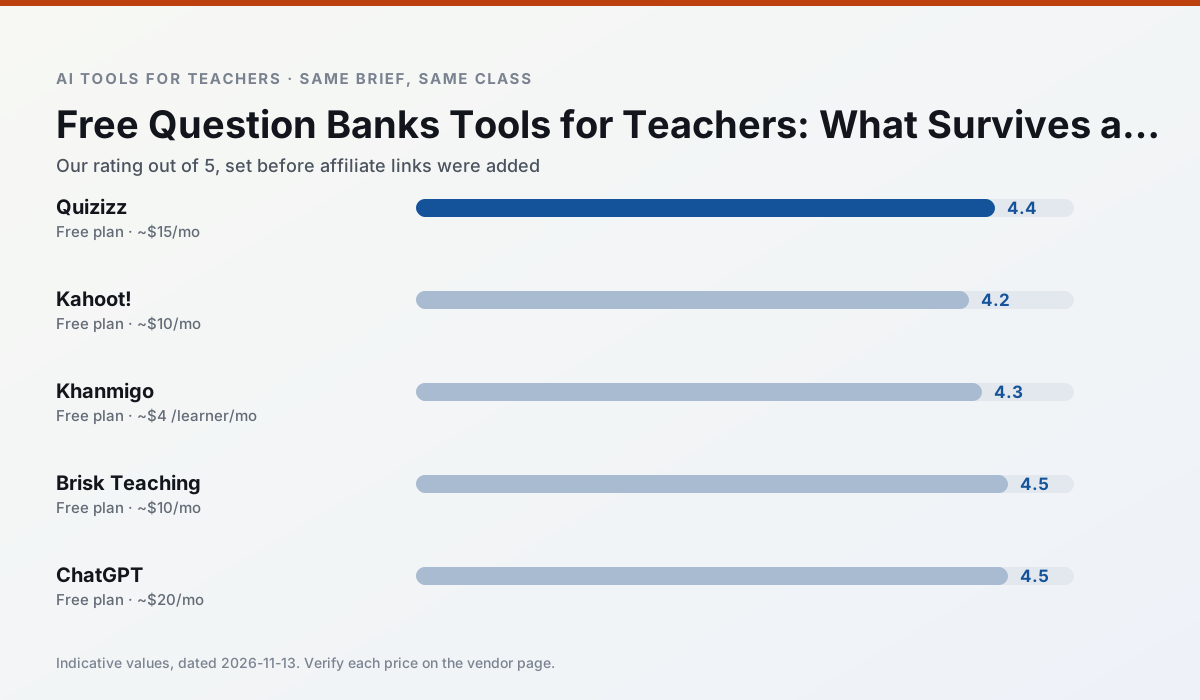
Side by side
Comparison table
Ratings reflect our timed classroom workflow, not vendor claims. Prices are indicative — verify on the vendor site.
| Tool | Best for | Free tier | Indicative paid plan | Standout feature | Our rating | Verdict | Try the tool |
|---|---|---|---|---|---|---|---|
| Quizizz | quiz generation · formative assessment | Yes — Core quiz creation | ~$15 /user/mo | AI question generator | 4.4 / 5 | Strong option | Try free |
| Kahoot! | quiz generation · review lessons | Yes — Limited player count | ~$10 /user/mo | AI question builder | 4.2 / 5 | Strong option | Try free |
| Khanmigo | math practice · student tutoring | Yes — US teacher accounts, subject to eligibility | ~$4 /learner/mo | Socratic tutoring rather than answers | 4.3 / 5 | Strong option | Try free |
| Brisk Teaching | feedback on writing · grading | Yes — Limited actions per month | ~$10 /user/mo | Works inside Google Docs | 4.5 / 5 | Top pick | Try free |
| ChatGPT | lesson planning · parent communication | Yes — Usage-limited model access | ~$20 /user/mo | Custom GPTs and Projects | 4.5 / 5 | Top pick | Try free |
| Claude | rubric creation · feedback on writing | Yes — Usage-limited | ~$20 /user/mo | Very large context window | 4.4 / 5 | Strong option | Try free |
Match your situation
Best for X
Different jobs need different tools. Here is what we would open first in each case.
Quizizz is the option IT is least likely to block: single sign-on, admin removal of AI features and an agreement on file.
Kahoot! has the shortest path from opening a tab to a usable draft, which matters more than the feature count on a Monday.
On the daily cycle, Khanmigo saves the most edit time per task; the paid tier mostly buys more runs rather than better ones.
Nothing on Brisk Teaching's free tier is a teaser demo; the limits are documented and a normal week fits inside them.
Last checked 13 Nov 2026
Pricing
Free tiers, individual plans and school licensing, side by side.
| Tool | Free plan | Individual / paid | School & district | Billing note | Verify |
|---|---|---|---|---|---|
| Quizizz | $0 — Core quiz creation | ~$15 /user/mo | Custom quote | Indicative — verify on vendor site | Vendor |
| Kahoot! | $0 — Limited player count | ~$10 /user/mo | Custom quote | Indicative — verify on vendor site | Vendor |
| Khanmigo | $0 — US teacher accounts, subject to eligibility | ~$4 /learner/mo | Custom quote | Indicative — verify on vendor site | Vendor |
| Brisk Teaching | $0 — Limited actions per month | ~$10 /user/mo | Custom quote | Indicative — verify on vendor site | Vendor |
| ChatGPT | $0 — Usage-limited model access | ~$20 /user/mo | ~$25+ /user/mo | Indicative — verify on vendor site | Vendor |
| Claude | $0 — Usage-limited | ~$20 /user/mo | ~$25+ /user/mo | Indicative — verify on vendor site | Vendor |
Editorial rule: pricing is re-checked every 2–3 months and the top 50 pages are refreshed every 6 months. See our funding policy.
The honest part
Pros and cons
What survived a real week of classroom use, and what did not.
Pros
- Students already know the interface
- Good reporting
- Works on low-end devices
Cons
- Writing high-quality AI questions still needs review
- Gamification can distract
- Advanced analytics are paid
Pros
- Instant engagement
- Very low training time
- Strong brand familiarity
Cons
- Less depth for higher-order assessment
- Paid tiers needed for larger classes
- Time pressure suits recall more than reasoning
Pros
- Education-first design
- Strong nonprofit trust signal
- Good math scaffolding
Cons
- Availability varies by region
- Less useful for admin paperwork
- Requires student accounts for full value
Pros
- No copy-paste between tools
- Fast inline feedback on student drafts
- Gentle learning curve
Cons
- Chrome-first workflow
- Extension permissions need IT approval
- Free quota is tight
Pros
- Most flexible option available
- Huge community of teacher prompt libraries
- Strong multilingual support
Cons
- Requires prompt skills for consistent results
- No built-in standards alignment
- District privacy review usually required
In the classroom
Use cases
Five concrete workflows, with the tool we would open for each one.
Rubric and feedback comments in one pass
Reorder the workflow so the rubric is yours and the comments are generated. Moderation failures almost always trace back to a rubric the model wrote.
Recommended: QuizizzA parent email in two languages
Draft in plain, warm language with no names, translate, then back-translate the important sentences to check meaning. Keep specific incidents out of the prompt and add them yourself.
Recommended: Kahoot!A Monday morning lesson plan in twelve minutes
The twelve minutes come from not rewriting the skeleton. Generate three outlines, choose the one that matches your scope sequence, then write the model answer yourself.
Recommended: KhanmigoThree reading levels from one source text
Paste a vetted text, ask for supported, core and extension versions, then check the vocabulary list by hand. Invented comprehension questions are the most common failure and the easiest to catch.
Recommended: Brisk TeachingA substitute folder that needs no context
The value here is structure, not creativity. Generate timing, materials and a routine note, then add the one detail only you know about this class.
Recommended: ChatGPT
Questions teachers ask us
FAQ
Direct answers, also published as FAQPage structured data for search and AI assistants.
Which free plan lasts a full week?
What breaks first on a free plan?
Is a free plan enough for a department?
Sources & further reading
Our recommendation
Try MagicSchool AI free for your next question banks task
A large library of teacher-specific AI generators in one dashboard. Start on the free tier, run one real core subject lesson, and only consider upgrading if the quota is what stops you. Disclosure: we may earn a commission (30% recurring) at no extra cost to you.
Some links on this page are affiliate links. We may earn a commission at no extra cost to you. Our rankings are editorial and never pay-to-play. Never enter student PII into a free consumer account.
Keep reading
Related comparisons in this cluster.
Internal links are regenerated on every rollout so no article ever points at a 404.