The short answer
- HeyGen is our default pick for teachers who need to draft a standards-aware lesson plan quickly; Synthesia is better when differentiation is the bottleneck.
- The cheapest honest test is a week of real work on the free plans: HeyGen: Yes — Limited credit plan; Synthesia: No ongoing free plan; Gamma: Yes — Credit-limited generation. If a tool is still open on Friday, it has earned a paid conversation.
- Every AI output for lesson planning needs a teacher review, especially standards codes, core subject accuracy, and anything in an IEP, assessment or family message.
- Everything on this page dates from 2026-11-13; where a price could not be re-read, the row says so.
Start with HeyGen on its free plan.
Last term, I copied forty paragraphs of student writing into a browser tab and hit generate. Five minutes later, I realized I had just fed unredacted reflections on school anxiety into a commercial chat tool with my district login. If you are wondering what student data ChatGPT keeps when a teacher asks a question, the short answer is that OpenAI stores your prompts, chats, and uploaded files to train its models unless you actively opt out in your settings, or use an enterprise workspace with privacy guarantees.
That realization sent me down a rabbit hole of data policies, prompting habits, and alternative tools that don't rely on raw chat inputs. When we look at the broader landscape of AI tools we use in our classrooms—from presentation builders like Gamma to video generators like HeyGen and Synthesia—data privacy is rarely as straightforward as a marketing page suggests. Here is how to handle your planning, parent communication, and resource creation without accidentally leaking student PII.
Why your prompt history matters for compliance
Every time you paste a paragraph of student work into a free or standard chat account, that text becomes training data unless you toggle off chat history in your user settings. Even with history turned off, OpenAI retains data for thirty days for abuse monitoring before permanent deletion. If your prompt includes a student's full name, a specific diagnosis from an IEP, or a unique incident report, you have crossed a compliance line.
To stay safe, I run my planning through a strict anonymization filter. If I need help leveling a text or building a rubric, I scrub every name, school identifier, and specific behavioral detail before it touches a model. This connects directly to how we build our wider workflow, which you can read more about in our guide on best AI tools for teachers 2026. Treat every chat prompt as though it will be read by a third party, because functionally, it is.
Prompt: Write a differentiated reading comprehension quiz based on this student paragraph about Sarah Miller in period 3 who struggles with decoding.
What came back: A generic quiz with several factual errors, followed by automated intervention suggestions that named the student and cited her specific reading level.
Edit 1: Removed the student's name, period number, and specific diagnosis, replacing the prompt with a generic grade-level Lexile band.
Edit 2: Stripped out the model's auto-generated comprehension questions, keeping only the vocabulary definitions which were accurate.
Managing video tools and student likenesses
Video generation and translation tools have become popular for reaching multilingual families, but they carry distinct consent hurdles. HeyGen, which we rank as best overall for daily use, offers best-in-class lip-sync translation and generous trial credits for roughly $29 per user per month. However, its voice and likeness cloning features require documented, explicit consent. You cannot clone a student's voice or generate an avatar from a student's photo without written parental permission.
Synthesia operates similarly at around $29 per user per month, turning text scripts into presenter-led videos without requiring a camera or complex editing skills. While it is useful for creating asynchronous review modules or flipping your direct instruction, the same privacy rule applies. Never use student likenesses or student-generated video footage in these platforms without a signed district media release on file. If you are looking for free options, Synthesia does not offer an ongoing free tier, so you have to budget carefully or rely on institutional licenses.
Generating presentations without exposing student records
When building slide decks or handouts, teachers often fall into the trap of uploading entire grade books or student profile documents into presentation generators to "personalize" the output. Gamma is fantastic for this workflow, serving as our top pick for schools and districts at roughly $10 per user per month. It takes a single prompt and generates a modern-looking presentation or document in seconds.
The catch is that Gamma is built as a content creation tool, not a student information system. It does not handle student data securely by default, and its credit system can run out quickly if you are generating heavy slide decks every day. Treat Gamma strictly as an outline generator. Write your curriculum standards and topic headers into the prompt, but leave student rosters, formative scores, and behavioral notes entirely out of the app. For more targeted help on structuring accommodations, check out our piece on 504 plans prompt templates for teachers.
Canva for Education and quick daily templates
Canva for Education remains our favorite tool for quick setup, offering a massive template library and basic AI writing and image features for free once your educator account is verified. The catch is that while the education tier has specific student-data terms, you still need to read them carefully before letting students log in directly.
When I use Canva to whip up an exit ticket set or a parent newsletter, I keep my workflow compartmentalized.
Prompt: Draft a warm parent email explaining that we are starting a new fractions unit next week and asking families to practice basic division facts at home.
What came back: A polite, overly formal letter that sounded like a corporate memo rather than a message from a 5th-grade teacher.
Edit 1: Prompted the model to rewrite the output in a conversational tone with a friendly subject line.
Edit 2: Inserted specific classroom dates and my actual classroom routines by hand, deleting the generic placeholders the AI invented.
Two things went wrong during my first week using AI design and text tools. First, I relied on an AI-generated exit ticket set that snuck in a redundant recall question, which wasted the last three minutes of class. Second, I trusted a generated rubric wholesale, only to realize the criteria did not match our district's actual grading scale. Now, I write the rubric myself and let the AI handle the low-stakes comment phrasing.
Assessment platforms and institutional privacy
When you move past simple text generation and into automated grading and live assessment, consumer tools no longer cut it. Platforms like Gradescope and Formative handle actual student work, scanned assessments, and live formative data. Gradescope offers massive time savings on paper assessments and consistent rubric application, but its institutional pricing is opaque and setup effort is high. Because it handles direct student work, a full DPA and FERPA review is required by your district.
Formative runs around $15 per user per month, providing live formative assessment with auto-grading and standards tracking that feeds directly into intervention groups. It works with existing PDFs and Docs, but the best value requires a school-wide rollout. Before you roster your classes into Formative or Gradescope, verify your district's data processing agreement. Consumer chat tools are easy to test on a whim, but assessment platforms require institutional clearance to ensure student work is never swept into a third-party training pool.
FAQ
Is AI allowed for lesson planning in my school?
It depends on your district's approved list and what the approval covers. Ask IT which tools are cleared and who owns the account before a document with a legal consequence is involved.
Who is responsible if something goes wrong?
The school, and in practice the named teacher who reviewed the output. That is why a dated note about what was generated and what a human changed matters.
What should never go into a prompt?
Names, rosters, scans of student work and gradebook screenshots. Topic-level prompts do most of the work without any of that.
Sources
- OpenAI Privacy Policy and Enterprise Data Governance Documentation
- HeyGen Pricing and Feature Specifications (2026)
- Synthesia Enterprise Security and Compliance Overview
- Gamma Pricing and Account Limits (2026)
- Canva for Education Privacy Terms and Verification Guidelines
- Gradescope FERPA and Security Compliance Documentation
- Formative District Data Processing Agreements (2026)
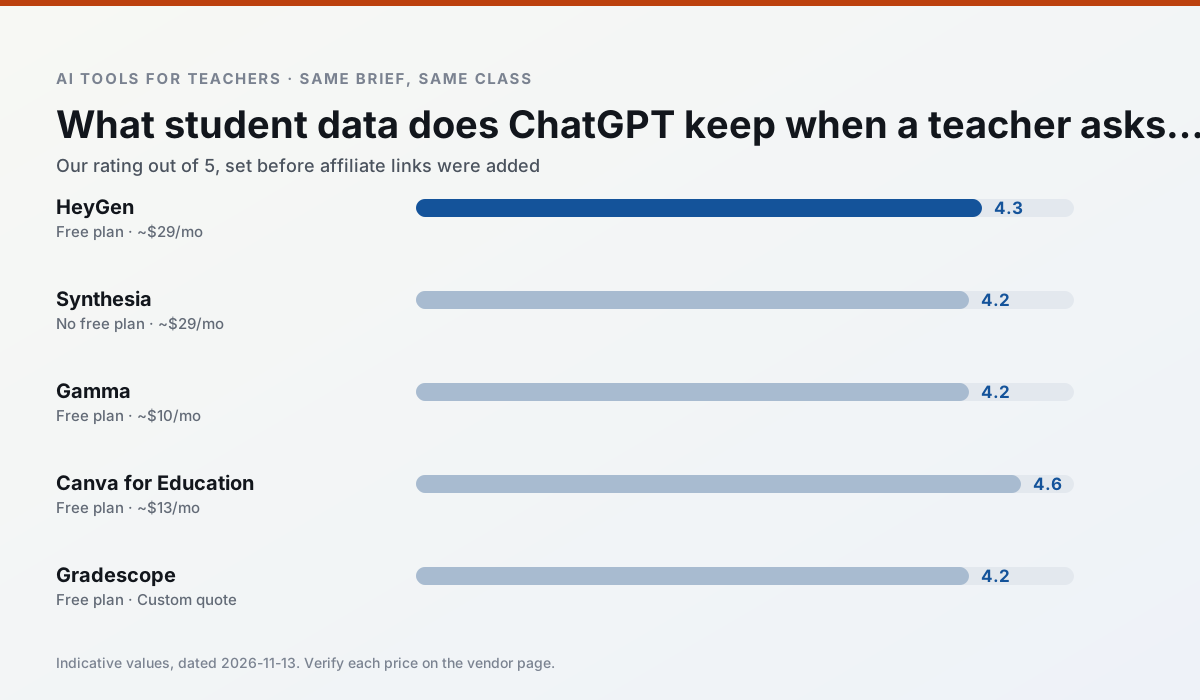
Side by side
Comparison table
Ratings reflect our timed classroom workflow, not vendor claims. Prices are indicative — verify on the vendor site.
| Tool | Best for | Free tier | Indicative paid plan | Standout feature | Our rating | Verdict | Try the tool |
|---|---|---|---|---|---|---|---|
| HeyGen | video lessons · translation | Yes — Limited credit plan | ~$29 /user/mo | Video translation | 4.3 / 5 | Strong option | Try free |
| Synthesia | flipped lessons · video lessons | No ongoing free plan | ~$29 /user/mo | 140+ languages | 4.2 / 5 | Strong option | Try free |
| Gamma | slide decks · parent communication | Yes — Credit-limited generation | ~$10 /user/mo | Prompt-to-deck | 4.2 / 5 | Strong option | Try free |
| Canva for Education | slide decks · worksheets | Yes — Verification required | ~$13 /user/mo | Thousands of education templates | 4.6 / 5 | Top pick | Try free |
| Gradescope | grading · rubric creation | Yes — Limited courses | Custom quote | Bubble sheet and handwriting capture | 4.2 / 5 | Strong option | Try free |
| Formative | formative assessment · grading | Yes — Core assessment tools | ~$15 /user/mo | Live student responses | 4.3 / 5 | Strong option | Try free |
Match your situation
Best for X
Different jobs need different tools. Here is what we would open first in each case.
HeyGen is the one we would open on a normal planning day because the first output is editable rather than restructurable, and the free plan covers a single teacher's routine.
Synthesia's free plan is the most usable in this comparison: a quota that survives a normal week. Not enough for a department, enough for one teacher to decide.
Gamma answers the three questions a district actually asks: rostering, admin controls and a data-processing agreement. That is usually what decides a school purchase.
Canva for Education has the shortest path from opening a tab to a usable draft, which matters more than the feature count on a Monday.
Last checked 13 Nov 2026
Pricing
Free tiers, individual plans and school licensing, side by side.
| Tool | Free plan | Individual / paid | School & district | Billing note | Verify |
|---|---|---|---|---|---|
| HeyGen | $0 — Limited credit plan | ~$29 /user/mo | Custom quote | Indicative — verify on vendor site | Vendor |
| Synthesia | No ongoing free tier | ~$29 /user/mo | Custom quote | Indicative — verify on vendor site | Vendor |
| Gamma | $0 — Credit-limited generation | ~$10 /user/mo | ~$20 /user/mo | Indicative — verify on vendor site | Vendor |
| Canva for Education | $0 — Verification required | ~$13 /user/mo | Custom quote | Indicative — verify on vendor site | Vendor |
| Gradescope | $0 — Limited courses | Custom quote | Custom quote | LMS integration and support | Vendor |
| Formative | $0 — Core assessment tools | ~$15 /user/mo | Custom quote | Indicative — verify on vendor site | Vendor |
Editorial rule: pricing is re-checked every 2–3 months and the top 50 pages are refreshed every 6 months. See our funding policy.
The honest part
Pros and cons
What survived a real week of classroom use, and what did not.
Pros
- Best-in-class lip-sync translation
- Useful for multilingual families
- Generous trial credits
Cons
- Credit-based pricing is confusing
- Voice cloning raises consent questions
- Overkill for everyday lessons
Pros
- No camera or editing skills required
- Excellent multilingual voice output
- Easy updates to existing videos
Cons
- Cost is hard to justify for a single teacher
- Avatar video can feel impersonal
- No free ongoing tier
Pros
- Fastest path from outline to deck
- Modern-looking output by default
- Good export options
Cons
- Design control is limited
- Credits run out quickly
- Not built for student data
Pros
- Effectively free for verified teachers
- Huge template library
- No design skills needed
Cons
- AI features are capped
- Easy to produce cluttered slides
- Account verification can be slow
Pros
- Large time savings on paper assessments
- Consistent rubric application
- Detailed item analytics
Cons
- Overkill for elementary classrooms
- Institutional pricing is opaque
- Setup effort is real
In the classroom
Use cases
Five concrete workflows, with the tool we would open for each one.
A Monday morning lesson plan in twelve minutes
The twelve minutes come from not rewriting the skeleton. Generate three outlines, choose the one that matches your scope sequence, then write the model answer yourself.
Recommended: HeyGenThree reading levels from one source text
Paste a vetted text, ask for supported, core and extension versions, then check the vocabulary list by hand. Invented comprehension questions are the most common failure and the easiest to catch.
Recommended: SynthesiaRubric and feedback comments in one pass
Reorder the workflow so the rubric is yours and the comments are generated. Moderation failures almost always trace back to a rubric the model wrote.
Recommended: GammaA parent email in two languages
Draft in plain, warm language with no names, translate, then back-translate the important sentences to check meaning. Keep specific incidents out of the prompt and add them yourself.
Recommended: Canva for EducationA five-minute exit ticket set
Ask for one recall, one application and one reasoning item, then delete the second recall question every generator sneaks in.
Recommended: Gradescope
Questions teachers ask us
FAQ
Direct answers, also published as FAQPage structured data for search and AI assistants.
Is AI allowed for lesson planning in my school?
Who is responsible if something goes wrong?
What should never go into a prompt?
Sources & further reading
Our recommendation
Try HeyGen free for your next lesson planning task
AI avatar video and video translation for instructional content. Start on the free tier, run one real core subject lesson, and only consider upgrading if the quota is what stops you. Disclosure: we may earn a commission (35% recurring) at no extra cost to you.
Some links on this page are affiliate links. We may earn a commission at no extra cost to you. Our rankings are editorial and never pay-to-play. Never enter student PII into a free consumer account.
Keep reading
Related comparisons in this cluster.
Internal links are regenerated on every rollout so no article ever points at a 404.