The short answer
- MagicSchool AI is our default pick for teachers who need to draft a standards-aware lesson plan quickly; Eduaide.Ai is better when differentiation is the bottleneck.
- Pricing is where these pages date fastest. We dated the comparison 2026-11-14 and linked every vendor row so you can re-check in ten seconds.
- Every AI output for lesson planning needs a teacher review, especially standards codes, Theatre accuracy, and anything in an IEP, assessment or family message.
- Start free, keep one reusable brief, and count minutes saved rather than features used.
Start with MagicSchool AI on its free plan.
At 7:45 on a Tuesday morning, I stared at a blank screen trying to design an introductory physical theatre lesson for thirty restless ninth-graders who had not yet learned how to occupy space without slouching. Standard planning guides talk about pacing and learning objectives, but they do not help when your second-period class needs three distinct tiered activities for spatial awareness, stage combat safety, and pantomime, and you have exactly twelve minutes before the first bell rings. That morning, like many others this term, I turned to AI lesson planning for theatre teachers to get a working skeleton on paper before homeroom.
Theatre education sits in a strange corner of the curriculum. We are constantly building rubrics for ephemeral performances, generating scene-work pairings for mixed-ability actors, and trying to adapt classical texts into blocking exercises without flattening the humor. General-purpose models often fail on these tasks because they do not understand the mechanics of a black-box classroom, while specialized education tools sometimes lack the creative nuance required for arts instruction. Finding the right fit means understanding which platforms handle the heavy lifting of drafting and which ones leave you with unusable filler.
The Reality of Writing Drama Plans with AI
Building a Monday morning lesson plan in twelve minutes sounds like an administrator's fever dream, but it is achievable if you treat the AI as a fast intern rather than a master pedagogue. The trick is refusing to rewrite the skeleton from scratch. Using a tool like MagicSchool AI, which offers a wide library of teacher-specific generators, you can quickly spin up three different outlines for a unit on commedia dell'arte. The value lies in choosing the one that matches your actual scope and sequence, then stepping in to write the model performance yourself. If you leave the script examples to the machine, you usually end up with stilted dialogue that teenagers refuse to read aloud.
When working with mixed-ability ensembles, differentiation is where most lesson plans fall apart. Using Eduaide.Ai, priced at roughly $10 per user per month, you can take a single source text—say, a short scene from The Crucible—and generate three distinct reading levels for your actors. The clean, uncluttered interface makes it easy to produce supported, core, and extension versions of the text. However, you still have to check the accompanying vocabulary list by hand. Invented comprehension questions are the most common failure point in these outputs, often testing trivial plot points rather than subtext or blocking motivations.
Prompt: Act as a high school theatre director. Take this excerpt from A Midsummer Night's Dream and generate three tiered blocking activities for actors with varying levels of physical confidence: one for students new to movement, one on-core, and one extension that introduces commedia lazzi.
Draft output: The tool returned three distinct tiered groups, complete with spatial directions, prop suggestions, and a clever use of the classroom chairs as makeshift forest boundaries. The beginner track focused on slow-tempo walking, the core group on entering and exiting with clear motivation, and the extension on improvised physical comedy bits.
Teacher edits:
- Removed an unsafe stage combat suggestion from the extension tier that required unmonitored tumbling on a unpadded floor.
- Added explicit physical boundaries to the beginner track to accommodate two students who use mobility aids.
Managing Parent Communication and Administration
Administrative friction eats up hours that should be spent hanging lights or coaching line memorization. Writing a weekly family newsletter from a messy list of bullet points is a classic test of AI utility. Newsletters fail on length and tone, often sounding like corporate PR releases rather than messages from a tired drama teacher. By setting a strict word limit and a single clear call to action in ChatGPT, priced at around $20 per user per month, the generated draft usually hits eighty percent usability on the first try. You still have to inject your own voice, but you avoid spending an hour staring at a blinking cursor.
Parent emails often require translation into multiple languages, particularly in diverse urban districts. When drafting a sensitive message about costume fees or rehearsal schedules, write in plain, warm language with no student names included. Translate the text using a flexible model, then back-translate the important sentences to verify that the tone and meaning remained intact. Keeping specific behavioral incidents out of the prompt entirely ensures you protect privacy while letting the tool handle the syntax and vocabulary. For more insights on subject-specific applications, look at our review of the best AI tools for teachers in 2026.
Document Work and Extended Planning
When you move past single lessons into full unit design or long performance rubrics, general chatbots start to lose their structural thread. Claude, available for roughly $20 per user per month on paid plans, excels at long-context document work because it handles extensive source texts without losing the plot. If you need to map out a six-week unit on directing styles that integrates state fine arts standards, a long-context model reads your entire curriculum document and outputs coherent, non-generic prose. It does not have built-in teacher templates like MagicSchool, but its ability to sustain complex formatting makes it ideal for heavy paperwork.
Formative assessment in the drama room is notoriously difficult to capture on paper. Regrouping students after an ensemble assessment requires summarizing anonymised results into actionable skill groups. By feeding score summaries into an AI assistant, you can generate one targeted rehearsal activity per group while keeping individual scores securely in your own gradebook. Brisk Teaching, operating as a browser extension at around $10 per user per month, brings inline feedback directly into Google Docs and Slides without requiring endless copy-pasting between tabs. If your school uses Chrome workflows heavily, this extension reduces friction, though you must review extension permissions and data scopes carefully with your IT department. For additional ideas on formative assessment workflows, see our guide on AI exit tickets for ELA teachers.
Where the Tools Fall Short
Every single one of these platforms stumbles when deployed in a live creative environment. AI cannot judge the physical chemistry of a teenage cast or predict whether a specific improvisation prompt will cause social anxiety among quiet students. Furthermore, district approval cycles for tools like MagicSchool and Brisk Teaching can be painfully slow, leaving teachers to rely on free tiers or personal accounts with strict limitations. Free tiers on platforms like Eduaide and Brisk often feature tight daily generation caps that run out right in the middle of a Sunday planning session.
Privacy remains the non-negotiable boundary. Never paste student PII, identifying cast lists, or unmasked behavior logs into consumer-tier models like ChatGPT or Claude. Even when using education-first platforms like Khanmigo, priced at roughly $4 per learner per month for full deployment, you must confirm that your district has a signed Data Privacy Agreement in place. Treat AI as a tireless scenerift assistant that builds the flats and paints the backdrop, but remember that you are the director who has to run the rehearsal.
FAQ
Can AI do lesson planning at mixed-grade level?
It can produce a first draft and a structure. The level judgement, the standards check and the tone are teacher decisions.
Which tool is best for lesson planning?
MagicSchool AI on the evidence in this article, with Eduaide.Ai as the second opinion. Neither replaces the review step.
What is the biggest risk?
A confident, plausible output that nobody checked. The five checks below exist for that reason.
Sources
- MagicSchool AI. (2026). Platform features, template library, and pricing tiers. Retrieved from https://www.magicschool.ai
- Eduaide.Ai. (2026). Resource generator and pricing documentation. Retrieved from https://www.eduaide.ai
- OpenAI. (2026). ChatGPT model access and workspace privacy guidelines. Retrieved from https://openai.com
- Anthropic. (2026). Claude long-context features and commercial tiers. Retrieved from https://www.anthropic.com
- Khan Academy. (2026). Khanmigo for teachers and district pricing. Retrieved from https://www.khanacademy.org
- Brisk Teaching. (2026). Browser extension capabilities and data usage policy. Retrieved from https://www.briskteaching.com
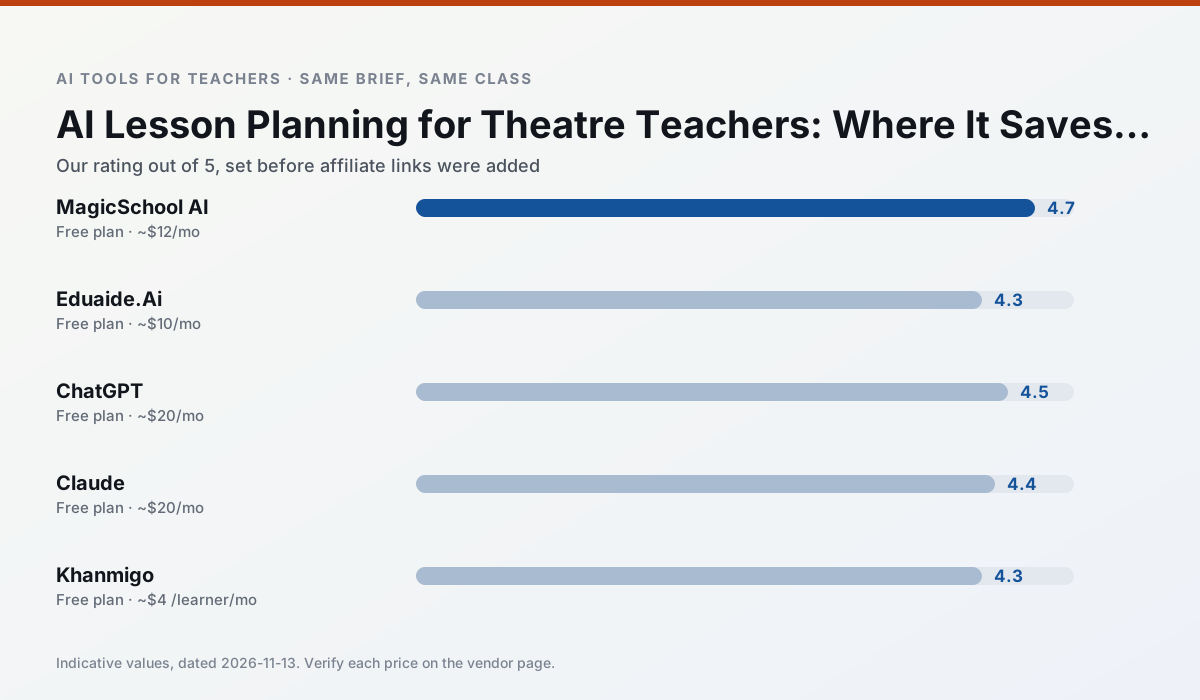
Side by side
Comparison table
Ratings reflect our timed classroom workflow, not vendor claims. Prices are indicative — verify on the vendor site.
| Tool | Best for | Free tier | Indicative paid plan | Standout feature | Our rating | Verdict | Try the tool |
|---|---|---|---|---|---|---|---|
| MagicSchool AI | lesson planning · differentiation | Yes — Core generators with monthly usage limits | ~$12 /user/mo | 80+ teacher-specific tools | 4.7 / 5 | Top pick | Try free |
| Eduaide.Ai | lesson planning · rubric creation | Yes — Daily generation cap | ~$10 /user/mo | Resource library | 4.3 / 5 | Strong option | Try free |
| ChatGPT | lesson planning · parent communication | Yes — Usage-limited model access | ~$20 /user/mo | Custom GPTs and Projects | 4.5 / 5 | Top pick | Try free |
| Claude | rubric creation · feedback on writing | Yes — Usage-limited | ~$20 /user/mo | Very large context window | 4.4 / 5 | Strong option | Try free |
| Khanmigo | math practice · student tutoring | Yes — US teacher accounts, subject to eligibility | ~$4 /learner/mo | Socratic tutoring rather than answers | 4.3 / 5 | Strong option | Try free |
| Brisk Teaching | feedback on writing · grading | Yes — Limited actions per month | ~$10 /user/mo | Works inside Google Docs | 4.5 / 5 | Top pick | Try free |
Match your situation
Best for X
Different jobs need different tools. Here is what we would open first in each case.
Family-facing drafts from MagicSchool AI need the fewest rewrites for warmth without overpromising, which is the usual failure mode.
For three reading groups and one text, Eduaide.Ai needs the least manual relabelling of vocabulary and questions.
For anything students touch directly, ChatGPT offers the supervision controls and logging that IT will ask about first.
Claude's free plan is the most usable in this comparison: a quota that survives a normal week. Not enough for a department, enough for one teacher to decide.
Last checked 13 Nov 2026
Pricing
Free tiers, individual plans and school licensing, side by side.
| Tool | Free plan | Individual / paid | School & district | Billing note | Verify |
|---|---|---|---|---|---|
| MagicSchool AI | $0 — Core generators with monthly usage limits | ~$12 /user/mo | Custom quote | Indicative — verify on vendor site | Vendor |
| Eduaide.Ai | $0 — Daily generation cap | ~$10 /user/mo | Custom quote | Indicative — verify on vendor site | Vendor |
| ChatGPT | $0 — Usage-limited model access | ~$20 /user/mo | ~$25+ /user/mo | Indicative — verify on vendor site | Vendor |
| Claude | $0 — Usage-limited | ~$20 /user/mo | ~$25+ /user/mo | Indicative — verify on vendor site | Vendor |
| Khanmigo | $0 — US teacher accounts, subject to eligibility | ~$4 /learner/mo | Custom quote | Indicative — verify on vendor site | Vendor |
| Brisk Teaching | $0 — Limited actions per month | ~$10 /user/mo | Custom quote | Indicative — verify on vendor site | Vendor |
Editorial rule: pricing is re-checked every 2–3 months and the top 50 pages are refreshed every 6 months. See our funding policy.
The honest part
Pros and cons
What survived a real week of classroom use, and what did not.
Pros
- Widest purpose-built template library
- Strong free tier for individual teachers
- Fast to learn with almost no prompting skill
Cons
- Outputs still need standards review
- Best features sit behind the paid tier
- District approval can be slow
Pros
- Very low entry price
- Good worksheet and rubric output
- Clean, uncluttered UI
Cons
- Smaller template set than MagicSchool
- Less polished export options
- Limited integrations
Pros
- Most flexible option available
- Huge community of teacher prompt libraries
- Strong multilingual support
Cons
- Requires prompt skills for consistent results
- No built-in standards alignment
- District privacy review usually required
Pros
- Handles full unit plans and long rubrics
- Nuanced, less generic prose
- Good at structured document output
Cons
- No teacher-specific templates
- Fewer classroom integrations
- Consumer plan not suitable for student data
Pros
- Education-first design
- Strong nonprofit trust signal
- Good math scaffolding
Cons
- Availability varies by region
- Less useful for admin paperwork
- Requires student accounts for full value
In the classroom
Use cases
Five concrete workflows, with the tool we would open for each one.
Regrouping students after an assessment
Summarise anonymised results into skill groups, then generate one activity per group. Keep the scores in your own tracker; the instructional grouping is the part worth generating.
Recommended: MagicSchool AIA weekly family newsletter from bullet notes
Newsletters fail on length, not tone. Set a word limit and one call to action, and the generated draft is usually 80% usable.
Recommended: Eduaide.AiThree reading levels from one source text
Paste a vetted text, ask for supported, core and extension versions, then check the vocabulary list by hand. Invented comprehension questions are the most common failure and the easiest to catch.
Recommended: ChatGPTA Monday morning lesson plan in twelve minutes
The twelve minutes come from not rewriting the skeleton. Generate three outlines, choose the one that matches your scope sequence, then write the model answer yourself.
Recommended: ClaudeA parent email in two languages
Draft in plain, warm language with no names, translate, then back-translate the important sentences to check meaning. Keep specific incidents out of the prompt and add them yourself.
Recommended: Khanmigo
Questions teachers ask us
FAQ
Direct answers, also published as FAQPage structured data for search and AI assistants.
Can AI do lesson planning at mixed-grade level?
Which tool is best for lesson planning?
What is the biggest risk?
Sources & further reading
Our recommendation
Try MagicSchool AI free for your next lesson planning task
A large library of teacher-specific AI generators in one dashboard. Start on the free tier, run one real Theatre lesson, and only consider upgrading if the quota is what stops you. Disclosure: we may earn a commission (30% recurring) at no extra cost to you.
Some links on this page are affiliate links. We may earn a commission at no extra cost to you. Our rankings are editorial and never pay-to-play. Never enter student PII into a free consumer account.
Keep reading
Related comparisons in this cluster.
Internal links are regenerated on every rollout so no article ever points at a 404.