The short answer
- Eduaide.Ai is our default pick for teachers who need to write criterion-referenced rubrics quickly; Claude is better when differentiation is the bottleneck.
- All 3 shortlisted tools are priced for one teacher first and a school second. Eduaide.Ai and Claude are the two worth trialling on a real task before any purchase conversation.
- Every AI output for rubric creation needs a teacher review, especially standards codes, computer science accuracy, and anything in an IEP, assessment or family message.
- Everything on this page dates from 2026-11-13; where a price could not be re-read, the row says so.
Start with HeyGen on its free plan.
At two o'clock on a Tuesday, I was staring at forty Python scripts that all threw the exact same IndexError, wondering why I had promised my AP Computer Science class a detailed rubric for their sorting algorithms. Writing rubrics for code is tedious. You need to balance syntax correctness, efficiency, design patterns, and edge-case handling without writing a novel for every student. That night, I decided to let an AI do the heavy lifting. It was a disaster, and it taught me everything I needed to know about using AI rubric creation for cs teachers.
The first attempt produced a rubric that penalized students for not using Object-Oriented Programming principles in a procedural script we hadn't even covered yet. The AI hallucinated standards, bloated the point values, and missed the actual learning objective entirely. If you want to save time without lowering your grading standards, you have to know where the machine shines and where you must draw a hard line. For a broader look at how these tools fit into your daily workflow, check out our guide on best AI tools for teachers in 2026.
The Anatomy of a Bad CS Rubric
Generative models love to add fluff. When you ask for a coding rubric, they tend to invent categories like "code aesthetics" or "creative flair" that mean nothing in a functional programming context. High school computer science thrives on logic, syntax, and structured problem-solving. When an AI designs the criteria from scratch, it often misses the specific constraints of the assignment, such as memory limits or specific loop requirements.
This happens because standard chat interfaces do not understand your scope and sequence. They pull from generic introductory programming rubrics found across the open internet, which might reward Java conventions when you are grading AP Python. If you let the model drive the process, you spend more time editing the rubric than it would have taken to write it yourself.
Controlling the Prompt for Precise Code Criteria
To get a useful grading matrix, you must supply the constraints before the model writes a single word. Do not ask for a general rubric. Feed it your exact assignment prompt, your learning objectives, and your non-negotiable deduction points.
Prompt: "Act as a high school computer science teacher. Create a 4-point analytic rubric for a Python linear search project. The categories must be: Correctness (passes test cases), Efficiency (Big-O notation understanding), Code Structure (functions and variable naming), and Documentation (comments and docstrings). Do not include vague categories like creativity or aesthetics."
First pass output: The model generated four solid categories, but put 'Efficiency' at 40% of the total grade and included a requirement for recursive solutions, which we had not taught.
Teacher edits:
- Capped 'Efficiency' at 15% and shifted the weight to 'Correctness' at 50%.
- Replaced the recursion requirement with a check for proper
whileloop termination conditions.
When you structure your prompts this way, you turn the model from a confused generator into a fast typist. For more targeted workflow strategies, read our breakdown of AI essay feedback for history teachers.
Choosing Your Tool: Eduaide.Ai Versus Claude
Not all platforms handle technical subjects the same way. When building rubrics and supporting instructional assets, Eduaide.Ai stands out as best for schools and districts. It offers a clean, uncluttered user interface with dedicated teaching-resource libraries, lesson generators, and worksheet tools. The free tier includes a daily generation cap, while the paid tier sits around $10 per user per month (indicative). It is quick to use, though its template set is smaller than some competitors and export options are somewhat limited. Always confirm data retention settings before putting any school or student information into the system.
If you need fast setup and heavy document handling, Claude is the better fit. It acts as best for quick setup, operating as a long-context assistant that easily digests full unit plans and multi-page programming specifications. A usage-limited free tier is available, with paid plans around $20 per user per month (indicative). It produces nuanced, less generic prose and handles structured document outputs brilliantly. However, it lacks teacher-specific templates, and consumer plans are not suitable for student data, meaning you must use an approved workspace tier for any school-related documents.
Scaling Up to Automated Grading
Once your rubric is locked down, applying it across dozens of student submissions is where the real bottleneck occurs. For paper-based or scanned assessments, Gradescope serves as best overall for daily use. It offers AI-assisted rubric grading that groups similar student answers together, allowing you to apply point deductions across a batch of papers simultaneously with consistent rubric application.
The time savings on paper assessments and detailed item analytics are massive, but the setup effort is very real. It includes a limited courses free tier and custom institutional pricing (indicative). Be aware that because it handles actual student work, a full Data Privacy Agreement (DPA) and FERPA review are required before deployment. It is fundamentally overkill for elementary classrooms, but a lifesaver for high school CS teachers managing multiple sections.
Presenting Code Concepts and Demos
Sometimes your rubric is tied to a complex project demonstration that students struggle to visualize. This is where media generation tools come into play. Gamma provides the fastest path from an outline to a presentation deck, generating modern-looking slides and documents from a single prompt for about $10 per user per month (indicative) with credit-limited free tiers. Design control is limited, but it is great for knocking out a quick visual overview of a coding project. Treat it as a content tool only, and never upload student work.
For video-based explanations of complex algorithms, Colossyan and HeyGen offer distinct routes. Colossyan builds training and explainer videos from documents and scripts at around $27 per user per month (indicative) with no permanent free plan, making it strong for staff training and compliance exports. Meanwhile, HeyGen serves as the best free option, featuring a limited credit plan and paid tiers around $29 per user per month (indicative). It boasts best-in-class lip-sync translation, which is useful for multilingual families, though voice and likeness cloning raise serious consent questions and require documented permission before use.
Drawing the Line
The line in CS teaching is simple: use AI to draft the scaffolding, but never let it decide what mastery looks like. When you own the rubric, the grading is fair, the feedback is targeted, and your sanity stays intact.
FAQ
Can AI do rubric creation at mixed-grade level?
It can produce a first draft and a structure. The level judgement, the standards check and the tone are teacher decisions.
Which tool is best for rubric creation?
Eduaide.Ai on the evidence in this article, with Claude as the second opinion. Neither replaces the review step.
What is the biggest risk?
A confident, plausible output that nobody checked. The five checks below exist for that reason.
Sources
- Eduaide.Ai Vendor Pricing and Features: https://www.eduaide.ai
- Anthropic Claude Pricing and Usage Guidelines: https://www.anthropic.com/claude
- Gradescope Documentation and Privacy Standards: https://www.gradescope.com
- HeyGen Pricing and Feature Overview: https://www.heygen.com
- Colossyan Documentation: https://www.colossyan.com
- Gamma App Features: https://gamma.app
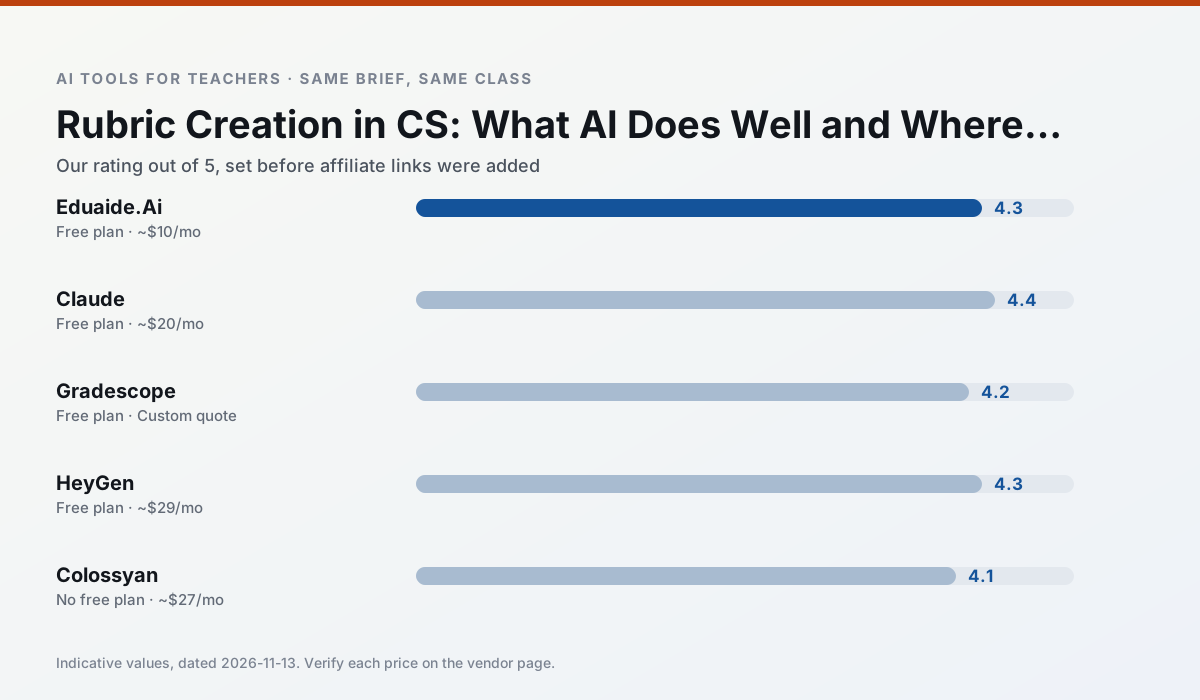
Side by side
Comparison table
Ratings reflect our timed classroom workflow, not vendor claims. Prices are indicative — verify on the vendor site.
| Tool | Best for | Free tier | Indicative paid plan | Standout feature | Our rating | Verdict | Try the tool |
|---|---|---|---|---|---|---|---|
| Eduaide.Ai | lesson planning · rubric creation | Yes — Daily generation cap | ~$10 /user/mo | Resource library | 4.3 / 5 | Strong option | Try free |
| Claude | rubric creation · feedback on writing | Yes — Usage-limited | ~$20 /user/mo | Very large context window | 4.4 / 5 | Strong option | Try free |
| Gradescope | grading · rubric creation | Yes — Limited courses | Custom quote | Bubble sheet and handwriting capture | 4.2 / 5 | Strong option | Try free |
| HeyGen | video lessons · translation | Yes — Limited credit plan | ~$29 /user/mo | Video translation | 4.3 / 5 | Strong option | Try free |
| Colossyan | PD materials · video lessons | No ongoing free plan | ~$27 /user/mo | PDF/PPT-to-video | 4.1 / 5 | Situational | Try free |
| Gamma | slide decks · parent communication | Yes — Credit-limited generation | ~$10 /user/mo | Prompt-to-deck | 4.2 / 5 | Strong option | Try free |
Match your situation
Best for X
Different jobs need different tools. Here is what we would open first in each case.
Eduaide.Ai answers the three questions a district actually asks: rostering, admin controls and a data-processing agreement. That is usually what decides a school purchase.
Claude has the shortest path from opening a tab to a usable draft, which matters more than the feature count on a Monday.
Gradescope wins on the default path: fewer clicks to a usable draft, and the interface does not get in the way at 7:40am.
HeyGen's free plan is the most usable in this comparison: a quota that survives a normal week. Not enough for a department, enough for one teacher to decide.
Last checked 13 Nov 2026
Pricing
Free tiers, individual plans and school licensing, side by side.
| Tool | Free plan | Individual / paid | School & district | Billing note | Verify |
|---|---|---|---|---|---|
| Eduaide.Ai | $0 — Daily generation cap | ~$10 /user/mo | Custom quote | Indicative — verify on vendor site | Vendor |
| Claude | $0 — Usage-limited | ~$20 /user/mo | ~$25+ /user/mo | Indicative — verify on vendor site | Vendor |
| Gradescope | $0 — Limited courses | Custom quote | Custom quote | LMS integration and support | Vendor |
| HeyGen | $0 — Limited credit plan | ~$29 /user/mo | Custom quote | Indicative — verify on vendor site | Vendor |
| Colossyan | No ongoing free tier | ~$27 /user/mo | Custom quote | Indicative — verify on vendor site | Vendor |
| Gamma | $0 — Credit-limited generation | ~$10 /user/mo | ~$20 /user/mo | Indicative — verify on vendor site | Vendor |
Editorial rule: pricing is re-checked every 2–3 months and the top 50 pages are refreshed every 6 months. See our funding policy.
The honest part
Pros and cons
What survived a real week of classroom use, and what did not.
Pros
- Very low entry price
- Good worksheet and rubric output
- Clean, uncluttered UI
Cons
- Smaller template set than MagicSchool
- Less polished export options
- Limited integrations
Pros
- Handles full unit plans and long rubrics
- Nuanced, less generic prose
- Good at structured document output
Cons
- No teacher-specific templates
- Fewer classroom integrations
- Consumer plan not suitable for student data
Pros
- Large time savings on paper assessments
- Consistent rubric application
- Detailed item analytics
Cons
- Overkill for elementary classrooms
- Institutional pricing is opaque
- Setup effort is real
Pros
- Best-in-class lip-sync translation
- Useful for multilingual families
- Generous trial credits
Cons
- Credit-based pricing is confusing
- Voice cloning raises consent questions
- Overkill for everyday lessons
Pros
- Strong for staff training, not just lessons
- Good compliance/LMS export
- Fast document-to-video
Cons
- No permanent free plan
- Higher price point
- Less suited to K-12 student-facing content
In the classroom
Use cases
Five concrete workflows, with the tool we would open for each one.
Rubric and feedback comments in one pass
Reorder the workflow so the rubric is yours and the comments are generated. Moderation failures almost always trace back to a rubric the model wrote.
Recommended: Eduaide.AiA parent email in two languages
Draft in plain, warm language with no names, translate, then back-translate the important sentences to check meaning. Keep specific incidents out of the prompt and add them yourself.
Recommended: ClaudeA Monday morning lesson plan in twelve minutes
The twelve minutes come from not rewriting the skeleton. Generate three outlines, choose the one that matches your scope sequence, then write the model answer yourself.
Recommended: GradescopeThree reading levels from one source text
Paste a vetted text, ask for supported, core and extension versions, then check the vocabulary list by hand. Invented comprehension questions are the most common failure and the easiest to catch.
Recommended: HeyGenA substitute folder that needs no context
The value here is structure, not creativity. Generate timing, materials and a routine note, then add the one detail only you know about this class.
Recommended: Colossyan
Questions teachers ask us
FAQ
Direct answers, also published as FAQPage structured data for search and AI assistants.
Can AI do rubric creation at mixed-grade level?
Which tool is best for rubric creation?
What is the biggest risk?
Sources & further reading
Our recommendation
Try HeyGen free for your next rubric creation task
AI avatar video and video translation for instructional content. Start on the free tier, run one real computer science lesson, and only consider upgrading if the quota is what stops you. Disclosure: we may earn a commission (35% recurring) at no extra cost to you.
Some links on this page are affiliate links. We may earn a commission at no extra cost to you. Our rankings are editorial and never pay-to-play. Never enter student PII into a free consumer account.
Keep reading
Related comparisons in this cluster.
Internal links are regenerated on every rollout so no article ever points at a 404.