The short answer
- Grammarly is our default pick for teachers who need to produce specific, evidence-based comments quickly; Curipod is better when differentiation is the bottleneck.
- The cheapest honest test is a week of real work on the free plans: Grammarly: Yes — Core grammar and tone checks; Curipod: Yes — Limited lessons per month; Eduaide.Ai: Yes — Daily generation cap. If a tool is still open on Friday, it has earned a paid conversation.
- Every AI output for report card comments needs a teacher review, especially standards codes, Foreign language accuracy, and anything in an IEP, assessment or family message.
- Everything on this page dates from 2026-11-13; where a price could not be re-read, the row says so.
Start with Grammarly on its free plan.
At 11:30 on a Friday night in November, my desk looked like a grammar graveyard. I had seventy-eight intermediate Spanish term reports to write, and every single one needed to address interpretive listening, interpersonal speaking, and presential writing without sounding like I had pulled phrases from a shredded textbook. We have all stared at a blinking cursor while trying to explain to a parent why their child understands subjunctive verb endings in theory but freezes up during a pair-share in the target language. That specific brand of exhaustion is why many of us started looking at AI report card comments for world language teachers to keep our weekends intact.
Generating these narratives requires balancing professional polish with actual instructional meaning. If you are exploring broader classroom applications, our overview of the best AI tools for teachers in 2026 covers the foundational platforms. But when it comes to foreign language reporting, you need tools that understand the nuance of language acquisition stages, rather than generic praise like "works hard in class."
Finding the Right Balance in Subject-Specific Writing
Writing about language acquisition is distinct from writing standard homeroom remarks. You are not just commenting on behavior; you are assessing a student's willingness to take communicative risks. When leaning on assistants for AI report card comments for world language teachers, the goal is to cut down the typing time without stripping away the specific feedback that helps a learner grow. If you teach world languages, you also need to manage parent communication in English while translating language progress milestones clearly.
How Platforms Stack Up for Term Reporting
Different platforms handle the repetitive strain of reporting in different ways. Some teachers rely on structured libraries like MagicSchool AI, which offers a wide purpose-built template library and a strong free tier for individual teachers at roughly $12 per user/month on its paid plan. It is fast to learn and requires almost no prompting skill, though its outputs still need careful standards review to ensure they match your curriculum. For broader writing assistance across newsletters and parent emails, Grammarly acts as a reliable writing assistant at roughly $12 per user/month, catching errors in high-stakes notes and working everywhere you already write, though it is not education-specific and can flatten your voice without careful oversight.
If you are building communicative practice materials to back up your grading data, tools outside the direct reporting niche become useful. Diffit is our pick for mixed-ability classes, helping level any text or video into differentiated reading materials at roughly $15 per user/month, even if its leveling is approximate rather than a formal assessment. For lesson delivery and quick checks, Curipod turns topics into interactive student-response lessons at roughly $12 per user/month, keeping engagement high without requiring student accounts for basic use. Meanwhile, Eduaide.Ai provides solid worksheet and rubric generation at a low entry price of roughly $10 per user/month, and SchoolAI offers a secure, district-approved workspace for student-facing tasks at around $15 per user/month.
A Practical Prompting Workflow
To see how this works in practice, look at what happens when you feed raw formative notes into a generator and shape the output into something ready for a report card.
Prompt typed into the tool: "Generate a 3-sentence report card comment for an 8th-grade Spanish student named Leo. Strengths: strong interpretive listening, great vocabulary retention. Area for growth: hesitant to initiate spontaneous conversation in interpersonal speaking. Tone: encouraging, professional, constructive."
What came back: "Leo is a pleasure to have in Spanish class. He demonstrates strong interpretive listening skills and excellent vocabulary retention, consistently scoring well on listening quizzes. However, Leo is hesitant to initiate spontaneous conversation during interpersonal speaking activities and needs to take more risks when speaking out loud."
The two edits that made it usable:
- Removed the generic filler sentence about him being a pleasure to class to get straight to the language acquisition data.
- Replaced "needs to take more risks" with a specific action item: "using our circumlocution strategies when he forgets a specific word during pair-share."
Where Things Go Wrong in Practice
Relying entirely on automated text generation without supervision introduces two common traps. First, the tone can easily drift into overly sugary positivity that hides a student's actual gaps in proficiency. When I tested raw outputs for my level-two classes, every single struggling student was described as "enthusiastic despite challenges," which told parents nothing about their inability to control past-tense markers. I had to manually inject specific grammar and vocabulary targets back into the drafts.
Second, generic assistants often misunderstand the scaffolding required in a proficiency-based classroom. A tool might suggest that a student "needs to practice more Spanish at home," which ignores the reality of single-language households and shifts the burden unfairly to parents. To fix this, I stopped asking generators for broad advice and instead restricted them to summarizing the specific rubric scores I provided.
Data Privacy and District Boundaries
Before pasting any grade data or student profiles into these platforms, check your district's data privacy agreements. While tools like SchoolAI are designed specifically for district approval with strong safeguarding defaults, general assistants require you to strip out any personally identifiable information. Never include student full names or ID numbers in prompts. For a related look at how subject-specific feedback differs across disciplines, check out our guide on AI essay feedback for history teachers. Keep your records local, use AI purely as a drafting engine, and always read every single sentence before it heads out the door to a parent.
FAQ
Can AI do report card comments at mixed-grade level?
It can produce a first draft and a structure. The level judgement, the standards check and the tone are teacher decisions.
Which tool is best for report card comments?
Grammarly on the evidence in this article, with Curipod as the second opinion. Neither replaces the review step.
What is the biggest risk?
A confident, plausible output that nobody checked. The five checks below exist for that reason.
Sources
- Grammarly Educator Resources: grammarly.com/edu
- Curipod Platform Overview: curipod.com
- Eduaide.Ai Feature Directory: eduaide.ai
- Diffit Documentation: diffit.me
- MagicSchool AI Tool Suite: magicschool.ai
- SchoolAI Safety and Compliance: school.ai
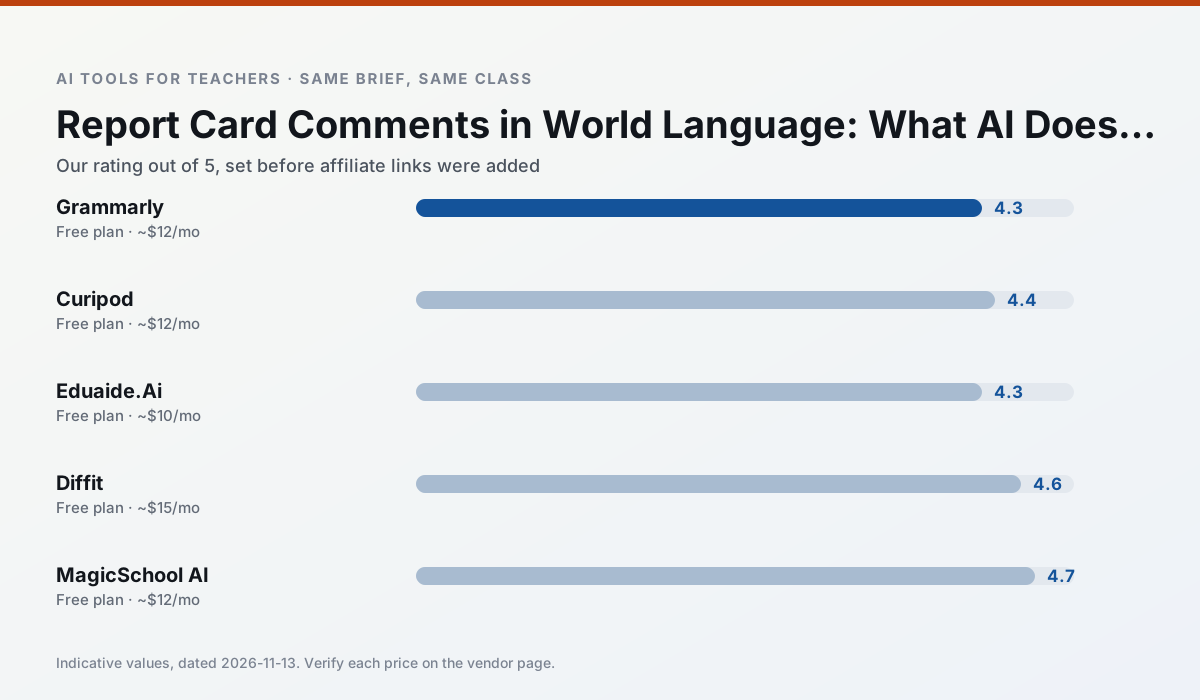
Side by side
Comparison table
Ratings reflect our timed classroom workflow, not vendor claims. Prices are indicative — verify on the vendor site.
| Tool | Best for | Free tier | Indicative paid plan | Standout feature | Our rating | Verdict | Try the tool |
|---|---|---|---|---|---|---|---|
| Grammarly | parent communication · report card comments | Yes — Core grammar and tone checks | ~$12 /user/mo | Tone adjustments | 4.3 / 5 | Strong option | Try free |
| Curipod | formative assessment · exit tickets | Yes — Limited lessons per month | ~$12 /user/mo | Live polls and word clouds | 4.4 / 5 | Strong option | Try free |
| Eduaide.Ai | lesson planning · rubric creation | Yes — Daily generation cap | ~$10 /user/mo | Resource library | 4.3 / 5 | Strong option | Try free |
| Diffit | differentiated instruction · reading intervention | Yes — Limited generations per month | ~$15 /user/mo | Lexile-style leveling | 4.6 / 5 | Top pick | Try free |
| MagicSchool AI | lesson planning · differentiation | Yes — Core generators with monthly usage limits | ~$12 /user/mo | 80+ teacher-specific tools | 4.7 / 5 | Top pick | Try free |
| SchoolAI | student-safe AI · differentiated instruction | Yes — Limited seats | ~$15 /user/mo | Teacher-monitored student chats | 4.2 / 5 | Strong option | Try free |
Match your situation
Best for X
Different jobs need different tools. Here is what we would open first in each case.
Grammarly produces levelled versions from one source in a single pass, which is the highest-value differentiation shortcut we tested at this level.
Curipod has the strongest tone control for family emails and report comments, provided you still read the message aloud before sending.
For anything students touch directly, Eduaide.Ai offers the supervision controls and logging that IT will ask about first.
On the daily cycle, Diffit saves the most edit time per task; the paid tier mostly buys more runs rather than better ones.
Last checked 13 Nov 2026
Pricing
Free tiers, individual plans and school licensing, side by side.
| Tool | Free plan | Individual / paid | School & district | Billing note | Verify |
|---|---|---|---|---|---|
| Grammarly | $0 — Core grammar and tone checks | ~$12 /user/mo | ~$15 /user/mo | Indicative — billed annually | Vendor |
| Curipod | $0 — Limited lessons per month | ~$12 /user/mo | Custom quote | Indicative — verify on vendor site | Vendor |
| Eduaide.Ai | $0 — Daily generation cap | ~$10 /user/mo | Custom quote | Indicative — verify on vendor site | Vendor |
| Diffit | $0 — Limited generations per month | ~$15 /user/mo | Custom quote | Indicative — verify on vendor site | Vendor |
| MagicSchool AI | $0 — Core generators with monthly usage limits | ~$12 /user/mo | Custom quote | Indicative — verify on vendor site | Vendor |
| SchoolAI | $0 — Limited seats | ~$15 /user/mo | Custom quote | Indicative — verify on vendor site | Vendor |
Editorial rule: pricing is re-checked every 2–3 months and the top 50 pages are refreshed every 6 months. See our funding policy.
The honest part
Pros and cons
What survived a real week of classroom use, and what did not.
Pros
- Catches errors in high-stakes parent emails
- Works everywhere you already write
- Very low learning curve
Cons
- Not education-specific
- Can flatten teacher voice
- Premium needed for tone rewriting
Pros
- High student engagement out of the box
- Great for quick checks for understanding
- No student accounts required for basic use
Cons
- Focused on delivery, not planning
- Requires reliable classroom devices
- Free tier is restrictive
Pros
- Very low entry price
- Good worksheet and rubric output
- Clean, uncluttered UI
Cons
- Smaller template set than MagicSchool
- Less polished export options
- Limited integrations
Pros
- Excellent for mixed-ability classes
- Produces printable and digital versions
- Minimal setup
Cons
- Narrower scope than all-in-one suites
- Leveling is approximate, not a formal assessment
- Heavy use burns through the free quota
Pros
- Widest purpose-built template library
- Strong free tier for individual teachers
- Fast to learn with almost no prompting skill
Cons
- Outputs still need standards review
- Best features sit behind the paid tier
- District approval can be slow
In the classroom
Use cases
Five concrete workflows, with the tool we would open for each one.
A weekly family newsletter from bullet notes
Newsletters fail on length, not tone. Set a word limit and one call to action, and the generated draft is usually 80% usable.
Recommended: GrammarlyRegrouping students after an assessment
Summarise anonymised results into skill groups, then generate one activity per group. Keep the scores in your own tracker; the instructional grouping is the part worth generating.
Recommended: CuripodA five-minute exit ticket set
Ask for one recall, one application and one reasoning item, then delete the second recall question every generator sneaks in.
Recommended: Eduaide.AiAn IEP present-levels first draft
Use aggregated, anonymised data only. Ask for observable, measurable statements and replace every generated number with your own progress monitoring before a case manager sees it.
Recommended: DiffitA substitute folder that needs no context
The value here is structure, not creativity. Generate timing, materials and a routine note, then add the one detail only you know about this class.
Recommended: MagicSchool AI
Questions teachers ask us
FAQ
Direct answers, also published as FAQPage structured data for search and AI assistants.
Can AI do report card comments at mixed-grade level?
Which tool is best for report card comments?
What is the biggest risk?
Sources & further reading
Our recommendation
Try Grammarly free for your next report card comments task
Writing assistant for polished parent emails, newsletters and reports. Start on the free tier, run one real Foreign language lesson, and only consider upgrading if the quota is what stops you. Disclosure: we may earn a commission ($20 per paid upgrade + $0.20/signup) at no extra cost to you.
Some links on this page are affiliate links. We may earn a commission at no extra cost to you. Our rankings are editorial and never pay-to-play. Never enter student PII into a free consumer account.
Keep reading
Related comparisons in this cluster.
Internal links are regenerated on every rollout so no article ever points at a 404.