The short answer
- Claude is our default pick for teachers who need to give actionable draft feedback quickly; Brisk Teaching is better when differentiation is the bottleneck.
- Free-tier reality for this shortlist: Claude: Yes — Usage-limited; Brisk Teaching: Yes — Limited actions per month; Turnitin Clarity / Feedback Studio: No ongoing free plan. Treat every paid figure as indicative until you have read the vendor page; only the free quota is something you can test yourself this week.
- Every AI output for feedback on student writing needs a teacher review, especially standards codes, math accuracy, and anything in an IEP, assessment or family message.
- Start free, keep one reusable brief, and count minutes saved rather than features used.
Start with HeyGen on its free plan.
At 9:45 PM on a Tuesday in November 2026, I was staring at thirty-four sophomore geometry paragraphs explaining why their proofs worked, and my brain had turned to porridge. We had just finished a unit where students had to write out their geometric reasoning in complete sentences rather than just throwing down a two-column table. The math was mostly right. The writing was an absolute disaster of run-on sentences, missing premises, and sentences starting with "Because it looks like." I needed a way to give meaningful AI feedback on student writing for math teachers without spending my entire Wednesday night decoding algebraic prose.
Math teachers face a specific trap when assigning writing. We want students to articulate their logic, but grading thirty paragraph responses means reading thirty different variations of muddled syntax. Most general writing tools treat math prose like an English essay, missing the logical leaps entirely. Over the past term, I tested tools that claim to handle student text, ranging from browser extensions to institutional heavyweights. Some worked brilliantly. Others broke down the moment a student mixed up a transversal angle with a corresponding one.
Finding the Right Fit for Math Prose
When evaluating tools for mathematical writing, standard rubric-based checkers often fall short because they judge grammar over geometric validity. We need systems that understand why a student's explanation of a proof holds water, even if the sentence structure wobbles. To make sense of the landscape for the best AI tools for teachers 2026 review, I looked at how different platforms handle the intersection of prose and proof.
For quick, inline drafting checks, Brisk Teaching brings AI feedback straight into Docs, Slides, and articles via a browser extension priced around $10 a user per month. It is best for parent-facing writing because you can generate summaries without copy-pasting text across tabs. The catch is that the free quota is tight, and your school IT department has to approve the extension permissions since it reads document content. If your students are working entirely on paper and you need to parse handwritten paragraphs, Class Companion costs about $12 a user per month and offers surprisingly good math support for scanned work, earning it our spot for quick setup.
When Institutional Tools Make Sense
If your school district already licenses Turnitin Clarity or Feedback Studio, you get a consistent institutional workflow with detailed revision history and mixed-ability class support. Individual teachers cannot buy it, and AI detection remains a messy, contested space, but the revision tracking is top-tier for older students writing extended math justifications.
For heavy-duty planning, document work, and student-safe deployments, Claude is my go-to long-context assistant. At roughly $20 a user per month on the paid tier, it handles full unit plans and long rubrics with a nuanced prose style that avoids the robotic cheerfulness of other models. You have to remember that the consumer plan is not suitable for student data, so you must use an approved workspace tier for any school-related documents.
Prompt: Act as an expert high school geometry teacher. Review this student's written explanation of a circle theorem proof. Provide three targeted comments: one on mathematical precision, one on clarity of reasoning, and one on vocabulary use. Do not rewrite the paragraph for the student; ask guiding questions. Student text: "The angle at the center is double the angle at the edge because they both open up to the same arc, so if the inscribed angle is thirty, the middle is sixty."
First AI Output: The model provided generic praise, noted that "thirty" and "sixty" should have degree symbols, and suggested using the term "intercepted arc" instead of "open up to."
Two Edits:
- I added a constraint to the prompt demanding the AI check if the student explicitly named the intercepted arc by its vertex letters.
- I instructed the model to flag any informal phrasing like "the middle" and prompt the student to use "central angle."
Two Ways It Went Wrong
Using AI for math writing feedback is not a set-it-and-forget-it affair. The first major failure happened when I fed a batch of scanned student proofs into Class Companion. Scan quality proved to be a massive hurdle. Students who wrote in faint pencil or messy cursive generated OCR errors that the AI interpreted as mathematical errors. The system penalized a student for writing $x^2$ because the scan read it as $r^2$, sending completely incorrect feedback back to the kid before I caught it in the moderation queue. My fix was simple: I had to mandate dark pen-only writing for any assignment slated for AI scan review, which created a minor rebellion among the pencil traditionalists.
The second failure involved prompt drift when generating a five-minute exit ticket set. I asked an assistant to create a quick three-question check involving one recall, one application, and one reasoning item about linear functions. The generator inevitably sneaked in a second recall question disguised as an application. I learned to delete the extra recall question manually every single time before deploying the exit ticket to my students, mirroring the same workflow I use when adapting AI exit tickets for ELA teachers.
Expanding Beyond Text and Writing
Sometimes the writing barrier is not just about student output, but about how we scaffold our instructions for multilingual families or absent students. Tools like HeyGen and Synthesia, both hovering around $29 a user per month on paid tiers, let you turn scripts into presenter-led video with AI avatars or translate instructional content. HeyGen offers best-in-class lip-sync translation, which proved useful for reaching multilingual families, though its credit-based pricing is confusing and voice cloning raises serious consent questions. Synthesia removes the need for camera skills, but the avatar video can feel impersonal for daily math lessons. Neither tool is essential for daily writing feedback, but they sit in the toolkit if you need to translate an explainer video overnight.
We also have to manage administrative overhead like IEP present-levels drafts and substitute folders. When building a substitute folder that needs no context, the value is pure structure. You generate the timing, materials, and routine notes, then add the one detail only you know about this class, like which student needs to sit near the door. For IEP present-levels, use aggregated, anonymised data only, asking for observable, measurable statements, and replace every generated number with your own progress monitoring before a case manager sees it.
AI feedback on student writing in math works best when it acts as a tireless first reader that catches missing logic and informal vocabulary before you do. It will never replace the moment you look over a kid's shoulder and point out where their algebra derailed. But it buys back enough of your evening that you might actually finish dinner while it's still warm.
FAQ
Can AI do feedback on student writing at mixed-grade level?
It can produce a first draft and a structure. The level judgement, the standards check and the tone are teacher decisions.
Which tool is best for feedback on student writing?
Claude on the evidence in this article, with Brisk Teaching as the second opinion. Neither replaces the review step.
What is the biggest risk?
A confident, plausible output that nobody checked. The five checks below exist for that reason.
Sources
- Anthropic. (2026). Claude Pricing and Workspace Privacy Guidelines. anthropic.com/pricing
- Brisk Teaching. (2026). Brisk Teaching Chrome Extension Features and DPA Overview. briskteaching.com
- Turnitin. (2026). Turnitin Clarity and Feedback Studio institutional integration. turnitin.com
- Class Companion. (2026). Class Companion Math AI Feedback and Scanning Specifications. classcompanion.com
- HeyGen. (2026). HeyGen Translation and Credit Pricing Plans. heygen.com
- Synthesia. (2026). Synthesia AI Video Generator Features. synthesia.io
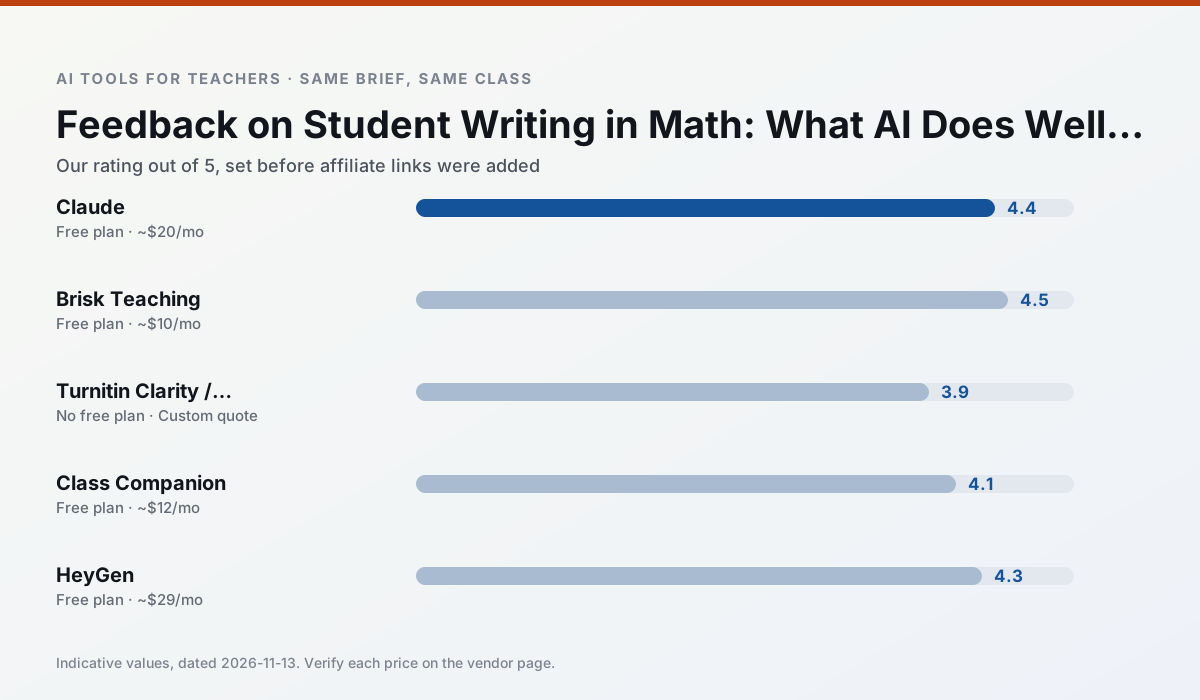
Side by side
Comparison table
Ratings reflect our timed classroom workflow, not vendor claims. Prices are indicative — verify on the vendor site.
| Tool | Best for | Free tier | Indicative paid plan | Standout feature | Our rating | Verdict | Try the tool |
|---|---|---|---|---|---|---|---|
| Claude | rubric creation · feedback on writing | Yes — Usage-limited | ~$20 /user/mo | Very large context window | 4.4 / 5 | Strong option | Try free |
| Brisk Teaching | feedback on writing · grading | Yes — Limited actions per month | ~$10 /user/mo | Works inside Google Docs | 4.5 / 5 | Top pick | Try free |
| Turnitin Clarity / Feedback Studio | feedback on writing · academic integrity | No ongoing free plan | Custom quote | Similarity reports | 3.9 / 5 | Situational | Try free |
| Class Companion | grading · feedback on writing | Yes — Limited assignments | ~$12 /user/mo | Handwriting recognition | 4.1 / 5 | Situational | Try free |
| HeyGen | video lessons · translation | Yes — Limited credit plan | ~$29 /user/mo | Video translation | 4.3 / 5 | Strong option | Try free |
| Synthesia | flipped lessons · video lessons | No ongoing free plan | ~$29 /user/mo | 140+ languages | 4.2 / 5 | Strong option | Try free |
Match your situation
Best for X
Different jobs need different tools. Here is what we would open first in each case.
For anything students touch directly, Claude offers the supervision controls and logging that IT will ask about first.
Brisk Teaching has the strongest tone control for family emails and report comments, provided you still read the message aloud before sending.
Turnitin Clarity / Feedback Studio produces levelled versions from one source in a single pass, which is the highest-value differentiation shortcut we tested at this level.
Class Companion has the shortest path from opening a tab to a usable draft, which matters more than the feature count on a Monday.
Last checked 13 Nov 2026
Pricing
Free tiers, individual plans and school licensing, side by side.
| Tool | Free plan | Individual / paid | School & district | Billing note | Verify |
|---|---|---|---|---|---|
| Claude | $0 — Usage-limited | ~$20 /user/mo | ~$25+ /user/mo | Indicative — verify on vendor site | Vendor |
| Brisk Teaching | $0 — Limited actions per month | ~$10 /user/mo | Custom quote | Indicative — verify on vendor site | Vendor |
| Turnitin Clarity / Feedback Studio | No ongoing free tier | Custom quote | Custom quote | LMS-wide deployment | Vendor |
| Class Companion | $0 — Limited assignments | ~$12 /user/mo | Custom quote | Indicative — verify on vendor site | Vendor |
| HeyGen | $0 — Limited credit plan | ~$29 /user/mo | Custom quote | Indicative — verify on vendor site | Vendor |
| Synthesia | No ongoing free tier | ~$29 /user/mo | Custom quote | Indicative — verify on vendor site | Vendor |
Editorial rule: pricing is re-checked every 2–3 months and the top 50 pages are refreshed every 6 months. See our funding policy.
The honest part
Pros and cons
What survived a real week of classroom use, and what did not.
Pros
- Handles full unit plans and long rubrics
- Nuanced, less generic prose
- Good at structured document output
Cons
- No teacher-specific templates
- Fewer classroom integrations
- Consumer plan not suitable for student data
Pros
- No copy-paste between tools
- Fast inline feedback on student drafts
- Gentle learning curve
Cons
- Chrome-first workflow
- Extension permissions need IT approval
- Free quota is tight
Pros
- Already licensed at many schools
- Consistent institutional workflow
- Detailed revision history
Cons
- Individual teachers cannot buy it
- AI detection remains contested
- Heavy administrative setup
Pros
- Useful where work is done on paper
- Fast, specific comments
- Good math support
Cons
- Scan quality affects accuracy
- Narrow use case
- Feedback still needs teacher review
Pros
- Best-in-class lip-sync translation
- Useful for multilingual families
- Generous trial credits
Cons
- Credit-based pricing is confusing
- Voice cloning raises consent questions
- Overkill for everyday lessons
In the classroom
Use cases
Five concrete workflows, with the tool we would open for each one.
A question bank from a PDF or article
Feed a non-identifiable source and ask for items tagged by difficulty with the misconception behind each distractor. Spot-check every answer key; numerical items are least reliable.
Recommended: ClaudeA substitute folder that needs no context
The value here is structure, not creativity. Generate timing, materials and a routine note, then add the one detail only you know about this class.
Recommended: Brisk TeachingAn IEP present-levels first draft
Use aggregated, anonymised data only. Ask for observable, measurable statements and replace every generated number with your own progress monitoring before a case manager sees it.
Recommended: Turnitin Clarity / Feedback StudioA five-minute exit ticket set
Ask for one recall, one application and one reasoning item, then delete the second recall question every generator sneaks in.
Recommended: Class CompanionA parent email in two languages
Draft in plain, warm language with no names, translate, then back-translate the important sentences to check meaning. Keep specific incidents out of the prompt and add them yourself.
Recommended: HeyGen
Questions teachers ask us
FAQ
Direct answers, also published as FAQPage structured data for search and AI assistants.
Can AI do feedback on student writing at mixed-grade level?
Which tool is best for feedback on student writing?
What is the biggest risk?
Sources & further reading
Our recommendation
Try HeyGen free for your next feedback on student writing task
AI avatar video and video translation for instructional content. Start on the free tier, run one real math lesson, and only consider upgrading if the quota is what stops you. Disclosure: we may earn a commission (35% recurring) at no extra cost to you.
Some links on this page are affiliate links. We may earn a commission at no extra cost to you. Our rankings are editorial and never pay-to-play. Never enter student PII into a free consumer account.
Keep reading
Related comparisons in this cluster.
Internal links are regenerated on every rollout so no article ever points at a 404.