The short answer
- Diffit is our default pick for teachers who need to level one resource for three reading groups quickly; Brisk Teaching is better when differentiation is the bottleneck.
- Pricing is where these pages date fastest. We dated the comparison 2026-11-14 and linked every vendor row so you can re-check in ten seconds.
- Every AI output for differentiated instruction needs a teacher review, especially standards codes, core subject accuracy, and anything in an IEP, assessment or family message.
- Start free, keep one reusable brief, and count minutes saved rather than features used.
Start with MagicSchool AI on its free plan.
At 8:15 on a Tuesday morning, my second-grade reading group looked like a textbook case of why teachers burn out. I had six kids who were decoding CVCe words with ease, eight who were still mixing up their short e and i sounds, and four who needed texts read aloud entirely. My standard reading curriculum offered one story for the whole room. That gap is where AI differentiated instruction for k-2 teachers actually matters, long before anyone talks about automated grading or lesson planning suites.
The reality of early elementary classrooms is that we spend half our prep time rewriting materials just so every child can access the same science or social studies concept. If you want a deeper look at how these workflows fit into broader support structures, read our guide on ai accommodations for elementary teachers. Here is how I tested six popular tools across a full term to see which ones actually survive a room full of seven-year-olds.
Best for Quick Setup: Diffit
Diffit is built to take any article, video, or PDF and spit out leveled reading passages with vocabulary and comprehension questions attached. In my room, it became the go-to when I needed three versions of a text about animal habitats in ten minutes flat. The free tier offers a limited number of generations per month, while paid tiers run around $15 per user per month. It shines in mixed-ability classes because the layout is clean, printable, and requires almost no formatting on my end.
The catch is that its leveling is approximate rather than a formal Lexile assessment, and heavy use will burn through your free quota in a week. More importantly, you have to read the generated questions before handing them out. Invented comprehension details are the most common failure mode, and they are the easiest to catch if you skim the output. Never paste identifiable student work into any open prompt; keep your source text focused on public domain articles or curriculum summaries.
Prompt:
Take this article on honeybees and rewrite it into three reading levels: a supported version for a late kindergarten level with simple sentences, a core version for mid-second grade, and an extension version for early third grade. Include four multiple-choice questions for each.What came back: Three distinct levels with clean formatting, but two of the extension questions asked about facts that were completely missing from the generated text.
Two edits that made it usable: I deleted the unsupported questions, tightened the vocabulary glossary on the supported worksheet to match our current phonics pattern, and printed the result directly for small group rotations.
Best for Schools and Districts: Brisk Teaching
Brisk Teaching operates as a browser extension that brings AI directly into Google Docs, Slides, and web articles. Because it lives in your browser toolbar, it eliminates the tedious copy-pasting between separate AI chat windows and your instructional materials. The free tier features a tight limit on monthly actions, and paid plans sit around $10 per user per month. It is remarkably fast for inline feedback on student drafts, and the learning curve is gentle enough for teachers who hate onboarding new software.
That said, because it is a Chrome extension, your district IT department will need to approve it before installation. The extension reads whatever document content is open on your screen, which means you need to review the vendor data privacy agreement and scope carefully. It is best suited for schools that want a centralized writing assistant rather than a standalone content generator.
Best Free Option: SchoolAI
SchoolAI functions as a school-safe AI workspace where teachers can spin up guided student spaces with robust safeguarding rails. The free tier includes a limited number of student seats, while paid plans run around $15 per user per month. It is designed from the ground up for district approval, giving teachers real-time visibility into what students are typing and doing inside the platform.
The downside is that it requires school-wide buy-in to unlock its full utility, and the student-facing chat interface is less flexible than general-purpose language models. Younger students still need significant scaffolding to type their responses effectively, making it more useful for teacher-guided stations than independent seatwork. Always check local data retention policies to ensure student session logs meet your district requirements.
Best Overall for Daily Use: Formative
Formative bridges the gap between live instruction and asynchronous assessment by letting you upload existing PDFs or Docs, add auto-graded questions, and track standards in real time. The core assessment tools are available on a free tier, while paid versions cost about $15 per user per month. It is my favorite tool for daily use because the diagnostic data it generates makes regrouping students after an assessment almost effortless.
The setup is steeper than simple quiz games, and the best value requires a school-wide rollout. When looking at student results, I use the platform to summarize anonymised scores into skill groups, then generate one targeted activity per group. Keep the actual scores in your own gradebook; the instructional grouping is the part genuinely worth generating. If you want to explore broader digital adaptations, check out our insights on ai accommodations for k-2 classrooms.
For Scanned and Handwritten Assessments: Gradescope
Gradescope is designed for AI-assisted rubric grading on scanned and handwritten student work, saving large amounts of time on batch assessments. It offers a limited free course tier, with paid plans available only through custom institutional quotes. Its main strengths are consistent rubric application and detailed item analytics across large cohorts.
In an elementary setting, however, Gradescope is usually overkill. Setting up regions of interest on a handwritten primary worksheet takes longer than just grading a small stack of spelling tests by hand, and the institutional pricing is opaque. If you pilot it, ensure your DPA and FERPA compliance reviews are thorough since you are uploading images of student handwriting.
For Quick Reviews and Engagement: Kahoot!
Kahoot! needs little introduction, but its AI-assisted question generation features help teachers spin up review games in seconds. The free tier limits player counts per session, while paid upgrades cost roughly $10 per user per month. It provides instant engagement and requires virtually zero training time for students.
The limitations are clear: the rapid pace favors quick recall over higher-order reasoning, making it a poor fit for diagnosing deep conceptual misunderstandings. For younger learners, you must enforce the use of anonymous nicknames rather than real names to keep data privacy intact. Use it as a Friday wrap-up activity rather than an instructional cornerstone.
What Went Wrong This Term
Every teacher trying out these tools hits a wall eventually, and my classroom was no exception. First, I tried using an AI tool to draft a weekly family newsletter straight from my messy bullet points. The result was a three-page wall of therapeutic-sounding fluff that no parent had time to read. Newsletters fail on length, not tone. I fixed the workflow by enforcing a strict 150-word limit and demanding a single clear call to action in the prompt.
Second, I tried to generate a parent communication email about a behavioral incident in two languages, letting the model draft the whole narrative with student names included. That was a near-miss privacy violation. I quickly learned to draft in plain, warm language without names, translate the general message, and then back-translate the important sentences to verify the meaning. Keep specific incidents out of the prompt entirely and add them yourself by hand afterward. AI differentiation is a powerful assistant, but the steering wheel stays firmly in your hands.
FAQ
Can AI do differentiated instruction at K-2 level?
It can produce a first draft and a structure. The level judgement, the standards check and the tone are teacher decisions.
Which tool is best for differentiated instruction?
Diffit on the evidence in this article, with Brisk Teaching as the second opinion. Neither replaces the review step.
What is the biggest risk?
A confident, plausible output that nobody checked. The five checks below exist for that reason.
Sources
- Diffit. Diffit: Level text, videos, and resources for any student. https://diffit.me/
- Brisk Teaching. Brisk Teaching: AI chrome extension for teachers and students. https://briskteaching.com/
- SchoolAI. SchoolAI: The AI platform built for schools. https://schoolai.com/
- Formative. GoFormative: Real-time student assessment and data platform. https://www.goformative.com/
- Gradescope. Gradescope: Faster and fairer grading. https://www.gradescope.com/
- Kahoot! Kahoot! Learning games and gamified quizzes. https://kahoot.com/
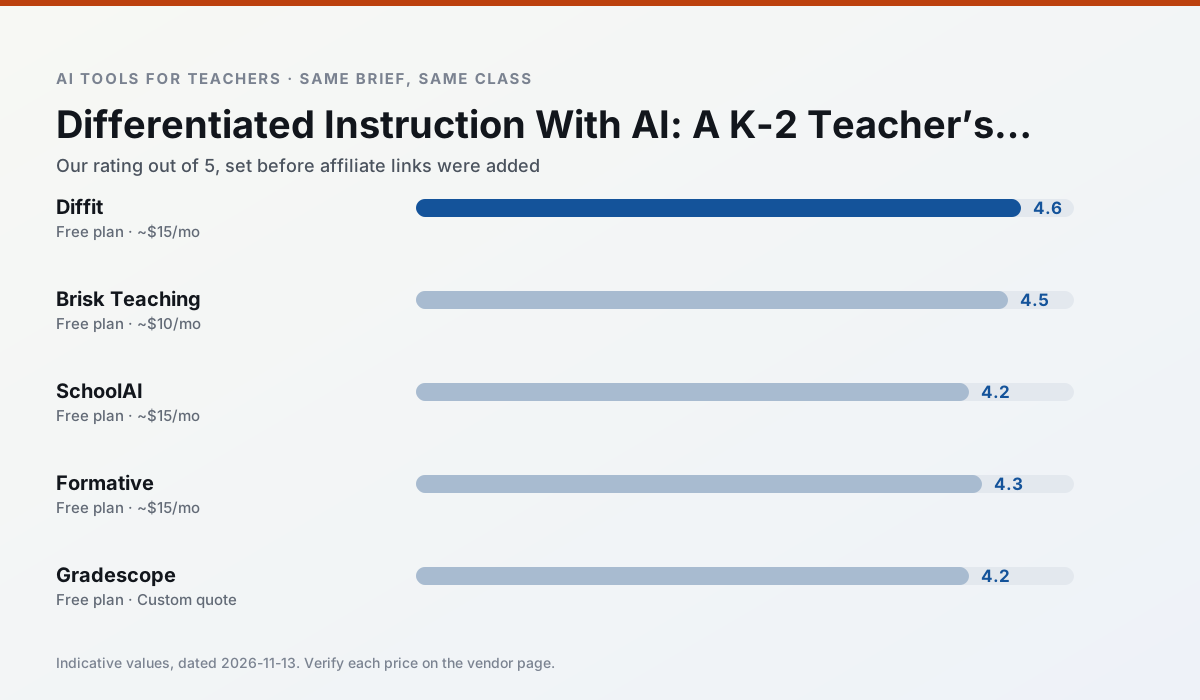
Side by side
Comparison table
Ratings reflect our timed classroom workflow, not vendor claims. Prices are indicative — verify on the vendor site.
| Tool | Best for | Free tier | Indicative paid plan | Standout feature | Our rating | Verdict | Try the tool |
|---|---|---|---|---|---|---|---|
| Diffit | differentiated instruction · reading intervention | Yes — Limited generations per month | ~$15 /user/mo | Lexile-style leveling | 4.6 / 5 | Top pick | Try free |
| Brisk Teaching | feedback on writing · grading | Yes — Limited actions per month | ~$10 /user/mo | Works inside Google Docs | 4.5 / 5 | Top pick | Try free |
| SchoolAI | student-safe AI · differentiated instruction | Yes — Limited seats | ~$15 /user/mo | Teacher-monitored student chats | 4.2 / 5 | Strong option | Try free |
| Formative | formative assessment · grading | Yes — Core assessment tools | ~$15 /user/mo | Live student responses | 4.3 / 5 | Strong option | Try free |
| Gradescope | grading · rubric creation | Yes — Limited courses | Custom quote | Bubble sheet and handwriting capture | 4.2 / 5 | Strong option | Try free |
| Kahoot! | quiz generation · review lessons | Yes — Limited player count | ~$10 /user/mo | AI question builder | 4.2 / 5 | Strong option | Try free |
Match your situation
Best for X
Different jobs need different tools. Here is what we would open first in each case.
Diffit runs in a browser tab with no extension, no student accounts and no onboarding call, so you can test it in a free period.
Brisk Teaching answers the three questions a district actually asks: rostering, admin controls and a data-processing agreement. That is usually what decides a school purchase.
If there is no budget, start with SchoolAI: free plan with clearest quota is the least punishing free tier here.
On the daily cycle, Formative saves the most edit time per task; the paid tier mostly buys more runs rather than better ones.
Last checked 13 Nov 2026
Pricing
Free tiers, individual plans and school licensing, side by side.
| Tool | Free plan | Individual / paid | School & district | Billing note | Verify |
|---|---|---|---|---|---|
| Diffit | $0 — Limited generations per month | ~$15 /user/mo | Custom quote | Indicative — verify on vendor site | Vendor |
| Brisk Teaching | $0 — Limited actions per month | ~$10 /user/mo | Custom quote | Indicative — verify on vendor site | Vendor |
| SchoolAI | $0 — Limited seats | ~$15 /user/mo | Custom quote | Indicative — verify on vendor site | Vendor |
| Formative | $0 — Core assessment tools | ~$15 /user/mo | Custom quote | Indicative — verify on vendor site | Vendor |
| Gradescope | $0 — Limited courses | Custom quote | Custom quote | LMS integration and support | Vendor |
| Kahoot! | $0 — Limited player count | ~$10 /user/mo | Custom quote | Indicative — verify on vendor site | Vendor |
Editorial rule: pricing is re-checked every 2–3 months and the top 50 pages are refreshed every 6 months. See our funding policy.
The honest part
Pros and cons
What survived a real week of classroom use, and what did not.
Pros
- Excellent for mixed-ability classes
- Produces printable and digital versions
- Minimal setup
Cons
- Narrower scope than all-in-one suites
- Leveling is approximate, not a formal assessment
- Heavy use burns through the free quota
Pros
- No copy-paste between tools
- Fast inline feedback on student drafts
- Gentle learning curve
Cons
- Chrome-first workflow
- Extension permissions need IT approval
- Free quota is tight
Pros
- Designed for district approval
- Teacher visibility into student use
- Good safeguarding defaults
Cons
- Requires school-wide buy-in
- Less flexible than general LLMs
- Pricing is mostly quote-based
Pros
- Strong data for intervention groups
- Works with existing PDFs and Docs
- Good LMS integrations
Cons
- Steeper setup than quiz games
- Best value requires school-wide rollout
- Price adds up per teacher
Pros
- Large time savings on paper assessments
- Consistent rubric application
- Detailed item analytics
Cons
- Overkill for elementary classrooms
- Institutional pricing is opaque
- Setup effort is real
In the classroom
Use cases
Five concrete workflows, with the tool we would open for each one.
Regrouping students after an assessment
Summarise anonymised results into skill groups, then generate one activity per group. Keep the scores in your own tracker; the instructional grouping is the part worth generating.
Recommended: DiffitA weekly family newsletter from bullet notes
Newsletters fail on length, not tone. Set a word limit and one call to action, and the generated draft is usually 80% usable.
Recommended: Brisk TeachingA parent email in two languages
Draft in plain, warm language with no names, translate, then back-translate the important sentences to check meaning. Keep specific incidents out of the prompt and add them yourself.
Recommended: SchoolAIRubric and feedback comments in one pass
Reorder the workflow so the rubric is yours and the comments are generated. Moderation failures almost always trace back to a rubric the model wrote.
Recommended: FormativeThree reading levels from one source text
Paste a vetted text, ask for supported, core and extension versions, then check the vocabulary list by hand. Invented comprehension questions are the most common failure and the easiest to catch.
Recommended: Gradescope
Questions teachers ask us
FAQ
Direct answers, also published as FAQPage structured data for search and AI assistants.
Can AI do differentiated instruction at K-2 level?
Which tool is best for differentiated instruction?
What is the biggest risk?
Sources & further reading
Our recommendation
Try MagicSchool AI free for your next differentiated instruction task
A large library of teacher-specific AI generators in one dashboard. Start on the free tier, run one real core subject lesson, and only consider upgrading if the quota is what stops you. Disclosure: we may earn a commission (30% recurring) at no extra cost to you.
Some links on this page are affiliate links. We may earn a commission at no extra cost to you. Our rankings are editorial and never pay-to-play. Never enter student PII into a free consumer account.
Keep reading
Related comparisons in this cluster.
Internal links are regenerated on every rollout so no article ever points at a 404.