The short answer
- Jasper is our default pick for teachers who need to document accessible alternatives quickly; Originality.ai is better when differentiation is the bottleneck.
- Free-tier reality for this shortlist: Jasper: No ongoing free plan; Originality.ai: No ongoing free plan; Writesonic: Yes — Limited credits. Treat every paid figure as indicative until you have read the vendor page; only the free quota is something you can test yourself this week.
- Every AI output for accommodations needs a teacher review, especially standards codes, core subject accuracy, and anything in an IEP, assessment or family message.
- Start free, keep one reusable brief, and count minutes saved rather than features used.
Start with Jasper on its free plan.
At 3:45 on a Tuesday afternoon, my desk looks like a paper shredder exploded. I had seven IEP review meetings scheduled for the end of the week, a stack of reading passages that were way too dense for my second-year English language learners, and zero energy left to reinvent the wheel. We are expected to differentiate every single text, rewrite parent letters so they actually make sense, and keep data logs that would impress a data scientist. Using AI accommodations for elementary teachers isn't about chasing tech trends anymore. It is about surviving a caseload that stopped making sense three years ago.
If you have tried using generic chatbots for lesson planning, you already know the frustration. You ask for a modified reading passage and get back something that looks like it was written by a nineteenth-century novelist who swallowed a dictionary. To make these tools work in a real primary classroom, you need to know which platforms handle specific workloads and where the guardrails have to go up. For a broader look at how these systems fit into daily routines, check out the best AI tools for teachers in 2026.
Writing Parent Communications That Actually Land
When you need to send home sensitive updates about a student's accommodation plan, tone matters. You want clarity without sounding clinical, and firmness without sounding defensive. Jasper is a brand-voice writing assistant priced around $39 per user per month on an indicative plan, and it shines here. It has no free tier and zero education-specific features, but its long-form editor and brand-voice controls keep your communication consistent across multiple newsletters or district-mandated update letters.
The catch is that Jasper is built for marketing teams, making it expensive overkill for a single classroom. More importantly, it is not intended for student data. You never paste real names, specific diagnoses, or identifiable metrics into it. Use it to draft the structure of a difficult conversation or polish a weekly family update, keeping all student references strictly anonymous. If you need primary-level differentiation ideas specifically for early grades, take a look at our guide on AI accommodations for K-2 classrooms.
Generating Leveled Texts Without Inventing Facts
Every elementary teacher knows the pain of finding a great science article that half the room cannot decode. You can feed a vetted, non-identifiable source text into an AI workspace to generate multiple Lexile levels, but you have to watch the comprehension checks like a hawk. Invented questions and distorted facts are the most common failures of text-leveling workflows.
Prompt: "Act as an elementary reading specialist. Take this paragraph about the water cycle and rewrite it into three versions: Supported (low 2nd grade vocabulary, short sentences), Core (grade-level 3rd), and Extension (4th grade challenge). Include three multiple-choice comprehension questions for each version."
First draft output: The tool generated three clean text levels, but the comprehension questions for the supported version relied on idioms that second-grade English learners wouldn't know, and the answer key marked a distractor as correct by mistake.
Two edits that made it usable:
- Swapped the idioms in the supported question set for literal comprehension checks based explicitly on the text.
- Manually verified the answer key twice, correcting the faulty multiple-choice option before printing.
Managing IEP Present-Levels Drafts Safely
Drafting IEP present levels of performance takes hours of cross-referencing standardized test scores, work samples, and behavioral logs. Notion AI, available for about $10 per user per month on an indicative plan, acts as a flexible workspace for organizing these long-term curriculum records and student notes. It handles team collaboration well, though its pricing has shifted over time and setup requires significant initial organization.
The golden rule here is aggregation and anonymization. Never store identifiable student personal information in personal workspaces unless your district has an explicit, vetted enterprise agreement. When drafting present levels, ask the AI for observable, measurable statements based on anonymized trend data. You must replace every single generated number with your own precise progress monitoring data before a case manager or a parent ever sees the document.
Spot-Checking Question Banks and Exit Tickets
When building a five-minute exit ticket set, generators love to sneak in a second recall question when you specifically asked for an application task. To keep formative assessment honest, ask the tool for one recall item, one application item, and one reasoning item, and then ruthlessly delete the extra recall question that invariably slips through.
If you are pulling a question bank from an existing PDF, feed the source into a tool like Writesonic, which costs around $16 per user per month on an indicative plan. It offers a reasonable free trial and plenty of content templates, making it cheaper than enterprise writing suites. However, its output can be generic, and its credit system is notoriously confusing. Spot-check every single answer key it produces, keeping in mind that numerical calculation items are consistently its least reliable output.
Student-Safe Workspaces and Institutional Control
If you want students interacting directly with an AI tool under your supervision, consumer-grade chatbots are out of the question. SchoolAI provides a school-safe workspace with teacher-controlled student spaces, costing around $15 per user per month on an indicative plan with limited free seats. It gives teachers real-time visibility into student use and comes with built-in safeguarding defaults that align with district requirements.
On the administrative and publishing side, tools like Originality.ai run about $12 per user per month on an indicative plan for content QA and bulk scanning. While mixed-ability classrooms often require diverse content creation, remember that AI detection tools produce false positives and should never be used as the sole evidence of academic dishonesty. They are QA workflows for publishers, not disciplinary tools for children. Meanwhile, platforms like Turnitin Clarity and Feedback Studio offer institutional writing feedback and similarity checking with established FERPA agreements, though individual teachers cannot purchase licenses independently.
When things go wrong, they go wrong fast. Last month, an automated lesson extension prompt suggested an online game that required creating an unapproved student account. I caught it during my prep period because I clicked the link instead of trusting the output, and I immediately pivoted back to a hands-on manipulative activity. Another time, a quick quiz generator hallucinated an entire ecosystem fact that contradicted our science curriculum. I fixed it with a red pen before copying the worksheet. AI tools are capable assistants, but you remain the editor in chief.
FAQ
Can AI do accommodations at Elementary level?
It can produce a first draft and a structure. The level judgement, the standards check and the tone are teacher decisions.
Which tool is best for accommodations?
Jasper on the evidence in this article, with Originality.ai as the second opinion. Neither replaces the review step.
What is the biggest risk?
A confident, plausible output that nobody checked. The five checks below exist for that reason.
Sources
- Jasper pricing and product details: Jasper.ai Pricing
- Originality.ai features and verification limits: Originality.ai
- Writesonic plans and credit system overview: Writesonic Pricing
- Notion AI subscription tiers: Notion Pricing
- SchoolAI safety and district workspace documentation: SchoolAI
Side by side
Comparison table
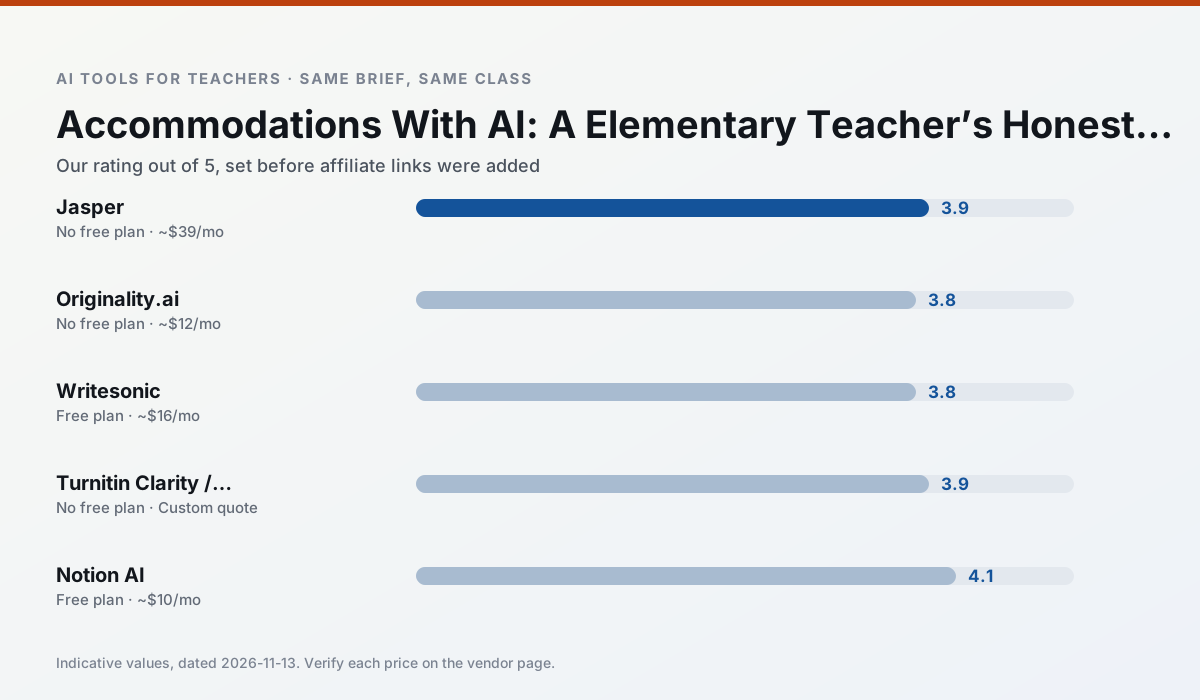
Ratings reflect our timed classroom workflow, not vendor claims. Prices are indicative — verify on the vendor site.
| Tool | Best for | Free tier | Indicative paid plan | Standout feature | Our rating | Verdict | Try the tool |
|---|---|---|---|---|---|---|---|
| Jasper | newsletters · parent communication | No ongoing free plan | ~$39 /user/mo | Brand voice profiles | 3.9 / 5 | Situational | Try free |
| Originality.ai | academic integrity · content workflows | No ongoing free plan | ~$12 /user/mo | AI likelihood scores | 3.8 / 5 | Situational | Try free |
| Writesonic | newsletters · parent communication | Yes — Limited credits | ~$16 /user/mo | Article and email generators | 3.8 / 5 | Situational | Try free |
| Turnitin Clarity / Feedback Studio | feedback on writing · academic integrity | No ongoing free plan | Custom quote | Similarity reports | 3.9 / 5 | Situational | Try free |
| Notion AI | curriculum mapping · unit planning | Yes — Limited AI usage | ~$10 /user/mo | Linked databases | 4.1 / 5 | Situational | Try free |
| SchoolAI | student-safe AI · differentiated instruction | Yes — Limited seats | ~$15 /user/mo | Teacher-monitored student chats | 4.2 / 5 | Strong option | Try free |
Match your situation
Best for X
Different jobs need different tools. Here is what we would open first in each case.
Jasper is the steadiest of this set at plain, respectful language; names and specific incidents still belong in your draft, not the prompt.
Originality.ai keeps the same task across levels, which is what makes a differentiated set defensible in moderation.
Writesonic is the student-facing option here with boundaries a teacher can actually set and supervise.
Turnitin Clarity / Feedback Studio's free plan is the most usable in this comparison: a quota that survives a normal week. Not enough for a department, enough for one teacher to decide.
Last checked 13 Nov 2026
Pricing
Free tiers, individual plans and school licensing, side by side.
| Tool | Free plan | Individual / paid | School & district | Billing note | Verify |
|---|---|---|---|---|---|
| Jasper | No ongoing free tier | ~$39 /user/mo | ~$59+ /user/mo | Indicative — verify on vendor site | Vendor |
| Originality.ai | No ongoing free tier | ~$12 /user/mo | Custom quote | Indicative — verify on vendor site | Vendor |
| Writesonic | $0 — Limited credits | ~$16 /user/mo | ~$49 /user/mo | Indicative — verify on vendor site | Vendor |
| Turnitin Clarity / Feedback Studio | No ongoing free tier | Custom quote | Custom quote | LMS-wide deployment | Vendor |
| Notion AI | $0 — Limited AI usage | ~$10 /user/mo | ~$8 /user/mo | Indicative — verify on vendor site | Vendor |
| SchoolAI | $0 — Limited seats | ~$15 /user/mo | Custom quote | Indicative — verify on vendor site | Vendor |
Editorial rule: pricing is re-checked every 2–3 months and the top 50 pages are refreshed every 6 months. See our funding policy.
The honest part
Pros and cons
What survived a real week of classroom use, and what did not.
Pros
- Consistent tone across communications
- Strong long-form editor
- Good for district comms teams
Cons
- Priced for marketing teams
- Overkill for one classroom
- No education-specific features
Pros
- Useful for content publishing QA
- Fast bulk scanning
- Transparent credit model
Cons
- AI detection produces false positives
- Should never be sole evidence of misconduct
- Not a teaching tool
Pros
- Cheaper than enterprise writing suites
- Many templates
- Reasonable free trial
Cons
- Generic classroom output
- Credit system is confusing
- Limited education context
Pros
- Already licensed at many schools
- Consistent institutional workflow
- Detailed revision history
Cons
- Individual teachers cannot buy it
- AI detection remains contested
- Heavy administrative setup
Pros
- Great for long-term curriculum records
- Strong team collaboration
- Flexible structure
Cons
- Setup time is significant
- AI add-on pricing changed more than once
- Not purpose-built for lesson generation
In the classroom
Use cases
Five concrete workflows, with the tool we would open for each one.
An IEP present-levels first draft
Use aggregated, anonymised data only. Ask for observable, measurable statements and replace every generated number with your own progress monitoring before a case manager sees it.
Recommended: JasperA five-minute exit ticket set
Ask for one recall, one application and one reasoning item, then delete the second recall question every generator sneaks in.
Recommended: Originality.aiA question bank from a PDF or article
Feed a non-identifiable source and ask for items tagged by difficulty with the misconception behind each distractor. Spot-check every answer key; numerical items are least reliable.
Recommended: WritesonicA substitute folder that needs no context
The value here is structure, not creativity. Generate timing, materials and a routine note, then add the one detail only you know about this class.
Recommended: Turnitin Clarity / Feedback StudioThree reading levels from one source text
Paste a vetted text, ask for supported, core and extension versions, then check the vocabulary list by hand. Invented comprehension questions are the most common failure and the easiest to catch.
Recommended: Notion AI
Questions teachers ask us
FAQ
Direct answers, also published as FAQPage structured data for search and AI assistants.
Can AI do accommodations at Elementary level?
Which tool is best for accommodations?
What is the biggest risk?
Sources & further reading
Our recommendation
Try Jasper free for your next accommodations task
Brand-voice writing assistant for school communications teams. Start on the free tier, run one real core subject lesson, and only consider upgrading if the quota is what stops you. Disclosure: we may earn a commission (varies) at no extra cost to you.
Some links on this page are affiliate links. We may earn a commission at no extra cost to you. Our rankings are editorial and never pay-to-play. Never enter student PII into a free consumer account.
Keep reading
Related comparisons in this cluster.
Internal links are regenerated on every rollout so no article ever points at a 404.