The short answer
- Notion AI is our default pick for Special education who need to structure accommodation language quickly; Turnitin Clarity / Feedback Studio is better when differentiation is the bottleneck.
- The cheapest honest test is a week of real work on the free plans: Notion AI: Yes — Limited AI usage; Turnitin Clarity / Feedback Studio: No ongoing free plan; Class Companion: Yes — Limited assignments. If a tool is still open on Friday, it has earned a paid conversation.
- Every AI output for 504 plans needs a teacher review, especially standards codes, core subject accuracy, and anything in an IEP, assessment or family message.
- Everything on this page dates from 2026-11-13; where a price could not be re-read, the row says so.
Start with Notion AI on its free plan.
It is 8:42 PM on a Thursday in November 2026. My kitchen table is buried under three psychoeducational evaluations, a stack of blank accommodation logs, and a half-eaten granola bar. I have four distinct 504 accommodation plans to draft by tomorrow morning, and my brain stopped working around the fourth paragraph of the third file.
If you teach special education, you already know this panic. Writing legally binding, distinct, and practical accommodations for kids with ADHD, anxiety, or physical impairments takes hours. You spend half your energy trying to phrase measurable goals that will actually hold up at an annual review without sounding like boilerplate nonsense.
Using AI 504 plans for special education does not solve the underlying administrative bloat, but it can take the heavy lift out of the drafting process. The trick is knowing which platforms handle student data safely and which ones will generate a mess of generic accommodations that violate a student's rights before recess even starts.
Managing Records and Long-Term Goals with Notion AI
When you are tracking long-term student progress across multiple tiers of support, standard word processors become black holes. Notion AI works well for building structured databases of student accommodations because it combines notes, trackers, and text generation in one workspace.
On the free tier, you get limited AI usage, while the paid tier runs around $10 per user per month. Its biggest strength is keeping extensive curriculum records clean and searchable. The downside is that setting up your database takes significant upfront time, and the pricing model has shifted more than once. Most importantly, never store student PII—personally identifiable information—in personal workspaces. Keep your databases anonymized using student ID numbers or initials if you use a personal account, and rely on district-approved instances for anything sensitive.
Prompt: Act as a veteran special education case manager. Draft three measurable, classroom-ready accommodations for a seventh-grade student with severe processing speed delays who struggles with multi-step written directions. Do not include student names.
First-pass output: The student will be given extra time on all tests and quizzes. The teacher will repeat instructions slowly. The student will sit near the front of the room.
Edits that made it usable:
- Changed "extra time" to "50% extended time on assessments exceeding 15 minutes, provided proactively."
- Replaced "repeat instructions slowly" with "written multi-step directions broken down into single-step visual prompts delivered via checklist."
School-Safe Environments with SchoolAI
If your district IT department breaks out in hives every time you mention generative tools, you need a platform built from the ground up for safeguarding. SchoolAI is designed for district approval, offering strong teacher visibility into student use and reliable default safeguards.
Priced around $15 per user per month with limited seats on the free tier, it functions as a school-safe AI workspace with teacher-controlled student spaces. It is our top pick for student-safe deployments because it provides district-focused data processing agreements and audit logs. The catch is that it requires school-wide buy-in to unlock its full utility, and it lacks the free-form flexibility of open-ended consumer models. When writing 504 plans, you can use its secure spaces to help students reflect on their own accommodation needs during check-ins, keeping everything inside a walled garden.
Supporting Mixed-Ability Classes via Turnitin Clarity
Writing accommodations is only half the battle. You also have to grade the modified assignments those plans require. Turnitin Clarity and Feedback Studio are already licensed at many secondary schools, offering consistent institutional workflows and detailed revision history for student writing.
There is no free tier, and individual teachers cannot buy subscriptions directly since it requires institutional licensing. AI detection remains contested, and the administrative setup is heavy. However, if your school already licenses it, it is our pick for mixed-ability classes because it helps teachers parse student drafts without losing track of specific accommodations. When a student on a 504 plan submits an essay where spelling and grammar are explicitly not graded per their accommodation, you can configure feedback parameters to focus strictly on structural reasoning.
Parent-Facing Writing with Class Companion
Communicating accommodation updates to families can drain what little evening time you have left. Class Companion helps generate fast, specific comments on student work, making it our pick for parent-facing writing and formative feedback.
It includes a free tier for limited assignments, with paid plans sitting around $12 per user per month. It shines when students submit work done on paper because it scans and provides targeted commentary, which is ideal for mixed paper-and-digital classrooms. The limitations are real: scan quality directly affects accuracy, and the feedback still requires heavy teacher review before you send it home.
Consider this common workflow failure: newsletters and parent updates fail on length rather than tone. When drafting an update about a student's 504 transition milestones, feed your raw bullet notes into an AI assistant with strict constraints.
Prompt: Write a 100-word parent update email explaining that their child successfully utilized their sensory break accommodation three times this week. Tone: warm, professional. Call to action: reply to schedule our bi-weekly check-in.
First-pass output: Dear Parent, I am happy to report that your child had a wonderful week. They used their sensory break accommodation three times. This is great progress! Please let me know when you want to meet.
Edits that made it usable:
- Added specific context: "They independently recognized when they needed a reset during morning independent reading."
- Replaced the vague closing with a direct link to a calendar booking tool for Thursday afternoon.
If you are exploring broader frameworks, read our guide on the best AI tools for teachers. You can also pair these writing workflows with targeted strategies found in our breakdown of AI accommodations for special education.
Creating Multi-Media Supports with Fliki and Murf AI
Sometimes a 504 plan mandates alternative presentation formats, such as audio books or visual explainers for complex concepts. This is where media generators earn their keep. Fliki handles text-to-video conversions using stock media and AI voiceovers for roughly $21 per user per month, while Murf AI provides studio-quality voiceovers for presentations and audio materials at about $19 per user per month.
Both tools have restrictive limits: Fliki operates on strict minute-based allocations, and Murf features a trial-only output on its free tier. Neither tool is built specifically for education, meaning you must scrub out any potential student PII before generating content. Use them to turn dry, text-heavy accommodation guides into digestible audio files for auditory learners, or to create quick visual explainers for kids who need predictable routines.
Always check license terms before distributing generated audio or video publicly, and remember that these tools are strictly content producers, not compliance assistants. Keep your compliance documents in your secure district system, and let AI handle the heavy lifting of drafting, formatting, and refining your daily practice.
FAQ
Can AI do 504 plans at mixed-grade level?
It can produce a first draft and a structure. The level judgement, the standards check and the tone are teacher decisions.
Which tool is best for 504 plans?
Notion AI on the evidence in this article, with Turnitin Clarity / Feedback Studio as the second opinion. Neither replaces the review step.
What is the biggest risk?
A confident, plausible output that nobody checked. The five checks below exist for that reason.
Sources
- Notion AI Pricing and Workspace Features, Notion.so (2026)
- Turnitin Clarity and Feedback Studio Institutional Specifications, Turnitin.com (2026)
- Class Companion Platform Documentation, Classcompanion.com (2026)
- SchoolAI Privacy, Security, and Compliance Overview, SchoolAI.com (2026)
- Fliki Text-to-Video Feature Set, Fliki.ai (2026)
- Murf AI Voice Generation and Licensing Terms, Murf.ai (2026)
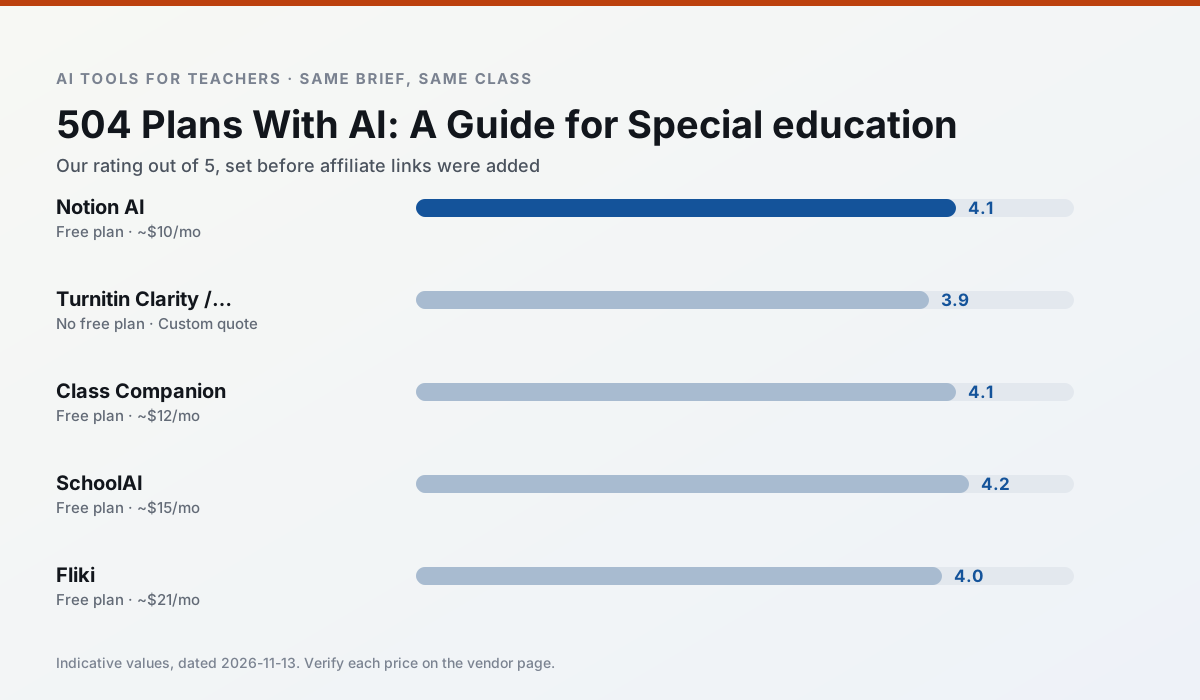
Side by side
Comparison table
Ratings reflect our timed classroom workflow, not vendor claims. Prices are indicative — verify on the vendor site.
| Tool | Best for | Free tier | Indicative paid plan | Standout feature | Our rating | Verdict | Try the tool |
|---|---|---|---|---|---|---|---|
| Notion AI | curriculum mapping · unit planning | Yes — Limited AI usage | ~$10 /user/mo | Linked databases | 4.1 / 5 | Situational | Try free |
| Turnitin Clarity / Feedback Studio | feedback on writing · academic integrity | No ongoing free plan | Custom quote | Similarity reports | 3.9 / 5 | Situational | Try free |
| Class Companion | grading · feedback on writing | Yes — Limited assignments | ~$12 /user/mo | Handwriting recognition | 4.1 / 5 | Situational | Try free |
| SchoolAI | student-safe AI · differentiated instruction | Yes — Limited seats | ~$15 /user/mo | Teacher-monitored student chats | 4.2 / 5 | Strong option | Try free |
| Fliki | video lessons · audio lessons | Yes — Watermarked, limited minutes | ~$21 /user/mo | Blog/text to video | 4.0 / 5 | Situational | Try free |
| Murf AI | audio lessons · accessibility | Yes — Trial-only output | ~$19 /user/mo | Voice fine-tuning | 4.1 / 5 | Situational | Try free |
Match your situation
Best for X
Different jobs need different tools. Here is what we would open first in each case.
Notion AI is the student-facing option here with boundaries a teacher can actually set and supervise.
Turnitin Clarity / Feedback Studio produces levelled versions from one source in a single pass, which is the highest-value differentiation shortcut we tested at this level.
Family-facing drafts from Class Companion need the fewest rewrites for warmth without overpromising, which is the usual failure mode.
SchoolAI answers the three questions a district actually asks: rostering, admin controls and a data-processing agreement. That is usually what decides a school purchase.
Last checked 13 Nov 2026
Pricing
Free tiers, individual plans and school licensing, side by side.
| Tool | Free plan | Individual / paid | School & district | Billing note | Verify |
|---|---|---|---|---|---|
| Notion AI | $0 — Limited AI usage | ~$10 /user/mo | ~$8 /user/mo | Indicative — verify on vendor site | Vendor |
| Turnitin Clarity / Feedback Studio | No ongoing free tier | Custom quote | Custom quote | LMS-wide deployment | Vendor |
| Class Companion | $0 — Limited assignments | ~$12 /user/mo | Custom quote | Indicative — verify on vendor site | Vendor |
| SchoolAI | $0 — Limited seats | ~$15 /user/mo | Custom quote | Indicative — verify on vendor site | Vendor |
| Fliki | $0 — Watermarked, limited minutes | ~$21 /user/mo | ~$66 /user/mo | Indicative — verify on vendor site | Vendor |
| Murf AI | $0 — Trial-only output | ~$19 /user/mo | ~$39 /user/mo | Indicative — verify on vendor site | Vendor |
Editorial rule: pricing is re-checked every 2–3 months and the top 50 pages are refreshed every 6 months. See our funding policy.
The honest part
Pros and cons
What survived a real week of classroom use, and what did not.
Pros
- Great for long-term curriculum records
- Strong team collaboration
- Flexible structure
Cons
- Setup time is significant
- AI add-on pricing changed more than once
- Not purpose-built for lesson generation
Pros
- Already licensed at many schools
- Consistent institutional workflow
- Detailed revision history
Cons
- Individual teachers cannot buy it
- AI detection remains contested
- Heavy administrative setup
Pros
- Useful where work is done on paper
- Fast, specific comments
- Good math support
Cons
- Scan quality affects accuracy
- Narrow use case
- Feedback still needs teacher review
Pros
- Designed for district approval
- Teacher visibility into student use
- Good safeguarding defaults
Cons
- Requires school-wide buy-in
- Less flexible than general LLMs
- Pricing is mostly quote-based
Pros
- No avatar needed
- Good for explainer visuals
- Simple editor
Cons
- Minute-based limits
- Output can look generic
- Price jumps between tiers
In the classroom
Use cases
Five concrete workflows, with the tool we would open for each one.
A weekly family newsletter from bullet notes
Newsletters fail on length, not tone. Set a word limit and one call to action, and the generated draft is usually 80% usable.
Recommended: Notion AIRegrouping students after an assessment
Summarise anonymised results into skill groups, then generate one activity per group. Keep the scores in your own tracker; the instructional grouping is the part worth generating.
Recommended: Turnitin Clarity / Feedback StudioA substitute folder that needs no context
The value here is structure, not creativity. Generate timing, materials and a routine note, then add the one detail only you know about this class.
Recommended: Class CompanionA question bank from a PDF or article
Feed a non-identifiable source and ask for items tagged by difficulty with the misconception behind each distractor. Spot-check every answer key; numerical items are least reliable.
Recommended: SchoolAIA five-minute exit ticket set
Ask for one recall, one application and one reasoning item, then delete the second recall question every generator sneaks in.
Recommended: Fliki
Questions teachers ask us
FAQ
Direct answers, also published as FAQPage structured data for search and AI assistants.
Can AI do 504 plans at mixed-grade level?
Which tool is best for 504 plans?
What is the biggest risk?
Sources & further reading
Our recommendation
Try Notion AI free for your next 504 plans task
AI-assisted notes, databases and curriculum planning in one workspace. Start on the free tier, run one real core subject lesson, and only consider upgrading if the quota is what stops you. Disclosure: we may earn a commission (varies) at no extra cost to you.
Some links on this page are affiliate links. We may earn a commission at no extra cost to you. Our rankings are editorial and never pay-to-play. Never enter student PII into a free consumer account.
Keep reading
Related comparisons in this cluster.
Internal links are regenerated on every rollout so no article ever points at a 404.