The short answer
- Writesonic is our default pick for teachers who need to draft a standards-aware lesson plan quickly; Kahoot! is better when differentiation is the bottleneck.
- Start with Writesonic on its free plan, keep Kahoot! as the second opinion, and do not open a card until the quota, not the feature list, is what stops you.
- Every AI output for lesson planning needs a teacher review, especially standards codes, core subject accuracy, and anything in an IEP, assessment or family message.
- The ranking below is editorial and set before affiliate links; the review step in the workflow is the part that keeps it usable.
Start with Writesonic on its free plan.
It is 11:45 PM on a Tuesday in November 2026, and I am staring at three open tabs of psychoeducational evaluations, a cold cup of coffee, and a blinking cursor on an IEP goal page that has been empty for twenty minutes. Every special education case manager knows this exact brand of fatigue. When you are juggling twenty-eight active caseloads, four manifestation determinations, and a stack of re-evaluations, the temptation to paste a student's profile into an AI tool and let it draft your Present Levels of Academic Achievement and Functional Performance is nearly overwhelming. Do not do it. Using AI for IEP writing: legal risks a case manager should know is not a theoretical webinar topic; it is about keeping your license and keeping your district out of a due process hearing.
The FERPA Trap in General-Purpose Tools
The single biggest mistake special educators make is treating consumer-grade AI models like a secure vault. Tools like Writesonic and Claude are brilliant for administrative drafting, long-context document review, and general planning. Writesonic offers plenty of templates at roughly $16 per user per month, and Claude handles long-context planning exceptionally well for around $20 per user per month, but neither is built for student data. If you paste a student’s diagnostic scores, medical diagnoses, and full name into a consumer-tier AI prompt box, you have likely violated the Family Educational Rights and Privacy Act before your morning prep period even starts.
Even when paid tiers offer data privacy controls, consumer platforms do not automatically align with your district’s specific data processing agreements. When you need general assistance without student identifiers, you might look at tools that make the best free option lists like Quizizz, or browser-based helpers like Brisk Teaching at roughly $10 per user per month, which brings AI inline into Google Docs and Slides. Even so, Brisk reads document content directly, meaning any unredacted IEP draft sitting in that tab is within reach of the extension's processing scope. If your district has not cleared the tool through IT and signed a DPA, you are taking a massive compliance gamble.
What You Can Automate Without Breaking the Law
You do not need to feed student names or protected health information into an algorithm to get value out of these platforms. The trick to safe AI use in special education is strict anonymization. If you want to build instructional materials, adapt texts, or generate accommodation ideas, strip every single identifier out of the prompt. For instance, if you are looking for ways to present information at three different reading levels, take a public domain source text and use an assistant to generate supported, core, and extension versions. You must still check the vocabulary list and comprehension questions by hand, because invented reading comprehension prompts are the most common failure point and the easiest to catch.
Prompt:
"Act as a special education curriculum specialist. Based on the following anonymized fifth-grade passage about ecosystems, generate three reading levels: one at a third-grade accessibility level, one at grade level, and one extension version. Provide a five-word vocabulary list for each."

First-pass output:
The model generated three clear text tiers with appropriate vocabulary, but included comprehension questions that referenced fictional characters not present in the original source text.

Edits that made it usable:
1. Stripped out the hallucinated comprehension questions entirely, keeping only the leveled texts and vocabulary lists.
2. Cross-referenced the leveled vocabulary against the students' actual tier-two intervention lists to ensure alignment.
When building quizzes or review games, platforms like Kahoot! at roughly $10 per user per month and Quizizz make it easy to generate practice questions for mixed-ability classrooms. You can safely paste a state standard into Quizizz without exposing any child's IEP data, ensuring your review sessions target the exact skills your students need to practice. For a broader look at how classrooms are adapting these workflows, check out our guide on the best AI tools for teachers.
The Danger of AI-Generated IEP Goals and Baselines
Never let an AI write a Measurable Annual Goal from scratch using real student data. A valid IEP goal requires a precise baseline, specific conditions, a clear behavior, and measurable criteria. When general AI writing tools attempt this, they often produce vague language that sounds professional on the surface but fails the legal test of measurability. A goal that states "The student will improve reading comprehension with 80% accuracy" is useless if the baseline data is fabricated or generalized by an algorithm trying to fill in blanks.
If you use a tool like Claude to help structure a complex accommodation list, you must feed it entirely scrubbed scenarios. Better yet, look to purpose-built educational ecosystems like Khanmigo at roughly $4 per learner per month, which offers nonprofit trust signals and education-first design, though it is still primarily built for student tutoring and teacher scaffolding rather than admin paperwork. If you are exploring targeted interventions for specific plans, you can also consult specialized resources such as our breakdown on AI 504 plans for special education.
Maintaining Human Oversight on Every Document
Every word in a finalized IEP is your professional responsibility. If a due process hearing officer asks why a specific accommodation or modification was selected, you cannot point to a software log and say the machine suggested it. Use AI as a sounding board for phrasing, a grammar checker for rough parent communication emails, or a generator for generic graphic organizers. Never use it to synthesize evaluation summaries, determine placement, or write present levels. Keep your student records in your secure district SIS, and keep the AI strictly in the realm of anonymous brainstorming.
FAQ
Is AI allowed for lesson planning in my school?
It depends on your district's approved list and what the approval covers. Ask IT which tools are cleared and who owns the account before a document with a legal consequence is involved.
Who is responsible if something goes wrong?
The school, and in practice the named teacher who reviewed the output. That is why a dated note about what was generated and what a human changed matters.
What should never go into a prompt?
Names, rosters, scans of student work and gradebook screenshots. Topic-level prompts do most of the work without any of that.
Sources
- Writesonic Pricing and Features: https://writesonic.com/pricing
- Kahoot! Educator Plans: https://kahoot.com/schools-u/pricing/
- Quizizz Educator Tiers: https://quizizz.com/home/pricing
- Brisk Teaching Extension Scope: https://briskteaching.com/
- Khanmigo for Teachers: https://www.khanacademy.org/khanmigo
- Anthropic Claude Privacy and Terms: https://support.anthropic.com/
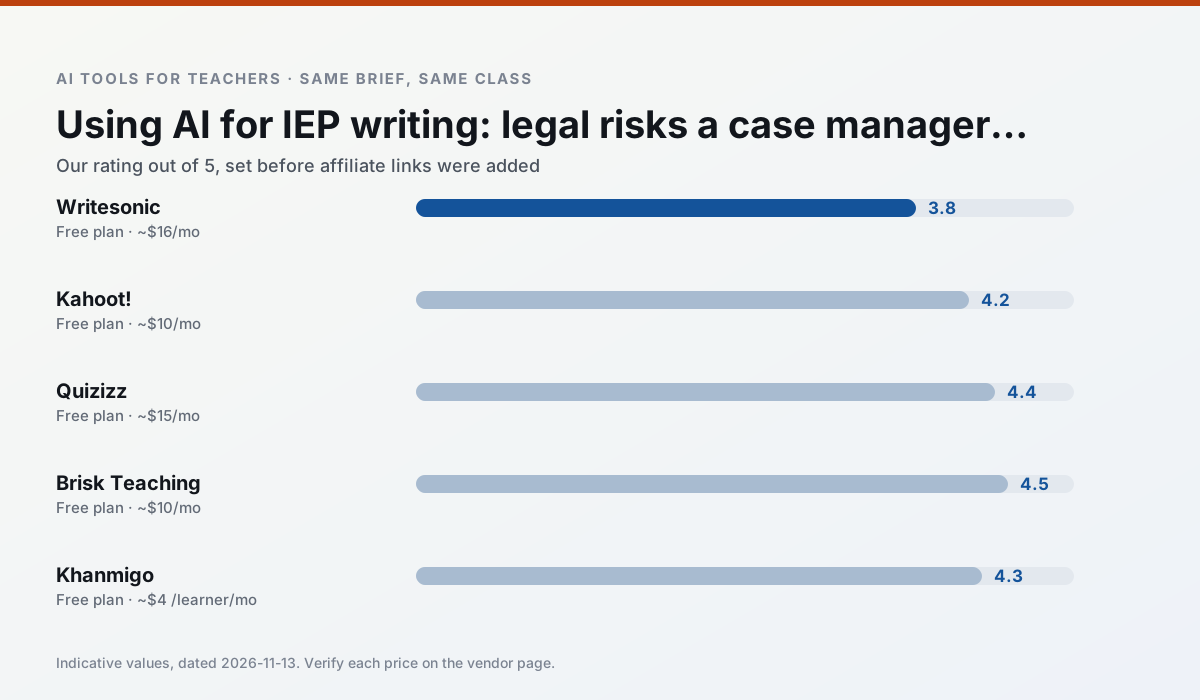
Side by side
Comparison table
Ratings reflect our timed classroom workflow, not vendor claims. Prices are indicative — verify on the vendor site.
| Tool | Best for | Free tier | Indicative paid plan | Standout feature | Our rating | Verdict | Try the tool |
|---|---|---|---|---|---|---|---|
| Writesonic | newsletters · parent communication | Yes — Limited credits | ~$16 /user/mo | Article and email generators | 3.8 / 5 | Situational | Try free |
| Kahoot! | quiz generation · review lessons | Yes — Limited player count | ~$10 /user/mo | AI question builder | 4.2 / 5 | Strong option | Try free |
| Quizizz | quiz generation · formative assessment | Yes — Core quiz creation | ~$15 /user/mo | AI question generator | 4.4 / 5 | Strong option | Try free |
| Brisk Teaching | feedback on writing · grading | Yes — Limited actions per month | ~$10 /user/mo | Works inside Google Docs | 4.5 / 5 | Top pick | Try free |
| Khanmigo | math practice · student tutoring | Yes — US teacher accounts, subject to eligibility | ~$4 /learner/mo | Socratic tutoring rather than answers | 4.3 / 5 | Strong option | Try free |
| Claude | rubric creation · feedback on writing | Yes — Usage-limited | ~$20 /user/mo | Very large context window | 4.4 / 5 | Strong option | Try free |
Match your situation
Best for X
Different jobs need different tools. Here is what we would open first in each case.
Writesonic runs in a browser tab with no extension, no student accounts and no onboarding call, so you can test it in a free period.
Kahoot! answers the three questions a district actually asks: rostering, admin controls and a data-processing agreement. That is usually what decides a school purchase.
If there is no budget, start with Quizizz: free plan with clearest quota is the least punishing free tier here.
Brisk Teaching wins on the default path: fewer clicks to a usable draft, and the interface does not get in the way at 7:40am.
Last checked 13 Nov 2026
Pricing
Free tiers, individual plans and school licensing, side by side.
| Tool | Free plan | Individual / paid | School & district | Billing note | Verify |
|---|---|---|---|---|---|
| Writesonic | $0 — Limited credits | ~$16 /user/mo | ~$49 /user/mo | Indicative — verify on vendor site | Vendor |
| Kahoot! | $0 — Limited player count | ~$10 /user/mo | Custom quote | Indicative — verify on vendor site | Vendor |
| Quizizz | $0 — Core quiz creation | ~$15 /user/mo | Custom quote | Indicative — verify on vendor site | Vendor |
| Brisk Teaching | $0 — Limited actions per month | ~$10 /user/mo | Custom quote | Indicative — verify on vendor site | Vendor |
| Khanmigo | $0 — US teacher accounts, subject to eligibility | ~$4 /learner/mo | Custom quote | Indicative — verify on vendor site | Vendor |
| Claude | $0 — Usage-limited | ~$20 /user/mo | ~$25+ /user/mo | Indicative — verify on vendor site | Vendor |
Editorial rule: pricing is re-checked every 2–3 months and the top 50 pages are refreshed every 6 months. See our funding policy.
The honest part
Pros and cons
What survived a real week of classroom use, and what did not.
Pros
- Cheaper than enterprise writing suites
- Many templates
- Reasonable free trial
Cons
- Generic classroom output
- Credit system is confusing
- Limited education context
Pros
- Instant engagement
- Very low training time
- Strong brand familiarity
Cons
- Less depth for higher-order assessment
- Paid tiers needed for larger classes
- Time pressure suits recall more than reasoning
Pros
- Students already know the interface
- Good reporting
- Works on low-end devices
Cons
- Writing high-quality AI questions still needs review
- Gamification can distract
- Advanced analytics are paid
Pros
- No copy-paste between tools
- Fast inline feedback on student drafts
- Gentle learning curve
Cons
- Chrome-first workflow
- Extension permissions need IT approval
- Free quota is tight
Pros
- Education-first design
- Strong nonprofit trust signal
- Good math scaffolding
Cons
- Availability varies by region
- Less useful for admin paperwork
- Requires student accounts for full value
In the classroom
Use cases
Five concrete workflows, with the tool we would open for each one.
Regrouping students after an assessment
Summarise anonymised results into skill groups, then generate one activity per group. Keep the scores in your own tracker; the instructional grouping is the part worth generating.
Recommended: WritesonicA weekly family newsletter from bullet notes
Newsletters fail on length, not tone. Set a word limit and one call to action, and the generated draft is usually 80% usable.
Recommended: Kahoot!A parent email in two languages
Draft in plain, warm language with no names, translate, then back-translate the important sentences to check meaning. Keep specific incidents out of the prompt and add them yourself.
Recommended: QuizizzRubric and feedback comments in one pass
Reorder the workflow so the rubric is yours and the comments are generated. Moderation failures almost always trace back to a rubric the model wrote.
Recommended: Brisk TeachingThree reading levels from one source text
Paste a vetted text, ask for supported, core and extension versions, then check the vocabulary list by hand. Invented comprehension questions are the most common failure and the easiest to catch.
Recommended: Khanmigo
Questions teachers ask us
FAQ
Direct answers, also published as FAQPage structured data for search and AI assistants.
Is AI allowed for lesson planning in my school?
Who is responsible if something goes wrong?
What should never go into a prompt?
Sources & further reading
Our recommendation
Try Writesonic free for your next lesson planning task
Budget-friendly AI writing and content generation. Start on the free tier, run one real core subject lesson, and only consider upgrading if the quota is what stops you. Disclosure: we may earn a commission (varies) at no extra cost to you.
Some links on this page are affiliate links. We may earn a commission at no extra cost to you. Our rankings are editorial and never pay-to-play. Never enter student PII into a free consumer account.
Keep reading
Related comparisons in this cluster.
Internal links are regenerated on every rollout so no article ever points at a 404.