The short answer
- Murf AI is our default pick for Special education who need to document accessible alternatives quickly; Fliki is better when differentiation is the bottleneck.
- Pricing is where these pages date fastest. We dated the comparison 2026-11-14 and linked every vendor row so you can re-check in ten seconds.
- Every AI output for accommodations needs a teacher review, especially standards codes, core subject accuracy, and anything in an IEP, assessment or family message.
- Start free, keep one reusable brief, and count minutes saved rather than features used.
Start with Murf AI on its free plan.
At 7:40 on a Tuesday morning, I had a stack of worksheets meant for seven different reading levels, six kids missing their assistive listening devices, and a paraprofessional who had just called in sick. Finding working AI accommodations for special education used to mean falling down a three-hour rabbit hole of broken prompts and generic templates. Now, we have specific utility tools that can actually pull their weight in a resource room or inclusion setting, provided you know which buttons to push and which guardrails to keep firmly in place.
If you want a broader look at what is holding up in classrooms right now, check out the best AI tools for teachers. For targeted support work, pairing these systems with workflows for AI 504 plans for special education saves hours of weekend prep. Let us look at what works, what breaks, and how to keep student privacy intact.
Converting Text to Audio Accommodations
For students who need auditory support alongside text, Murf AI stands out as the best free option when you are testing the waters with a trial-only output, though the paid tier runs around $19 per user per month. The audio is remarkably clean, the pacing controls actually make sense, and it drops right into slide decks without messing up your formatting. The catch is that the free tier is purely trial-based and won't sustain a whole term of material creation, and you have to watch out for commercial licensing rules if you are publishing things outside your school walls.
When you need something more visual to anchor an explainer for students with processing gaps, Fliki takes the crown as best overall for daily use at around $21 per user per month. It handles text-to-video with stock media and AI voiceovers without requiring digital avatars that often distract kids on the spectrum. You get minute-based limits, and the output can sometimes look a bit generic if you do not swap out the stock clips, but it is fast enough to spin up a Monday morning vocabulary preview before first period.
Prompt: "Take this paragraph on the water cycle and rewrite it into three distinct reading levels: core, supported with glossaries, and extension. Then generate five comprehension questions for each tier."
What came back: The three reading levels were surprisingly solid, cleanly matching Lexile shifts. However, the comprehension questions for the supported tier asked students to recall abstract details that weren't actually in the modified text, and one of the glossary terms defined 'condensation' as magic.
Two edits that made it usable:
- Stripped out all AI-generated comprehension questions and wrote three literal, find-it-in-the-text questions by hand.
- Replaced the glossary definitions with our classroom anchor chart vocabulary list before printing.
Managing Special Education Workflows and Notes
Keeping curriculum records straight across a caseload of thirty IEPs is a nightmare of fragmented documents. Notion AI, sitting at roughly $10 per user per month with limited free usage, acts as a flexible workspace for notes, databases, and long-term curriculum planning. It is fantastic for tracking team collaboration and keeping accommodation histories in one place, but the setup time is significant, and the pricing structure has shifted more than once. Never store actual student personally identifiable information in these open workspaces.
If you are publishing teacher-created resources to supplement your intervention room or want to share adapted materials on platforms like Teachers Pay Teachers, Surfer SEO remains the best for quick setup at about $79 per month with no free tier. It gives you on-line content optimization and clear scoring, though it is fundamentally designed for resource creators rather than direct classroom instruction and requires basic SEO knowledge to make the cost worthwhile.
Repurposing Recorded Lessons for Review
Some students with executive functioning challenges need to hear instructions or direct instruction multiple times to grasp the multi-step directions. OpusClip, which runs around $15 per user per month with limited monthly clips on the free plan, turns long recorded lessons into short, captioned clips. It is fast, generates brilliant captions, and effectively turns a rambling lecture into bite-sized review segments. The major limitation is that it is heavily optimized for social formats rather than traditional classroom assignments, and you must never upload recordings containing identifiable students due to privacy laws.
When dealing with institutional writing feedback and similarity checking across a high school resource department, Turnitin Clarity and Feedback Studio offer consistent institutional workflows and detailed revision history. These tools require custom institutional quotes and cannot be bought by individual teachers. Furthermore, AI detection remains notoriously contested, and the heavy administrative setup means you are reliant on district IT rather than a quick personal login.
Two Things That Went Wrong and How I Fixed Them
The first major failure happened when I tried to use an AI model to draft an IEP present-levels statement directly from a student's raw data sheet. I forgot to scrub a student's full name and local ID from the prompt, which nearly violated district FERPA compliance before I caught it on the review screen. Now, my golden rule is to use strictly anonymized, aggregated data only, asking for observable, measurable statements, and replacing every single generated number with our actual progress monitoring charts before any case manager sees the draft.
The second breakdown occurred during a rubric-making session. I let the generator write both the rubric criteria and the subsequent feedback comments in one pass. The resulting moderation check failed because the AI had evaluated students against a standard we hadn't actually taught yet. Now, the workflow is strictly reversed: the rubric must always be mine, written from our state standards, and the AI is only allowed to generate sentence starters for feedback comments matched to those pre-existing cells.
FAQ
Can AI do accommodations at mixed-grade level?
It can produce a first draft and a structure. The level judgement, the standards check and the tone are teacher decisions.
Which tool is best for accommodations?
Murf AI on the evidence in this article, with Fliki as the second opinion. Neither replaces the review step.
What is the biggest risk?
A confident, plausible output that nobody checked. The five checks below exist for that reason.
Sources
- Murf AI: Pricing and Voice Studio features (https://murf.ai)
- Fliki: Text-to-Video capabilities and plan limits (https://fliki.ai)
- Surfer SEO: Content editor and optimization data (https://surferseo.com)
- OpusClip: Video repurposing and captioning limits (https://www.opus.pro)
- Turnitin: Feedback Studio and institutional compliance (https://www.turnitin.com)
- Notion AI: Workspace and document features (https://www.notion.so)
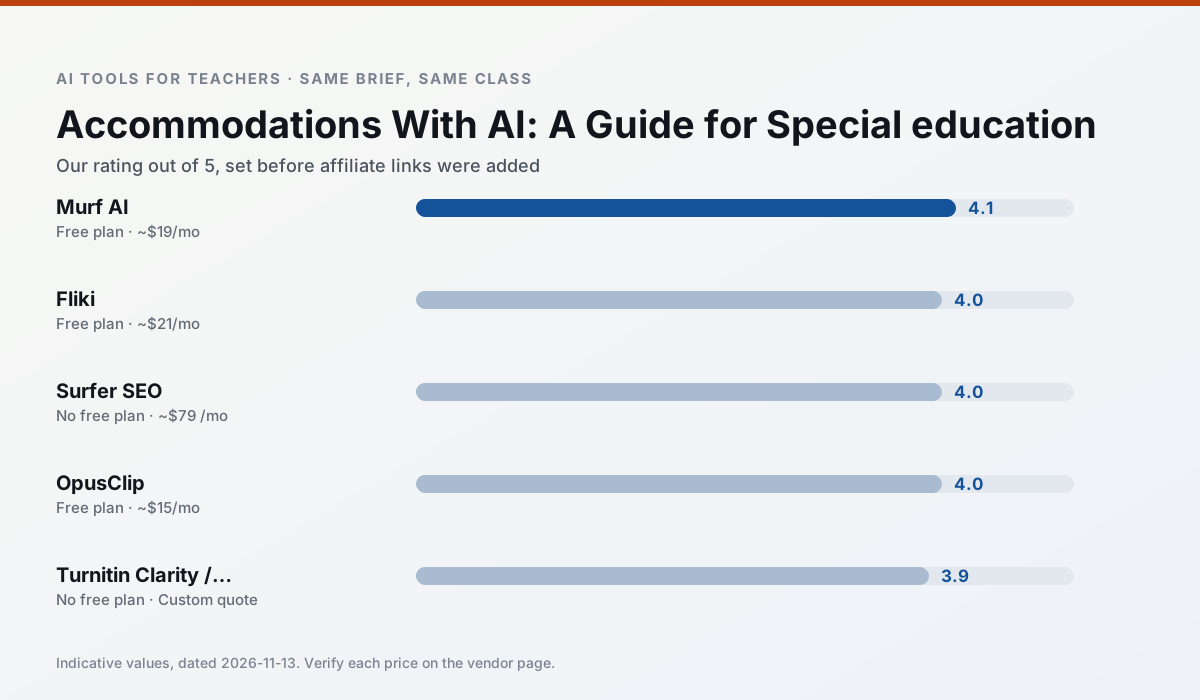
Side by side
Comparison table
Ratings reflect our timed classroom workflow, not vendor claims. Prices are indicative — verify on the vendor site.
| Tool | Best for | Free tier | Indicative paid plan | Standout feature | Our rating | Verdict | Try the tool |
|---|---|---|---|---|---|---|---|
| Murf AI | audio lessons · accessibility | Yes — Trial-only output | ~$19 /user/mo | Voice fine-tuning | 4.1 / 5 | Situational | Try free |
| Fliki | video lessons · audio lessons | Yes — Watermarked, limited minutes | ~$21 /user/mo | Blog/text to video | 4.0 / 5 | Situational | Try free |
| Surfer SEO | teacher bloggers · resource sellers | No ongoing free plan | ~$79 /mo | Content Editor | 4.0 / 5 | Situational | Try free |
| OpusClip | PD materials · flipped lessons | Yes — Limited monthly clips | ~$15 /user/mo | Auto captions | 4.0 / 5 | Situational | Try free |
| Turnitin Clarity / Feedback Studio | feedback on writing · academic integrity | No ongoing free plan | Custom quote | Similarity reports | 3.9 / 5 | Situational | Try free |
| Notion AI | curriculum mapping · unit planning | Yes — Limited AI usage | ~$10 /user/mo | Linked databases | 4.1 / 5 | Situational | Try free |
Match your situation
Best for X
Different jobs need different tools. Here is what we would open first in each case.
If there is no budget, start with Murf AI: free plan with clearest quota is the least punishing free tier here.
Fliki wins on the default path: fewer clicks to a usable draft, and the interface does not get in the way at 7:40am.
Setup cost is one login for Surfer SEO; everything else can wait until you know the tool is useful.
OpusClip is the option IT is least likely to block: single sign-on, admin removal of AI features and an agreement on file.
Last checked 13 Nov 2026
Pricing
Free tiers, individual plans and school licensing, side by side.
| Tool | Free plan | Individual / paid | School & district | Billing note | Verify |
|---|---|---|---|---|---|
| Murf AI | $0 — Trial-only output | ~$19 /user/mo | ~$39 /user/mo | Indicative — verify on vendor site | Vendor |
| Fliki | $0 — Watermarked, limited minutes | ~$21 /user/mo | ~$66 /user/mo | Indicative — verify on vendor site | Vendor |
| Surfer SEO | No ongoing free tier | ~$79 /mo | Custom quote | Indicative — verify on vendor site | Vendor |
| OpusClip | $0 — Limited monthly clips | ~$15 /user/mo | ~$29 /user/mo | Indicative — verify on vendor site | Vendor |
| Turnitin Clarity / Feedback Studio | No ongoing free tier | Custom quote | Custom quote | LMS-wide deployment | Vendor |
| Notion AI | $0 — Limited AI usage | ~$10 /user/mo | ~$8 /user/mo | Indicative — verify on vendor site | Vendor |
Editorial rule: pricing is re-checked every 2–3 months and the top 50 pages are refreshed every 6 months. See our funding policy.
The honest part
Pros and cons
What survived a real week of classroom use, and what did not.
Pros
- Very clean audio
- Good pacing controls
- Easy slide integration
Cons
- Commercial licensing rules matter
- Free tier is not usable long-term
- Single-purpose
Pros
- No avatar needed
- Good for explainer visuals
- Simple editor
Cons
- Minute-based limits
- Output can look generic
- Price jumps between tiers
Pros
- Best-in-class on-page guidance
- Useful for TpT / resource-shop content
- Clear scoring
Cons
- Expensive for individual teachers
- Not a classroom tool
- Requires SEO basics
Pros
- Turns a recorded lesson into review clips
- Excellent captions
- Fast
Cons
- Optimised for social formats
- Not a lesson design tool
- Free plan is restrictive
Pros
- Already licensed at many schools
- Consistent institutional workflow
- Detailed revision history
Cons
- Individual teachers cannot buy it
- AI detection remains contested
- Heavy administrative setup
In the classroom
Use cases
Five concrete workflows, with the tool we would open for each one.
Three reading levels from one source text
Paste a vetted text, ask for supported, core and extension versions, then check the vocabulary list by hand. Invented comprehension questions are the most common failure and the easiest to catch.
Recommended: Murf AIA Monday morning lesson plan in twelve minutes
The twelve minutes come from not rewriting the skeleton. Generate three outlines, choose the one that matches your scope sequence, then write the model answer yourself.
Recommended: FlikiA parent email in two languages
Draft in plain, warm language with no names, translate, then back-translate the important sentences to check meaning. Keep specific incidents out of the prompt and add them yourself.
Recommended: Surfer SEORubric and feedback comments in one pass
Reorder the workflow so the rubric is yours and the comments are generated. Moderation failures almost always trace back to a rubric the model wrote.
Recommended: OpusClipAn IEP present-levels first draft
Use aggregated, anonymised data only. Ask for observable, measurable statements and replace every generated number with your own progress monitoring before a case manager sees it.
Recommended: Turnitin Clarity / Feedback Studio
Questions teachers ask us
FAQ
Direct answers, also published as FAQPage structured data for search and AI assistants.
Can AI do accommodations at mixed-grade level?
Which tool is best for accommodations?
What is the biggest risk?
Sources & further reading
Our recommendation
Try Murf AI free for your next accommodations task
Studio-quality AI voiceover for presentations and audio materials. Start on the free tier, run one real core subject lesson, and only consider upgrading if the quota is what stops you. Disclosure: we may earn a commission (varies) at no extra cost to you.
Some links on this page are affiliate links. We may earn a commission at no extra cost to you. Our rankings are editorial and never pay-to-play. Never enter student PII into a free consumer account.
Keep reading
Related comparisons in this cluster.
Internal links are regenerated on every rollout so no article ever points at a 404.