The short answer
- Diffit is our default pick for Special education who need to level one resource for three reading groups quickly; Brisk Teaching is better when differentiation is the bottleneck.
- Start with Diffit on its free plan, keep Brisk Teaching as the second opinion, and do not open a card until the quota, not the feature list, is what stops you.
- Every AI output for differentiated instruction needs a teacher review, especially standards codes, core subject accuracy, and anything in an IEP, assessment or family message.
- Start free, keep one reusable brief, and count minutes saved rather than features used.
Start with MagicSchool AI on its free plan.
At 3:15 PM on a Tuesday, I was staring at a stack of seven IEP progress reports and a single article on ecosystems that my eighth-grade inclusion class needed to read the next morning. Three of my students read at a second-grade level, four are English learners who need heavy scaffolding, and the rest span the middle. Standard AI tools give you one generic rewrite that misses the point entirely. If you want AI differentiated instruction for special education to actually save time rather than create a fresh editing chore, you need tools built to handle mixed-ability classrooms without flattening the curriculum.
The Reality of Multi-Tiered Lesson Prep
Special educators spend hours tearing apart grade-level text and rebuilding it so students with varied support needs can access the same core ideas. Generic chatbots like ChatGPT are fine for a quick brainstorm, but they lack the structural scaffolding needed for true accommodation. In a typical week, I need tools that can ingest a PDF or a web link and spin out multiple reading levels, targeted vocabulary lists, and clean formative checks. The tools that survived my classroom testing in late 2026 are those that respect the cognitive load of the teacher as much as the needs of the learner.
If you are just getting started with these workflows, take a look at our broader review of the best ai tools for teachers-2026 to see how these specialized platforms fit into a daily planning routine. For targeted legal documents, our guide on ai accommodations for special education offers specific workflows for writing legally compliant student supports.
Leveling Text Without Losing the Content
When you need three reading levels from one source text, Diffit is my go-to choice, particularly for parent-facing writing and resource adjustments. You paste a vetted text or drop a YouTube link, and the platform outputs leveled summaries, vocabulary definitions, and comprehension checks. The free tier offers a limited number of generations per month, while paid plans run around $15 per user per month. It is brilliant for mixed-ability classes because students can discuss the same core topic regardless of their decoding ability.
Prompt: Level this article on marine ecosystems into three versions: Supported (Grade 3 lexile), Core (Grade 8 lexile), and Extension (Grade 10 lexile). Include five vocabulary words with student-friendly definitions for the supported version only.
Returned: The tool generated three clean tiers with vocabulary definitions and multiple-choice questions. The supported text was genuinely accessible, though the vocabulary choices were a bit dry.
Edits: First, I swapped out two of the generated vocabulary definitions for terms our class had used during our anchor chart session. Second, I deleted the comprehension questions it automatically generated, because AI-invented questions are notorious for testing trivial details rather than conceptual understanding.
Two things went wrong during my first month with Diffit. First, I relied too heavily on the automated leveling for a student with severe dyslexia, assuming the AI-generated lexile score meant zero decoding barriers; I had to manually add a visual glossary. Second, heavy use quickly exhausts the free quota, forcing you to be strategic about which articles you process. Always double-check the leveling yourself, as these tools offer approximate leveling rather than formal clinical assessments.
Streamlining Inline Feedback in Daily Work
For day-to-day drafting in Google Docs and Slides, Brisk Teaching lives right inside your browser extension bar. At roughly $10 per user per month with a tight free tier, it eliminates the tedious copy-pasting routine between browser tabs. It shines in mixed-ability classes because you can highlight a student paragraph and instantly generate targeted feedback or a simpler sentence frame right inside the working document.
+-------------------------------------------------------+
| Brisk Extension Toolbar                              |
| [Level Text] [Change Reading Level] [Create Quiz]     |
| [Give Feedback] <-- Clicked inside student Doc        |
+-------------------------------------------------------+
You do need IT approval because the extension reads document content to provide inline actions. One afternoon, the extension permissions reset district-wide right before a writing block, leaving me stranded without my quick-feedback prompts. I kept a backup folder of pre-written sentence frames on my desktop so the accommodation cycle did not grind to a halt.
Centralized Prompt Libraries for IEP Support
When you are staring down a blank screen trying to write an IEP present-levels first draft, MagicSchool AI provides an enormous library of purpose-built generators. The free tier offers core generators with monthly usage limits, while paid access sits around $12 per user per month. It has the widest template collection for teachers, requiring almost no prompt-engineering skill to get a clean layout.
When drafting present levels, use aggregated, anonymised data only. Never paste student names or identifying details into any AI generator. Ask the tool for observable, measurable statements, and then replace every generated number with your own hard data from progress monitoring before a case manager sees it. The AI will happily invent plausible-looking percentages and trial counts if you let it, which will instantly undermine your compliance documentation.
Safe Student Spaces and Interactive Delivery
If your students are interacting directly with the AI tool, safety and data privacy become non-negotiable. SchoolAI is designed specifically for district approval, offering teacher-controlled student spaces and robust safeguarding defaults for roughly $15 per user per month. It requires school-wide buy-in, but the visibility it gives you into student chats makes it the gold standard for student-safe deployments.
For quick formative checks without student accounts, Curipod turns any topic into an interactive lesson in minutes for about $12 per user per month after the free tier. When I need a five-minute exit ticket set, I ask Curipod to generate one recall item, one application item, and one reasoning item. I almost always have to delete the second recall question that the generator sneaks in to pad the slide count. Students respond anonymously by default, which lowers the anxiety barrier for kids with specific learning disabilities who dread public mistakes.
Eduaide.Ai rounds out the ecosystem at roughly $10 per user per month with a daily generation cap. It provides a clean, uncluttered interface for building worksheets and rubrics. When building a substitute folder that needs no context, Eduaide is exceptional at structuring the routine. The value here is structure, not creativity. I generate the timing, materials list, and routine notes, and then I manually add the one critical detail only I know about this class, such as specific sensory breaks or behavior triggers.
Privacy and Data Guardrails
Special education data demands strict adherence to FERPA and IDEA guidelines. Never paste identifiable student work, diagnosis specifics, or full names into unvetted tools. Check your district data privacy agreement before deploying any browser extension or student-facing workspace. AI is a powerful assistant for cutting down administrative drag, but the professional judgment regarding student capabilities always stays with the teacher of record.
FAQ
Can AI do differentiated instruction at mixed-grade level?
It can produce a first draft and a structure. The level judgement, the standards check and the tone are teacher decisions.
Which tool is best for differentiated instruction?
Diffit on the evidence in this article, with Brisk Teaching as the second opinion. Neither replaces the review step.
What is the biggest risk?
A confident, plausible output that nobody checked. The five checks below exist for that reason.
Sources
- Diffit. "Diffit for Teachers: Differentiate Any Material." Diffit Vendor Documentation, 2026. diffit.me
- Brisk Teaching. "Brisk Teaching Chrome Extension and Workspace Integration." Brisk Teaching Vendor Site, 2026. briskteaching.com
- SchoolAI. "SchoolAI: The Safe AI Workspace for Students and Teachers." SchoolAI Platform Overview, 2026. schoolai.com
- MagicSchool AI. "MagicSchool AI Tool Suite for Educators." MagicSchool Vendor Guide, 2026. magicschool.ai
- Curipod. "Curipod Interactive Lesson Generator." Curipod Product Specifications, 2026. curipod.com
- Eduaide.Ai. "Eduaide.Ai Resource and Lesson Planning Suite." Eduaide Documentation, 2026. eduaide.ai
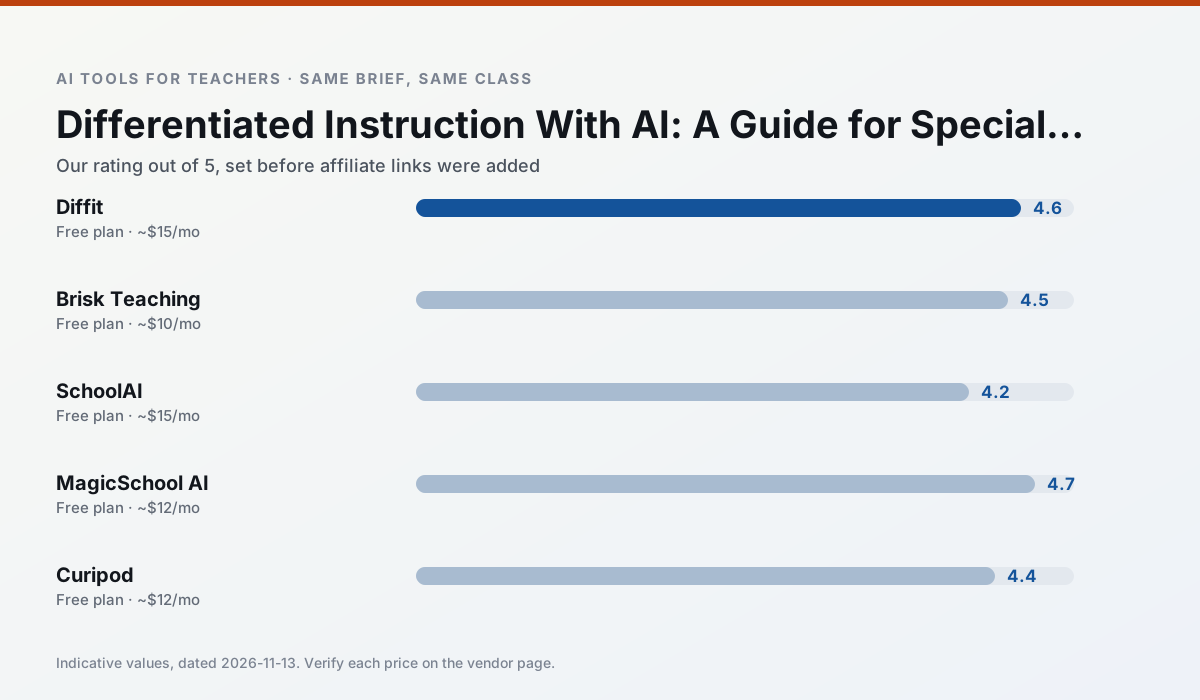
Side by side
Comparison table
Ratings reflect our timed classroom workflow, not vendor claims. Prices are indicative — verify on the vendor site.
| Tool | Best for | Free tier | Indicative paid plan | Standout feature | Our rating | Verdict | Try the tool |
|---|---|---|---|---|---|---|---|
| Diffit | differentiated instruction · reading intervention | Yes — Limited generations per month | ~$15 /user/mo | Lexile-style leveling | 4.6 / 5 | Top pick | Try free |
| Brisk Teaching | feedback on writing · grading | Yes — Limited actions per month | ~$10 /user/mo | Works inside Google Docs | 4.5 / 5 | Top pick | Try free |
| SchoolAI | student-safe AI · differentiated instruction | Yes — Limited seats | ~$15 /user/mo | Teacher-monitored student chats | 4.2 / 5 | Strong option | Try free |
| MagicSchool AI | lesson planning · differentiation | Yes — Core generators with monthly usage limits | ~$12 /user/mo | 80+ teacher-specific tools | 4.7 / 5 | Top pick | Try free |
| Curipod | formative assessment · exit tickets | Yes — Limited lessons per month | ~$12 /user/mo | Live polls and word clouds | 4.4 / 5 | Strong option | Try free |
| Eduaide.Ai | lesson planning · rubric creation | Yes — Daily generation cap | ~$10 /user/mo | Resource library | 4.3 / 5 | Strong option | Try free |
Match your situation
Best for X
Different jobs need different tools. Here is what we would open first in each case.
Diffit is the steadiest of this set at plain, respectful language; names and specific incidents still belong in your draft, not the prompt.
Brisk Teaching produces levelled versions from one source in a single pass, which is the highest-value differentiation shortcut we tested at this level.
SchoolAI is built around teacher-monitored student spaces and audit logs rather than a consumer chat account, which is a different approval conversation.
Nothing on MagicSchool AI's free tier is a teaser demo; the limits are documented and a normal week fits inside them.
Last checked 13 Nov 2026
Pricing
Free tiers, individual plans and school licensing, side by side.
| Tool | Free plan | Individual / paid | School & district | Billing note | Verify |
|---|---|---|---|---|---|
| Diffit | $0 — Limited generations per month | ~$15 /user/mo | Custom quote | Indicative — verify on vendor site | Vendor |
| Brisk Teaching | $0 — Limited actions per month | ~$10 /user/mo | Custom quote | Indicative — verify on vendor site | Vendor |
| SchoolAI | $0 — Limited seats | ~$15 /user/mo | Custom quote | Indicative — verify on vendor site | Vendor |
| MagicSchool AI | $0 — Core generators with monthly usage limits | ~$12 /user/mo | Custom quote | Indicative — verify on vendor site | Vendor |
| Curipod | $0 — Limited lessons per month | ~$12 /user/mo | Custom quote | Indicative — verify on vendor site | Vendor |
| Eduaide.Ai | $0 — Daily generation cap | ~$10 /user/mo | Custom quote | Indicative — verify on vendor site | Vendor |
Editorial rule: pricing is re-checked every 2–3 months and the top 50 pages are refreshed every 6 months. See our funding policy.
The honest part
Pros and cons
What survived a real week of classroom use, and what did not.
Pros
- Excellent for mixed-ability classes
- Produces printable and digital versions
- Minimal setup
Cons
- Narrower scope than all-in-one suites
- Leveling is approximate, not a formal assessment
- Heavy use burns through the free quota
Pros
- No copy-paste between tools
- Fast inline feedback on student drafts
- Gentle learning curve
Cons
- Chrome-first workflow
- Extension permissions need IT approval
- Free quota is tight
Pros
- Designed for district approval
- Teacher visibility into student use
- Good safeguarding defaults
Cons
- Requires school-wide buy-in
- Less flexible than general LLMs
- Pricing is mostly quote-based
Pros
- Widest purpose-built template library
- Strong free tier for individual teachers
- Fast to learn with almost no prompting skill
Cons
- Outputs still need standards review
- Best features sit behind the paid tier
- District approval can be slow
Pros
- High student engagement out of the box
- Great for quick checks for understanding
- No student accounts required for basic use
Cons
- Focused on delivery, not planning
- Requires reliable classroom devices
- Free tier is restrictive
In the classroom
Use cases
Five concrete workflows, with the tool we would open for each one.
An IEP present-levels first draft
Use aggregated, anonymised data only. Ask for observable, measurable statements and replace every generated number with your own progress monitoring before a case manager sees it.
Recommended: DiffitA five-minute exit ticket set
Ask for one recall, one application and one reasoning item, then delete the second recall question every generator sneaks in.
Recommended: Brisk TeachingA question bank from a PDF or article
Feed a non-identifiable source and ask for items tagged by difficulty with the misconception behind each distractor. Spot-check every answer key; numerical items are least reliable.
Recommended: SchoolAIA substitute folder that needs no context
The value here is structure, not creativity. Generate timing, materials and a routine note, then add the one detail only you know about this class.
Recommended: MagicSchool AIThree reading levels from one source text
Paste a vetted text, ask for supported, core and extension versions, then check the vocabulary list by hand. Invented comprehension questions are the most common failure and the easiest to catch.
Recommended: Curipod
Questions teachers ask us
FAQ
Direct answers, also published as FAQPage structured data for search and AI assistants.
Can AI do differentiated instruction at mixed-grade level?
Which tool is best for differentiated instruction?
What is the biggest risk?
Sources & further reading
Our recommendation
Try MagicSchool AI free for your next differentiated instruction task
A large library of teacher-specific AI generators in one dashboard. Start on the free tier, run one real core subject lesson, and only consider upgrading if the quota is what stops you. Disclosure: we may earn a commission (30% recurring) at no extra cost to you.
Some links on this page are affiliate links. We may earn a commission at no extra cost to you. Our rankings are editorial and never pay-to-play. Never enter student PII into a free consumer account.
Keep reading
Related comparisons in this cluster.
Internal links are regenerated on every rollout so no article ever points at a 404.