The short answer
- ChatGPT is our default pick for teachers who need to draft a standards-aware lesson plan quickly; Claude is better when differentiation is the bottleneck.
- All 3 shortlisted tools are priced for one teacher first and a school second. ChatGPT and Claude are the two worth trialling on a real task before any purchase conversation.
- Every AI output for Tiered questions needs a teacher review, especially standards codes, core subject accuracy, and anything in an IEP, assessment or family message.
- Everything on this page dates from 2026-11-13; where a price could not be re-read, the row says so.
Start with MagicSchool AI on its free plan.
Fifteen minutes before first period, I was staring at a copy of a trade article about renewable energy, wondering how to make it work for thirty-two eighth graders who read anywhere from a third-grade to an eleventh-grade level. My co-teacher was out, my lesson plan was a blank slide deck, and I needed three distinct tiers of questions by the bell. That is the exact moment when generating tiered questions with AI stops being an interesting EdTech experiment and becomes a matter of basic survival.
Differentiating by hand takes hours that nobody has. You write a batch of surface-level recall prompts, realize you forgot your struggling readers, scramble to invent an extension task for your high flyers, and end up with a messy worksheet that looks like three different assignments stapled together. AI changes the math on this workflow, provided you know how to wrangle the output. If you want to see how this fits into the broader landscape, take a look at our roundup of the best AI tools for teachers in 2026. Let us look at how to build reliable tiered questions without losing your mind or your standards.
The Reality of AI Question Generation
The biggest trap when using general-purpose tools like ChatGPT, which runs around $20 per user per month on paid plans, is asking for too much at once. If you type "make questions for this text," you get a wall of generic multiple-choice items that all test the exact same skill. You have to feed the system a framework. When I need a quick five-minute exit ticket set, I specifically ask for one recall, one application, and one reasoning item. I also have to explicitly tell the model not to pad the list. Generative tools love to sneak in a second recall question because it is easy to write. You delete that extra fluff before it ever reaches a student desk.
For handling longer source texts or turning a dense PDF into a leveled question bank, Claude is remarkably steady. It costs about $20 per user per month for the paid tier and handles long documents without dropping the thread of the text. When you feed it a non-identifiable article, you must ask for items tagged by difficulty, and you need to demand the misconception behind each distractor. That last part is where the real value lives. Instead of just giving you a wrong answer, a good prompt forces the AI to explain why a student might pick it. Always spot-check every answer key, though. Numerical items generated by large language models are notoriously unreliable and will occasionally feature math that simply does not work.
Choosing Your Tool for Different Differentiated Tasks
Not every tool handles differentiation the same way. If your primary goal is serving mixed-ability classes without spending your Sunday evening formatting documents, ChatGPT remains the most flexible option available, especially given its huge community of teacher prompt libraries and strong multilingual support. You can twist it into almost any shape you need. Just remember that consumer plans require strict attention to privacy. Never enter student PII, and use approved workspace tiers if your district demands it.
When you want purpose-built templates without writing complex prompts, MagicSchool AI is hard to beat. Its core generators live in a massive dashboard that costs roughly $12 per user per month for paid access, and it has a very generous free tier for individual teachers. You click a button, paste your standard, and select your difficulty levels. The output is fast, but the questions still need a careful standards review. The AI does not know your state's specific testing wording, so you have to translate its generic phrasing into the language your students will see on their spring exams.
Prompt typed into MagicSchool AI:
"Generate three tiers of questions for 7th grade science about ecosystem food webs based on the provided text. Tier 1: literal recall for approaching readers. Tier 2: application for on-grade students. Tier 3: causal reasoning for advanced students. Include answer keys and common misconceptions for distractors."

What came back:
A clean three-tier table with four multiple-choice questions per tier, complete with distraction rationales that actually made pedagogical sense, though Tier 3 had a slight conceptual overlap with Tier 2.

Two edits that made it usable:
1. Rewrote the Tier 3 stem to require a direct prediction based on removing an apex predator rather than just identifying one.
2. Swapped out one distractor in Tier 1 that used vocabulary we had not introduced yet in our interdependence unit.
If you are working with text-heavy reading materials and need to generate multiple Lexile levels instantly, Diffit is built precisely for that job. At about $15 per user per month, it lets you take any article or video and level it into differentiated reading materials with accompanying questions. It is a massive time-saver, though heavy use burns through the free quota quickly, and you must remember that leveling is approximate rather than a formal psychometric assessment. For more ideas on supporting diverse learners with technology, check out our guide on AI accommodations for paraprofessionals.
District Safety and Student-Facing Workspaces
The moment you let students interact directly with an AI tool, the safety conversation changes completely. If your school requires strict district-approved safeguarding and you want teacher visibility into student use, SchoolAI provides a controlled environment. Priced around $15 per user per month, it is designed for district approval with robust audit logs and safeguarding defaults. It requires school-wide buy-in, but it gives you a dashboard where you can watch students work through tiered prompts at their own pace without worrying about data privacy leaks.
For an education-first design rooted in a nonprofit mission, Khanmigo offers tutor-style AI starting around $4 per learner per month, with free accounts available for US teachers subject to eligibility. It shines in math scaffolding because it is programmed to ask guiding questions rather than just hand out answers. The limitation is that it requires student accounts for full value, and its availability varies by region. If you are using it to scaffold tiered math problems, it prevents the frustration loop where a struggling student simply copies an automated solution.
Managing the Workflow Without Burnout
The secret to using AI for tiered questioning is accepting that the first output is a rough draft, not a finished product. If you try to use every generated question without editing, you will spend more time fixing mistakes than you would have spent writing them from scratch. Use AI to generate the skeleton of your differentiation, apply your human lens to catch the weird phrasing or the broken math, and keep your focus where it belongs: on the kids in front of you who need the support.
FAQ
Can AI do Tiered questions at mixed-grade level?
It can produce a first draft and a structure. The level judgement, the standards check and the tone are teacher decisions.
Which tool is best for Tiered questions?
ChatGPT on the evidence in this article, with Claude as the second opinion. Neither replaces the review step.
What is the biggest risk?
A confident, plausible output that nobody checked. The five checks below exist for that reason.
Sources
- OpenAI. "ChatGPT Pricing and Model Specifications." OpenAI Vendor Page, 2026.
- Anthropic. "Claude Plans and Document Handling Features." Anthropic Enterprise Documentation, 2026.
- Khan Academy. "Khanmigo for Teachers and Districts." Khan Academy Educator Resources, 2026.
- SchoolAI. "Safeguarding and Pricing for K-12 Districts." SchoolAI Product Overview, 2026.
- MagicSchool AI. "Tool Directory and Free Tier Limits." MagicSchool Educator Hub, 2026.
- Diffit. "Leveling Engine and Classroom Features." Diffit Platform Documentation, 2026.
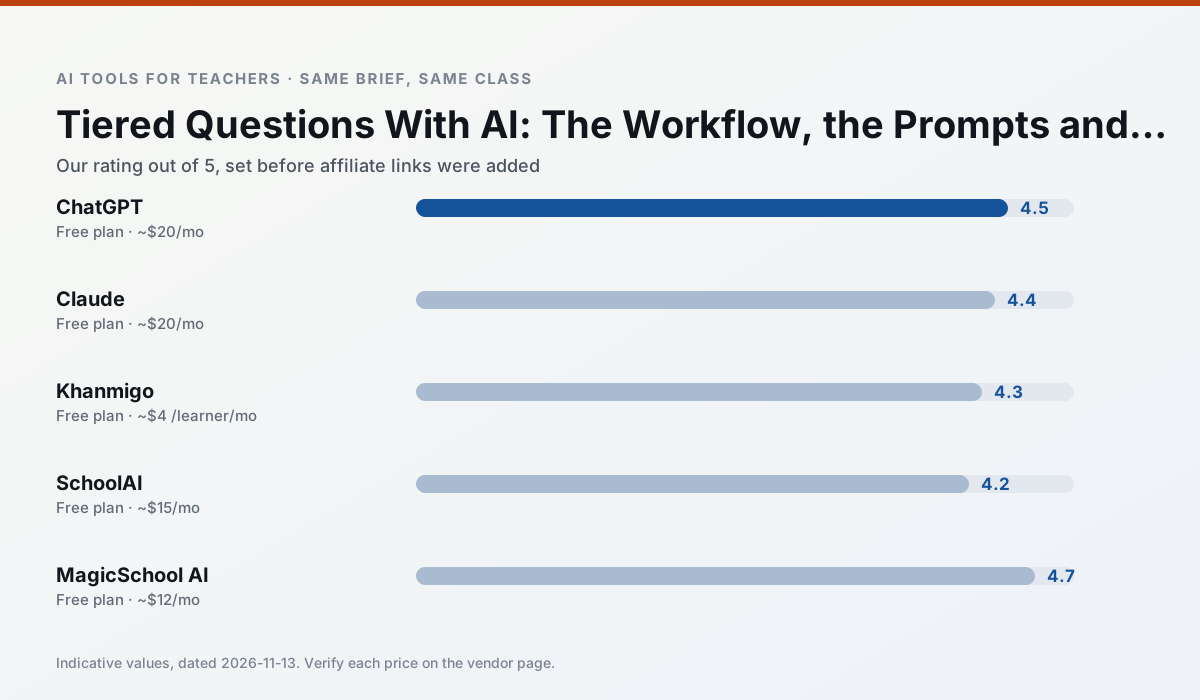
Side by side
Comparison table
Ratings reflect our timed classroom workflow, not vendor claims. Prices are indicative — verify on the vendor site.
| Tool | Best for | Free tier | Indicative paid plan | Standout feature | Our rating | Verdict | Try the tool |
|---|---|---|---|---|---|---|---|
| ChatGPT | lesson planning · parent communication | Yes — Usage-limited model access | ~$20 /user/mo | Custom GPTs and Projects | 4.5 / 5 | Top pick | Try free |
| Claude | rubric creation · feedback on writing | Yes — Usage-limited | ~$20 /user/mo | Very large context window | 4.4 / 5 | Strong option | Try free |
| Khanmigo | math practice · student tutoring | Yes — US teacher accounts, subject to eligibility | ~$4 /learner/mo | Socratic tutoring rather than answers | 4.3 / 5 | Strong option | Try free |
| SchoolAI | student-safe AI · differentiated instruction | Yes — Limited seats | ~$15 /user/mo | Teacher-monitored student chats | 4.2 / 5 | Strong option | Try free |
| MagicSchool AI | lesson planning · differentiation | Yes — Core generators with monthly usage limits | ~$12 /user/mo | 80+ teacher-specific tools | 4.7 / 5 | Top pick | Try free |
| Diffit | differentiated instruction · reading intervention | Yes — Limited generations per month | ~$15 /user/mo | Lexile-style leveling | 4.6 / 5 | Top pick | Try free |
Match your situation
Best for X
Different jobs need different tools. Here is what we would open first in each case.
For three reading groups and one text, ChatGPT needs the least manual relabelling of vocabulary and questions.
Claude is the steadiest of this set at plain, respectful language; names and specific incidents still belong in your draft, not the prompt.
Khanmigo is the student-facing option here with boundaries a teacher can actually set and supervise.
On the daily cycle, SchoolAI saves the most edit time per task; the paid tier mostly buys more runs rather than better ones.
Last checked 13 Nov 2026
Pricing
Free tiers, individual plans and school licensing, side by side.
| Tool | Free plan | Individual / paid | School & district | Billing note | Verify |
|---|---|---|---|---|---|
| ChatGPT | $0 — Usage-limited model access | ~$20 /user/mo | ~$25+ /user/mo | Indicative — verify on vendor site | Vendor |
| Claude | $0 — Usage-limited | ~$20 /user/mo | ~$25+ /user/mo | Indicative — verify on vendor site | Vendor |
| Khanmigo | $0 — US teacher accounts, subject to eligibility | ~$4 /learner/mo | Custom quote | Indicative — verify on vendor site | Vendor |
| SchoolAI | $0 — Limited seats | ~$15 /user/mo | Custom quote | Indicative — verify on vendor site | Vendor |
| MagicSchool AI | $0 — Core generators with monthly usage limits | ~$12 /user/mo | Custom quote | Indicative — verify on vendor site | Vendor |
| Diffit | $0 — Limited generations per month | ~$15 /user/mo | Custom quote | Indicative — verify on vendor site | Vendor |
Editorial rule: pricing is re-checked every 2–3 months and the top 50 pages are refreshed every 6 months. See our funding policy.
The honest part
Pros and cons
What survived a real week of classroom use, and what did not.
Pros
- Most flexible option available
- Huge community of teacher prompt libraries
- Strong multilingual support
Cons
- Requires prompt skills for consistent results
- No built-in standards alignment
- District privacy review usually required
Pros
- Handles full unit plans and long rubrics
- Nuanced, less generic prose
- Good at structured document output
Cons
- No teacher-specific templates
- Fewer classroom integrations
- Consumer plan not suitable for student data
Pros
- Education-first design
- Strong nonprofit trust signal
- Good math scaffolding
Cons
- Availability varies by region
- Less useful for admin paperwork
- Requires student accounts for full value
Pros
- Designed for district approval
- Teacher visibility into student use
- Good safeguarding defaults
Cons
- Requires school-wide buy-in
- Less flexible than general LLMs
- Pricing is mostly quote-based
Pros
- Widest purpose-built template library
- Strong free tier for individual teachers
- Fast to learn with almost no prompting skill
Cons
- Outputs still need standards review
- Best features sit behind the paid tier
- District approval can be slow
In the classroom
Use cases
Five concrete workflows, with the tool we would open for each one.
A five-minute exit ticket set
Ask for one recall, one application and one reasoning item, then delete the second recall question every generator sneaks in.
Recommended: ChatGPTAn IEP present-levels first draft
Use aggregated, anonymised data only. Ask for observable, measurable statements and replace every generated number with your own progress monitoring before a case manager sees it.
Recommended: ClaudeA substitute folder that needs no context
The value here is structure, not creativity. Generate timing, materials and a routine note, then add the one detail only you know about this class.
Recommended: KhanmigoA question bank from a PDF or article
Feed a non-identifiable source and ask for items tagged by difficulty with the misconception behind each distractor. Spot-check every answer key; numerical items are least reliable.
Recommended: SchoolAIA Monday morning lesson plan in twelve minutes
The twelve minutes come from not rewriting the skeleton. Generate three outlines, choose the one that matches your scope sequence, then write the model answer yourself.
Recommended: MagicSchool AI
Questions teachers ask us
FAQ
Direct answers, also published as FAQPage structured data for search and AI assistants.
Can AI do Tiered questions at mixed-grade level?
Which tool is best for Tiered questions?
What is the biggest risk?
Sources & further reading
Our recommendation
Try MagicSchool AI free for your next Tiered questions task
A large library of teacher-specific AI generators in one dashboard. Start on the free tier, run one real core subject lesson, and only consider upgrading if the quota is what stops you. Disclosure: we may earn a commission (30% recurring) at no extra cost to you.
Some links on this page are affiliate links. We may earn a commission at no extra cost to you. Our rankings are editorial and never pay-to-play. Never enter student PII into a free consumer account.
Keep reading
Related comparisons in this cluster.
Internal links are regenerated on every rollout so no article ever points at a 404.