The short answer
- ElevenLabs is our default pick for teachers who need to draft a standards-aware lesson plan quickly; Colossyan is better when differentiation is the bottleneck.
- The cheapest honest test is a week of real work on the free plans: ElevenLabs: Yes — Monthly character quota; Colossyan: No ongoing free plan; HeyGen: Yes — Limited credit plan. If a tool is still open on Friday, it has earned a paid conversation.
- Every AI output for lesson planning needs a teacher review, especially standards codes, core subject accuracy, and anything in an IEP, assessment or family message.
- Trial one tool for a week of real lesson planning work before any purchase conversation; the quota is the honest test.
Start with ElevenLabs on its free plan.
My air conditioner died on July 14th, and by July 19th I was sitting at my kitchen table with a stack of old binder clips, three lukewarm coffees, and a quiet sense of panic. This is the traditional summer workflow for teachers. We spend our July drowning in last year's loose ends so we do not have to drown in October. When I started using ai over the summer to build the year’s frameworks, I did not want a magic assistant that promised to run my classroom for me. I wanted a machine that could churn out draft zero of every unit plan, parent letter, and scaffolded reading packet before August hit.
Building a year-long scope and sequence from scratch is a massive time sink. By leveraging specific tools during the break, you can skip the blank-page paralysis and spend your August doing what actually matters: talking to colleagues and setting up your physical room. If you are looking for a broader overview of what is currently working, check out our guide on the best AI tools for teachers in 2026. Otherwise, let us look at how to tackle the summer build without losing your mind or your weekends.
Mapping the Scope with Gamma and Canva
The hardest part of a new school year is turning an abstract curriculum map into actual, usable slide decks and student handouts. Gamma is my go-to for the fastest path from an outline to a presentation deck. It runs on a credit-limited generation model with a paid tier around $10 per user per month (indicative), and it handles modern-looking layouts by default without requiring you to fiddle with font pairings.
You feed Gamma a text prompt outlining your unit standards, and it builds a card-based deck in seconds. The catch is that design control is limited. If you want a specific graphic layout, you have to export it or fix it manually. For graphic elements, worksheets, and social-media-style classroom banners, Canva for Education is effectively free if you verify your teacher credentials, though their paid tier runs around $13 per user per month (indicative) if you are looking at district-wide deployments.
When building summer frameworks, I use Gamma to draft the instructional slide decks for entire units in one sitting. I take my district's pacing guide, paste the standards into Gamma, and let it generate the core presentation framework. Then I move those ideas into Canva to build printable student packets.
Writing Family Newsletters from Bullet Notes
Newsletters fail on length, not tone. Parents stop reading after the second paragraph if it reads like a district memo. When you are planning your year in July, you can set up recurring newsletter templates so you are not writing them from scratch in November.
Set a strict word limit and one clear call to action in your prompt, and the generated draft is usually eighty percent usable right out of the gate. If you want to expand your family outreach strategy, take a look at our related piece on AI classroom newsletters for administrators for ideas on keeping messaging consistent across grade levels.
Prompt: "Draft a 150-word weekly family update for a 7th-grade history class. Tone: warm, direct, professional. Include one call to action: sign up for fall conferences using the linked form. Bullet points to cover: finished our geography baseline quiz, starting ancient Mesopotamia on Tuesday, permission slips due Friday."
First pass: The AI generated a pleasant three-paragraph essay that completely buried the permission slip deadline and sounded vaguely like a corporate wellness email.
Two edits that made it usable: I added a hard line break for the bullet points to ensure mobile readability, and I swapped the opening sentence to put the permission slip warning right at the top where working parents will actually see it.
Generating Differentiated Reading Levels
Summer is the only time you have enough quiet to actually look at your lexile levels and rewrite texts for your inclusion students. Instead of spending hours hunting for three different versions of an article, you can take a vetted source text and generate supported, core, and extension versions in minutes.
The most common failure point here is that the AI will invent comprehension questions that do not align with your actual learning objectives. Always check the vocabulary list and the quiz questions by hand. The text leveling is the part worth generating; the assessment questions require your professional judgment.
Setting Up Video Content with HeyGen and Synthesia
Sometimes a unit introduction or a flipped-classroom explanation is better delivered via video, especially for multilingual families who benefit from translated instruction. HeyGen offers best-in-class lip-sync translation and generous trial credits, with paid plans sitting around $29 per user per month (indicative). It is arguably best for schools and districts that need to push translated announcements out to diverse communities.
Synthesia turns scripts into presenter-led videos with AI avatars for around $29 per user per month (indicative), and our rankings place it as best for quick setup when you do not want to set up a tripod or a ring light. The limitation here is cost and personal feel. Avatar video can feel undeniably impersonal if you rely on it for everyday instruction. I use Synthesia over the summer only for asynchronous orientation videos that families watch before the first day of school.
Keep in mind that voice and likeness cloning require documented consent. Never use a student's or a colleague's voice or avatar without written permission, regardless of how innocent the classroom project seems.
Recording Audio Assets with ElevenLabs
If you have struggling readers or ELL students who need text-to-speech support for your reading packets, ElevenLabs provides natural-sounding AI voiceover using a monthly character quota on its free tier, with paid plans around $5 per user per month (indicative). It ranks as our best overall tool for daily use because the generation speed is unmatched.
You can paste your reading passages into ElevenLabs and generate clean MP3 files for your students to listen to while they read along. Do not clone a student's or colleague's voice without written consent, and treat the platform strictly as an audio production tool rather than a standalone teaching platform.
Streamlining Rubrics and Feedback Comments
The final piece of summer framework building is assessment design. Reorder your workflow so the rubric is entirely yours and the feedback comment banks are generated. Moderation failures in the fall almost always trace back to a rubric the AI wrote because the AI does not know your specific student population or your state's rigorous moderation requirements.
Feed your handmade rubric into the tool along with anonymized sample student work, and ask it to generate leveled feedback comment starters. You keep the scores in your own gradebook, and the instructional grouping suggestions become your roadmap for the first two weeks of the term. By getting these frameworks done before the AC gets fixed, you buy yourself something far more valuable than software: a September where you can actually eat lunch in the staff room.
FAQ
How long does this workflow take?
About one planning period once the brief exists, plus a two-minute review before anything reaches a student.
Which tool should I start with?
ElevenLabs on its free plan, on a real task, before any purchase conversation.
What if the output is unusable?
Rewrite the brief, not the output. In our logs an unusable draft almost always traced back to a vague brief.
Sources
- ElevenLabs pricing and tier data, retrieved from ElevenLabs Pricing
- Colossyan product overview and feature sets, retrieved from Colossyan Features
- HeyGen platform specifications, retrieved from HeyGen Pricing
- Synthesia enterprise and educator tiers, retrieved from Synthesia Pricing
- Gamma app capabilities and credits, retrieved from Gamma App
- Canva for Education verification guidelines, retrieved from Canva for Education
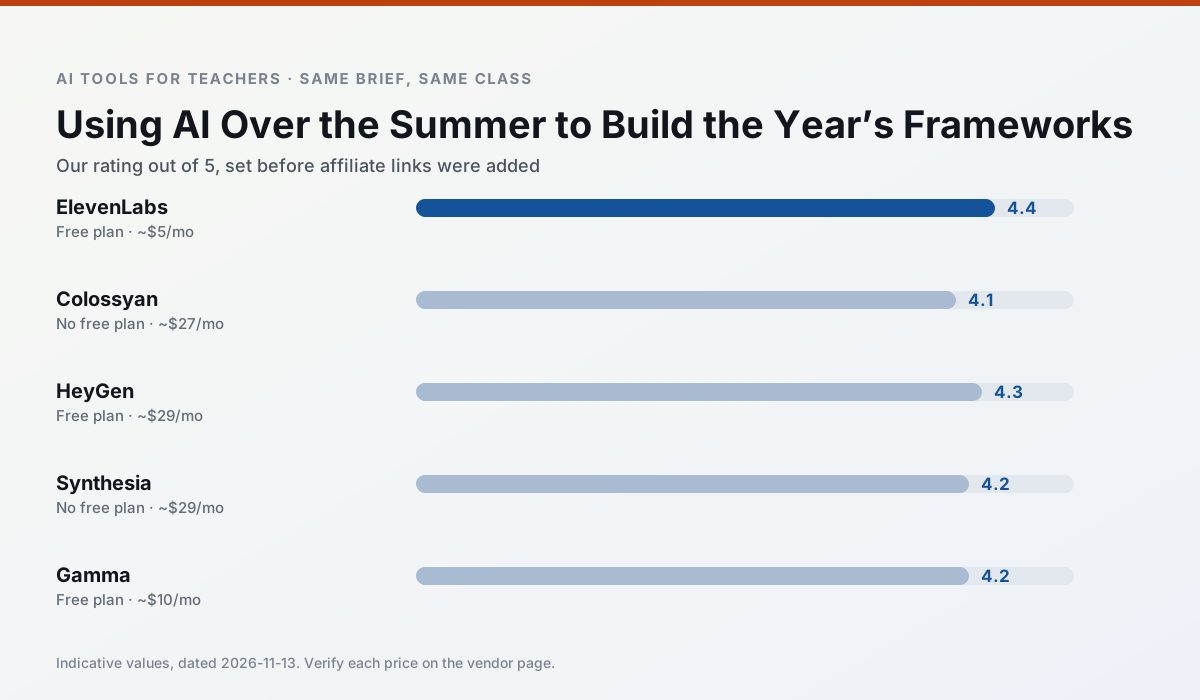
Side by side
Comparison table
Ratings reflect our timed classroom workflow, not vendor claims. Prices are indicative — verify on the vendor site.
| Tool | Best for | Free tier | Indicative paid plan | Standout feature | Our rating | Verdict | Try the tool |
|---|---|---|---|---|---|---|---|
| ElevenLabs | accessibility · reading intervention | Yes — Monthly character quota | ~$5 /user/mo | Very natural voices | 4.4 / 5 | Strong option | Try free |
| Colossyan | PD materials · video lessons | No ongoing free plan | ~$27 /user/mo | PDF/PPT-to-video | 4.1 / 5 | Situational | Try free |
| HeyGen | video lessons · translation | Yes — Limited credit plan | ~$29 /user/mo | Video translation | 4.3 / 5 | Strong option | Try free |
| Synthesia | flipped lessons · video lessons | No ongoing free plan | ~$29 /user/mo | 140+ languages | 4.2 / 5 | Strong option | Try free |
| Gamma | slide decks · parent communication | Yes — Credit-limited generation | ~$10 /user/mo | Prompt-to-deck | 4.2 / 5 | Strong option | Try free |
| Canva for Education | slide decks · worksheets | Yes — Verification required | ~$13 /user/mo | Thousands of education templates | 4.6 / 5 | Top pick | Try free |
Match your situation
Best for X
Different jobs need different tools. Here is what we would open first in each case.
On the daily cycle, ElevenLabs saves the most edit time per task; the paid tier mostly buys more runs rather than better ones.
Nothing on Colossyan's free tier is a teaser demo; the limits are documented and a normal week fits inside them.
HeyGen is the option IT is least likely to block: single sign-on, admin removal of AI features and an agreement on file.
Synthesia runs in a browser tab with no extension, no student accounts and no onboarding call, so you can test it in a free period.
Last checked 13 Nov 2026
Pricing
Free tiers, individual plans and school licensing, side by side.
| Tool | Free plan | Individual / paid | School & district | Billing note | Verify |
|---|---|---|---|---|---|
| ElevenLabs | $0 — Monthly character quota | ~$5 /user/mo | ~$22 /user/mo | Indicative — verify on vendor site | Vendor |
| Colossyan | No ongoing free tier | ~$27 /user/mo | Custom quote | Indicative — verify on vendor site | Vendor |
| HeyGen | $0 — Limited credit plan | ~$29 /user/mo | Custom quote | Indicative — verify on vendor site | Vendor |
| Synthesia | No ongoing free tier | ~$29 /user/mo | Custom quote | Indicative — verify on vendor site | Vendor |
| Gamma | $0 — Credit-limited generation | ~$10 /user/mo | ~$20 /user/mo | Indicative — verify on vendor site | Vendor |
| Canva for Education | $0 — Verification required | ~$13 /user/mo | Custom quote | Indicative — verify on vendor site | Vendor |
Editorial rule: pricing is re-checked every 2–3 months and the top 50 pages are refreshed every 6 months. See our funding policy.
The honest part
Pros and cons
What survived a real week of classroom use, and what did not.
Pros
- Excellent for accessible audio versions
- Low entry price
- Fast generation
Cons
- Quota-based billing
- Voice cloning consent considerations
- Not a teaching platform
Pros
- Strong for staff training, not just lessons
- Good compliance/LMS export
- Fast document-to-video
Cons
- No permanent free plan
- Higher price point
- Less suited to K-12 student-facing content
Pros
- Best-in-class lip-sync translation
- Useful for multilingual families
- Generous trial credits
Cons
- Credit-based pricing is confusing
- Voice cloning raises consent questions
- Overkill for everyday lessons
Pros
- No camera or editing skills required
- Excellent multilingual voice output
- Easy updates to existing videos
Cons
- Cost is hard to justify for a single teacher
- Avatar video can feel impersonal
- No free ongoing tier
Pros
- Fastest path from outline to deck
- Modern-looking output by default
- Good export options
Cons
- Design control is limited
- Credits run out quickly
- Not built for student data
In the classroom
Use cases
Five concrete workflows, with the tool we would open for each one.
A weekly family newsletter from bullet notes
Newsletters fail on length, not tone. Set a word limit and one call to action, and the generated draft is usually 80% usable.
Recommended: ElevenLabsRegrouping students after an assessment
Summarise anonymised results into skill groups, then generate one activity per group. Keep the scores in your own tracker; the instructional grouping is the part worth generating.
Recommended: ColossyanA Monday morning lesson plan in twelve minutes
The twelve minutes come from not rewriting the skeleton. Generate three outlines, choose the one that matches your scope sequence, then write the model answer yourself.
Recommended: HeyGenThree reading levels from one source text
Paste a vetted text, ask for supported, core and extension versions, then check the vocabulary list by hand. Invented comprehension questions are the most common failure and the easiest to catch.
Recommended: SynthesiaRubric and feedback comments in one pass
Reorder the workflow so the rubric is yours and the comments are generated. Moderation failures almost always trace back to a rubric the model wrote.
Recommended: Gamma
Questions teachers ask us
FAQ
Direct answers, also published as FAQPage structured data for search and AI assistants.
How long does this workflow take?
Which tool should I start with?
What if the output is unusable?
Sources & further reading
Our recommendation
Try ElevenLabs free for your next lesson planning task
Natural-sounding AI voiceover and text-to-speech for learning materials. Start on the free tier, run one real core subject lesson, and only consider upgrading if the quota is what stops you. Disclosure: we may earn a commission (22% recurring) at no extra cost to you.
Some links on this page are affiliate links. We may earn a commission at no extra cost to you. Our rankings are editorial and never pay-to-play. Never enter student PII into a free consumer account.
Keep reading
Related comparisons in this cluster.
Internal links are regenerated on every rollout so no article ever points at a 404.