The short answer
- Quizizz is our default pick for teachers who need to draft a standards-aware lesson plan quickly; Brisk Teaching is better when differentiation is the bottleneck.
- Free-tier reality for this shortlist: Quizizz: Yes — Core quiz creation; Brisk Teaching: Yes — Limited actions per month; Claude: Yes — Usage-limited. Treat every paid figure as indicative until you have read the vendor page; only the free quota is something you can test yourself this week.
- Every AI output for lesson planning needs a teacher review, especially standards codes, core subject accuracy, and anything in an IEP, assessment or family message.
- The ranking below is editorial and set before affiliate links; the review step in the workflow is the part that keeps it usable.
Start with Colossyan on its free plan.
It is late October, and I am staring at a district compliance warning flashing on my screen because I pasted thirty student reading scores and first names into a free chat window to generate differentiated reading groups. My principal did not yell, but the tone of the email made it clear that "convenience" is not a legal defense under the Family Educational Rights and Privacy Act. Since then, working out which AI tools are FERPA-safe for teachers has become less of an IT headache and more of a daily survival skill. If you are trying to balance time-saving technology with student data privacy in 2026-11-13, you quickly realize that the word "safe" means something very specific depending on whether you are analyzing student work, writing a family newsletter, or building a quiz.
Understanding What FERPA Actually Means for Your Browser Tab
Before looking at specific platforms, we need to clear up the most common misunderstanding in the staff room. FERPA regulates student education records, and consumer AI subscriptions generally do not meet the legal definitions required to process personally identifiable information unless your district has signed a specific Data Processing Agreement. Tools like ChatGPT and Claude are powerful, but pasting a paragraph of student writing that includes a full name or an unredacted ID number into a free tier account is a compliance violation. When we ask which AI tools are FERPA-safe for teachers, the answer depends entirely on whether the software vendor offers district-level data protection, student safeguarding guardrails, and compliance documentation that your tech department has actually vetted.
General Assistants Versus School-Specific Workspaces
If you want the most flexible option available for general lesson planning, ChatGPT remains the top free option for teachers who understand how to write structured prompts. It adapts to almost any classroom task, but its consumer plan requires strict vigilance regarding student PII. You can use it safely to build a question bank from a PDF or article by feeding in non-identifiable source material, asking for items tagged by difficulty, and noting the misconception behind each distractor. Just remember to spot-check every answer key, because numerical items are notorious for hallucinating calculations. Claude serves as a long-context assistant suited to document-heavy planning and feedback, making it ideal for processing long rubrics and unit plans without losing track of details. However, like ChatGPT, the consumer tier is not suitable for student data, and you must use an approved workspace tier for any school-related documents.
Inline Extensions and Assessment Platforms
For teachers drowning in grading, Brisk Teaching brings AI feedback directly into Google Docs, Slides, and articles as a browser extension. It eliminates the friction of copy-pasting text between different tabs, which helps when you need fast inline feedback on student drafts in mixed-ability classes. Because the extension reads document content right inside your browser, your IT department needs to review the extension permissions and DPA scope carefully before you roll it out. On the assessment side, Quizizz offers AI-assisted quiz creation with a massive question bank and live games that students already know how to use. It works well on low-end devices and provides solid reporting, making it our pick for parent-facing writing because you can easily pull clean assessment data to share home. You still need to review the AI-generated questions for quality, and advanced analytics require a paid plan at about $15 per user per month, but its COPPA and FERPA documentation is accessible if you confirm details with your district.
Dedicated School Platforms and Video Generation
When districts want safety defaults built into the architecture, SchoolAI provides a school-safe AI workspace with teacher-controlled student spaces. It is designed specifically for district approval, offering teacher visibility into student use and robust safeguarding defaults, though pricing is mostly quote-based alongside an indicative $15 per user per month tier. It requires school-wide buy-in, meaning you cannot easily adopt it as a rogue solo project on a Friday afternoon. On the other end of the spectrum, Colossyan builds training and explainer videos from documents and scripts at around $27 per user per month. It has no permanent free plan and is far more suited to staff training and compliance LMS exports than K-12 student-facing content, but it handles document-to-video conversion rapidly if your professional development team needs to spin up a quick tutorial.
Prompt: Write a set of five exit tickets for an 8th-grade unit on cellular respiration, including one recall item, one application item, and one reasoning item per ticket.
First output: The generator produced two recall questions, one application question, and a lengthy essay prompt about mitochondria that would take twenty minutes to answer.
Two edits that made it usable:
- Deleted the second recall question that the AI sneaked in to ensure the 5-minute time limit actually worked.
- Rewrote the reasoning item to reference the specific lab diagram we used on Tuesday instead of a generic textbook scenario.
Practical Safeguards for Daily Planning
Even with compliant tools, your workflow dictates your security. When you are regrouping students after an assessment, summarize anonymized results into skill groups rather than uploading a spreadsheet of names and scores, then generate one targeted activity per group. Keep the actual scores in your own secure gradebook tracker; the instructional grouping is the only part worth generating. The same rule applies when drafting an IEP present-levels document. Use aggregated, anonymised data only, ask for observable, measurable statements, and replace every generated number with your own progress monitoring data before a case manager or ARD committee lays eyes on it. For a weekly family newsletter from bullet notes, newsletters fail on length rather than tone, so set a strict word limit and one clear call to action to keep the generated draft about eighty percent usable. For broader strategies on managing workloads without burning out, review our guide on our 2026 ranking, or see how support staff utilize secure workflows in AI Accommodations for Paraprofessionals.
FAQ
Is AI allowed for lesson planning in my school?
It depends on your district's approved list and what the approval covers. Ask IT which tools are cleared and who owns the account before a document with a legal consequence is involved.
Who is responsible if something goes wrong?
The school, and in practice the named teacher who reviewed the output. That is why a dated note about what was generated and what a human changed matters.
What should never go into a prompt?
Names, rosters, scans of student work and gradebook screenshots. Topic-level prompts do most of the work without any of that.
Sources
- Quizizz Vendor Overview and Pricing: https://quizizz.com/
- Brisk Teaching Privacy and Extension Scope: https://briskteaching.com/
- Anthropic Claude Business and Enterprise Tiers: https://claude.ai/
- OpenAI ChatGPT Edu and Team Privacy Policies: https://openai.com/
- Colossyan Compliance and Video Generation Features: https://www.colossyan.com/
- SchoolAI Safeguarding and District DPA Documentation: https://schoolai.com/
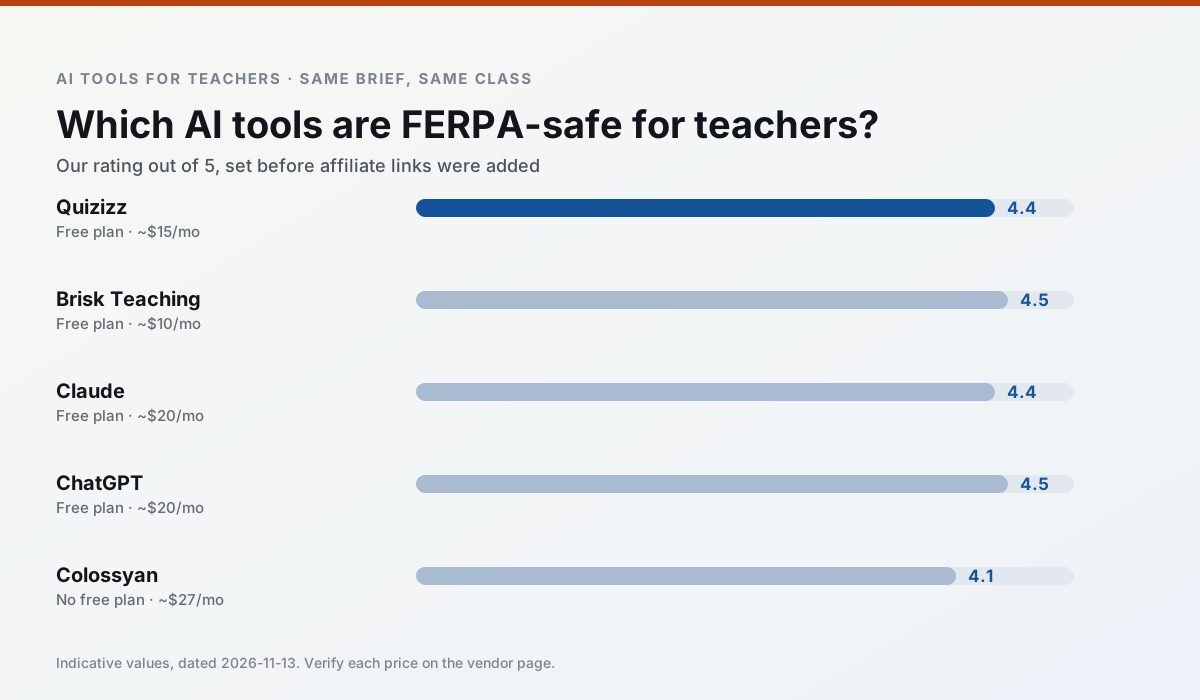
Side by side
Comparison table
Ratings reflect our timed classroom workflow, not vendor claims. Prices are indicative — verify on the vendor site.
| Tool | Best for | Free tier | Indicative paid plan | Standout feature | Our rating | Verdict | Try the tool |
|---|---|---|---|---|---|---|---|
| Quizizz | quiz generation · formative assessment | Yes — Core quiz creation | ~$15 /user/mo | AI question generator | 4.4 / 5 | Strong option | Try free |
| Brisk Teaching | feedback on writing · grading | Yes — Limited actions per month | ~$10 /user/mo | Works inside Google Docs | 4.5 / 5 | Top pick | Try free |
| Claude | rubric creation · feedback on writing | Yes — Usage-limited | ~$20 /user/mo | Very large context window | 4.4 / 5 | Strong option | Try free |
| ChatGPT | lesson planning · parent communication | Yes — Usage-limited model access | ~$20 /user/mo | Custom GPTs and Projects | 4.5 / 5 | Top pick | Try free |
| Colossyan | PD materials · video lessons | No ongoing free plan | ~$27 /user/mo | PDF/PPT-to-video | 4.1 / 5 | Situational | Try free |
| SchoolAI | student-safe AI · differentiated instruction | Yes — Limited seats | ~$15 /user/mo | Teacher-monitored student chats | 4.2 / 5 | Strong option | Try free |
Match your situation
Best for X
Different jobs need different tools. Here is what we would open first in each case.
Quizizz is the steadiest of this set at plain, respectful language; names and specific incidents still belong in your draft, not the prompt.
Brisk Teaching produces levelled versions from one source in a single pass, which is the highest-value differentiation shortcut we tested at this level.
For anything students touch directly, Claude offers the supervision controls and logging that IT will ask about first.
Nothing on ChatGPT's free tier is a teaser demo; the limits are documented and a normal week fits inside them.
Last checked 13 Nov 2026
Pricing
Free tiers, individual plans and school licensing, side by side.
| Tool | Free plan | Individual / paid | School & district | Billing note | Verify |
|---|---|---|---|---|---|
| Quizizz | $0 — Core quiz creation | ~$15 /user/mo | Custom quote | Indicative — verify on vendor site | Vendor |
| Brisk Teaching | $0 — Limited actions per month | ~$10 /user/mo | Custom quote | Indicative — verify on vendor site | Vendor |
| Claude | $0 — Usage-limited | ~$20 /user/mo | ~$25+ /user/mo | Indicative — verify on vendor site | Vendor |
| ChatGPT | $0 — Usage-limited model access | ~$20 /user/mo | ~$25+ /user/mo | Indicative — verify on vendor site | Vendor |
| Colossyan | No ongoing free tier | ~$27 /user/mo | Custom quote | Indicative — verify on vendor site | Vendor |
| SchoolAI | $0 — Limited seats | ~$15 /user/mo | Custom quote | Indicative — verify on vendor site | Vendor |
Editorial rule: pricing is re-checked every 2–3 months and the top 50 pages are refreshed every 6 months. See our funding policy.
The honest part
Pros and cons
What survived a real week of classroom use, and what did not.
Pros
- Students already know the interface
- Good reporting
- Works on low-end devices
Cons
- Writing high-quality AI questions still needs review
- Gamification can distract
- Advanced analytics are paid
Pros
- No copy-paste between tools
- Fast inline feedback on student drafts
- Gentle learning curve
Cons
- Chrome-first workflow
- Extension permissions need IT approval
- Free quota is tight
Pros
- Handles full unit plans and long rubrics
- Nuanced, less generic prose
- Good at structured document output
Cons
- No teacher-specific templates
- Fewer classroom integrations
- Consumer plan not suitable for student data
Pros
- Most flexible option available
- Huge community of teacher prompt libraries
- Strong multilingual support
Cons
- Requires prompt skills for consistent results
- No built-in standards alignment
- District privacy review usually required
Pros
- Strong for staff training, not just lessons
- Good compliance/LMS export
- Fast document-to-video
Cons
- No permanent free plan
- Higher price point
- Less suited to K-12 student-facing content
In the classroom
Use cases
Five concrete workflows, with the tool we would open for each one.
Regrouping students after an assessment
Summarise anonymised results into skill groups, then generate one activity per group. Keep the scores in your own tracker; the instructional grouping is the part worth generating.
Recommended: QuizizzA weekly family newsletter from bullet notes
Newsletters fail on length, not tone. Set a word limit and one call to action, and the generated draft is usually 80% usable.
Recommended: Brisk TeachingAn IEP present-levels first draft
Use aggregated, anonymised data only. Ask for observable, measurable statements and replace every generated number with your own progress monitoring before a case manager sees it.
Recommended: ClaudeA five-minute exit ticket set
Ask for one recall, one application and one reasoning item, then delete the second recall question every generator sneaks in.
Recommended: ChatGPTA question bank from a PDF or article
Feed a non-identifiable source and ask for items tagged by difficulty with the misconception behind each distractor. Spot-check every answer key; numerical items are least reliable.
Recommended: Colossyan
Questions teachers ask us
FAQ
Direct answers, also published as FAQPage structured data for search and AI assistants.
Is AI allowed for lesson planning in my school?
Who is responsible if something goes wrong?
What should never go into a prompt?
Sources & further reading
Our recommendation
Try Colossyan free for your next lesson planning task
Training and explainer videos built from documents and scripts. Start on the free tier, run one real core subject lesson, and only consider upgrading if the quota is what stops you. Disclosure: we may earn a commission (25–50% recurring) at no extra cost to you.
Some links on this page are affiliate links. We may earn a commission at no extra cost to you. Our rankings are editorial and never pay-to-play. Never enter student PII into a free consumer account.
Keep reading
Related comparisons in this cluster.
Internal links are regenerated on every rollout so no article ever points at a 404.