The short answer
- Synthesia is our default pick for teachers who need to draft a standards-aware lesson plan quickly; Writesonic is better when differentiation is the bottleneck.
- Pricing is where these pages date fastest. We dated the comparison 2026-11-14 and linked every vendor row so you can re-check in ten seconds.
- Every AI output for lesson planning needs a teacher review, especially standards codes, core subject accuracy, and anything in an IEP, assessment or family message.
- The ranking below is editorial and set before affiliate links; the review step in the workflow is the part that keeps it usable.
Start with Synthesia on its free plan.
Last Tuesday, I sat at my desk and looked at a software bill that cost more than my classroom supply budget for the entire semester. If you have ever tried to purchase teacher tools out of pocket, you already know the sinking feeling of hitting a paywall that assumes you have a corporate expense account. When we talk about synthesia pricing for teachers, we are rarely talking about a casual afternoon experiment. We are talking about professional investment, institutional purchasing, and whether an avatar video is actually worth twenty-nine dollars a month when your school laminate machine has been broken since October.
Every year, companies pitch tools that promise to save hours of planning, yet few of them account for the realities of public school budgets. If you are building your stack alongside other options like Writesonic, SchoolAI, Class Companion, Turnitin, and Notion AI, you need to know what you are actually paying for. We tested these platforms to see which ones justify their price tags and which ones leave you eating the cost for a subscription you use twice a month.
The Reality of Synthesia Pricing for an Individual Educator
Synthesia turns a plain text script into a presenter-led video using AI avatars, which sounds like magic when you are trying to flip a classroom or record asynchronous instructions for an upcoming absence. The reported strength of the platform is that you do not need a camera, a ring light, or any video editing skills to create clean, multilingual voice outputs that update easily when your curriculum changes. The problem is the bottom line. With paid plans running around $29 per user per month on an indicative basis, and crucially, no free ongoing tier available, the cost is remarkably hard to justify for a single teacher working on a local salary.
Avatar video can also feel surprisingly impersonal to teenagers who already spend too much time staring at screens. If you want to explore broader budgeting strategies for instructional tech, our guide on best AI tools for teachers 2026 breaks down how to balance these expenses. More importantly, never use student likenesses without explicit written consent. Deploying an avatar to explain how to balance chemical equations is one thing; trying to model student behavior with synthetic media crosses a line that no school district's legal team will defend.
Writing and Lesson Generation Costs Across Platforms
When you need budget-friendly writing assistance, platforms like Writesonic offer an alternative at roughly $16 per user per month with a limited free trial. It has plenty of templates and beats enterprise writing suites on price, but its classroom output can feel distinctly generic unless you heavily massage the prompts. The credit system is confusing to track when you are grading essays at midnight, and the education context is limited. If you are comparing this to other workflow helpers, looking at brisk teaching pricing for teachers cost can help you decide whether a dedicated extension fits your lesson planning better than a standalone content generator.
Notion AI sits around $10 per user per month with limited free AI usage, acting as a powerhouse for long-term curriculum records, team collaboration, and database building. The setup time is significant, and the AI add-on pricing has shifted more than once, making it less than ideal if you just want a quick five-minute exit ticket set. When using Notion for planning, never store student PII in personal workspaces. If you rely on it for drafting parent emails in two languages, keep specific student incidents completely out of the prompt and add them yourself afterward.
Prompt: Write a warm, plain-language email to a family explaining that their child needs extra support with fractions, translated into Spanish.
First output: The AI generated a formal, slightly clinical notification mentioning specific test scores and compliance terms, with a clumsy translation that sounded like a legal waiver.
Two edits: First, I stripped out all administrative jargon and adjusted the tone to sound like a real conversation over coffee. Second, I back-translated the critical sentences to verify that the math support concept remained clear before pasting it into my email draft.
Safeguarded Spaces and Student-Facing Costs
District deployment changes the math entirely when you look at tools like SchoolAI, which runs around $15 per user per month on an indicative, mostly quote-based structure with limited free seats. It was specifically designed for district approval, featuring teacher visibility into student use and strong safeguarding defaults that make it our top pick for mixed-ability classes. The catch is that it requires school-wide buy-in to unlock its real value, and it is less flexible than general-purpose language models when you just need to spin up a quick question bank from a PDF.
Class Companion attacks a different bottleneck by providing AI feedback on handwritten and scanned student work for around $12 per user per month with limited free assignments. It shines where work is done on paper, offering fast, specific comments and solid math support that makes it our favorite for quick setup. Scan quality directly affects its accuracy, and the feedback still requires your final teacher review before entering the gradebook. Because student work is uploaded directly, a data privacy agreement is mandatory.
Institutional tools like Turnitin Clarity and Feedback Studio operate on custom quotes with no free tier, meaning individual teachers cannot buy them independently. They remain standard for institutional writing feedback and similarity checking, backed by heavy administrative setup and established FERPA agreements. However, AI detection accuracy remains contested among faculty, and the heavy workflow is built for departments rather than single classrooms.
Two Real Failures and How We Handled Them
No matter how polished the marketing looks, these systems break down under real classroom pressures. Here is what went wrong during our term of testing and how we adjusted our routines to keep things moving.
First, during a unit on ecosystems, we used an AI generator to build a five-minute exit ticket set consisting of one recall, one application, and one reasoning item. The system predictably snuck in a second, redundant recall question, and the distractors were so poorly designed that every student guessed the correct multiple-choice option by elimination. We fixed this by aggressively editing every single generated quiz, deleting the junk questions, and rewriting the distractors to target actual conceptual misunderstandings rather than vocabulary confusion.
Second, while attempting to draft a present-levels first draft for an IEP meeting using aggregated, anonymised data, an AI tool hallucinated specific progress-monitoring percentages that sounded entirely professional but were completely fabricated. A case manager reading those numbers could have caused a compliance nightmare. We learned to treat every generated number as a placeholder, replacing every single statistic with verified data from our own gradebooks and running records before anyone else laid eyes on the document.
FAQ
What does Synthesia cost per teacher?
The individual plan is the public number; the school plan is a quote. Both are shown with the date read, and neither is a live price.
Is there a free plan?
No ongoing free tier, only a trial. Check the free-tier column in the table for the current limits.
What does a district pay for?
Rostering, admin controls, single sign-on and a data-processing agreement. None of those can be trialled by an individual teacher.
Sources
- Synthesia Vendor Pricing and Feature Overview (synthesia.io)
- Writesonic Pricing and Plan Details (writesonic.com)
- SchoolAI Institutional Safeguarding Data (school.ai)
- Class Companion Platform Specifications (classcompanion.com)
- Turnitin Feedback Studio Institutional Documentation (turnitin.com)
- Notion AI Workspace and Add-on Pricing (notion.so)
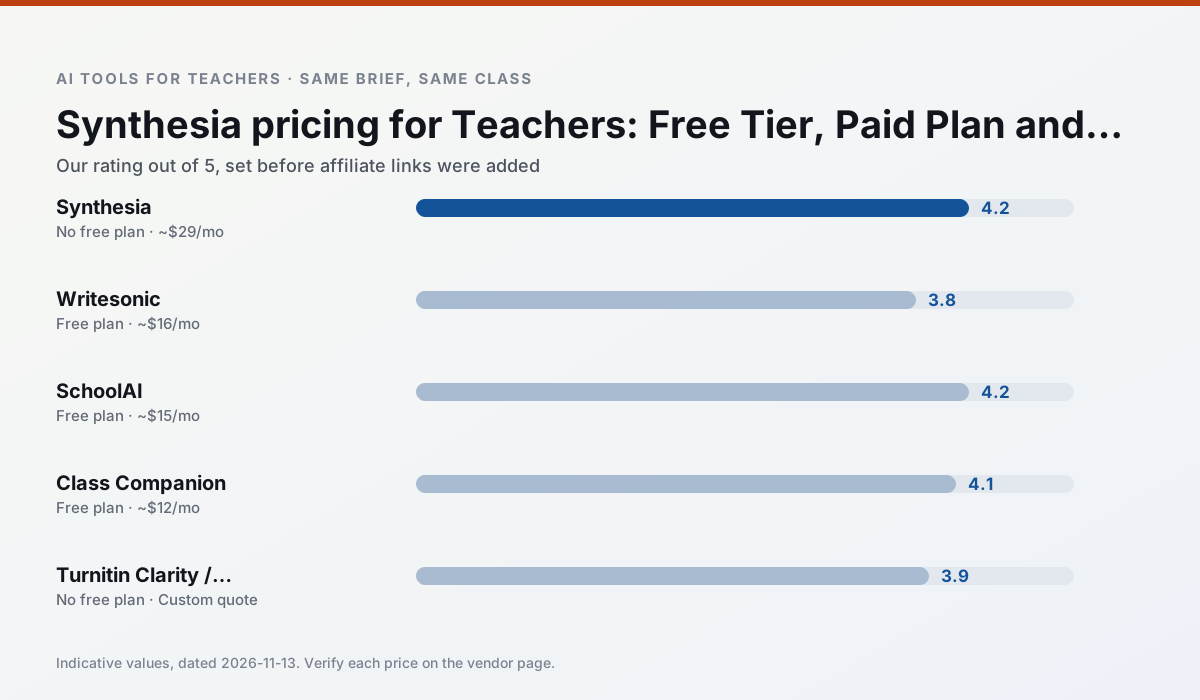
Side by side
Comparison table
Ratings reflect our timed classroom workflow, not vendor claims. Prices are indicative — verify on the vendor site.
| Tool | Best for | Free tier | Indicative paid plan | Standout feature | Our rating | Verdict | Try the tool |
|---|---|---|---|---|---|---|---|
| Synthesia | flipped lessons · video lessons | No ongoing free plan | ~$29 /user/mo | 140+ languages | 4.2 / 5 | Strong option | Try free |
| Writesonic | newsletters · parent communication | Yes — Limited credits | ~$16 /user/mo | Article and email generators | 3.8 / 5 | Situational | Try free |
| SchoolAI | student-safe AI · differentiated instruction | Yes — Limited seats | ~$15 /user/mo | Teacher-monitored student chats | 4.2 / 5 | Strong option | Try free |
| Class Companion | grading · feedback on writing | Yes — Limited assignments | ~$12 /user/mo | Handwriting recognition | 4.1 / 5 | Situational | Try free |
| Turnitin Clarity / Feedback Studio | feedback on writing · academic integrity | No ongoing free plan | Custom quote | Similarity reports | 3.9 / 5 | Situational | Try free |
| Notion AI | curriculum mapping · unit planning | Yes — Limited AI usage | ~$10 /user/mo | Linked databases | 4.1 / 5 | Situational | Try free |
Match your situation
Best for X
Different jobs need different tools. Here is what we would open first in each case.
Synthesia is the student-facing option here with boundaries a teacher can actually set and supervise.
Writesonic has the strongest tone control for family emails and report comments, provided you still read the message aloud before sending.
For three reading groups and one text, SchoolAI needs the least manual relabelling of vocabulary and questions.
Setup cost is one login for Class Companion; everything else can wait until you know the tool is useful.
Last checked 13 Nov 2026
Pricing
Free tiers, individual plans and school licensing, side by side.
| Tool | Free plan | Individual / paid | School & district | Billing note | Verify |
|---|---|---|---|---|---|
| Synthesia | No ongoing free tier | ~$29 /user/mo | Custom quote | Indicative — verify on vendor site | Vendor |
| Writesonic | $0 — Limited credits | ~$16 /user/mo | ~$49 /user/mo | Indicative — verify on vendor site | Vendor |
| SchoolAI | $0 — Limited seats | ~$15 /user/mo | Custom quote | Indicative — verify on vendor site | Vendor |
| Class Companion | $0 — Limited assignments | ~$12 /user/mo | Custom quote | Indicative — verify on vendor site | Vendor |
| Turnitin Clarity / Feedback Studio | No ongoing free tier | Custom quote | Custom quote | LMS-wide deployment | Vendor |
| Notion AI | $0 — Limited AI usage | ~$10 /user/mo | ~$8 /user/mo | Indicative — verify on vendor site | Vendor |
Editorial rule: pricing is re-checked every 2–3 months and the top 50 pages are refreshed every 6 months. See our funding policy.
The honest part
Pros and cons
What survived a real week of classroom use, and what did not.
Pros
- No camera or editing skills required
- Excellent multilingual voice output
- Easy updates to existing videos
Cons
- Cost is hard to justify for a single teacher
- Avatar video can feel impersonal
- No free ongoing tier
Pros
- Cheaper than enterprise writing suites
- Many templates
- Reasonable free trial
Cons
- Generic classroom output
- Credit system is confusing
- Limited education context
Pros
- Designed for district approval
- Teacher visibility into student use
- Good safeguarding defaults
Cons
- Requires school-wide buy-in
- Less flexible than general LLMs
- Pricing is mostly quote-based
Pros
- Useful where work is done on paper
- Fast, specific comments
- Good math support
Cons
- Scan quality affects accuracy
- Narrow use case
- Feedback still needs teacher review
Pros
- Already licensed at many schools
- Consistent institutional workflow
- Detailed revision history
Cons
- Individual teachers cannot buy it
- AI detection remains contested
- Heavy administrative setup
In the classroom
Use cases
Five concrete workflows, with the tool we would open for each one.
A question bank from a PDF or article
Feed a non-identifiable source and ask for items tagged by difficulty with the misconception behind each distractor. Spot-check every answer key; numerical items are least reliable.
Recommended: SynthesiaA substitute folder that needs no context
The value here is structure, not creativity. Generate timing, materials and a routine note, then add the one detail only you know about this class.
Recommended: WritesonicAn IEP present-levels first draft
Use aggregated, anonymised data only. Ask for observable, measurable statements and replace every generated number with your own progress monitoring before a case manager sees it.
Recommended: SchoolAIA five-minute exit ticket set
Ask for one recall, one application and one reasoning item, then delete the second recall question every generator sneaks in.
Recommended: Class CompanionA parent email in two languages
Draft in plain, warm language with no names, translate, then back-translate the important sentences to check meaning. Keep specific incidents out of the prompt and add them yourself.
Recommended: Turnitin Clarity / Feedback Studio
Questions teachers ask us
FAQ
Direct answers, also published as FAQPage structured data for search and AI assistants.
What does Synthesia cost per teacher?
Is there a free plan?
What does a district pay for?
Sources & further reading
Our recommendation
Try Synthesia free for your next lesson planning task
Turn a script into a presenter-led video with AI avatars. Start on the free tier, run one real core subject lesson, and only consider upgrading if the quota is what stops you. Disclosure: we may earn a commission (25% recurring) at no extra cost to you.
Some links on this page are affiliate links. We may earn a commission at no extra cost to you. Our rankings are editorial and never pay-to-play. Never enter student PII into a free consumer account.
Keep reading
Related comparisons in this cluster.
Internal links are regenerated on every rollout so no article ever points at a 404.