The short answer
- Synthesia is our default pick for teachers who need to draft a standards-aware lesson plan quickly; ElevenLabs is better when differentiation is the bottleneck.
- Synthesia handles the broad case; ElevenLabs handles the narrow one. Anything beyond that pair should be justified by a recurring weekly job, not a feature demo.
- Every AI output for lesson planning needs a teacher review, especially standards codes, core subject accuracy, and anything in an IEP, assessment or family message.
- Everything on this page dates from 2026-11-13; where a price could not be re-read, the row says so.
Start with Synthesia on its free plan.
The district purchase nobody asked for
Third-period chemistry was thirty minutes into a double block when the district tech coordinator walked in, smiled brightly, and announced we were getting Synthesia licenses. I looked down at my desk, covered in burnt copper turnings and half-graded stoichiometry quizzes, and wondered if he had ever set foot in a room with twenty-eight sophomores. At roughly $29 per user per month on an indicative pricing scale, turning text scripts into presenter-led video with AI avatars sounds great in a board meeting slide deck. In practice, nobody asked for it, and the cost is exceptionally hard for a single teacher to justify out of pocket.
Synthesia removes the need for camera or editing skills, which appeals to administrators who want polished asynchronous modules. It also boasts excellent multilingual voice output and makes updating existing videos painless. If you need to swap out a safety rule or a vocabulary term across fifty district training videos without reshooting, it works. But there is no free ongoing tier, and watching a synthetic human explain molar mass feels remarkably impersonal to teenagers who can spot a fake smile from across the gym. When you factor in the strict privacy note that you must never use student likenesses without consent, the shiny avatar novelty wears off fast.
Where video and audio tools actually fit
If you want to explore broader approaches to classroom tech, our best AI tools for teachers 2026 guide covers the baseline landscape. For most teachers, high-end avatars are overkill, but targeted audio tools have a genuine place in lesson prep. ElevenLabs provides natural-sounding AI voiceover and text-to-speech starting at around $5 per user per month on an indicative plan, backed by a monthly character quota on its free tier. It stands out as our pick for quick setup, making it easy to generate accessible audio versions of reading passages for students with IEP accommodations. You must never clone a student or colleague's voice without written consent, and because it operates on quota-based billing, you have to watch your character counts.
For daily instructional content, HeyGen has emerged as the best overall for use cases involving video translation and AI avatars at about $29 per user per month with a limited credit plan. Its lip-sync translation is arguably best-in-class, which helps immensely when communicating with multilingual families who need district updates in their home language. Still, its credit-based pricing can be confusing, and voice cloning always raises consent questions that require documented permission. If you just need to turn a recorded classroom lecture into bite-sized review materials, OpusClip handles the job at roughly $15 per user per month, taking long recordings and cutting them into captioned shorts. The free plan is quite restrictive, and since it is optimized for social formats, you must never upload recordings containing identifiable students.
Building decks and slides without the midnight drag
When you are staring at a blank presentation at ten o'clock on a Sunday night, generative slide decks can save your sanity. Gamma sits at around $10 per user per month with a credit-limited generation tier, offering the fastest path from a rough outline to a modern-looking presentation deck. It handles formatting automatically, which spares you from wrestling with text boxes in standard software.
Prompt entered into Gamma:
"Create a 6-slide introductory deck on plate tectonics for 9th-grade Earth science, focusing on convergent, divergent, and transform boundaries with simple diagrams and key vocabulary."

What came back:
A clean, visually appealing deck with modern fonts, accurate definitions for the three boundary types, and neat placeholder graphics for tectonic plates.

Two edits that made it usable:
1. Swapped out the generic stock image on slide four for a real map of the San Andreas Fault to anchor the transform boundary concept in actual geography.
2. Rewrote the vocabulary check on the final slide because the tool included academic jargon that bypassed our actual curriculum standards.
Design control in Gamma is somewhat limited compared to traditional authoring tools, and your generation credits run out quickly if you tinker too much. Treat it strictly as a content creation tool and never upload student work to the platform.
The workhorse free option in the classroom
For everyday creation without subscription anxiety, Canva for Education remains the undisputed champion. It is effectively free for verified teachers, though account verification can sometimes take a moment. You get a massive template library and zero need for advanced design skills, making it easy to spin up anchor charts, worksheets, and slide decks.
You can pair it with writing assistance to speed up your prep, but keep an eye on your workflow. If you need inspiration for specific subjects, our AI exit tickets for history teachers guide offers practical ways to blend quick design templates with formative assessment. The main trap with Canva is producing cluttered slides because the template choices are so vast, and you must review their specific student-data terms regarding privacy.
Two times the tools broke down in the real world
Relying on AI tools in a school setting means planning for inevitable failures. The first time I tried to use an automated avatar tool to generate a week of absent-student review videos, the voice output mispronounced half the chemical nomenclature. Students laughed through the entire clip, and the pedagogical value plummeted because I had trusted the generated pronunciation without a preliminary listen. I had to scrap the video entirely and record a quick, two-minute screen share with my own voice over a PDF.
The second failure happened when I generated a reading comprehension worksheet using a presentation tool that included auto-generated quiz questions. The tool invented a completely fictional historical event to anchor a question about cause and effect, which created total confusion when students tried to cite text evidence that did not exist in our source material. I learned quickly that generative features are great for structural scaffolding, but the factual content requires strict human oversight before it ever reaches a student desk.
Choosing what stays and what goes
District purchases like Synthesia are built for corporate training departments, not high school classrooms where lesson pivots happen on the fly. If your school hands you a license, test it for specific translation tasks or asynchronous parent communication, but do not feel guilty about ignoring it for daily teaching. Stick to tools that reduce your administrative friction rather than adding another layer of synthetic production to your day.
FAQ
Is Synthesia worth paying for at mixed-grade level?
Only if lesson planning is a weekly job for you. At one use a month the free plan is enough; at weekly use the paid tier buys back more time than it costs, provided you keep the review step.
What does Synthesia get wrong most often?
Invented standards codes and assumed resources, in that order. Both survive a quick read, which is why the review checklist in this article starts with those two.
Can Synthesia replace a planning period?
It replaces the blank page, not the planning. Our edit time ranged from eleven minutes for an outline to most of an evening for a full differentiated set.
Is Synthesia safe to use with student data?
Not on a personal account. Use topic-level prompts, keep work samples out, and check what your district has approved before a student's work reaches any tool.
Sources
- Synthesia Platform Overview and Pricing: https://www.synthesia.io
- ElevenLabs Text-to-Speech Features: https://elevenlabs.io
- HeyGen Video Translation and Avatar Suite: https://www.heygen.com
- Canva for Education Terms and Verification: https://www.canva.com/education
- Gamma Presentation Generator: https://gamma.app
- OpusClip Video Repurposing Tool: https://www.opus.pro
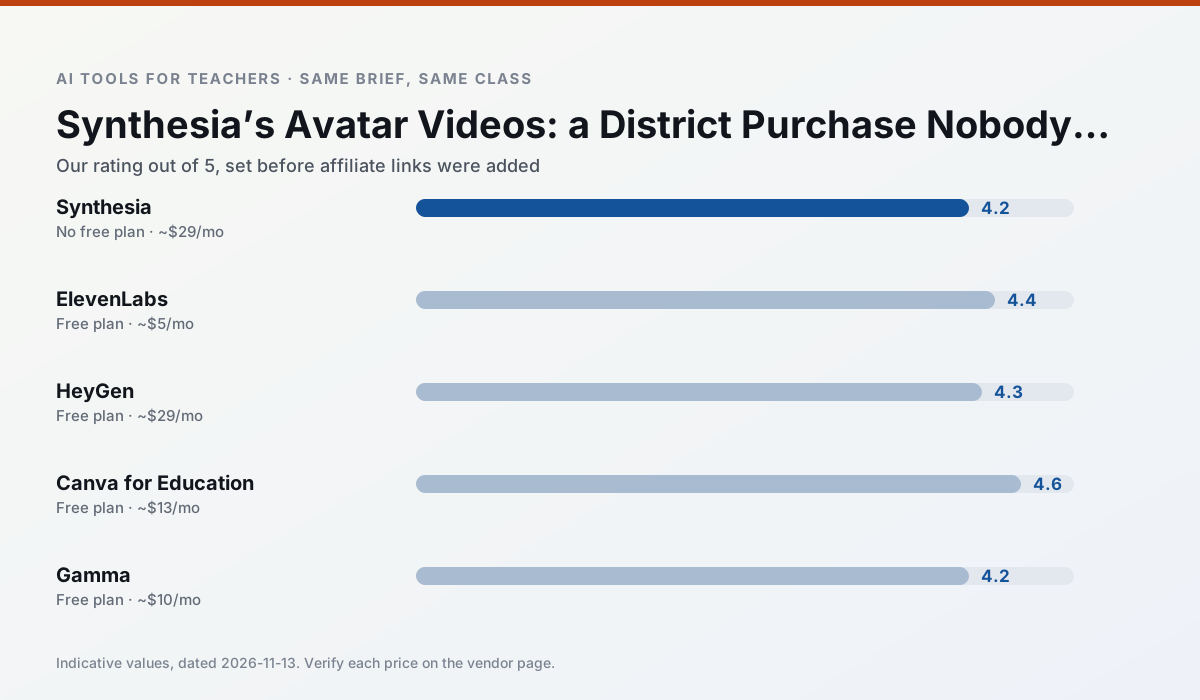
Side by side
Comparison table
Ratings reflect our timed classroom workflow, not vendor claims. Prices are indicative — verify on the vendor site.
| Tool | Best for | Free tier | Indicative paid plan | Standout feature | Our rating | Verdict | Try the tool |
|---|---|---|---|---|---|---|---|
| Synthesia | flipped lessons · video lessons | No ongoing free plan | ~$29 /user/mo | 140+ languages | 4.2 / 5 | Strong option | Try free |
| ElevenLabs | accessibility · reading intervention | Yes — Monthly character quota | ~$5 /user/mo | Very natural voices | 4.4 / 5 | Strong option | Try free |
| HeyGen | video lessons · translation | Yes — Limited credit plan | ~$29 /user/mo | Video translation | 4.3 / 5 | Strong option | Try free |
| Canva for Education | slide decks · worksheets | Yes — Verification required | ~$13 /user/mo | Thousands of education templates | 4.6 / 5 | Top pick | Try free |
| Gamma | slide decks · parent communication | Yes — Credit-limited generation | ~$10 /user/mo | Prompt-to-deck | 4.2 / 5 | Strong option | Try free |
| OpusClip | PD materials · flipped lessons | Yes — Limited monthly clips | ~$15 /user/mo | Auto captions | 4.0 / 5 | Situational | Try free |
Match your situation
Best for X
Different jobs need different tools. Here is what we would open first in each case.
For a school rollout, Synthesia offers the paperwork and the admin console; the classroom features are standard by comparison.
ElevenLabs has the shortest path from opening a tab to a usable draft, which matters more than the feature count on a Monday.
HeyGen is the one we would open on a normal planning day because the first output is editable rather than restructurable, and the free plan covers a single teacher's routine.
Canva for Education's free plan is the most usable in this comparison: a quota that survives a normal week. Not enough for a department, enough for one teacher to decide.
Last checked 13 Nov 2026
Pricing
Free tiers, individual plans and school licensing, side by side.
| Tool | Free plan | Individual / paid | School & district | Billing note | Verify |
|---|---|---|---|---|---|
| Synthesia | No ongoing free tier | ~$29 /user/mo | Custom quote | Indicative — verify on vendor site | Vendor |
| ElevenLabs | $0 — Monthly character quota | ~$5 /user/mo | ~$22 /user/mo | Indicative — verify on vendor site | Vendor |
| HeyGen | $0 — Limited credit plan | ~$29 /user/mo | Custom quote | Indicative — verify on vendor site | Vendor |
| Canva for Education | $0 — Verification required | ~$13 /user/mo | Custom quote | Indicative — verify on vendor site | Vendor |
| Gamma | $0 — Credit-limited generation | ~$10 /user/mo | ~$20 /user/mo | Indicative — verify on vendor site | Vendor |
| OpusClip | $0 — Limited monthly clips | ~$15 /user/mo | ~$29 /user/mo | Indicative — verify on vendor site | Vendor |
Editorial rule: pricing is re-checked every 2–3 months and the top 50 pages are refreshed every 6 months. See our funding policy.
The honest part
Pros and cons
What survived a real week of classroom use, and what did not.
Pros
- No camera or editing skills required
- Excellent multilingual voice output
- Easy updates to existing videos
Cons
- Cost is hard to justify for a single teacher
- Avatar video can feel impersonal
- No free ongoing tier
Pros
- Excellent for accessible audio versions
- Low entry price
- Fast generation
Cons
- Quota-based billing
- Voice cloning consent considerations
- Not a teaching platform
Pros
- Best-in-class lip-sync translation
- Useful for multilingual families
- Generous trial credits
Cons
- Credit-based pricing is confusing
- Voice cloning raises consent questions
- Overkill for everyday lessons
Pros
- Effectively free for verified teachers
- Huge template library
- No design skills needed
Cons
- AI features are capped
- Easy to produce cluttered slides
- Account verification can be slow
Pros
- Fastest path from outline to deck
- Modern-looking output by default
- Good export options
Cons
- Design control is limited
- Credits run out quickly
- Not built for student data
In the classroom
Use cases
Five concrete workflows, with the tool we would open for each one.
Rubric and feedback comments in one pass
Reorder the workflow so the rubric is yours and the comments are generated. Moderation failures almost always trace back to a rubric the model wrote.
Recommended: SynthesiaA parent email in two languages
Draft in plain, warm language with no names, translate, then back-translate the important sentences to check meaning. Keep specific incidents out of the prompt and add them yourself.
Recommended: ElevenLabsA Monday morning lesson plan in twelve minutes
The twelve minutes come from not rewriting the skeleton. Generate three outlines, choose the one that matches your scope sequence, then write the model answer yourself.
Recommended: HeyGenThree reading levels from one source text
Paste a vetted text, ask for supported, core and extension versions, then check the vocabulary list by hand. Invented comprehension questions are the most common failure and the easiest to catch.
Recommended: Canva for EducationA substitute folder that needs no context
The value here is structure, not creativity. Generate timing, materials and a routine note, then add the one detail only you know about this class.
Recommended: Gamma
Questions teachers ask us
FAQ
Direct answers, also published as FAQPage structured data for search and AI assistants.
Is Synthesia worth paying for at mixed-grade level?
What does Synthesia get wrong most often?
Can Synthesia replace a planning period?
Is Synthesia safe to use with student data?
Sources & further reading
Our recommendation
Try Synthesia free for your next lesson planning task
Turn a script into a presenter-led video with AI avatars. Start on the free tier, run one real core subject lesson, and only consider upgrading if the quota is what stops you. Disclosure: we may earn a commission (25% recurring) at no extra cost to you.
Some links on this page are affiliate links. We may earn a commission at no extra cost to you. Our rankings are editorial and never pay-to-play. Never enter student PII into a free consumer account.
Keep reading
Related comparisons in this cluster.
Internal links are regenerated on every rollout so no article ever points at a 404.