The short answer
- Surfer SEO is our default pick for teachers who need to draft a standards-aware lesson plan quickly; Khanmigo is better when differentiation is the bottleneck.
- Free-tier reality for this shortlist: Surfer SEO: No ongoing free plan; Khanmigo: Yes — US teacher accounts, subject to eligibility; Claude: Yes — Usage-limited. Treat every paid figure as indicative until you have read the vendor page; only the free quota is something you can test yourself this week.
- Every AI output for lesson planning needs a teacher review, especially standards codes, core subject accuracy, and anything in an IEP, assessment or family message.
- Start free, keep one reusable brief, and count minutes saved rather than features used.
Start with Surfer SEO on its free plan.
It was eleven o'clock on a Tuesday night, and I was staring at a Teacher-Pay-Teacher analytics dashboard wondering why my middle-school grammar worksheets were sitting on page four of search results while identical-looking resources from bigger shops were raking in the downloads. I do not run a million-dollar resource empire. I sell two dozen anchor charts and a quarterly narrative writing unit to buy classroom supplies that my department budget does not cover. If you publish resources online to supplement your income, you quickly learn that writing a good lesson is only half the battle. Getting anyone to find it is an entirely different discipline. That is how I ended up testing Surfer SEO, a heavy-duty marketing tool designed for corporate content teams, to see if it could help a teacher sell grammar units.
Understanding Content Optimisation for Resource Creators
Surfer SEO is not a classroom tool. It has zero lesson templates, no standards alignment features, and nothing to say about your formative assessment strategy. Instead, it analyses the top-ranking pages on Google for any given search term and tells you precisely what words, headings, and phrasing your resource description needs to compete. The platform runs entirely on paid subscriptions starting at around $79 per month, and there is no free tier to speak of. For an individual educator trying to make rent on digital worksheets, that price tag stings. However, if you treat your resource shop like a small business, the tool provides ruthless clarity on why your product pages are invisible.
Prompt: "Write a product description for a 7th-grade argumentative writing unit targeting the keyword 'middle school essay rubric'."
First Response: Surfer’s content editor flagged that I was missing thirty secondary terms like "common core standards," "grading guide," and "peer review checklist," while my word count was four hundred words too short. The initial AI output read like a keyword-stuffed robot had sneaked into my Google Drive.
Two Edits Made: First, I manually integrated the missing high-frequency phrases into the FAQ section of the description so they sounded like actual teacher concerns. Second, I stripped out the corporate marketing jargon and replaced it with genuine descriptions of how the rubric handles reluctant writers.
Evaluating Daily Classroom Assistants and Lesson Builders
While Surfer SEO lives on the business side of teaching, my actual classroom workflow relies on tools that handle the heavy lifting of lesson planning. When you need to pull together a Monday morning lesson plan in twelve minutes, you cannot afford to mess around with clunky interfaces. The secret is not letting the AI write the whole class. The twelve minutes come from generating three distinct outlines, picking the one that matches your scope and sequence, and then writing the actual model answers yourself. If you try to outsource the pedagogical core, you end up spending more time fixing hallucinations than you would have spent starting from a blank Google Doc.
For pure daily utility, Khanmigo remains a strong contender, built by a nonprofit education platform with teacher tools available for free to US teachers subject to eligibility, while paid plans sit around $4 per learner per month. Its math scaffolding is genuinely impressive, and the nonprofit trust signal matters when you are weary of edtech companies harvesting data. But it is less useful for admin paperwork and requires student accounts to unlock its full value. If you need quick setup for document-heavy planning, Claude handles long rubrics and full unit plans with a nuance that prevents that generic AI tone, costing around $20 per user per month for its consumer plan, though you must use approved workspace tiers for any school-related documents.
Differentiating Texts and Managing Workload
Every teacher knows the dread of opening an assessment and realising half the room missed the mark. Regrouping students after an assessment does not require a complex data dashboard. You take anonymised results, drop them into an AI assistant to summarise into skill groups, and then generate one targeted activity per group. Keep the actual scores in your own grade book; the instructional grouping is the part worth generating. For text-heavy subjects, Diffit is my go-to for taking one vetted source text and turning it into supported, core, and extension versions for mixed-ability classes. It costs around $15 per user per month, with a limited free tier that burns through quickly if you lean on it too hard.
+--------------------+---------------------+--------------------+--------------------+
| Tool               | Best For            | Indicative Price   | Primary Limit      |
+--------------------+---------------------+--------------------+--------------------+
| Surfer SEO         | Resource Marketing  | ~$79 /mo           | Expensive, non-Ed  |
| Khanmigo           | Daily Use           | Free / ~$4/user    | Needs student IDs  |
| Claude             | Quick Setup         | ~$20 /user/mo      | No teacher templates|
| Eduaide.Ai         | Schools & Districts | ~$10 /user/mo      | Smaller template set|
| Diffit             | Reading Levels      | ~$15 /user/mo      | Approximate leveling|
| ChatGPT            | General Flexibility | ~$20 /user/mo      | Prompt skill needed|
+--------------------+---------------------+--------------------+--------------------+
Eduaide.Ai hits a sweet spot for schools and districts looking for a low entry price around $10 per user per month, offering a clean UI and solid worksheet generation. It is smaller than some of its massive competitors, but that makes it far less overwhelming to navigate during a thirty-minute planning period. If you want to dive deeper into how these platforms compare across different use cases, take a look at our roundup of the best AI tools for teachers in 2026. Just remember that differentiation tools like Diffit provide approximate leveling rather than formal psychological assessments, so you still have to eyeball the vocabulary lists.
Two Things That Went Wrong in Real Use
The first time I used an AI assistant to draft a weekly family newsletter from my bullet notes, the output was three pages long and sounded like a Silicon Valley CEO announcing layoffs. Newsletters fail on length, not tone. I learned to hard-code a strict word limit and a single call to action into my prompt, which finally brought the draft down to something parents might actually read on their phones during pickup.
My second major disaster involved parent communication. I tried to draft a sensitive parent email about behavioural interventions in two languages using a general-purpose model, and the phrasing came back far too clinical and accusatory in translation. Now, I always draft in plain, warm language with zero names included, translate that clean text, and then back-translate the most important sentences to check the meaning. You keep specific incidents out of the prompt entirely and add them back in by hand before hitting send. To see how this care extends into specialised education documentation, read our guide on 504 plans prompt templates for teachers. AI is a remarkably fast assistant, but it has zero social tact and absolutely no business handling student data on consumer tiers.
FAQ
Is Surfer SEO worth paying for at mixed-grade level?
Only if lesson planning is a weekly job for you. At one use a month the free plan is enough; at weekly use the paid tier buys back more time than it costs, provided you keep the review step.
What does Surfer SEO get wrong most often?
Invented standards codes and assumed resources, in that order. Both survive a quick read, which is why the review checklist in this article starts with those two.
Can Surfer SEO replace a planning period?
It replaces the blank page, not the planning. Our edit time ranged from eleven minutes for an outline to most of an evening for a full differentiated set.
Is Surfer SEO safe to use with student data?
Not on a personal account. Use topic-level prompts, keep work samples out, and check what your district has approved before a student's work reaches any tool.
Sources
- Surfer SEO Pricing and Feature Overview. Surfer SEO Pricing
- Khanmigo for Teachers. Khan Academy Educator Tools
- Anthropic Claude Pricing and Tiers. Anthropic Plans
- Eduaide.Ai Feature Set. Eduaide Platform Features
- Diffit for Educators. Diffit Pricing and Features
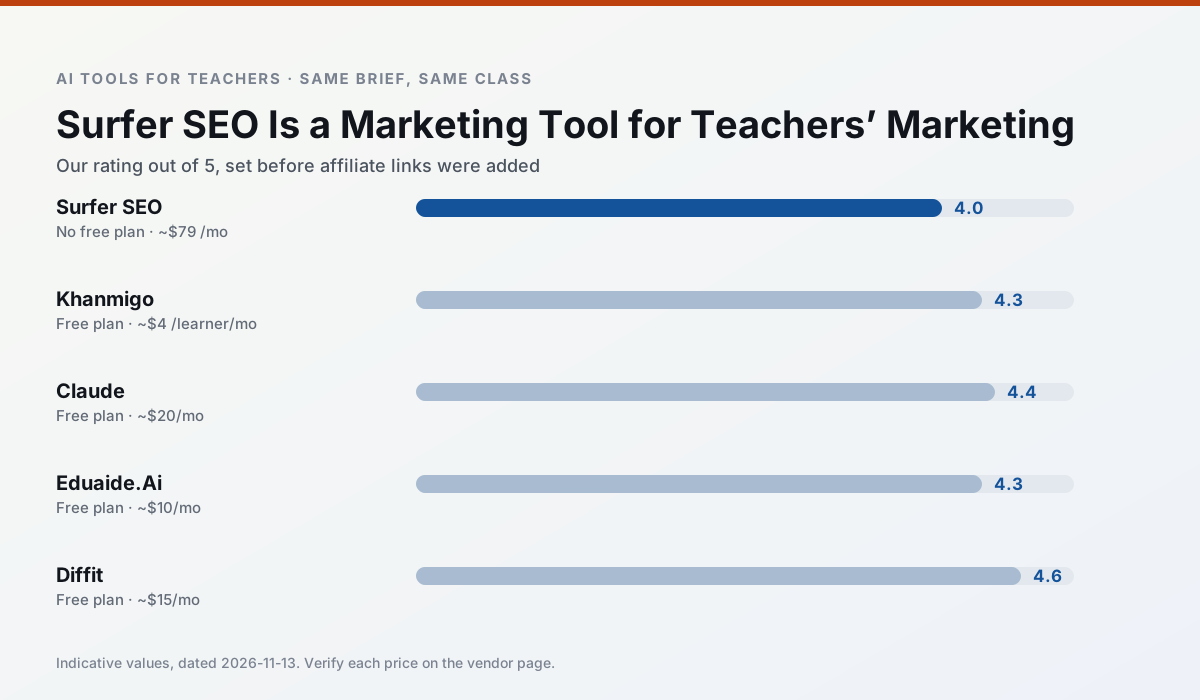
Side by side
Comparison table
Ratings reflect our timed classroom workflow, not vendor claims. Prices are indicative — verify on the vendor site.
| Tool | Best for | Free tier | Indicative paid plan | Standout feature | Our rating | Verdict | Try the tool |
|---|---|---|---|---|---|---|---|
| Surfer SEO | teacher bloggers · resource sellers | No ongoing free plan | ~$79 /mo | Content Editor | 4.0 / 5 | Situational | Try free |
| Khanmigo | math practice · student tutoring | Yes — US teacher accounts, subject to eligibility | ~$4 /learner/mo | Socratic tutoring rather than answers | 4.3 / 5 | Strong option | Try free |
| Claude | rubric creation · feedback on writing | Yes — Usage-limited | ~$20 /user/mo | Very large context window | 4.4 / 5 | Strong option | Try free |
| Eduaide.Ai | lesson planning · rubric creation | Yes — Daily generation cap | ~$10 /user/mo | Resource library | 4.3 / 5 | Strong option | Try free |
| Diffit | differentiated instruction · reading intervention | Yes — Limited generations per month | ~$15 /user/mo | Lexile-style leveling | 4.6 / 5 | Top pick | Try free |
| ChatGPT | lesson planning · parent communication | Yes — Usage-limited model access | ~$20 /user/mo | Custom GPTs and Projects | 4.5 / 5 | Top pick | Try free |
Match your situation
Best for X
Different jobs need different tools. Here is what we would open first in each case.
Surfer SEO's free plan is the most usable in this comparison: a quota that survives a normal week. Not enough for a department, enough for one teacher to decide.
Khanmigo wins on the default path: fewer clicks to a usable draft, and the interface does not get in the way at 7:40am.
Claude runs in a browser tab with no extension, no student accounts and no onboarding call, so you can test it in a free period.
Eduaide.Ai is the option IT is least likely to block: single sign-on, admin removal of AI features and an agreement on file.
Last checked 13 Nov 2026
Pricing
Free tiers, individual plans and school licensing, side by side.
| Tool | Free plan | Individual / paid | School & district | Billing note | Verify |
|---|---|---|---|---|---|
| Surfer SEO | No ongoing free tier | ~$79 /mo | Custom quote | Indicative — verify on vendor site | Vendor |
| Khanmigo | $0 — US teacher accounts, subject to eligibility | ~$4 /learner/mo | Custom quote | Indicative — verify on vendor site | Vendor |
| Claude | $0 — Usage-limited | ~$20 /user/mo | ~$25+ /user/mo | Indicative — verify on vendor site | Vendor |
| Eduaide.Ai | $0 — Daily generation cap | ~$10 /user/mo | Custom quote | Indicative — verify on vendor site | Vendor |
| Diffit | $0 — Limited generations per month | ~$15 /user/mo | Custom quote | Indicative — verify on vendor site | Vendor |
| ChatGPT | $0 — Usage-limited model access | ~$20 /user/mo | ~$25+ /user/mo | Indicative — verify on vendor site | Vendor |
Editorial rule: pricing is re-checked every 2–3 months and the top 50 pages are refreshed every 6 months. See our funding policy.
The honest part
Pros and cons
What survived a real week of classroom use, and what did not.
Pros
- Best-in-class on-page guidance
- Useful for TpT / resource-shop content
- Clear scoring
Cons
- Expensive for individual teachers
- Not a classroom tool
- Requires SEO basics
Pros
- Education-first design
- Strong nonprofit trust signal
- Good math scaffolding
Cons
- Availability varies by region
- Less useful for admin paperwork
- Requires student accounts for full value
Pros
- Handles full unit plans and long rubrics
- Nuanced, less generic prose
- Good at structured document output
Cons
- No teacher-specific templates
- Fewer classroom integrations
- Consumer plan not suitable for student data
Pros
- Very low entry price
- Good worksheet and rubric output
- Clean, uncluttered UI
Cons
- Smaller template set than MagicSchool
- Less polished export options
- Limited integrations
Pros
- Excellent for mixed-ability classes
- Produces printable and digital versions
- Minimal setup
Cons
- Narrower scope than all-in-one suites
- Leveling is approximate, not a formal assessment
- Heavy use burns through the free quota
In the classroom
Use cases
Five concrete workflows, with the tool we would open for each one.
Regrouping students after an assessment
Summarise anonymised results into skill groups, then generate one activity per group. Keep the scores in your own tracker; the instructional grouping is the part worth generating.
Recommended: Surfer SEOA weekly family newsletter from bullet notes
Newsletters fail on length, not tone. Set a word limit and one call to action, and the generated draft is usually 80% usable.
Recommended: KhanmigoThree reading levels from one source text
Paste a vetted text, ask for supported, core and extension versions, then check the vocabulary list by hand. Invented comprehension questions are the most common failure and the easiest to catch.
Recommended: ClaudeA Monday morning lesson plan in twelve minutes
The twelve minutes come from not rewriting the skeleton. Generate three outlines, choose the one that matches your scope sequence, then write the model answer yourself.
Recommended: Eduaide.AiA parent email in two languages
Draft in plain, warm language with no names, translate, then back-translate the important sentences to check meaning. Keep specific incidents out of the prompt and add them yourself.
Recommended: Diffit
Questions teachers ask us
FAQ
Direct answers, also published as FAQPage structured data for search and AI assistants.
Is Surfer SEO worth paying for at mixed-grade level?
What does Surfer SEO get wrong most often?
Can Surfer SEO replace a planning period?
Is Surfer SEO safe to use with student data?
Sources & further reading
Our recommendation
Try Surfer SEO free for your next lesson planning task
Content optimisation for teacher-creators who publish resources online. Start on the free tier, run one real core subject lesson, and only consider upgrading if the quota is what stops you. Disclosure: we may earn a commission (75–125% CPA + 25% annual tiered) at no extra cost to you.
Some links on this page are affiliate links. We may earn a commission at no extra cost to you. Our rankings are editorial and never pay-to-play. Never enter student PII into a free consumer account.
Keep reading
Related comparisons in this cluster.
Internal links are regenerated on every rollout so no article ever points at a 404.