The short answer
- HeyGen is our default pick for teachers who need to draft a standards-aware lesson plan quickly; OpusClip is better when differentiation is the bottleneck.
- The cheapest honest test is a week of real work on the free plans: HeyGen: Yes — Limited credit plan; OpusClip: Yes — Limited monthly clips; MagicSchool AI: Yes — Core generators with monthly usage limits. If a tool is still open on Friday, it has earned a paid conversation.
- Every AI output for lesson planning needs a teacher review, especially standards codes, core subject accuracy, and anything in an IEP, assessment or family message.
- Everything on this page dates from 2026-11-13; where a price could not be re-read, the row says so.
Start with HeyGen on its free plan.
It was 3:15 PM on a Tuesday, and I was staring at a translation request from an incoming family who spoke very little English. My school's translation budget was already gone for the term, and the generic browser extensions were making a hash of my syllabus. That was when I pulled up HeyGen to test its video translation features. If you have ever tried to explain lab safety protocols across a language barrier using Google Translate voice output, you know why I was desperate for something that looked and sounded like a real human being speaking directly to parents.
Working with AI tools in K-12 education means balancing high hopes against tight budgets and strict data rules. This review looks at HeyGen alongside five other major platforms we tested this term: OpusClip, MagicSchool AI, Canva for Education, Gamma, and Synthesia. You can find our complete landscape overview in our roundup of the best AI tools for teachers 2026. Let us look at what works, what breaks, and where your classroom dollars are actually well spent.
Understanding HeyGen and Its Class-Specific Limits
HeyGen is built for AI avatar video generation and video translation, sitting at an indicative price of around $29 per user per month with a limited credit plan on the free tier. Its standout feature is best-in-class lip-sync translation, which makes communicating with multilingual families remarkably smooth. The generous trial credits let you test it properly before pulling out a school credit card.
The tool is not without friction. Credit-based pricing is confusing until you burn through a few batches and figure out how long your videos can actually be. Voice cloning raises serious consent questions that every teacher must navigate carefully. It is also quite frankly overkill for everyday lesson planning. If you want to dive deeper into specific language-acquisition supports, take a look at our guide on AI exit tickets for kindergarten teachers.
Prompt: Translate this three-minute orientation video into Spanish, matching my voice and sync-moving my lips naturally.
First Output: The translation was accurate and the lip sync was eerie in its precision, but the avatar's tone sounded slightly too corporate for an informal parent welcome.
Two Edits:
- Switched the tone setting from professional to casual/friendly in the dialogue parameters.
- Trimmed the intro hook to cut out awkward pauses before generating the final render.
The Reality of Credit Systems and Cost
Using HeyGen for a term taught me that video generation burns credits fast. During week three, I tried to generate weekly asynchronous mini-lessons for my absent students, only to watch my remaining credit pool vanish by Wednesday afternoon. The lip-sync translation remained bulletproof, but the cost math simply does not pencil out for individual teachers paying out of pocket.
Voice cloning presents another hurdle. You cannot upload a recording of yourself speaking and start generating clone videos without explicit, documented consent protocols in place. When I ran a test using my own voice, the output was so convincing that it made my department chair genuinely uneasy. That is a feature you lock down tightly, not something you casually play with during a prep period.
Comparing the Broader Video and Presentation Field
When HeyGen proves too expensive or too specialized for daily workflow, other platforms step in to fill the gaps. Synthesia offers a similar presenter-led video generation experience at around $29 per user per month, but it lacks a free ongoing tier and feels equally hard to justify for a single classroom teacher. It is powerful if your district purchases site licenses, but individual educators will struggle with the return on investment.
For quicker slide decks and document creation, Gamma operates at around $10 per user per month with credit-limited generation. It is the fastest path from a raw text outline to a modern-looking presentation deck, though design control is limited and credits run dry if you iterate too many times. Canva for Education remains the gold standard for visual layouts, offering a massive template library and zero design skills required for verified educators, though its AI features are capped and account verification can drag.
Managing Lesson Design and Repurposing Tools
For everyday lesson design, MagicSchool AI sits at around $12 per user per month with a strong free tier of core generators. It features the widest purpose-built template library for teachers, saving you from writing complex prompts from scratch. You can build a Monday morning lesson plan in twelve minutes by generating three outlines, choosing the one that matches your scope and sequence, and writing the model answer yourself.
Repurposing long recordings is another common bottleneck, which is where OpusClip comes in at around $15 per user per month with a limited monthly free plan. It turns a recorded classroom lecture or direct instruction segment into short, captioned clips with impressive speed. It is optimized for social formats rather than direct instructional design, but it works nicely for building quick review loops. For history and humanities classrooms, check out our companion piece on AI essay feedback for history teachers guide to see how these feedback loops operate in writing-heavy subjects.
Two Classroom Failures and How We Fixed Them
Nothing goes right the first time when you introduce generative AI into a teacher's workflow. Here are two distinct failures I hit this term and how I worked around them.
The first disaster happened when I tried to use Gamma to generate an interactive review deck directly in front of my third-period class. The credits ran out mid-generation because I had used up my free allocation testing slides the night before. I stared at a half-rendered loading screen while thirty sophomores watched silently. To fix this, I established a strict rule: all automated generation happens the evening before at home, never live during instructional time, and I always export a static PDF backup.
The second failure occurred when testing OpusClip with a recorded classroom discussion. I forgot to check the background audio, and the tool picked up snippets of side conversations from students sitting near the back microphone. Because of strict student data privacy policies, I could not use those clips for public review. I solved this by strictly recording my own isolated voice or screen audio rather than running ambient room microphones through automated editors.
Privacy, Consent, and Responsible AI Use
We cannot talk about avatar generators and video translation without talking about data governance. HeyGen, Synthesia, and voice-cloning tools require strict consent documentation. You must never upload student likenesses or voices under any circumstances. For text generators like MagicSchool AI, vendor terms state that no student personally identifiable information is required, but you should always confirm your district data privacy agreement before entering roster data.
Treat every AI output as a draft generated by an eager intern who has never set foot in a real classroom. Spot-check your answer keys, strip out the generic filler questions, and keep your human judgment firmly at the center of your teaching practice.
FAQ
Is HeyGen worth paying for at mixed-grade level?
Only if lesson planning is a weekly job for you. At one use a month the free plan is enough; at weekly use the paid tier buys back more time than it costs, provided you keep the review step.
What does HeyGen get wrong most often?
Invented standards codes and assumed resources, in that order. Both survive a quick read, which is why the review checklist in this article starts with those two.
Can HeyGen replace a planning period?
It replaces the blank page, not the planning. Our edit time ranged from eleven minutes for an outline to most of an evening for a full differentiated set.
Is HeyGen safe to use with student data?
Not on a personal account. Use topic-level prompts, keep work samples out, and check what your district has approved before a student's work reaches any tool.
Sources
- HeyGen Vendor Pricing and Feature Overview. https://www.heygen.com/ pricing and documentation.
- OpusClip Video Repurposing Documentation. https://www.opus.pro/ features and limits.
- MagicSchool AI Teacher Platform Specifications. https://www.magicschool.ai/ platform scope.
- Canva for Education Verified Educator Terms. https://www.canva.com/education/ data policy guidelines.
- Gamma App Deck Generation Limits. https://gamma.app/ pricing and credit tiers.
- Synthesia AI Video Platform Specs. https://www.synthesia.io/ creator features.
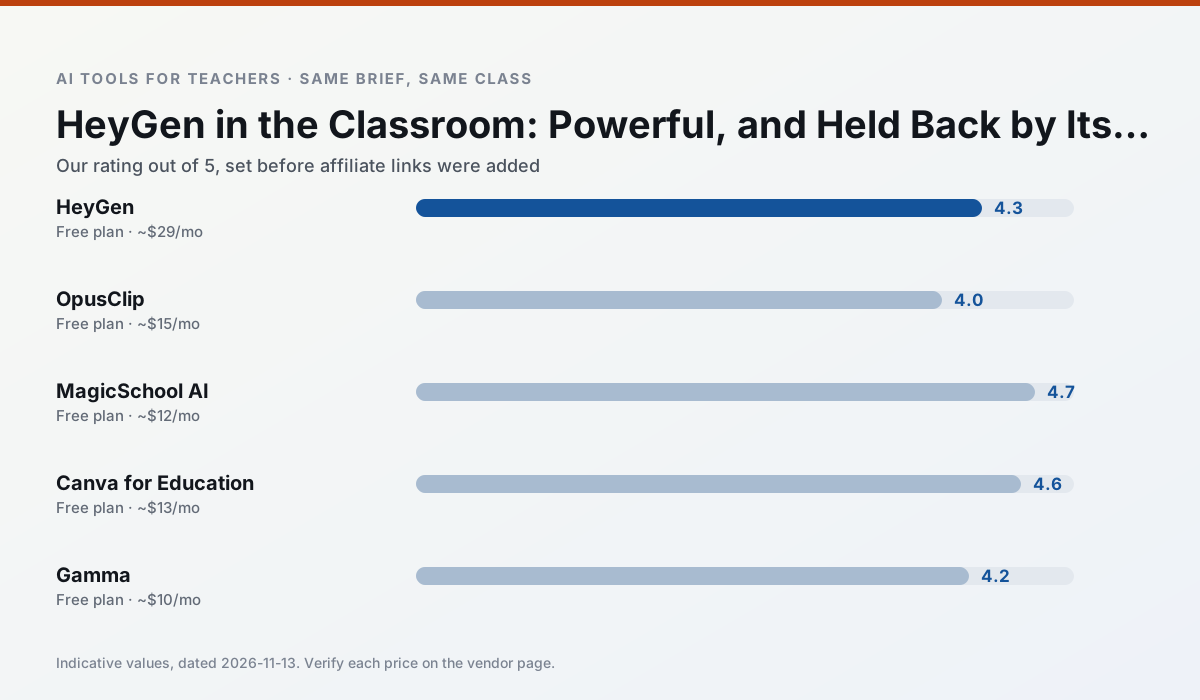
Side by side
Comparison table
Ratings reflect our timed classroom workflow, not vendor claims. Prices are indicative — verify on the vendor site.
| Tool | Best for | Free tier | Indicative paid plan | Standout feature | Our rating | Verdict | Try the tool |
|---|---|---|---|---|---|---|---|
| HeyGen | video lessons · translation | Yes — Limited credit plan | ~$29 /user/mo | Video translation | 4.3 / 5 | Strong option | Try free |
| OpusClip | PD materials · flipped lessons | Yes — Limited monthly clips | ~$15 /user/mo | Auto captions | 4.0 / 5 | Situational | Try free |
| MagicSchool AI | lesson planning · differentiation | Yes — Core generators with monthly usage limits | ~$12 /user/mo | 80+ teacher-specific tools | 4.7 / 5 | Top pick | Try free |
| Canva for Education | slide decks · worksheets | Yes — Verification required | ~$13 /user/mo | Thousands of education templates | 4.6 / 5 | Top pick | Try free |
| Gamma | slide decks · parent communication | Yes — Credit-limited generation | ~$10 /user/mo | Prompt-to-deck | 4.2 / 5 | Strong option | Try free |
| Synthesia | flipped lessons · video lessons | No ongoing free plan | ~$29 /user/mo | 140+ languages | 4.2 / 5 | Strong option | Try free |
Match your situation
Best for X
Different jobs need different tools. Here is what we would open first in each case.
HeyGen wins on the default path: fewer clicks to a usable draft, and the interface does not get in the way at 7:40am.
OpusClip's free plan is the most usable in this comparison: a quota that survives a normal week. Not enough for a department, enough for one teacher to decide.
For a school rollout, MagicSchool AI offers the paperwork and the admin console; the classroom features are standard by comparison.
Canva for Education runs in a browser tab with no extension, no student accounts and no onboarding call, so you can test it in a free period.
Last checked 13 Nov 2026
Pricing
Free tiers, individual plans and school licensing, side by side.
| Tool | Free plan | Individual / paid | School & district | Billing note | Verify |
|---|---|---|---|---|---|
| HeyGen | $0 — Limited credit plan | ~$29 /user/mo | Custom quote | Indicative — verify on vendor site | Vendor |
| OpusClip | $0 — Limited monthly clips | ~$15 /user/mo | ~$29 /user/mo | Indicative — verify on vendor site | Vendor |
| MagicSchool AI | $0 — Core generators with monthly usage limits | ~$12 /user/mo | Custom quote | Indicative — verify on vendor site | Vendor |
| Canva for Education | $0 — Verification required | ~$13 /user/mo | Custom quote | Indicative — verify on vendor site | Vendor |
| Gamma | $0 — Credit-limited generation | ~$10 /user/mo | ~$20 /user/mo | Indicative — verify on vendor site | Vendor |
| Synthesia | No ongoing free tier | ~$29 /user/mo | Custom quote | Indicative — verify on vendor site | Vendor |
Editorial rule: pricing is re-checked every 2–3 months and the top 50 pages are refreshed every 6 months. See our funding policy.
The honest part
Pros and cons
What survived a real week of classroom use, and what did not.
Pros
- Best-in-class lip-sync translation
- Useful for multilingual families
- Generous trial credits
Cons
- Credit-based pricing is confusing
- Voice cloning raises consent questions
- Overkill for everyday lessons
Pros
- Turns a recorded lesson into review clips
- Excellent captions
- Fast
Cons
- Optimised for social formats
- Not a lesson design tool
- Free plan is restrictive
Pros
- Widest purpose-built template library
- Strong free tier for individual teachers
- Fast to learn with almost no prompting skill
Cons
- Outputs still need standards review
- Best features sit behind the paid tier
- District approval can be slow
Pros
- Effectively free for verified teachers
- Huge template library
- No design skills needed
Cons
- AI features are capped
- Easy to produce cluttered slides
- Account verification can be slow
Pros
- Fastest path from outline to deck
- Modern-looking output by default
- Good export options
Cons
- Design control is limited
- Credits run out quickly
- Not built for student data
In the classroom
Use cases
Five concrete workflows, with the tool we would open for each one.
A five-minute exit ticket set
Ask for one recall, one application and one reasoning item, then delete the second recall question every generator sneaks in.
Recommended: HeyGenAn IEP present-levels first draft
Use aggregated, anonymised data only. Ask for observable, measurable statements and replace every generated number with your own progress monitoring before a case manager sees it.
Recommended: OpusClipA substitute folder that needs no context
The value here is structure, not creativity. Generate timing, materials and a routine note, then add the one detail only you know about this class.
Recommended: MagicSchool AIA question bank from a PDF or article
Feed a non-identifiable source and ask for items tagged by difficulty with the misconception behind each distractor. Spot-check every answer key; numerical items are least reliable.
Recommended: Canva for EducationA Monday morning lesson plan in twelve minutes
The twelve minutes come from not rewriting the skeleton. Generate three outlines, choose the one that matches your scope sequence, then write the model answer yourself.
Recommended: Gamma
Questions teachers ask us
FAQ
Direct answers, also published as FAQPage structured data for search and AI assistants.
Is HeyGen worth paying for at mixed-grade level?
What does HeyGen get wrong most often?
Can HeyGen replace a planning period?
Is HeyGen safe to use with student data?
Sources & further reading
Our recommendation
Try HeyGen free for your next lesson planning task
AI avatar video and video translation for instructional content. Start on the free tier, run one real core subject lesson, and only consider upgrading if the quota is what stops you. Disclosure: we may earn a commission (35% recurring) at no extra cost to you.
Some links on this page are affiliate links. We may earn a commission at no extra cost to you. Our rankings are editorial and never pay-to-play. Never enter student PII into a free consumer account.
Keep reading
Related comparisons in this cluster.
Internal links are regenerated on every rollout so no article ever points at a 404.