The short answer
- Diffit is our default pick for teachers who need to draft a standards-aware lesson plan quickly; Quizizz is better when differentiation is the bottleneck.
- Diffit handles the broad case; Quizizz handles the narrow one. Anything beyond that pair should be justified by a recurring weekly job, not a feature demo.
- Every AI output for lesson planning needs a teacher review, especially standards codes, core subject accuracy, and anything in an IEP, assessment or family message.
- Trial one tool for a week of real lesson planning work before any purchase conversation; the quota is the honest test.
Start with MagicSchool AI on its free plan.
Thirty-four eighth-graders sat in front of me last term, and twenty-eight of them were reading the exact same excerpt on the reconstruction era. Four of those students could barely decode the first paragraph, fifteen were right on grade level, and five were already bored out of their skulls looking for ways to launch rubber bands across the room. If I spent my Sunday writing three versions of that text by hand, I would have zero energy left to actually teach any of them. That is the exact problem we run into when we look at standard lesson planning suites. They give you a generic shell, but they do not solve the brutal, daily reality of mixed-ability reading levels.
If you are looking at tools to fix this mess, you might want to read our roundup of the best AI tools for teachers 2026 to see how things shake out across the board. But if your immediate bottleneck is differentiation, the tool you actually need sitting in your browser tab is not a lesson planner at all.
What Diffit Actually Does for Daily Prep
Diffit is not a lesson plan generator, and that is its strength. It does not try to map out your entire Tuesday morning or write your unit objectives for you. Instead, it takes any article, PDF, textbook chapter, or YouTube video and levels it down or up to whatever Lexile or grade band you specify. You drop in a complex primary source, click a button, and within seconds you have a adapted reading passage, vocabulary definitions, open-ended questions, and multiple-choice checks ready to export.
The free tier gives you a limited number of generations per month, which you will burn through surprisingly fast if you use it for every single section. The paid tier sits at roughly $15 per user per month (indicative), which is about standard for classroom tools that actually save you hours on a Sunday night. It shines brightest in mixed-ability classrooms where you refuse to water the content down for everyone just to help the kids who are struggling. The setup takes about thirty seconds, and you can export the results as printable worksheets or digital student links. The catch is that the leveling is approximate rather than a formal psychometric assessment, and its scope is narrow compared to all-in-one suites. You still need to read through the output to make sure it kept the historical context intact.
Where Other AI Tools Fit Your Workflow
When you are trying to build out a complete workflow, you quickly realize that no single platform does every single job well. If you are comparing it to writing your materials from scratch in ChatGPT, which runs around $20 per user per month (indicative) on paid tiers, you notice that Diffit keeps you focused purely on texts and student readability. ChatGPT gives you infinite flexibility, but it requires serious prompt engineering to get a decent reading passage without inventing historical facts.
If you want AI assistance baked directly into your Google Docs or Slides without dealing with endless copy-pasting, Brisk Teaching operates as a browser extension that brings inline feedback and leveling right into your workspace. It costs roughly $10 per user per month (indicative) with a tight free quota, though your school IT department will need to review its extension permissions because it reads document content directly.
For quick checks for understanding and review sessions, teachers often lean toward gamified platforms. Quizizz offers AI-assisted question generation from a massive question bank, coming in at around $15 per user per month (indicative) with a core free tier. Students already know the interface, and the reporting is solid even on low-end school devices. Similarly, Kahoot! focuses on quick game-based review with instant engagement and very low training time, priced at roughly $10 per user per month (indicative) for full features. Both tools are fantastic for Friday reviews, but their time pressure formats tend to reward fast recall rather than deep, reasoned thought.
If you are hunting for a strong free option rooted in nonprofit trust, Khanmigo provides tutor-style AI and teacher tools. It is free for US teacher accounts subject to eligibility, while school deployments run about $4 per learner per month (indicative). It offers wonderful math scaffolding, though its availability varies by region and it requires student accounts for full value.
Two Real Classroom Failures and How to Fix Them
Initial Prompt: "Write a leveled reading passage about the industrial revolution for eighth graders, including vocabulary words and five questions to test comprehension."
First Output: The model generated a generic three-paragraph essay that used the word "capitalism" four times in the first sentence and provided multiple-choice questions with answers that were all obviously option C.
Teacher Edits:
- Switched from a generic generation prompt to dropping a specific primary source URL directly into Diffit so the content remained grounded in real history.
- Manually adjusted the target reading level slider and swapped two of the auto-generated vocabulary words for terms we had actually introduced in class on Monday.
The first major trap you will hit with these tools is trusting the AI to write your rubrics. If you let an AI generate both your assignment rubric and your feedback comments in one pass, you will inevitably end up moderating grades that make zero sense. Reorder your workflow so the rubric belongs strictly to you, and use the AI only to generate targeted feedback comments based on student performance.
The second trap is privacy leakage. Never paste identifiable student work into consumer AI models, and make sure you check your district data privacy agreements before rolling out any extension or platform. When sending parent emails in two languages, draft them in plain, warm language with zero student names, translate them, and then back-translate the crucial sentences to double-check the meaning. Keep specific behavioral incidents completely out of the prompt and add them yourself afterward.
Making the Right Choice for Your Classroom
If you need the best option for schools and districts that prioritizes equitable reading access, Diffit remains our top pick for text adaptation. If you want quick setup for formative checks, Quizizz is hard to beat. For daily review games, Kahoot! holds the crown. And if you need a reliable free option with strong educational roots, look closely at Khanmigo.
Whichever tool you choose, remember that the goal is not to hand your professional judgment over to an algorithm. Use these systems to clear away the clerical underbrush so you can spend your actual working hours sitting next to the kids who need you. For a deeper look at how these platforms compare, take a look at our detailed /articles/diffit-review and explore our guide on finding the right /articles/ai-lesson-plan-generator for your specific grade band.
FAQ
Is Diffit worth paying for at mixed-grade level?
Only if lesson planning is a weekly job for you. At one use a month the free plan is enough; at weekly use the paid tier buys back more time than it costs, provided you keep the review step.
What does Diffit get wrong most often?
Invented standards codes and assumed resources, in that order. Both survive a quick read, which is why the review checklist in this article starts with those two.
Can Diffit replace a planning period?
It replaces the blank page, not the planning. Our edit time ranged from eleven minutes for an outline to most of an evening for a full differentiated set.
Is Diffit safe to use with student data?
Not on a personal account. Use topic-level prompts, keep work samples out, and check what your district has approved before a student's work reaches any tool.
Sources
- Diffit product overview and feature specifications (diffit.me)
- Quizizz educator pricing and feature matrix (quizizz.com)
- Kahoot! teacher plans and accessibility data (kahoot.com)
- Khanmigo teacher eligibility and safety documentation (khanacademy.org)
- Brisk Teaching browser extension capabilities and privacy notes (briskteaching.com)
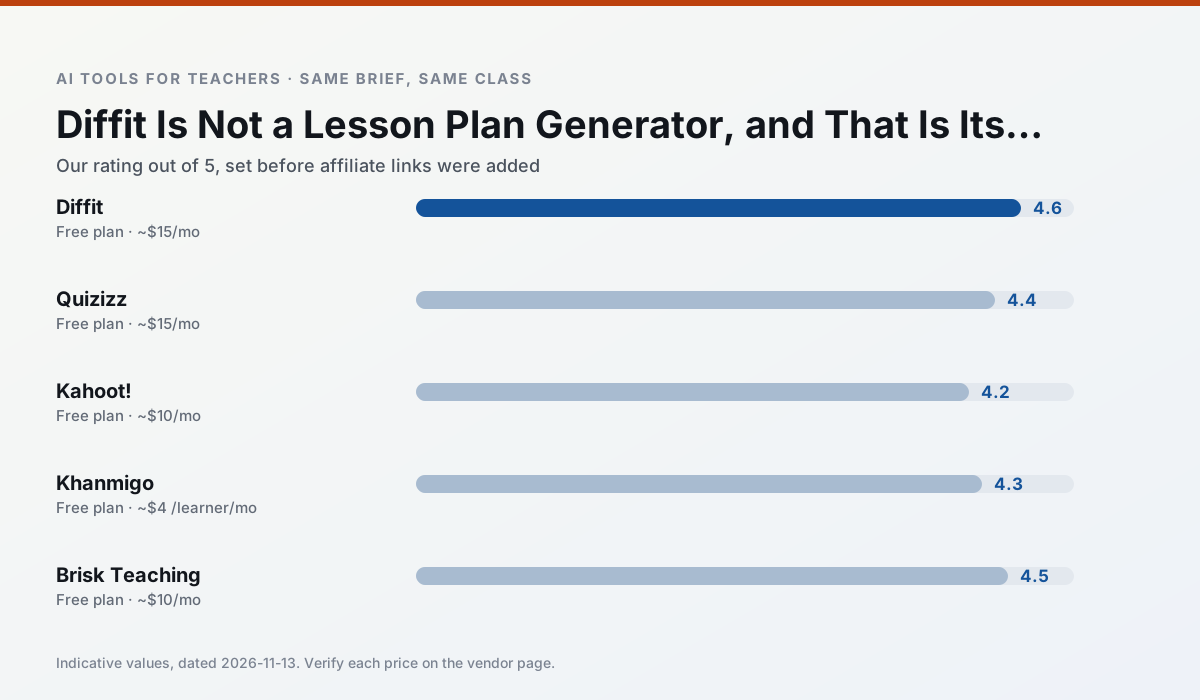
Side by side
Comparison table
Ratings reflect our timed classroom workflow, not vendor claims. Prices are indicative — verify on the vendor site.
| Tool | Best for | Free tier | Indicative paid plan | Standout feature | Our rating | Verdict | Try the tool |
|---|---|---|---|---|---|---|---|
| Diffit | differentiated instruction · reading intervention | Yes — Limited generations per month | ~$15 /user/mo | Lexile-style leveling | 4.6 / 5 | Top pick | Try free |
| Quizizz | quiz generation · formative assessment | Yes — Core quiz creation | ~$15 /user/mo | AI question generator | 4.4 / 5 | Strong option | Try free |
| Kahoot! | quiz generation · review lessons | Yes — Limited player count | ~$10 /user/mo | AI question builder | 4.2 / 5 | Strong option | Try free |
| Khanmigo | math practice · student tutoring | Yes — US teacher accounts, subject to eligibility | ~$4 /learner/mo | Socratic tutoring rather than answers | 4.3 / 5 | Strong option | Try free |
| Brisk Teaching | feedback on writing · grading | Yes — Limited actions per month | ~$10 /user/mo | Works inside Google Docs | 4.5 / 5 | Top pick | Try free |
| ChatGPT | lesson planning · parent communication | Yes — Usage-limited model access | ~$20 /user/mo | Custom GPTs and Projects | 4.5 / 5 | Top pick | Try free |
Match your situation
Best for X
Different jobs need different tools. Here is what we would open first in each case.
For a school rollout, Diffit offers the paperwork and the admin console; the classroom features are standard by comparison.
Quizizz runs in a browser tab with no extension, no student accounts and no onboarding call, so you can test it in a free period.
On the daily cycle, Kahoot! saves the most edit time per task; the paid tier mostly buys more runs rather than better ones.
Nothing on Khanmigo's free tier is a teaser demo; the limits are documented and a normal week fits inside them.
Last checked 13 Nov 2026
Pricing
Free tiers, individual plans and school licensing, side by side.
| Tool | Free plan | Individual / paid | School & district | Billing note | Verify |
|---|---|---|---|---|---|
| Diffit | $0 — Limited generations per month | ~$15 /user/mo | Custom quote | Indicative — verify on vendor site | Vendor |
| Quizizz | $0 — Core quiz creation | ~$15 /user/mo | Custom quote | Indicative — verify on vendor site | Vendor |
| Kahoot! | $0 — Limited player count | ~$10 /user/mo | Custom quote | Indicative — verify on vendor site | Vendor |
| Khanmigo | $0 — US teacher accounts, subject to eligibility | ~$4 /learner/mo | Custom quote | Indicative — verify on vendor site | Vendor |
| Brisk Teaching | $0 — Limited actions per month | ~$10 /user/mo | Custom quote | Indicative — verify on vendor site | Vendor |
| ChatGPT | $0 — Usage-limited model access | ~$20 /user/mo | ~$25+ /user/mo | Indicative — verify on vendor site | Vendor |
Editorial rule: pricing is re-checked every 2–3 months and the top 50 pages are refreshed every 6 months. See our funding policy.
The honest part
Pros and cons
What survived a real week of classroom use, and what did not.
Pros
- Excellent for mixed-ability classes
- Produces printable and digital versions
- Minimal setup
Cons
- Narrower scope than all-in-one suites
- Leveling is approximate, not a formal assessment
- Heavy use burns through the free quota
Pros
- Students already know the interface
- Good reporting
- Works on low-end devices
Cons
- Writing high-quality AI questions still needs review
- Gamification can distract
- Advanced analytics are paid
Pros
- Instant engagement
- Very low training time
- Strong brand familiarity
Cons
- Less depth for higher-order assessment
- Paid tiers needed for larger classes
- Time pressure suits recall more than reasoning
Pros
- Education-first design
- Strong nonprofit trust signal
- Good math scaffolding
Cons
- Availability varies by region
- Less useful for admin paperwork
- Requires student accounts for full value
Pros
- No copy-paste between tools
- Fast inline feedback on student drafts
- Gentle learning curve
Cons
- Chrome-first workflow
- Extension permissions need IT approval
- Free quota is tight
In the classroom
Use cases
Five concrete workflows, with the tool we would open for each one.
A weekly family newsletter from bullet notes
Newsletters fail on length, not tone. Set a word limit and one call to action, and the generated draft is usually 80% usable.
Recommended: DiffitRegrouping students after an assessment
Summarise anonymised results into skill groups, then generate one activity per group. Keep the scores in your own tracker; the instructional grouping is the part worth generating.
Recommended: QuizizzRubric and feedback comments in one pass
Reorder the workflow so the rubric is yours and the comments are generated. Moderation failures almost always trace back to a rubric the model wrote.
Recommended: Kahoot!A parent email in two languages
Draft in plain, warm language with no names, translate, then back-translate the important sentences to check meaning. Keep specific incidents out of the prompt and add them yourself.
Recommended: KhanmigoA Monday morning lesson plan in twelve minutes
The twelve minutes come from not rewriting the skeleton. Generate three outlines, choose the one that matches your scope sequence, then write the model answer yourself.
Recommended: Brisk Teaching
Questions teachers ask us
FAQ
Direct answers, also published as FAQPage structured data for search and AI assistants.
Is Diffit worth paying for at mixed-grade level?
What does Diffit get wrong most often?
Can Diffit replace a planning period?
Is Diffit safe to use with student data?
Sources & further reading
Our recommendation
Try MagicSchool AI free for your next lesson planning task
A large library of teacher-specific AI generators in one dashboard. Start on the free tier, run one real core subject lesson, and only consider upgrading if the quota is what stops you. Disclosure: we may earn a commission (30% recurring) at no extra cost to you.
Some links on this page are affiliate links. We may earn a commission at no extra cost to you. Our rankings are editorial and never pay-to-play. Never enter student PII into a free consumer account.
Keep reading
Related comparisons in this cluster.
Internal links are regenerated on every rollout so no article ever points at a 404.