The short answer
- Originality.ai is our default pick for teachers who need to draft a standards-aware lesson plan quickly; Khanmigo is better when differentiation is the bottleneck.
- Start with Originality.ai on its free plan, keep Khanmigo as the second opinion, and do not open a card until the quota, not the feature list, is what stops you.
- Every AI output for Reminder notes needs a teacher review, especially standards codes, core subject accuracy, and anything in an IEP, assessment or family message.
- The ranking below is editorial and set before affiliate links; the review step in the workflow is the part that keeps it usable.
Start with Originality.ai on its free plan.
At 4:15 on a Friday afternoon, my inbox held twenty-eight unread messages, and I still had to write the weekly family update for forty-two households across two dominant home languages. I used to stare at a blank Google Doc for twenty minutes, trying to sound professional yet approachable while summarizing our upcoming science fair timeline, three different permission slip deadlines, and a reminder about spirit week. By the time I hit send, my coffee was cold and my patience was thinner than standard copy paper. That is when I started experimenting with family reminders with AI to reclaim my weekend.
Using general-purpose text generators for parent communication is not about letting algorithms talk to families on your behalf. It is about speed-formatting. When you use tools like ChatGPT—which runs about ~$20 /user/mo (indicative) for paid tiers and sits as our best overall for daily use—you can turn a rough, bulleted list of classroom chaos into a warm, structured announcement in under two minutes. The secret is keeping student names out of the prompt entirely and handling the translation steps with specific safety checks so nothing gets lost in transit.
The Two-Language Parent Email Workflow
Translating classroom updates used to mean copying text into free web tools and praying the idioms translated correctly. Now, I draft the core reminder in plain, warm English without mentioning any student names. Then I ask the model to translate it into our secondary school language, followed by a mandatory back-translation step to catch any jarring tone shifts. ChatGPT handles this multilingual heavy lifting better than most, though Claude—offering a usage-limited free tier and ~$20 /user/mo (indicative) paid plans—is also exceptional at producing nuanced, less generic prose when you need a softer tone.
Prompt: Write a warm, encouraging weekly update for middle school families. Include these bullets: Science fair projects due Thursday, picture retakes on Wednesday, and the after-school club cancellation on Friday. Keep the tone friendly, clear, and professional. Translate the final approved draft into Spanish.
What came back: The English draft was solid, but the Spanish translation used overly formal regional vocabulary that would sound stiff to our local families. It also tried to insert placeholders for student names, which violates privacy best practices.
Two edits that made it usable: First, I explicitly instructed the model to use conversational Latin American Spanish rather than formal peninsular phrasing. Second, I stripped out all name placeholders and replaced them with general group reminders before running the final text through the translator.
Choosing the Right Assistant for Administrative Tasks
Not every assistant handles parent communication the same way, and picking the wrong tool leads to formatting headaches. If you need quick setup and administrative batch work, Originality.ai offers fast bulk scanning and a transparent credit model at ~$12 /user/mo (indicative), though it is primarily designed for publisher workflows and content QA rather than teaching tasks. For comprehensive school and district deployments, Khanmigo provides robust education-first design and strong nonprofit trust signals for about ~$4 /learner/mo (indicative), making it a reliable bet for districts already embedded in that ecosystem.
When building standalone worksheets or rubric-aligned parent handouts to accompany your weekly letters, Eduaide.Ai offers a clean, uncluttered interface and a low entry price of around ~$10 /user/mo (indicative) with a daily generation cap on its free tier. If you want to transform a static topic into an interactive family night review or a quick check for understanding during class, Curipod delivers high student engagement out of the box at roughly ~$12 /user/mo (indicative), though its free tier is quite restrictive. You can read more about foundational setup strategies in our guide on the best AI tools for teachers 2026.
Two Ways This Workflow Failed Me
The first major failure happened when I let an AI model draft an individualized behavior reminder for a parent meeting. The tool invented a detailed timeline of hallway incidents that never actually happened, mistaking general training data patterns for my specific student. I caught the error before hitting send, but it taught me a harsh lesson. I now treat AI output as a rough skeleton only; specific incidents, dates, and behavioral notes must come entirely from my own handwritten planner.
The second failure involved automated translation without verification. I trusted a quick Spanish output for a complex permission slip deadline regarding medication storage. A bilingual colleague pointed out that the translation accidentally altered the time window for drop-off from 3:00 PM to the morning. Since then, I always run a manual back-translation check on critical safety notices, or I rely on human translation services for high-stakes medical and legal communication. For more tips on navigating privacy boundaries with home languages, check out our advice on AI translation privacy for families.
Keeping Student Data Safe
Parent communication workflows demand absolute vigilance regarding personally identifiable information. Consumer-tier chatbots make it easy to paste student names, grades, and specific incidents into the prompt window to save time. Do not do this. Keep all prompts anonymous by using placeholders like "Student A" or removing names entirely before feeding text into tools like ChatGPT or Claude.
If your district has not approved a workspace tier with strict data privacy guarantees, stick to drafting generic templates, administrative announcements, and newsletters that contain zero student records. AI should handle the grammar, the formatting, and the tone adjustments, while you retain full responsibility for the facts, the names, and the relationships with your families.
FAQ
Can AI do Reminder notes at mixed-grade level?
It can produce a first draft and a structure. The level judgement, the standards check and the tone are teacher decisions.
Which tool is best for Reminder notes?
Originality.ai on the evidence in this article, with Khanmigo as the second opinion. Neither replaces the review step.
What is the biggest risk?
A confident, plausible output that nobody checked. The five checks below exist for that reason.
Sources
- OpenAI. ChatGPT Pricing and Model Specifications. openai.com
- Anthropic. Claude Feature Set and Security Whitepaper. anthropic.com
- Khan Academy. Khanmigo Educator Guide and Pricing. khanacademy.org
- Curipod. Interactive Lesson Platform Features. curipod.com
- Eduaide.Ai. Teacher Resource Library and Pricing. eduaide.ai
- Originality.ai. Content QA and Detection Documentation. originality.ai
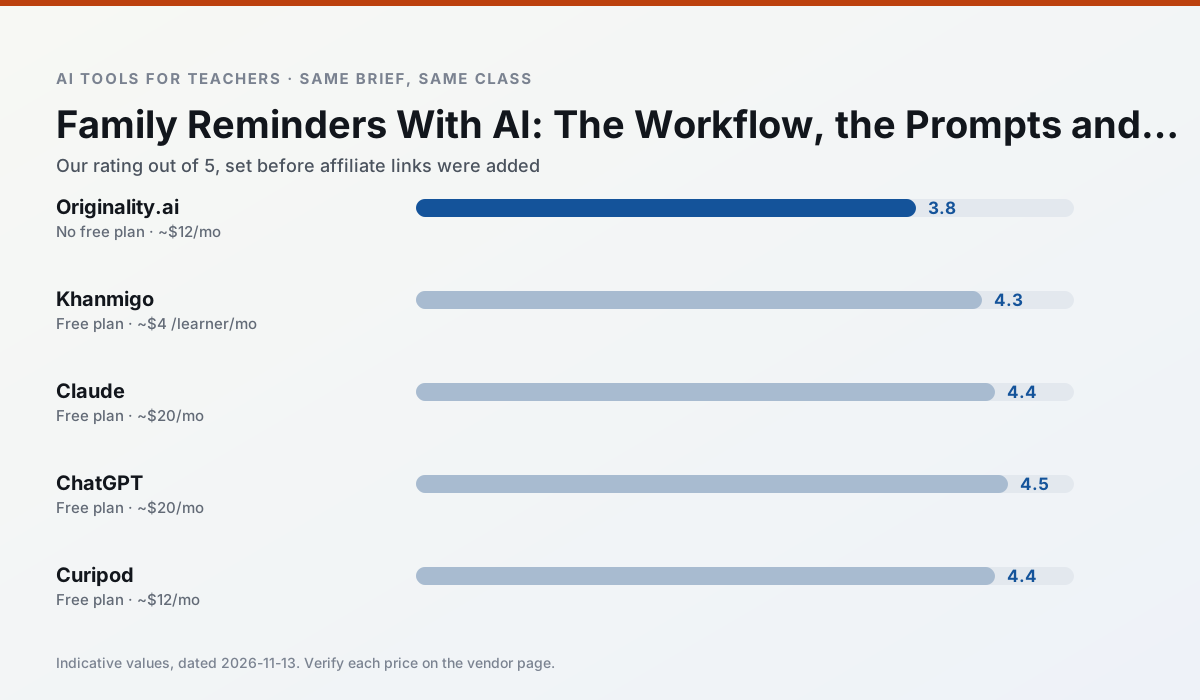
Side by side
Comparison table
Ratings reflect our timed classroom workflow, not vendor claims. Prices are indicative — verify on the vendor site.
| Tool | Best for | Free tier | Indicative paid plan | Standout feature | Our rating | Verdict | Try the tool |
|---|---|---|---|---|---|---|---|
| Originality.ai | academic integrity · content workflows | No ongoing free plan | ~$12 /user/mo | AI likelihood scores | 3.8 / 5 | Situational | Try free |
| Khanmigo | math practice · student tutoring | Yes — US teacher accounts, subject to eligibility | ~$4 /learner/mo | Socratic tutoring rather than answers | 4.3 / 5 | Strong option | Try free |
| Claude | rubric creation · feedback on writing | Yes — Usage-limited | ~$20 /user/mo | Very large context window | 4.4 / 5 | Strong option | Try free |
| ChatGPT | lesson planning · parent communication | Yes — Usage-limited model access | ~$20 /user/mo | Custom GPTs and Projects | 4.5 / 5 | Top pick | Try free |
| Curipod | formative assessment · exit tickets | Yes — Limited lessons per month | ~$12 /user/mo | Live polls and word clouds | 4.4 / 5 | Strong option | Try free |
| Eduaide.Ai | lesson planning · rubric creation | Yes — Daily generation cap | ~$10 /user/mo | Resource library | 4.3 / 5 | Strong option | Try free |
Match your situation
Best for X
Different jobs need different tools. Here is what we would open first in each case.
Originality.ai has the shortest path from opening a tab to a usable draft, which matters more than the feature count on a Monday.
Khanmigo answers the three questions a district actually asks: rostering, admin controls and a data-processing agreement. That is usually what decides a school purchase.
Nothing on Claude's free tier is a teaser demo; the limits are documented and a normal week fits inside them.
ChatGPT is the one we would open on a normal planning day because the first output is editable rather than restructurable, and the free plan covers a single teacher's routine.
Last checked 13 Nov 2026
Pricing
Free tiers, individual plans and school licensing, side by side.
| Tool | Free plan | Individual / paid | School & district | Billing note | Verify |
|---|---|---|---|---|---|
| Originality.ai | No ongoing free tier | ~$12 /user/mo | Custom quote | Indicative — verify on vendor site | Vendor |
| Khanmigo | $0 — US teacher accounts, subject to eligibility | ~$4 /learner/mo | Custom quote | Indicative — verify on vendor site | Vendor |
| Claude | $0 — Usage-limited | ~$20 /user/mo | ~$25+ /user/mo | Indicative — verify on vendor site | Vendor |
| ChatGPT | $0 — Usage-limited model access | ~$20 /user/mo | ~$25+ /user/mo | Indicative — verify on vendor site | Vendor |
| Curipod | $0 — Limited lessons per month | ~$12 /user/mo | Custom quote | Indicative — verify on vendor site | Vendor |
| Eduaide.Ai | $0 — Daily generation cap | ~$10 /user/mo | Custom quote | Indicative — verify on vendor site | Vendor |
Editorial rule: pricing is re-checked every 2–3 months and the top 50 pages are refreshed every 6 months. See our funding policy.
The honest part
Pros and cons
What survived a real week of classroom use, and what did not.
Pros
- Useful for content publishing QA
- Fast bulk scanning
- Transparent credit model
Cons
- AI detection produces false positives
- Should never be sole evidence of misconduct
- Not a teaching tool
Pros
- Education-first design
- Strong nonprofit trust signal
- Good math scaffolding
Cons
- Availability varies by region
- Less useful for admin paperwork
- Requires student accounts for full value
Pros
- Handles full unit plans and long rubrics
- Nuanced, less generic prose
- Good at structured document output
Cons
- No teacher-specific templates
- Fewer classroom integrations
- Consumer plan not suitable for student data
Pros
- Most flexible option available
- Huge community of teacher prompt libraries
- Strong multilingual support
Cons
- Requires prompt skills for consistent results
- No built-in standards alignment
- District privacy review usually required
Pros
- High student engagement out of the box
- Great for quick checks for understanding
- No student accounts required for basic use
Cons
- Focused on delivery, not planning
- Requires reliable classroom devices
- Free tier is restrictive
In the classroom
Use cases
Five concrete workflows, with the tool we would open for each one.
A parent email in two languages
Draft in plain, warm language with no names, translate, then back-translate the important sentences to check meaning. Keep specific incidents out of the prompt and add them yourself.
Recommended: Originality.aiRubric and feedback comments in one pass
Reorder the workflow so the rubric is yours and the comments are generated. Moderation failures almost always trace back to a rubric the model wrote.
Recommended: KhanmigoThree reading levels from one source text
Paste a vetted text, ask for supported, core and extension versions, then check the vocabulary list by hand. Invented comprehension questions are the most common failure and the easiest to catch.
Recommended: ClaudeA Monday morning lesson plan in twelve minutes
The twelve minutes come from not rewriting the skeleton. Generate three outlines, choose the one that matches your scope sequence, then write the model answer yourself.
Recommended: ChatGPTA question bank from a PDF or article
Feed a non-identifiable source and ask for items tagged by difficulty with the misconception behind each distractor. Spot-check every answer key; numerical items are least reliable.
Recommended: Curipod
Questions teachers ask us
FAQ
Direct answers, also published as FAQPage structured data for search and AI assistants.
Can AI do Reminder notes at mixed-grade level?
Which tool is best for Reminder notes?
What is the biggest risk?
Sources & further reading
Our recommendation
Try Originality.ai free for your next Reminder notes task
AI-detection and plagiarism scanning for publisher and admin workflows. Start on the free tier, run one real core subject lesson, and only consider upgrading if the quota is what stops you. Disclosure: we may earn a commission (25% recurring) at no extra cost to you.
Some links on this page are affiliate links. We may earn a commission at no extra cost to you. Our rankings are editorial and never pay-to-play. Never enter student PII into a free consumer account.
Keep reading
Related comparisons in this cluster.
Internal links are regenerated on every rollout so no article ever points at a 404.