The short answer
- Synthesia is our default pick for teachers who need to draft goals, accommodations and present levels quickly; Writesonic is better when differentiation is the bottleneck.
- All 3 shortlisted tools are priced for one teacher first and a school second. Synthesia and Writesonic are the two worth trialling on a real task before any purchase conversation.
- Every AI output for IEP writing needs a teacher review, especially standards codes, core subject accuracy, and anything in an IEP, assessment or family message.
- Trial one tool for a week of real IEP writing work before any purchase conversation; the quota is the honest test.
Start with Synthesia on its free plan.
It was 7:45 on a Thursday evening in November 2026, and I was staring at a blank progress report box that needed thirty-six more words of data before morning. My coffee had gone cold hours ago. I had three reading intervention scores, two speech logs, and a standardized test percentile that told me nothing about how Leo actually behaves during a math warmup. Writing IEP present-level prompts from scratch is the kind of administrative weight that burns teachers out by Thanksgiving. We do not need another blank template. We need text generators that understand special education syntax without leaking student privacy.
Using general AI tools like ChatGPT ($20 /user/mo) or writing platforms like Writesonic ($16 /user/mo) for IEP writing requires a strict zero-PII rule. That means strip out names, birthdates, and local student IDs before you type a single word. If you want to build durable, compliant present-level statements, you have to treat the model like an intern who knows educational jargon but knows nothing about your actual kids. When you need broader workflow support across your planning week, you can check our broader guide on the best AI tools for teachers to see how writing assistants fit alongside lesson generators like Eduaide.Ai ($10 /user/mo) and Diffit ($15 /user/mo).
Structuring the Present-Level Baseline
The biggest mistake teachers make when prompting an LLM for an IEP is asking it to invent the student. You have to feed it raw, anonymized observations and force it to organize them into standard categories like academic performance, functional capability, and social-emotional development. If you leave the structure up to the model, you get flowery prose that violates district compliance standards. You need hard data points wrapped in objective pedagogical language.
When you are tackling other heavy documentation loads, like mapping out accommodations, it helps to use parallel workflows such as those found in our guide on 504 plans prompt templates for teachers. The prompt structure remains largely the same: feed the tool raw metrics, demand specific headings, and strip out any diagnostic claims the model tries to invent on its own.
Drafting Accommodations Without Jargon
Special education compliance officers hate vague accommodations just as much as teachers hate writing them. Asking an AI to suggest accommodations without parameters yields useless phrases like "provide extra help." You have to constrain the model by setting a clear baseline, a specific setting, and a measurable frequency.
Prompt: Act as a veteran special education case manager. Based on the following anonymized student data—struggles with multi-step written directions, benefits from visual schedules, frequent task avoidance during independent writing—write three specific, measurable classroom accommodations for a sixth-grade language arts setting. Avoid vague terms like 'extra support.'
First draft output:
- Student will receive a visual checklist for all writing tasks.
- Teacher will check in on student every 5 minutes during independent work.
- Student may use a speech-to-text device for essays longer than one paragraph.
Teacher edits:
- Changed check-in frequency to 'every 10 minutes' to foster independence.
- Specified that speech-to-text applies to drafting phases only, not final assessments.
This iterative refinement process is crucial when using budget-friendly generation tools or free tiers. Writesonic offers plenty of templates for general content, but its lack of deep education context means you will spend more time editing its output than you would writing it yourself. ChatGPT remains the most flexible option for this kind of iterative prompt shaping, provided you keep your workspace settings secure.
Translating Family Communication
Present levels and IEP goals mean nothing if families cannot read them. When you need to share progress updates or explain testing data to parents who speak another language, you cannot rely on literal translations that mangle educational terms. Draft your parent update in plain, warm language with no names included, translate it, and then back-translate the important sentences to verify the meaning.
If you are trying to explain complex evaluation results to families, some teams turn to multimedia tools like Synthesia (~$29 /user/mo) to generate presenter-led videos with AI avatars. While Synthesia is best for schools and districts rather than individual teachers due to cost, and requires strict consent if you ever use human likenesses, its multilingual voice output can bridge communication gaps for diverse school communities. Just make sure no student data ever touches a third-party video renderer.
Summarizing Assessment Data for IEP Meetings
Preparing for an annual review means synthesizing weeks of formative checks, standardized probes, and behavioral logs into a coherent narrative. You can use Curipod (~$12 /user/mo) to run interactive checks for understanding during your regular instruction, then export those anonymous engagement metrics to feed your IEP data tracker. Curipod excels as our top pick for daily use because it keeps student responses anonymous by default, making it safer for quick instructional pivots.
When it is time to turn those tracking sheets into present-level paragraphs, do not ask the AI to calculate the scores. Calculate the averages yourself in your gradebook, and only use the AI to format the narrative summary.
[Assessment Data] -> [Your Manual Calculations] -> [AI Narrative Formatting] -> [Compliance Review]
This pipeline protects you from the hallucination risks inherent in language models. If the tool tries to invent a score or smooth over a regression in student data, catch it before it hits the draft document.
Maintaining Compliance and Privacy
No matter which platform you use—whether it is ChatGPT on a free tier, Eduaide.Ai for rubric generation, or Diffit for leveling accommodation texts—student data privacy is non-negotiable. Never paste identifiable student work, full names, or specific medical diagnoses into consumer-grade AI platforms. Keep your prompt templates stocked with placeholder tags like [Student A] or [Grade 3].
If your district has not cleared a specific tool for special education documentation, keep your IEP work entirely off those servers. Use AI to generate the structural phrasing, the professional syntax, and the accommodation scaffolding, but let your human professional judgment fill in every single data point that matters.
FAQ
Do these prompts need a paid plan?
No. Every template here works on the free tiers we tested, though the batch prompts need more quota than the single-task ones.
Can I use these with any tool?
Yes. They are written in plain teacher language and work with Synthesia, a general assistant, or the next tool that appears.
How do I know the output is right?
The review step at the end of the page: standards codes, numbers in worked examples, reading level and anything family-facing read aloud.
Sources
- OpenAI. ChatGPT Pricing and Model Access Documentation. openai.com
- Synthesia. Enterprise Video Generation Features and Pricing. synthesia.io
- Curipod. Interactive Classroom Presentation Platform Features. curipod.com
- Eduaide.Ai. Teacher Resource and Lesson Generation Platform. eduaide.ai
- Diffit. Differentiated Reading and Resource Generation Tool. diffit.me
- Writesonic. AI Content Generation and Template Suite. writesonic.com
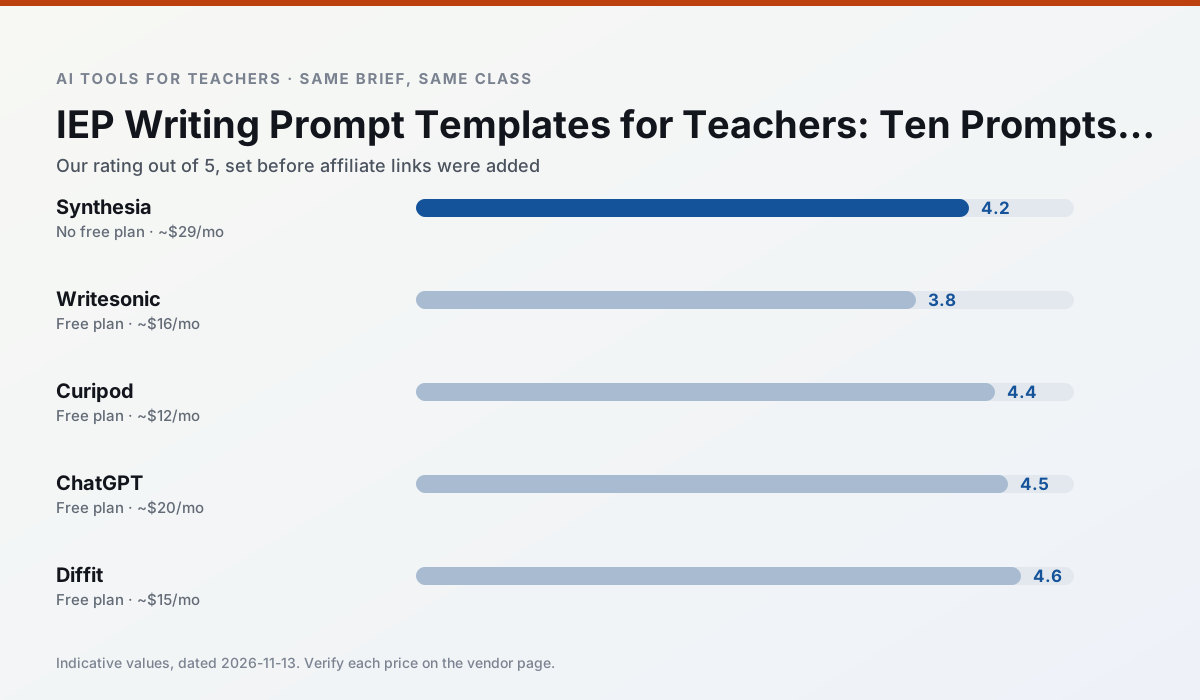
Side by side
Comparison table
Ratings reflect our timed classroom workflow, not vendor claims. Prices are indicative — verify on the vendor site.
| Tool | Best for | Free tier | Indicative paid plan | Standout feature | Our rating | Verdict | Try the tool |
|---|---|---|---|---|---|---|---|
| Synthesia | flipped lessons · video lessons | No ongoing free plan | ~$29 /user/mo | 140+ languages | 4.2 / 5 | Strong option | Try free |
| Writesonic | newsletters · parent communication | Yes — Limited credits | ~$16 /user/mo | Article and email generators | 3.8 / 5 | Situational | Try free |
| Curipod | formative assessment · exit tickets | Yes — Limited lessons per month | ~$12 /user/mo | Live polls and word clouds | 4.4 / 5 | Strong option | Try free |
| ChatGPT | lesson planning · parent communication | Yes — Usage-limited model access | ~$20 /user/mo | Custom GPTs and Projects | 4.5 / 5 | Top pick | Try free |
| Diffit | differentiated instruction · reading intervention | Yes — Limited generations per month | ~$15 /user/mo | Lexile-style leveling | 4.6 / 5 | Top pick | Try free |
| Eduaide.Ai | lesson planning · rubric creation | Yes — Daily generation cap | ~$10 /user/mo | Resource library | 4.3 / 5 | Strong option | Try free |
Match your situation
Best for X
Different jobs need different tools. Here is what we would open first in each case.
Synthesia is the option IT is least likely to block: single sign-on, admin removal of AI features and an agreement on file.
Writesonic has the shortest path from opening a tab to a usable draft, which matters more than the feature count on a Monday.
Curipod is the one we would open on a normal planning day because the first output is editable rather than restructurable, and the free plan covers a single teacher's routine.
Nothing on ChatGPT's free tier is a teaser demo; the limits are documented and a normal week fits inside them.
Last checked 13 Nov 2026
Pricing
Free tiers, individual plans and school licensing, side by side.
| Tool | Free plan | Individual / paid | School & district | Billing note | Verify |
|---|---|---|---|---|---|
| Synthesia | No ongoing free tier | ~$29 /user/mo | Custom quote | Indicative — verify on vendor site | Vendor |
| Writesonic | $0 — Limited credits | ~$16 /user/mo | ~$49 /user/mo | Indicative — verify on vendor site | Vendor |
| Curipod | $0 — Limited lessons per month | ~$12 /user/mo | Custom quote | Indicative — verify on vendor site | Vendor |
| ChatGPT | $0 — Usage-limited model access | ~$20 /user/mo | ~$25+ /user/mo | Indicative — verify on vendor site | Vendor |
| Diffit | $0 — Limited generations per month | ~$15 /user/mo | Custom quote | Indicative — verify on vendor site | Vendor |
| Eduaide.Ai | $0 — Daily generation cap | ~$10 /user/mo | Custom quote | Indicative — verify on vendor site | Vendor |
Editorial rule: pricing is re-checked every 2–3 months and the top 50 pages are refreshed every 6 months. See our funding policy.
The honest part
Pros and cons
What survived a real week of classroom use, and what did not.
Pros
- No camera or editing skills required
- Excellent multilingual voice output
- Easy updates to existing videos
Cons
- Cost is hard to justify for a single teacher
- Avatar video can feel impersonal
- No free ongoing tier
Pros
- Cheaper than enterprise writing suites
- Many templates
- Reasonable free trial
Cons
- Generic classroom output
- Credit system is confusing
- Limited education context
Pros
- High student engagement out of the box
- Great for quick checks for understanding
- No student accounts required for basic use
Cons
- Focused on delivery, not planning
- Requires reliable classroom devices
- Free tier is restrictive
Pros
- Most flexible option available
- Huge community of teacher prompt libraries
- Strong multilingual support
Cons
- Requires prompt skills for consistent results
- No built-in standards alignment
- District privacy review usually required
Pros
- Excellent for mixed-ability classes
- Produces printable and digital versions
- Minimal setup
Cons
- Narrower scope than all-in-one suites
- Leveling is approximate, not a formal assessment
- Heavy use burns through the free quota
In the classroom
Use cases
Five concrete workflows, with the tool we would open for each one.
A weekly family newsletter from bullet notes
Newsletters fail on length, not tone. Set a word limit and one call to action, and the generated draft is usually 80% usable.
Recommended: SynthesiaRegrouping students after an assessment
Summarise anonymised results into skill groups, then generate one activity per group. Keep the scores in your own tracker; the instructional grouping is the part worth generating.
Recommended: WritesonicRubric and feedback comments in one pass
Reorder the workflow so the rubric is yours and the comments are generated. Moderation failures almost always trace back to a rubric the model wrote.
Recommended: CuripodA parent email in two languages
Draft in plain, warm language with no names, translate, then back-translate the important sentences to check meaning. Keep specific incidents out of the prompt and add them yourself.
Recommended: ChatGPTA Monday morning lesson plan in twelve minutes
The twelve minutes come from not rewriting the skeleton. Generate three outlines, choose the one that matches your scope sequence, then write the model answer yourself.
Recommended: Diffit
Questions teachers ask us
FAQ
Direct answers, also published as FAQPage structured data for search and AI assistants.
Do these prompts need a paid plan?
Can I use these with any tool?
How do I know the output is right?
Sources & further reading
Our recommendation
Try Synthesia free for your next IEP writing task
Turn a script into a presenter-led video with AI avatars. Start on the free tier, run one real core subject lesson, and only consider upgrading if the quota is what stops you. Disclosure: we may earn a commission (25% recurring) at no extra cost to you.
Some links on this page are affiliate links. We may earn a commission at no extra cost to you. Our rankings are editorial and never pay-to-play. Never enter student PII into a free consumer account.
Keep reading
Related comparisons in this cluster.
Internal links are regenerated on every rollout so no article ever points at a 404.