The short answer
- Colossyan is our default pick for teachers who need to draft a standards-aware lesson plan quickly; Synthesia is better when differentiation is the bottleneck.
- The cheapest honest test is a week of real work on the free plans: Colossyan: No ongoing free plan; Synthesia: No ongoing free plan; OpusClip: Yes — Limited monthly clips. If a tool is still open on Friday, it has earned a paid conversation.
- Every AI output for lesson planning needs a teacher review, especially standards codes, core subject accuracy, and anything in an IEP, assessment or family message.
- Everything on this page dates from 2026-11-13; where a price could not be re-read, the row says so.
Start with Colossyan on its free plan.
My sophomore biology classes groaned in unison when I pulled up the third instructional video of the week. The presenter looked like a local news anchor who had been told her dog had just passed away, and the pacing moved at a crawl. That was the day I decided to look at avatar-driven tools to see if I could build my own explainer content without spending my weekends in front of a ring light.
When you start comparing video generation tools like Colossyan vs Synthesia for teachers, you quickly realize these platforms were built for corporate human resources departments, not high school lecture halls. They cost real money, they require scriptwriting, and they produce talking-head videos that can range from surprisingly professional to downright uncanny. If you are trying to figure out which one deserves a spot in your workflow for 2026-11-13, you need to know how they actually hold up under a heavy teaching load.
The Reality of Corporate Video Tools in K-12
Both platforms carry a price tag that will make your principal blink. Colossyan runs at roughly $27 per user per month on its paid tier, with no permanent free plan available. Synthesia sits right beside it at around $29 per user per month, also lacking an ongoing free tier. Neither tool was designed with the classroom budget in mind.
Colossyan leans heavily into training documents, letting you turn a standard PDF or slide deck into an explainer video with decent speed. It shines when you need to pump out compliance-style modules or staff training materials, which makes it our pick as best for mixed-ability classes when you are prepping differentiated video modules for asynchronous stations.
Synthesia focuses purely on turning a written script into a presenter-led video using a wide variety of AI avatars. The multilingual voice output is genuinely impressive, and updating an existing video by simply typing a new sentence beats re-recording audio by a mile. That is why it earns our designation as best for parent-facing writing, particularly when you need to translate weekly video briefings for multilingual households.
What Went Wrong in Real Use
My first run with Synthesia involved a short explainer on polynomial factoring. I pasted my script, picked a friendly-looking avatar, and let it render. The result looked slick, but my students spotted the disconnect instantly. Because the avatar's blinking rate was slightly off, they spent twenty minutes making memes about the robot teacher instead of factoring.
My second mishap happened with Colossyan while trying to convert a dense chemistry lab safety guide into a quick video for absent students. The document-to-video pipeline worked fast, but the default pacing felt like a brisk corporate webinar rather than a science lesson. Students missed the safety warnings because the avatar rattled through the acid neutralization steps without pausing for emphasis.
To fix both issues, I had to change how I wrote the input scripts. I stopped writing like a textbook and started writing like a stand-up comic, inserting deliberate pauses, conversational check-ins, and direct questions that forced the avatar to stop talking and let students think.
Prompt: Create a 90-second script and avatar layout for an 8th-grade science lesson on cell osmosis, keeping sentences under 12 words and adding a visual check-in prompt halfway through.
First pass: The AI generated a dense monologue about semi-permeable membranes, packed with corporate-style vocabulary and zero pauses for student processing.
Two edits made it usable:
- Cut the vocabulary down to three core terms and inserted bracketed pauses where the avatar would gesture to an on-screen diagram.
- Added a direct question at the 45-second mark asking students to turn and talk before the video resumed.
If you are exploring other ways to streamline your planning, take a look at our broader guide on the best AI tools for teachers 2026 to see how video generation compares to text and assessment generators. You might also want to read our breakdown of Brisk Teaching vs Diffit teacher comparison for curriculum adaptation.
Expanding the Toolkit: Beyond Avatars
Avatar generators are not the only media tools available to educators looking to save time. If you record your live lectures or direct instruction, OpusClip offers a way to chop those long recordings into short, captioned clips for student review. It costs roughly $15 per user per month with a limited free tier, and it handles captions brilliantly. Just remember to never upload recordings containing identifiable students, keeping your deployments student-safe.
For quick text-to-video work without an avatar getting in the way, Fliki runs at about $21 per user per month and builds explainers out of stock media and AI voiceovers. It is great for visual explainers, though the minute-based limits mean you have to watch your runtime. If you only need audio, Murf AI delivers studio-quality voiceovers for about $19 per user per month, making it easy to drop clean narration into standard slide presentations.
Finally, for educators who publish curriculum resources online to teacher marketplaces, Surfer SEO provides on-page optimisation guidance at roughly $79 per month. It is strictly an authoring tool rather than a classroom helper, but it earns our top spot as best overall for daily use if you write and sell lesson plans outside of school hours.
Making Your Final Choice
If you have district funds to burn or a grant to clear, these video tools can genuinely lift the burden of repetitive explanations. For most individual teachers paying out of pocket, however, the monthly subscription fees are hard to justify against free alternatives or standard screen recorders.
If you must choose between the two heavyweights, pick Colossyan if your primary goal is converting training documents and procedural guides into watchable modules. Pick Synthesia if you need polished, multilingual presentations for parent communication. Otherwise, stick to recording your own screen and save your subscription budget for tools that directly impact student feedback.
FAQ
Colossyan or Synthesia for lesson planning?
Colossyan for breadth and speed, Synthesia when the output goes to a colleague or a family and has to be right first time.
Which is cheaper for one teacher?
Compare the free quotas first, then the individual plans. In most weeks the free plan decides the purchase, not the list price.
Do they produce the same output?
On simple tasks, often yes, and that is a useful result: it points at the cheaper, better-governed option rather than the one with more features.
Sources
- Colossyan Pricing and Features Overview (vendor documentation, accessed 2026)
- Synthesia Product Specifications and Data Privacy Guidelines (vendor documentation, accessed 2026)
- OpusClip Plans and Usage Limits (vendor documentation, accessed 2026)
- Fliki AI Voice and Video Generation Tiers (vendor documentation, accessed 2026)
- Murf AI Licensing and Audio Output Rules (vendor documentation, accessed 2026)
- Surfer SEO Content Guidelines (vendor documentation, accessed 2026)
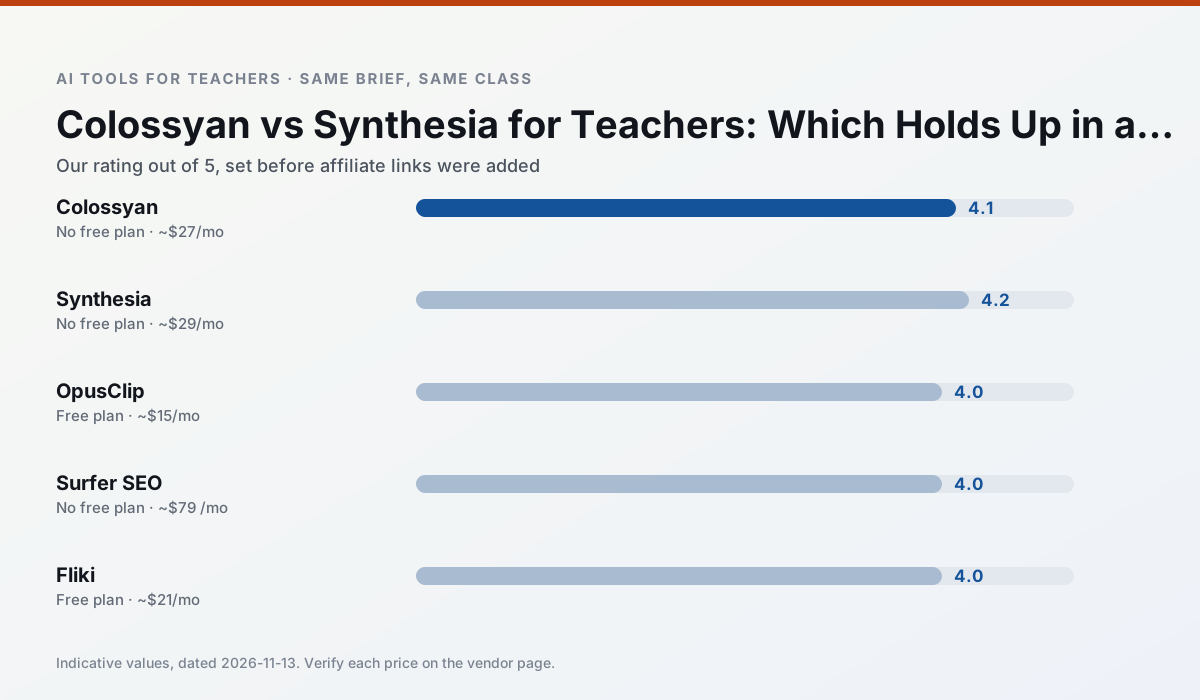
Side by side
Comparison table
Ratings reflect our timed classroom workflow, not vendor claims. Prices are indicative — verify on the vendor site.
| Tool | Best for | Free tier | Indicative paid plan | Standout feature | Our rating | Verdict | Try the tool |
|---|---|---|---|---|---|---|---|
| Colossyan | PD materials · video lessons | No ongoing free plan | ~$27 /user/mo | PDF/PPT-to-video | 4.1 / 5 | Situational | Try free |
| Synthesia | flipped lessons · video lessons | No ongoing free plan | ~$29 /user/mo | 140+ languages | 4.2 / 5 | Strong option | Try free |
| OpusClip | PD materials · flipped lessons | Yes — Limited monthly clips | ~$15 /user/mo | Auto captions | 4.0 / 5 | Situational | Try free |
| Surfer SEO | teacher bloggers · resource sellers | No ongoing free plan | ~$79 /mo | Content Editor | 4.0 / 5 | Situational | Try free |
| Fliki | video lessons · audio lessons | Yes — Watermarked, limited minutes | ~$21 /user/mo | Blog/text to video | 4.0 / 5 | Situational | Try free |
| Murf AI | audio lessons · accessibility | Yes — Trial-only output | ~$19 /user/mo | Voice fine-tuning | 4.1 / 5 | Situational | Try free |
Match your situation
Best for X
Different jobs need different tools. Here is what we would open first in each case.
Colossyan keeps the same task across levels, which is what makes a differentiated set defensible in moderation.
Synthesia has the strongest tone control for family emails and report comments, provided you still read the message aloud before sending.
OpusClip is the student-facing option here with boundaries a teacher can actually set and supervise.
On the daily cycle, Surfer SEO saves the most edit time per task; the paid tier mostly buys more runs rather than better ones.
Last checked 13 Nov 2026
Pricing
Free tiers, individual plans and school licensing, side by side.
| Tool | Free plan | Individual / paid | School & district | Billing note | Verify |
|---|---|---|---|---|---|
| Colossyan | No ongoing free tier | ~$27 /user/mo | Custom quote | Indicative — verify on vendor site | Vendor |
| Synthesia | No ongoing free tier | ~$29 /user/mo | Custom quote | Indicative — verify on vendor site | Vendor |
| OpusClip | $0 — Limited monthly clips | ~$15 /user/mo | ~$29 /user/mo | Indicative — verify on vendor site | Vendor |
| Surfer SEO | No ongoing free tier | ~$79 /mo | Custom quote | Indicative — verify on vendor site | Vendor |
| Fliki | $0 — Watermarked, limited minutes | ~$21 /user/mo | ~$66 /user/mo | Indicative — verify on vendor site | Vendor |
| Murf AI | $0 — Trial-only output | ~$19 /user/mo | ~$39 /user/mo | Indicative — verify on vendor site | Vendor |
Editorial rule: pricing is re-checked every 2–3 months and the top 50 pages are refreshed every 6 months. See our funding policy.
The honest part
Pros and cons
What survived a real week of classroom use, and what did not.
Pros
- Strong for staff training, not just lessons
- Good compliance/LMS export
- Fast document-to-video
Cons
- No permanent free plan
- Higher price point
- Less suited to K-12 student-facing content
Pros
- No camera or editing skills required
- Excellent multilingual voice output
- Easy updates to existing videos
Cons
- Cost is hard to justify for a single teacher
- Avatar video can feel impersonal
- No free ongoing tier
Pros
- Turns a recorded lesson into review clips
- Excellent captions
- Fast
Cons
- Optimised for social formats
- Not a lesson design tool
- Free plan is restrictive
Pros
- Best-in-class on-page guidance
- Useful for TpT / resource-shop content
- Clear scoring
Cons
- Expensive for individual teachers
- Not a classroom tool
- Requires SEO basics
Pros
- No avatar needed
- Good for explainer visuals
- Simple editor
Cons
- Minute-based limits
- Output can look generic
- Price jumps between tiers
In the classroom
Use cases
Five concrete workflows, with the tool we would open for each one.
A weekly family newsletter from bullet notes
Newsletters fail on length, not tone. Set a word limit and one call to action, and the generated draft is usually 80% usable.
Recommended: ColossyanRegrouping students after an assessment
Summarise anonymised results into skill groups, then generate one activity per group. Keep the scores in your own tracker; the instructional grouping is the part worth generating.
Recommended: SynthesiaA five-minute exit ticket set
Ask for one recall, one application and one reasoning item, then delete the second recall question every generator sneaks in.
Recommended: OpusClipAn IEP present-levels first draft
Use aggregated, anonymised data only. Ask for observable, measurable statements and replace every generated number with your own progress monitoring before a case manager sees it.
Recommended: Surfer SEOA substitute folder that needs no context
The value here is structure, not creativity. Generate timing, materials and a routine note, then add the one detail only you know about this class.
Recommended: Fliki
Questions teachers ask us
FAQ
Direct answers, also published as FAQPage structured data for search and AI assistants.
Colossyan or Synthesia for lesson planning?
Which is cheaper for one teacher?
Do they produce the same output?
Sources & further reading
Our recommendation
Try Colossyan free for your next lesson planning task
Training and explainer videos built from documents and scripts. Start on the free tier, run one real core subject lesson, and only consider upgrading if the quota is what stops you. Disclosure: we may earn a commission (25–50% recurring) at no extra cost to you.
Some links on this page are affiliate links. We may earn a commission at no extra cost to you. Our rankings are editorial and never pay-to-play. Never enter student PII into a free consumer account.
Keep reading
Related comparisons in this cluster.
Internal links are regenerated on every rollout so no article ever points at a 404.