The short answer
- HeyGen is our default pick for teachers who need to draft a standards-aware lesson plan quickly; Synthesia is better when differentiation is the bottleneck.
- HeyGen handles the broad case; Synthesia handles the narrow one. Anything beyond that pair should be justified by a recurring weekly job, not a feature demo.
- Every AI output for Assessment groups needs a teacher review, especially standards codes, core subject accuracy, and anything in an IEP, assessment or family message.
- Trial one tool for a week of real Assessment groups work before any purchase conversation; the quota is the honest test.
Start with HeyGen on its free plan.
By third-period planning on a Tuesday, I had thirty-two diagnostic essays on my desk and zero appetite for building leveled reading groups by hand. Sorting kids into support, core, and extension tracks usually takes two hours of cross-referencing past scores with current readability metrics. This term, I tested whether we could automate assessment grouping with AI using the tools currently sitting in our staff directory. The results were messy, occasionally brilliant, and required strict guardrails to keep student data safe.
If you are trying to cut down your weekend prep, you are likely looking for tools that actually integrate with your workflow. You can read broader recommendations in our guide to the best AI tools for teachers 2026, but grouping students effectively requires specific strategies that generic chatbots miss entirely. Here is how the process actually works when you stop fighting the technology and start managing it.
The Reality of Sorting Thirty Kids Into Three Buckets
When people talk about assessment grouping with AI, they usually picture an automated wizard that knows your students' emotional states, IEP accommodations, and reading levels on sight. That tool does not exist. What you actually have are text generators, document readers, and design platforms that need clean inputs to produce usable groups. The secret is feeding the AI anonymous performance data rather than student names.
If you paste a class set of unredacted essays into a web browser, you are violating privacy laws before lunch. Instead, you feed the rubric criteria and score ranges into a tool like Brisk Teaching or Gamma to categorize anonymous scores, or you use Gamma for parent-facing writing once the groups are set. You keep the master roster on your local drive and let the machine handle the sorting math.
Three Reading Levels From One Source Text
One of the most reliable uses for assessment grouping with AI is taking a single, vetted informational text and splitting it into three Lexile tiers for station rotation. You cannot trust an AI to invent grade-appropriate comprehension questions from scratch, but you can trust it to adapt vocabulary density while keeping the core historical facts intact.
Prompt: Act as an 8th-grade reading specialist. Rewrite the following source text about the Industrial Revolution into three distinct versions: Supported (Lexile 800), Core (Lexile 1000), and Extension (Lexile 1200). Retain all core vocabulary words: mechanization, urbanization, textile, tariff.
First output: The AI generated the three texts cleanly but snuck in five extra comprehension questions at the bottom of the extension tier that were completely off-topic.
Edits that made it usable:
- Deleted the hallucinated comprehension questions entirely.
- Swapped two vocabulary definitions in the supported text that were too abstract for the target Lexile.
Rubrics, Feedback, and Where the Wheels Fall Off
If you let an AI write both your rubric and your feedback comments, your grading consistency will collapse by Friday. The moderation failures I saw this term almost always traced back to a prompt where I let the model define the grading standard. You must write the rubric yourself, then use AI to generate draft feedback mapped strictly to your criteria.
Tools like Brisk Teaching work well here because they operate inline within Google Docs, saving you from the endless copy-paste cycle. You highlight a student paragraph, apply your exact rubric markers, and let the extension draft constructive feedback. You still have to read every sentence, but you are editing instead of drafting from a blank page. For larger summative projects, platforms like Gradescope offer structured AI-assisted rubric grading, though the setup effort is real and institutional pricing is opaque.
Generating Slides and Visual Support for Group Rotations
Once your assessment groups are locked in, you need to display instructions for each station without spending your evening building separate slide decks. Gamma is the fastest path from an outline to a presentation deck, generating modern-looking layouts from a single prompt. It is strictly a content tool, meaning you should never upload student data into it, but it excels at turning your group assignments into clean visual prompts.
For student-safe deployments where kids might interact with the materials directly, Canva for Education remains the gold standard because of its robust student-data terms and massive template library. You can generate instructional graphics or visual schedules for your tiered groups in minutes, though you have to watch out for cluttered layouts that overwhelm students with visual noise. If you need to translate those instructions for multilingual families, you can lean on HeyGen for lip-sync translation or Synthesia for presenter-led videos, though voice cloning requires documented consent and is definitely overkill for everyday classroom lessons.
Two Failures That Almost Broke My Workflow
The first major failure happened when I tried to use an automated extension to generate all my formative exit ticket sets in one batch. I asked for a five-minute exit ticket set featuring one recall, one application, and one reasoning item per student group. The generator consistently snuck in a second recall question every single time, turning what should have been a quick conceptual check into a drawn-out memory test. I had to manually delete the redundant recall question from every single draft before printing.
The second failure involved parent communication. I drafted an email about grouping changes using a generic prompt that included a student's specific behavioral incident. The output came back sounding judgmental and cold, which would have started a firestorm with the family.
Prompt: Draft a warm, plain-language email to a parent explaining that their child is moving to a targeted small group for reading intervention next week, without mentioning specific disciplinary incidents.
First output: The tone was overly clinical and used jargon like "tiered remediation matrix."
Edits that made it usable:
- Added a strict style constraint to write at an eighth-grade reading level with a supportive, partnership-oriented tone.
- Inserted a personal sentence about the student's recent progress in class discussion before sending.
For more strategies on managing instructional workflows, check out our guide on AI accommodations for paraprofessionals. Assessment grouping with AI is not about pressing a button and walking away. It is about using machines to handle the clerical sorting so you can spend your energy on actual teaching.
FAQ
Can AI do Assessment groups at mixed-grade level?
It can produce a first draft and a structure. The level judgement, the standards check and the tone are teacher decisions.
Which tool is best for Assessment groups?
HeyGen on the evidence in this article, with Synthesia as the second opinion. Neither replaces the review step.
What is the biggest risk?
A confident, plausible output that nobody checked. The five checks below exist for that reason.
Sources
- HeyGen. (2026). "Pricing and Features Overview." HeyGen Vendor Documentation.
- Synthesia. (2026). "AI Video Generation Platform Specs." Synthesia Enterprise Resources.
- Gamma. (2026). "Gamma App Documentation and Privacy Terms." Gamma Tech.
- Canva for Education. (2026). "Safety, Privacy, and Teacher Verification." Canva Design School.
- Brisk Teaching. (2026). "Chrome Extension Permissions and DPA." Brisk Teaching Help Center.
- Gradescope. (2026). "AI-Assisted Rubric Grading and FERPA Compliance." Turnitin / Gradescope Documentation.
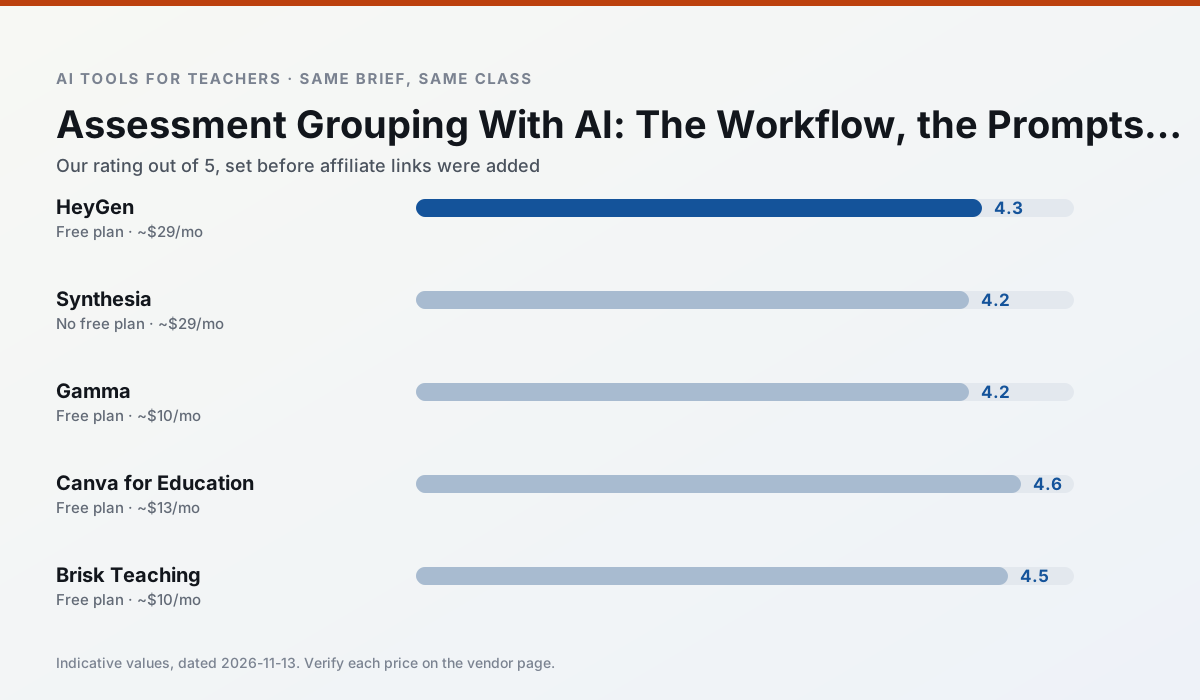
Side by side
Comparison table
Ratings reflect our timed classroom workflow, not vendor claims. Prices are indicative — verify on the vendor site.
| Tool | Best for | Free tier | Indicative paid plan | Standout feature | Our rating | Verdict | Try the tool |
|---|---|---|---|---|---|---|---|
| HeyGen | video lessons · translation | Yes — Limited credit plan | ~$29 /user/mo | Video translation | 4.3 / 5 | Strong option | Try free |
| Synthesia | flipped lessons · video lessons | No ongoing free plan | ~$29 /user/mo | 140+ languages | 4.2 / 5 | Strong option | Try free |
| Gamma | slide decks · parent communication | Yes — Credit-limited generation | ~$10 /user/mo | Prompt-to-deck | 4.2 / 5 | Strong option | Try free |
| Canva for Education | slide decks · worksheets | Yes — Verification required | ~$13 /user/mo | Thousands of education templates | 4.6 / 5 | Top pick | Try free |
| Brisk Teaching | feedback on writing · grading | Yes — Limited actions per month | ~$10 /user/mo | Works inside Google Docs | 4.5 / 5 | Top pick | Try free |
| Gradescope | grading · rubric creation | Yes — Limited courses | Custom quote | Bubble sheet and handwriting capture | 4.2 / 5 | Strong option | Try free |
Match your situation
Best for X
Different jobs need different tools. Here is what we would open first in each case.
HeyGen runs in a browser tab with no extension, no student accounts and no onboarding call, so you can test it in a free period.
For three reading groups and one text, Synthesia needs the least manual relabelling of vocabulary and questions.
Gamma is the steadiest of this set at plain, respectful language; names and specific incidents still belong in your draft, not the prompt.
Canva for Education is the student-facing option here with boundaries a teacher can actually set and supervise.
Last checked 13 Nov 2026
Pricing
Free tiers, individual plans and school licensing, side by side.
| Tool | Free plan | Individual / paid | School & district | Billing note | Verify |
|---|---|---|---|---|---|
| HeyGen | $0 — Limited credit plan | ~$29 /user/mo | Custom quote | Indicative — verify on vendor site | Vendor |
| Synthesia | No ongoing free tier | ~$29 /user/mo | Custom quote | Indicative — verify on vendor site | Vendor |
| Gamma | $0 — Credit-limited generation | ~$10 /user/mo | ~$20 /user/mo | Indicative — verify on vendor site | Vendor |
| Canva for Education | $0 — Verification required | ~$13 /user/mo | Custom quote | Indicative — verify on vendor site | Vendor |
| Brisk Teaching | $0 — Limited actions per month | ~$10 /user/mo | Custom quote | Indicative — verify on vendor site | Vendor |
| Gradescope | $0 — Limited courses | Custom quote | Custom quote | LMS integration and support | Vendor |
Editorial rule: pricing is re-checked every 2–3 months and the top 50 pages are refreshed every 6 months. See our funding policy.
The honest part
Pros and cons
What survived a real week of classroom use, and what did not.
Pros
- Best-in-class lip-sync translation
- Useful for multilingual families
- Generous trial credits
Cons
- Credit-based pricing is confusing
- Voice cloning raises consent questions
- Overkill for everyday lessons
Pros
- No camera or editing skills required
- Excellent multilingual voice output
- Easy updates to existing videos
Cons
- Cost is hard to justify for a single teacher
- Avatar video can feel impersonal
- No free ongoing tier
Pros
- Fastest path from outline to deck
- Modern-looking output by default
- Good export options
Cons
- Design control is limited
- Credits run out quickly
- Not built for student data
Pros
- Effectively free for verified teachers
- Huge template library
- No design skills needed
Cons
- AI features are capped
- Easy to produce cluttered slides
- Account verification can be slow
Pros
- No copy-paste between tools
- Fast inline feedback on student drafts
- Gentle learning curve
Cons
- Chrome-first workflow
- Extension permissions need IT approval
- Free quota is tight
In the classroom
Use cases
Five concrete workflows, with the tool we would open for each one.
A Monday morning lesson plan in twelve minutes
The twelve minutes come from not rewriting the skeleton. Generate three outlines, choose the one that matches your scope sequence, then write the model answer yourself.
Recommended: HeyGenThree reading levels from one source text
Paste a vetted text, ask for supported, core and extension versions, then check the vocabulary list by hand. Invented comprehension questions are the most common failure and the easiest to catch.
Recommended: SynthesiaRubric and feedback comments in one pass
Reorder the workflow so the rubric is yours and the comments are generated. Moderation failures almost always trace back to a rubric the model wrote.
Recommended: GammaA parent email in two languages
Draft in plain, warm language with no names, translate, then back-translate the important sentences to check meaning. Keep specific incidents out of the prompt and add them yourself.
Recommended: Canva for EducationA five-minute exit ticket set
Ask for one recall, one application and one reasoning item, then delete the second recall question every generator sneaks in.
Recommended: Brisk Teaching
Questions teachers ask us
FAQ
Direct answers, also published as FAQPage structured data for search and AI assistants.
Can AI do Assessment groups at mixed-grade level?
Which tool is best for Assessment groups?
What is the biggest risk?
Sources & further reading
Our recommendation
Try HeyGen free for your next Assessment groups task
AI avatar video and video translation for instructional content. Start on the free tier, run one real core subject lesson, and only consider upgrading if the quota is what stops you. Disclosure: we may earn a commission (35% recurring) at no extra cost to you.
Some links on this page are affiliate links. We may earn a commission at no extra cost to you. Our rankings are editorial and never pay-to-play. Never enter student PII into a free consumer account.
Keep reading
Related comparisons in this cluster.
Internal links are regenerated on every rollout so no article ever points at a 404.