The short answer
- HeyGen is our default pick for Esl who need to send family messages in home languages quickly; Originality.ai is better when differentiation is the bottleneck.
- Free-tier reality for this shortlist: HeyGen: Yes — Limited credit plan; Originality.ai: No ongoing free plan; Writesonic: Yes — Limited credits. Treat every paid figure as indicative until you have read the vendor page; only the free quota is something you can test yourself this week.
- Every AI output for translation needs a teacher review, especially standards codes, core subject accuracy, and anything in an IEP, assessment or family message.
- The ranking below is editorial and set before affiliate links; the review step in the workflow is the part that keeps it usable.
Start with HeyGen on its free plan.
At 3:45 PM on a Tuesday, I stared at a translated welcome email for a newcomer family and realized the automated translator had turned our school’s positive behavioral support policy into a sentence that essentially told a mother her son was banned from breathing in the hallway. Google Translate had choked on an idiom. That is the exact moment my relationship with machine translation shifted from casual convenience to paranoid verification. If you teach ESL, you already know that automated translation tools can be a lifeline for communicating with parents who do not speak English, but they can also destroy trust in a single mistranslated paragraph. When you are trying to explain state testing schedules, IEP meetings, or simple attendance policies, machine errors have real-world consequences for families trying to navigate an unfamiliar school system.
Using AI family translation for esl requires a strict workflow that protects families from confusing jargon and flat-out errors. You cannot just paste a staff memo into a generator and hit send. You need tools that handle multilingual text and video without turning formal notices into gibberish, while keeping privacy front and center. When evaluating how to bridge the communication gap, teachers often look across a range of platforms, from video translators to text generators and assessment tools. For a broader look at how these systems fit into daily routines, check out our guide on the best AI tools for teachers 2026.
Drafting Parent Emails That Actually Translate
The biggest trap in AI parent communication is writing in complicated educational-speak and expecting the machine to make sense of it in Spanish, Vietnamese, or Arabic. If your base English is full of acronyms like RTI, IEP, and PBIS, the translation output will collapse. Instead, write your draft in plain, warm language, keeping student names out of the prompt entirely to protect family privacy. Translate the text, and then back-translate the most important sentences yourself to check for meaning before hitting send. If you need a fast starting point for standard announcements, Writesonic offers budget-friendly AI writing and content generation with a reasonable free trial, priced around $16 per user per month (indicative), though its credit system can be confusing and the output often reads as generic if you do not supply the local context yourself.
Prompt: Write a short, warm email to a parent inviting them to our school's multilingual family night next Thursday at 6 PM. Explain that childcare and dinner will be provided. Keep sentences short and use a welcoming tone.
Initial Output: We are thrilled to extend a cordial invitation to our upcoming multilingual family engagement summit. Facilitative childcare paradigms and nutritional provisions will be accessible to all stakeholders.
First Edit: Drop the academic jargon so the translator can handle it cleanly. Change "facilitative childcare paradigms and nutritional provisions" to "free dinner and babysitting."
Second Edit: Remove any placeholder names and ensure the tone sounds like a human teacher rather than a corporate compliance officer.
When you need to turn text into accessible audio versions for parents who may struggle with reading text in either language, ElevenLabs provides natural-sounding AI voiceover and text-to-speech starting around $5 per user per month (indicative) with a monthly character quota. It is fast and cheap, but remember the privacy rules: never clone a student's or colleague's voice without explicit written consent, and treat the output as a supplementary tool rather than a replacement for direct dialogue.
Video and Lip-Sync Solutions for Multilingual Households
Sometimes text translation is simply not enough for families who rely on spoken communication or video updates. HeyGen has emerged as a useful option for AI avatar video and video translation, featuring a limited credit plan for its free tier and a paid tier running around $29 per user per month (indicative). Its best-in-class lip-sync translation makes it remarkably useful for multilingual families who need to watch school walkthroughs or curriculum night summaries in their home language. The trade-off is that its credit-based pricing can be confusing, and its voice cloning capabilities raise obvious consent questions, meaning it is often overkill for everyday classroom lessons but handy for district-wide or school-wide translation initiatives.
If you are producing staff training or larger instructional explainers from existing documents, Colossyan offers a strong alternative for schools and districts at around $27 per user per month (indicative), though it has no permanent free plan and a higher price point. It converts documents and scripts into training videos quickly with good compliance exports, but it is less suited to K-12 student-facing content and requires careful checks on data residency. For a deep dive into supporting non-instructional staff who work with language learners, see our guide on AI accommodations for paraprofessionals.
Managing Assessment Data and Avoiding False Positives
Family translation is only one part of the ESL workflow; you also have to grade student work fairly and communicate those results home. When dealing with scanned and handwritten assessments, Gradescope provides AI-assisted rubric grading, though its pricing is custom-quoted and it can feel like overkill for elementary classrooms. Because it handles sensitive student work, a full DPA and review of FERPA compliance is required before you upload anything. It saves massive amounts of time on paper assessments once the rubric is locked in, but the setup effort is very real.
On the administrative and publishing side, tools like Originality.ai are sometimes brought into school workflows for content quality assurance and plagiarism scanning, priced around $12 per user per month (indicative) with no free tier. However, you must remember that AI detection produces false positives and should never be used as the sole evidence of student academic misconduct. If an automated detector flags an ESL student's writing because their syntax is clean or structured differently than a native speaker's, relying on that score for disciplinary action is a fast track to a parent conference you do not want to host. Use detectors strictly for publisher QA, never as a disciplinary judge.
Keeping Trust at the Center
AI translation tools can save you hours of administrative friction, but they cannot replace cultural nuance. When you send a message home to a family, you are establishing a bridge of trust that takes months to build and seconds to break. Always run your translated outputs past a bilingual colleague or community liaison whenever possible, especially for sensitive topics like behavior or academic interventions. Treat AI as a fast first draft, not the final authority. By keeping human judgment in the driver's seat, you ensure that technology serves your families rather than confusing them.
FAQ
Can AI do translation at mixed-grade level?
It can produce a first draft and a structure. The level judgement, the standards check and the tone are teacher decisions.
Which tool is best for translation?
HeyGen on the evidence in this article, with Originality.ai as the second opinion. Neither replaces the review step.
What is the biggest risk?
A confident, plausible output that nobody checked. The five checks below exist for that reason.
Sources
- HeyGen Pricing and Features: https://www.heygen.com/pricing
- Originality.ai Documentation: https://originality.ai/
- Writesonic Plans: https://writesonic.com/pricing
- Colossyan Enterprise Features: https://www.colossyan.com/
- ElevenLabs Audio Generation: https://elevenlabs.io/pricing
- Gradescope Workflow and Security: https://www.gradescope.com/
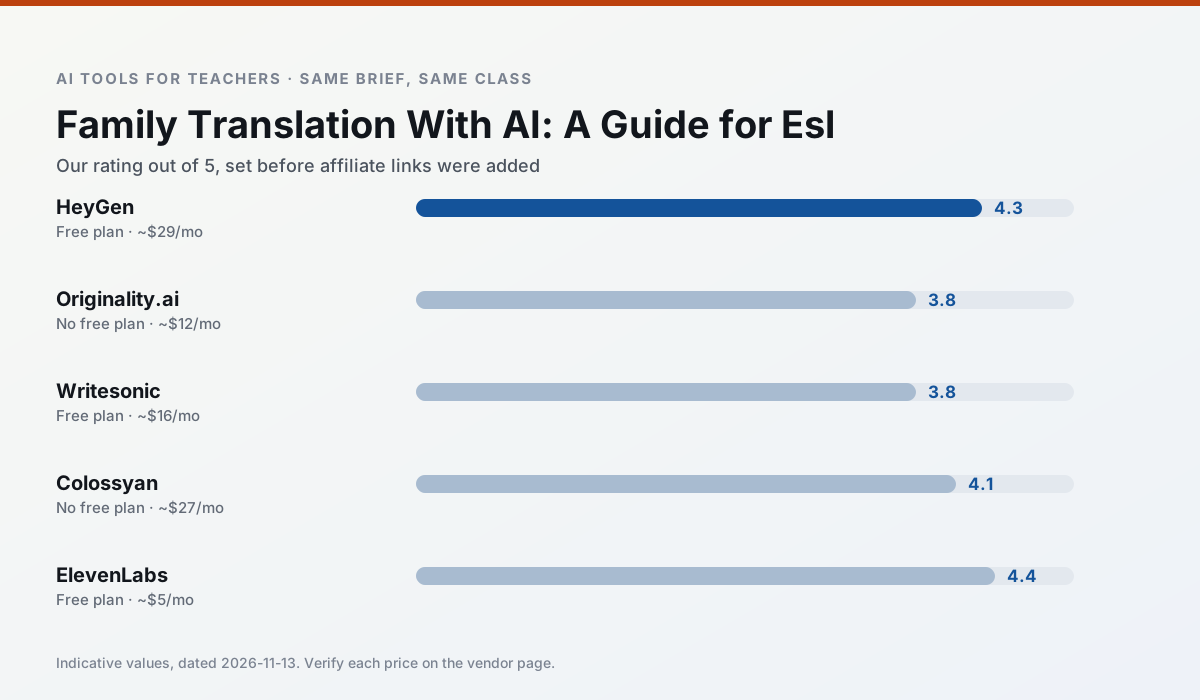
Side by side
Comparison table
Ratings reflect our timed classroom workflow, not vendor claims. Prices are indicative — verify on the vendor site.
| Tool | Best for | Free tier | Indicative paid plan | Standout feature | Our rating | Verdict | Try the tool |
|---|---|---|---|---|---|---|---|
| HeyGen | video lessons · translation | Yes — Limited credit plan | ~$29 /user/mo | Video translation | 4.3 / 5 | Strong option | Try free |
| Originality.ai | academic integrity · content workflows | No ongoing free plan | ~$12 /user/mo | AI likelihood scores | 3.8 / 5 | Situational | Try free |
| Writesonic | newsletters · parent communication | Yes — Limited credits | ~$16 /user/mo | Article and email generators | 3.8 / 5 | Situational | Try free |
| Colossyan | PD materials · video lessons | No ongoing free plan | ~$27 /user/mo | PDF/PPT-to-video | 4.1 / 5 | Situational | Try free |
| ElevenLabs | accessibility · reading intervention | Yes — Monthly character quota | ~$5 /user/mo | Very natural voices | 4.4 / 5 | Strong option | Try free |
| Gradescope | grading · rubric creation | Yes — Limited courses | Custom quote | Bubble sheet and handwriting capture | 4.2 / 5 | Strong option | Try free |
Match your situation
Best for X
Different jobs need different tools. Here is what we would open first in each case.
If there is no budget, start with HeyGen: free plan with clearest quota is the least punishing free tier here.
Originality.ai is the one we would open on a normal planning day because the first output is editable rather than restructurable, and the free plan covers a single teacher's routine.
Writesonic runs in a browser tab with no extension, no student accounts and no onboarding call, so you can test it in a free period.
For a school rollout, Colossyan offers the paperwork and the admin console; the classroom features are standard by comparison.
Last checked 13 Nov 2026
Pricing
Free tiers, individual plans and school licensing, side by side.
| Tool | Free plan | Individual / paid | School & district | Billing note | Verify |
|---|---|---|---|---|---|
| HeyGen | $0 — Limited credit plan | ~$29 /user/mo | Custom quote | Indicative — verify on vendor site | Vendor |
| Originality.ai | No ongoing free tier | ~$12 /user/mo | Custom quote | Indicative — verify on vendor site | Vendor |
| Writesonic | $0 — Limited credits | ~$16 /user/mo | ~$49 /user/mo | Indicative — verify on vendor site | Vendor |
| Colossyan | No ongoing free tier | ~$27 /user/mo | Custom quote | Indicative — verify on vendor site | Vendor |
| ElevenLabs | $0 — Monthly character quota | ~$5 /user/mo | ~$22 /user/mo | Indicative — verify on vendor site | Vendor |
| Gradescope | $0 — Limited courses | Custom quote | Custom quote | LMS integration and support | Vendor |
Editorial rule: pricing is re-checked every 2–3 months and the top 50 pages are refreshed every 6 months. See our funding policy.
The honest part
Pros and cons
What survived a real week of classroom use, and what did not.
Pros
- Best-in-class lip-sync translation
- Useful for multilingual families
- Generous trial credits
Cons
- Credit-based pricing is confusing
- Voice cloning raises consent questions
- Overkill for everyday lessons
Pros
- Useful for content publishing QA
- Fast bulk scanning
- Transparent credit model
Cons
- AI detection produces false positives
- Should never be sole evidence of misconduct
- Not a teaching tool
Pros
- Cheaper than enterprise writing suites
- Many templates
- Reasonable free trial
Cons
- Generic classroom output
- Credit system is confusing
- Limited education context
Pros
- Strong for staff training, not just lessons
- Good compliance/LMS export
- Fast document-to-video
Cons
- No permanent free plan
- Higher price point
- Less suited to K-12 student-facing content
Pros
- Excellent for accessible audio versions
- Low entry price
- Fast generation
Cons
- Quota-based billing
- Voice cloning consent considerations
- Not a teaching platform
In the classroom
Use cases
Five concrete workflows, with the tool we would open for each one.
Three reading levels from one source text
Paste a vetted text, ask for supported, core and extension versions, then check the vocabulary list by hand. Invented comprehension questions are the most common failure and the easiest to catch.
Recommended: HeyGenA Monday morning lesson plan in twelve minutes
The twelve minutes come from not rewriting the skeleton. Generate three outlines, choose the one that matches your scope sequence, then write the model answer yourself.
Recommended: Originality.aiA parent email in two languages
Draft in plain, warm language with no names, translate, then back-translate the important sentences to check meaning. Keep specific incidents out of the prompt and add them yourself.
Recommended: WritesonicRubric and feedback comments in one pass
Reorder the workflow so the rubric is yours and the comments are generated. Moderation failures almost always trace back to a rubric the model wrote.
Recommended: ColossyanAn IEP present-levels first draft
Use aggregated, anonymised data only. Ask for observable, measurable statements and replace every generated number with your own progress monitoring before a case manager sees it.
Recommended: ElevenLabs
Questions teachers ask us
FAQ
Direct answers, also published as FAQPage structured data for search and AI assistants.
Can AI do translation at mixed-grade level?
Which tool is best for translation?
What is the biggest risk?
Sources & further reading
Our recommendation
Try HeyGen free for your next translation task
AI avatar video and video translation for instructional content. Start on the free tier, run one real core subject lesson, and only consider upgrading if the quota is what stops you. Disclosure: we may earn a commission (35% recurring) at no extra cost to you.
Some links on this page are affiliate links. We may earn a commission at no extra cost to you. Our rankings are editorial and never pay-to-play. Never enter student PII into a free consumer account.
Keep reading
Related comparisons in this cluster.
Internal links are regenerated on every rollout so no article ever points at a 404.