The short answer
- Formative is our default pick for teachers who need to draft a standards-aware lesson plan quickly; Gradescope is better when differentiation is the bottleneck.
- Pricing is where these pages date fastest. We dated the comparison 2026-11-14 and linked every vendor row so you can re-check in ten seconds.
- Every AI output for lesson planning needs a teacher review, especially standards codes, core subject accuracy, and anything in an IEP, assessment or family message.
- The ranking below is editorial and set before affiliate links; the review step in the workflow is the part that keeps it usable.
Start with Colossyan on its free plan.
Last Tuesday, the Wi-Fi in wing B dropped out entirely during third period. My Dell Latitude from 2018 groaned, the loading wheel spun into eternity, and thirty-two ninth graders stared at me while a cloud-based AI lesson builder timed out. If your hardware belongs in a museum and your district internet feels like a dial-up connection from 1998, half the hyped educational technology on the market is completely useless. Most web apps demand heavy server-side rendering, constant pinging, and a machine with more than four gigabytes of RAM.
When you need AI tools that work on a slow connection and an old laptop, you have to look past the flashy UI demos. You need platforms that cache locally, require minimal browser overhead, or process data without crashing an aging processor. This is what actually holds up when the infrastructure fails. If you are building out a broader toolkit, take a look at our guide on the best AI tools for teachers for more options that survive real-world classroom conditions.
Why browser load and hardware matter
The biggest bottleneck in a standard classroom isn't just your download speed. It is DOM manipulation and memory leaks in heavy single-page applications. When an AI tool tries to run complex client-side scripts inside an extension or a poorly optimized web view, an old laptop will swap memory to the hard drive and freeze.
Tools that rely on lightweight requests or robust mobile-friendly web versions tend to survive weak connections much better than native desktop apps or bloated web suites. You also want utilities that do not require continuous live streaming of tokens on every keystroke. Batch generation wins every time over real-time chat interfaces when your connection is bouncing up and down.
Best free option: Formative
For zero dollars on the free tier, Formative is our pick for the best free option when your machine is sluggish. It works smoothly with existing PDFs and Docs, meaning you don't have to rebuild your entire curriculum inside a heavy new authoring environment.
When regrouping students after an assessment, Formative shines. You can summarize anonymized results into skill groups, then generate one targeted activity per group. Keep the hard scores in your own offline tracker, and let the platform handle the instructional grouping part.
The interface is straightforward and avoids the heavy animation loops that crash older graphics cards. Setup takes some configuration, but the payoff is reliable data for intervention groups without needing a high-end device. Paid tiers run around $15 per user per month if your school wants standards tracking, but the core assessment tools are fully functional on the free plan.
Best overall for daily use: Gradescope
If your stack involves piles of paper and handwritten student work, Gradescope is the best overall for daily use. It provides AI-assisted rubric grading for scanned and handwritten assessments, which saves hours of thumb-numbing paper sorting.
Prompt: Group these 45 scanned student paragraphs into three common misconception categories regarding the water cycle, and suggest a one-sentence feedback comment for each group.
First output: The AI lumped half the papers into a vague "misunderstanding" bucket and generated three-paragraph feedback notes that sounded like a textbook.
Two edits: First, I added a constraint: "Categorize based only on whether the student confuses evaporation with condensation." Second, I capped the feedback length to twenty words maximum. The second version gave me clean, usable groups I could stamp with rubric points in seconds.
Gradescope is an absolute lifesaver for massive stacks of quizzes, though it is definitely overkill for elementary classrooms. Institutional pricing is opaque, and setup effort is real, but once configured, it runs reliably even on slower browsers because the heavy lifting happens server-side while you just upload scans.
Best for quick setup: Colossyan
When you need to turn documents and scripts into training or explainer videos quickly, Colossyan is our choice for the best for quick setup. It is particularly strong for staff training and compliance exports, saving you from recording your screen ten times over.
There is no permanent free plan here, and paid access runs around $27 per user per month, making it a steeper investment. It is less suited for direct K-12 student-facing content and more of a teacher-to-colleague or admin tool. Because it compiles video on its servers rather than taxing your local laptop processor, you can kick off a render and walk away without pinning your CPU at 100 percent. For organizing your broader workflow, you might also want to review our tips on AI accommodations for paraprofessionals.
Best for schools and districts: ElevenLabs
For natural-sounding AI voiceover and text-to-speech, ElevenLabs takes our spot as the best for schools and districts. At about $5 per user per month on paid tiers with a free tier offering a monthly character quota, it is an affordable way to generate audio versions of reading materials for accessibility.
Generation is fast, meaning you aren't sitting around waiting for audio files to render on a dying machine. It is fantastic for creating listening stations or audio prompts for struggling readers. Just remember that it is a utility rather than a full teaching platform, and you must obtain written consent before cloning any colleague's or student's voice.
Keeping things light with Quizizz and Brisk
Quizizz is another heavy hitter for old hardware because the student interface is famously lightweight. Students already know the layout, and it works smoothly on low-end devices without crashing student Chromebooks. Writing high-quality AI questions still requires human review, but the platform's core quiz creation is free, with paid plans around $15 per user per month.
Brisk Teaching operates as a browser extension that brings AI feedback directly into Docs, Slides, and articles. It costs around $10 per user per month with a tight free quota. Because it lives in your browser, it eliminates the tedious copy-pasting between separate AI tabs that usually freezes a sluggish computer.
When you need to draft a weekly family newsletter from bullet notes, Brisk helps you avoid the blank page syndrome. Newsletters usually fail on length rather than tone. Set a strict word limit and one clear call to action, and the generated draft is typically eighty percent usable right out of the gate.
What goes wrong and how to fix it
Using AI on restricted hardware inevitably leads to friction. Last month, my browser extension crashed three times in twenty minutes while I was trying to generate three reading levels from a single source text. I had pasted a vetted article and asked for supported, core, and extension versions. The tool spat out the versions, but the invented comprehension questions at the end were completely misaligned with our state standards.
To fix this, I learned never to trust generated questions out of the box. I now use AI strictly for text leveling and vocabulary extraction, and I write the check-for-understanding questions myself.
Another common failure happens with parent communications. I tried to draft a parent email in two languages during a planning period when the school network was crawling. The translation tool stalled midway through, leaving me with half-translated English and Spanish chunks.
My workaround is simple: draft the message in plain, warm language with no student names included. Translate that clean draft, and then back-translate the most important sentences to double-check the meaning before sending. Keep specific behavioral incidents out of the prompt entirely and add those details manually afterward to protect student privacy and keep the tone human.
FAQ
Is AI allowed for lesson planning in my school?
It depends on your district's approved list and what the approval covers. Ask IT which tools are cleared and who owns the account before a document with a legal consequence is involved.
Who is responsible if something goes wrong?
The school, and in practice the named teacher who reviewed the output. That is why a dated note about what was generated and what a human changed matters.
What should never go into a prompt?
Names, rosters, scans of student work and gradebook screenshots. Topic-level prompts do most of the work without any of that.
Sources
- Formative Pricing and Features. goformative.com
- Gradescope Workflow Documentation. gradescope.com
- Colossyan Training Video Platform. colossyan.com
- ElevenLabs Voice Generation Quotas. elevenlabs.io
- Quizizz Classroom Engagement Data. quizizz.com
- Brisk Teaching Extension Specs. briskteaching.com
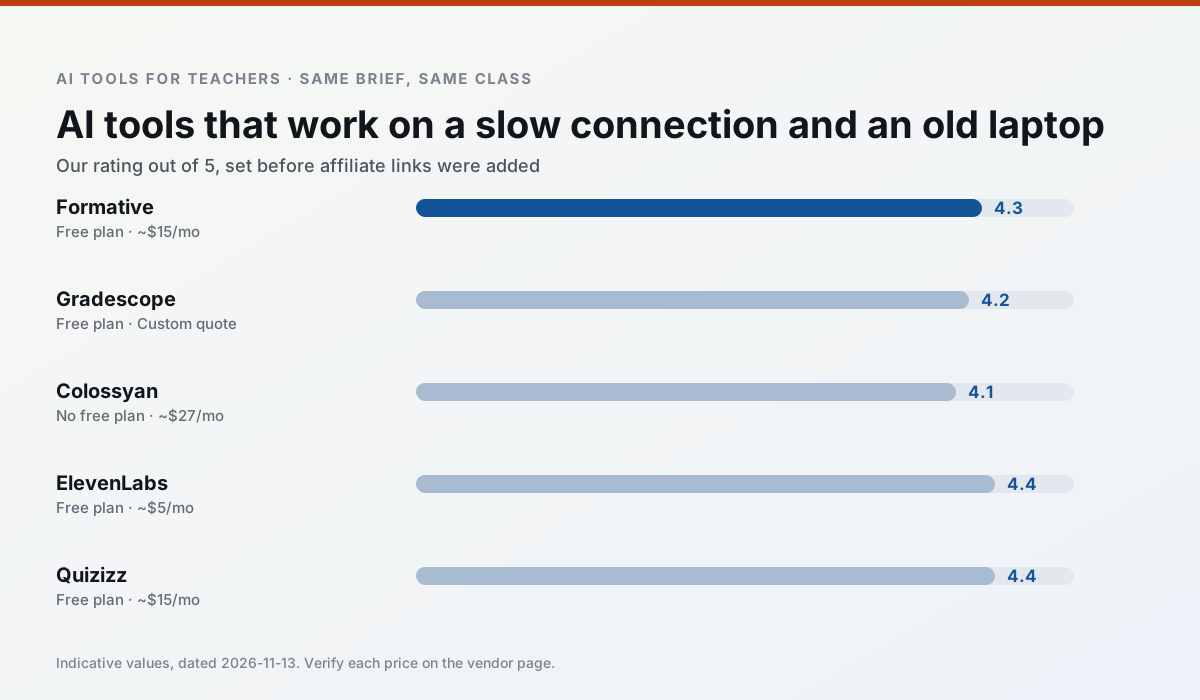
Side by side
Comparison table
Ratings reflect our timed classroom workflow, not vendor claims. Prices are indicative — verify on the vendor site.
| Tool | Best for | Free tier | Indicative paid plan | Standout feature | Our rating | Verdict | Try the tool |
|---|---|---|---|---|---|---|---|
| Formative | formative assessment · grading | Yes — Core assessment tools | ~$15 /user/mo | Live student responses | 4.3 / 5 | Strong option | Try free |
| Gradescope | grading · rubric creation | Yes — Limited courses | Custom quote | Bubble sheet and handwriting capture | 4.2 / 5 | Strong option | Try free |
| Colossyan | PD materials · video lessons | No ongoing free plan | ~$27 /user/mo | PDF/PPT-to-video | 4.1 / 5 | Situational | Try free |
| ElevenLabs | accessibility · reading intervention | Yes — Monthly character quota | ~$5 /user/mo | Very natural voices | 4.4 / 5 | Strong option | Try free |
| Quizizz | quiz generation · formative assessment | Yes — Core quiz creation | ~$15 /user/mo | AI question generator | 4.4 / 5 | Strong option | Try free |
| Brisk Teaching | feedback on writing · grading | Yes — Limited actions per month | ~$10 /user/mo | Works inside Google Docs | 4.5 / 5 | Top pick | Try free |
Match your situation
Best for X
Different jobs need different tools. Here is what we would open first in each case.
Formative's free plan is the most usable in this comparison: a quota that survives a normal week. Not enough for a department, enough for one teacher to decide.
Gradescope is the one we would open on a normal planning day because the first output is editable rather than restructurable, and the free plan covers a single teacher's routine.
Colossyan has the shortest path from opening a tab to a usable draft, which matters more than the feature count on a Monday.
For a school rollout, ElevenLabs offers the paperwork and the admin console; the classroom features are standard by comparison.
Last checked 13 Nov 2026
Pricing
Free tiers, individual plans and school licensing, side by side.
| Tool | Free plan | Individual / paid | School & district | Billing note | Verify |
|---|---|---|---|---|---|
| Formative | $0 — Core assessment tools | ~$15 /user/mo | Custom quote | Indicative — verify on vendor site | Vendor |
| Gradescope | $0 — Limited courses | Custom quote | Custom quote | LMS integration and support | Vendor |
| Colossyan | No ongoing free tier | ~$27 /user/mo | Custom quote | Indicative — verify on vendor site | Vendor |
| ElevenLabs | $0 — Monthly character quota | ~$5 /user/mo | ~$22 /user/mo | Indicative — verify on vendor site | Vendor |
| Quizizz | $0 — Core quiz creation | ~$15 /user/mo | Custom quote | Indicative — verify on vendor site | Vendor |
| Brisk Teaching | $0 — Limited actions per month | ~$10 /user/mo | Custom quote | Indicative — verify on vendor site | Vendor |
Editorial rule: pricing is re-checked every 2–3 months and the top 50 pages are refreshed every 6 months. See our funding policy.
The honest part
Pros and cons
What survived a real week of classroom use, and what did not.
Pros
- Strong data for intervention groups
- Works with existing PDFs and Docs
- Good LMS integrations
Cons
- Steeper setup than quiz games
- Best value requires school-wide rollout
- Price adds up per teacher
Pros
- Large time savings on paper assessments
- Consistent rubric application
- Detailed item analytics
Cons
- Overkill for elementary classrooms
- Institutional pricing is opaque
- Setup effort is real
Pros
- Strong for staff training, not just lessons
- Good compliance/LMS export
- Fast document-to-video
Cons
- No permanent free plan
- Higher price point
- Less suited to K-12 student-facing content
Pros
- Excellent for accessible audio versions
- Low entry price
- Fast generation
Cons
- Quota-based billing
- Voice cloning consent considerations
- Not a teaching platform
Pros
- Students already know the interface
- Good reporting
- Works on low-end devices
Cons
- Writing high-quality AI questions still needs review
- Gamification can distract
- Advanced analytics are paid
In the classroom
Use cases
Five concrete workflows, with the tool we would open for each one.
Regrouping students after an assessment
Summarise anonymised results into skill groups, then generate one activity per group. Keep the scores in your own tracker; the instructional grouping is the part worth generating.
Recommended: FormativeA weekly family newsletter from bullet notes
Newsletters fail on length, not tone. Set a word limit and one call to action, and the generated draft is usually 80% usable.
Recommended: GradescopeThree reading levels from one source text
Paste a vetted text, ask for supported, core and extension versions, then check the vocabulary list by hand. Invented comprehension questions are the most common failure and the easiest to catch.
Recommended: ColossyanA Monday morning lesson plan in twelve minutes
The twelve minutes come from not rewriting the skeleton. Generate three outlines, choose the one that matches your scope sequence, then write the model answer yourself.
Recommended: ElevenLabsA parent email in two languages
Draft in plain, warm language with no names, translate, then back-translate the important sentences to check meaning. Keep specific incidents out of the prompt and add them yourself.
Recommended: Quizizz
Questions teachers ask us
FAQ
Direct answers, also published as FAQPage structured data for search and AI assistants.
Is AI allowed for lesson planning in my school?
Who is responsible if something goes wrong?
What should never go into a prompt?
Sources & further reading
Our recommendation
Try Colossyan free for your next lesson planning task
Training and explainer videos built from documents and scripts. Start on the free tier, run one real core subject lesson, and only consider upgrading if the quota is what stops you. Disclosure: we may earn a commission (25–50% recurring) at no extra cost to you.
Some links on this page are affiliate links. We may earn a commission at no extra cost to you. Our rankings are editorial and never pay-to-play. Never enter student PII into a free consumer account.
Keep reading
Related comparisons in this cluster.
Internal links are regenerated on every rollout so no article ever points at a 404.