The short answer
- Originality.ai is our default pick for teachers who need to draft a standards-aware lesson plan quickly; Jasper is better when differentiation is the bottleneck.
- The cheapest honest test is a week of real work on the free plans: Originality.ai: No ongoing free plan; Jasper: No ongoing free plan; ChatGPT: Yes — Usage-limited model access. If a tool is still open on Friday, it has earned a paid conversation.
- Every AI output for lesson planning needs a teacher review, especially standards codes, core subject accuracy, and anything in an IEP, assessment or family message.
- Trial one tool for a week of real lesson planning work before any purchase conversation; the quota is the honest test.
Start with Originality.ai on its free plan.
Last August, our new charter school board handed the principal a lean operations budget and a silent challenge: figure out the tech stack before the front doors open. There was no dedicated IT department, no sprawling central office software license, and zero room for expensive enterprise subscriptions that promised the moon and delivered a glorified spellchecker. If you are building a school from the ground up, every dollar spent on a software license is a dollar pulled away from classroom consumables or support staff. We had to look closely at what AI tools a charter school can afford in year one without blowing the general fund or violating student privacy laws.
The market is flooded with shiny tools pitched at districts with millions in Title funds, but independent charters operate on razor-thin margins. You have to balance teacher utility against hard subscription costs, weighing general-purpose LLMs against education-specific platforms. Some tools require district-wide procurement departments to unlock, while others can be bought with a staff credit card on a month-to-month basis. We tested six distinct options to see where the real value lies for a tight-budget school. Before committing your discretionary funds, check our wider guide on the best AI tools for teachers to see how these stack up against free alternatives.
Daily Planning and Unit Design
When you need a tool that handles heavy text without hallucinating lesson objectives, Claude sits at the top of our list as the best overall for daily use. At roughly $20 per user per month on its paid tier, it handles massive documents, full unit plans, and long rubrics with a prose style that sounds less like a corporate robot and more like a seasoned department chair. It lacks teacher-specific templates, meaning you have to supply the formatting, but its long-context window makes it unmatched for drafting multi-week curriculum maps.
[Prompt]:
Act as an 8th-grade history teacher. Write a three-week inquiry unit on the Industrial Revolution based on these state standards [insert standards]. Include primary source analysis prompts and a performance task rubric.

[Draft returned]:
A comprehensive three-week unit plan with daily lesson breakdowns, standard alignments, four primary source excerpts with accompanying scaffolded questions, and a four-tier analytic rubric assessing historical thinking, evidence use, and communication.

[Two edits that made it usable]:
1. Cut the third week down; the pacing was unrealistic for a standard block schedule and required too many concurrent library resources.
2. Swapped out two of the generated primary sources for local textile mill archives that matched our regional history focus.
ChatGPT sits right alongside Claude at roughly $20 per user per month, offering massive flexibility and a huge community of teacher prompt libraries. It adapts to almost any classroom task, from generating exit tickets to translating parent notices into five different languages. However, it requires prompt engineering skills to get consistent results, and consumer plans must never be used with student PII. If you need a workflow for support staff, pair these general assistants with insights from our piece on AI accommodations for paraprofessionals to keep your intervention teams aligned.
Student-Safe Workspaces and Safeguarding
Keeping student data secure is non-negotiable when you are audited by state agencies or authorisers. SchoolAI comes in at about $15 per user per month, built specifically to provide a school-safe AI workspace with teacher-controlled student environments. It features strong safeguarding defaults, district-level visibility into student prompts, and audit logs that satisfy board compliance officers. The catch is that it requires school-wide buy-in to unlock its full utility, and pricing often leans quote-based, which can complicate a lean charter finance meeting.
Khanmigo brings a nonprofit trust signal to the table, priced at roughly $4 per learner per month alongside free US teacher accounts subject to eligibility. It is an education-first platform with exceptional math scaffolding and tutor-style AI interactions that prevent students from simply copying answers. On the downside, availability varies by region, and it is less useful for general admin paperwork or teacher lesson planning. You need active student accounts to extract real value, which requires clear parent consent forms signed during registration week.
Administrative Communication and Publishing QA
Parent-facing writing is high-stakes work in a charter school where enrollment retention directly impacts funding. Jasper is priced at roughly $39 per user per month, serving as a brand-voice writing assistant tailored for school communications teams. It maintains a consistent tone across weekly newsletters, board updates, and public relations campaigns with a strong long-form editor. Because it is priced for corporate marketing teams and lacks education-specific features, it is total overkill for a single classroom teacher, but it can save an overburdened principal hours on community outreach.
[Prompt]:
Write a parent newsletter in a warm, direct tone based on these bullet points: Fall festival is Friday, 8th grade field trip forms are due Wednesday, after-school tutoring starts next week. Keep it under 200 words and end with one clear action item.

[Draft returned]:
A cheerful, polished community update detailing the upcoming autumn celebration, highlighting the looming Wednesday deadline for eighth-grade permission slips, announcing the launch of tutorial sessions, and closing with a bold link to the volunteer signup form.

[Two edits that made it usable]:
1. Corrected the start date for tutoring, as the generator assumed a Monday start while our campus runs Tuesday-Thursday intervention blocks.
2. Removed an overly enthusiastic introductory paragraph about the changing leaves that felt out of place for an urban school community.
Originality.ai hits the administration side of the house at roughly $12 per user per month, acting as an AI-detection and plagiarism scanning utility for publisher and admin workflows. It offers fast bulk scanning and a transparent credit model, making it our pick for mixed-ability classes and publisher QA. Crucially, its AI detection produces false positives and should never be used as sole evidence of student misconduct or disciplinary action. It is strictly a quality assurance tool for staff publishing original materials, not a grading assistant for student essays.
Budgeting Realities for Year One
Deploying these tools successfully means avoiding subscription fatigue. Do not buy individual seats for every teacher if half the staff prefers free tiers or built-in district platforms. Start with one administrative seat on Jasper for community updates, one or two educator licenses for Claude or ChatGPT to handle heavy curriculum lifting, and a school-wide deployment of SchoolAI or Khanmigo only if student-facing licenses fit your initial grant parameters. Year one is about survival, compliance, and proving your instructional model works. Keep your tech stack lean, protect your student data fiercely, and let the software justify its line item before you renew for year two.
FAQ
Is AI allowed for lesson planning in my school?
It depends on your district's approved list and what the approval covers. Ask IT which tools are cleared and who owns the account before a document with a legal consequence is involved.
Who is responsible if something goes wrong?
The school, and in practice the named teacher who reviewed the output. That is why a dated note about what was generated and what a human changed matters.
What should never go into a prompt?
Names, rosters, scans of student work and gradebook screenshots. Topic-level prompts do most of the work without any of that.
Sources
- Originality.ai Pricing and Features. https://originality.ai/pricing
- Jasper AI Plans and Capabilities. https://www.jasper.ai/pricing
- OpenAI ChatGPT Team and Enterprise Plans. https://openai.com/chatgpt/pricing
- Anthropic Claude Pro and Team Tiers. https://claude.ai/pricing
- Khan Academy Khanmigo Educator and District Info. https://www.khanacademy.org/khanmigo
- SchoolAI Safety and Pricing Overview. https://www.schoolai.com/pricing
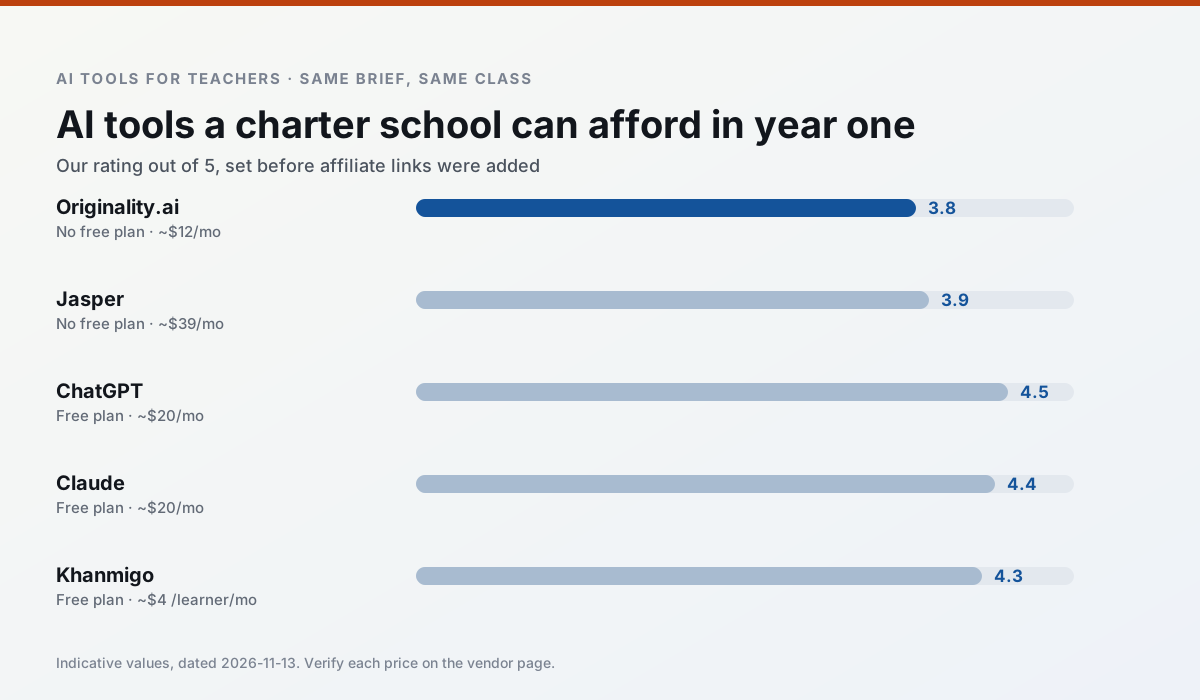
Side by side
Comparison table
Ratings reflect our timed classroom workflow, not vendor claims. Prices are indicative — verify on the vendor site.
| Tool | Best for | Free tier | Indicative paid plan | Standout feature | Our rating | Verdict | Try the tool |
|---|---|---|---|---|---|---|---|
| Originality.ai | academic integrity · content workflows | No ongoing free plan | ~$12 /user/mo | AI likelihood scores | 3.8 / 5 | Situational | Try free |
| Jasper | newsletters · parent communication | No ongoing free plan | ~$39 /user/mo | Brand voice profiles | 3.9 / 5 | Situational | Try free |
| ChatGPT | lesson planning · parent communication | Yes — Usage-limited model access | ~$20 /user/mo | Custom GPTs and Projects | 4.5 / 5 | Top pick | Try free |
| Claude | rubric creation · feedback on writing | Yes — Usage-limited | ~$20 /user/mo | Very large context window | 4.4 / 5 | Strong option | Try free |
| Khanmigo | math practice · student tutoring | Yes — US teacher accounts, subject to eligibility | ~$4 /learner/mo | Socratic tutoring rather than answers | 4.3 / 5 | Strong option | Try free |
| SchoolAI | student-safe AI · differentiated instruction | Yes — Limited seats | ~$15 /user/mo | Teacher-monitored student chats | 4.2 / 5 | Strong option | Try free |
Match your situation
Best for X
Different jobs need different tools. Here is what we would open first in each case.
For three reading groups and one text, Originality.ai needs the least manual relabelling of vocabulary and questions.
Family-facing drafts from Jasper need the fewest rewrites for warmth without overpromising, which is the usual failure mode.
ChatGPT is the student-facing option here with boundaries a teacher can actually set and supervise.
Claude is the one we would open on a normal planning day because the first output is editable rather than restructurable, and the free plan covers a single teacher's routine.
Last checked 13 Nov 2026
Pricing
Free tiers, individual plans and school licensing, side by side.
| Tool | Free plan | Individual / paid | School & district | Billing note | Verify |
|---|---|---|---|---|---|
| Originality.ai | No ongoing free tier | ~$12 /user/mo | Custom quote | Indicative — verify on vendor site | Vendor |
| Jasper | No ongoing free tier | ~$39 /user/mo | ~$59+ /user/mo | Indicative — verify on vendor site | Vendor |
| ChatGPT | $0 — Usage-limited model access | ~$20 /user/mo | ~$25+ /user/mo | Indicative — verify on vendor site | Vendor |
| Claude | $0 — Usage-limited | ~$20 /user/mo | ~$25+ /user/mo | Indicative — verify on vendor site | Vendor |
| Khanmigo | $0 — US teacher accounts, subject to eligibility | ~$4 /learner/mo | Custom quote | Indicative — verify on vendor site | Vendor |
| SchoolAI | $0 — Limited seats | ~$15 /user/mo | Custom quote | Indicative — verify on vendor site | Vendor |
Editorial rule: pricing is re-checked every 2–3 months and the top 50 pages are refreshed every 6 months. See our funding policy.
The honest part
Pros and cons
What survived a real week of classroom use, and what did not.
Pros
- Useful for content publishing QA
- Fast bulk scanning
- Transparent credit model
Cons
- AI detection produces false positives
- Should never be sole evidence of misconduct
- Not a teaching tool
Pros
- Consistent tone across communications
- Strong long-form editor
- Good for district comms teams
Cons
- Priced for marketing teams
- Overkill for one classroom
- No education-specific features
Pros
- Most flexible option available
- Huge community of teacher prompt libraries
- Strong multilingual support
Cons
- Requires prompt skills for consistent results
- No built-in standards alignment
- District privacy review usually required
Pros
- Handles full unit plans and long rubrics
- Nuanced, less generic prose
- Good at structured document output
Cons
- No teacher-specific templates
- Fewer classroom integrations
- Consumer plan not suitable for student data
Pros
- Education-first design
- Strong nonprofit trust signal
- Good math scaffolding
Cons
- Availability varies by region
- Less useful for admin paperwork
- Requires student accounts for full value
In the classroom
Use cases
Five concrete workflows, with the tool we would open for each one.
A weekly family newsletter from bullet notes
Newsletters fail on length, not tone. Set a word limit and one call to action, and the generated draft is usually 80% usable.
Recommended: Originality.aiRegrouping students after an assessment
Summarise anonymised results into skill groups, then generate one activity per group. Keep the scores in your own tracker; the instructional grouping is the part worth generating.
Recommended: JasperA five-minute exit ticket set
Ask for one recall, one application and one reasoning item, then delete the second recall question every generator sneaks in.
Recommended: ChatGPTAn IEP present-levels first draft
Use aggregated, anonymised data only. Ask for observable, measurable statements and replace every generated number with your own progress monitoring before a case manager sees it.
Recommended: ClaudeA substitute folder that needs no context
The value here is structure, not creativity. Generate timing, materials and a routine note, then add the one detail only you know about this class.
Recommended: Khanmigo
Questions teachers ask us
FAQ
Direct answers, also published as FAQPage structured data for search and AI assistants.
Is AI allowed for lesson planning in my school?
Who is responsible if something goes wrong?
What should never go into a prompt?
Sources & further reading
Our recommendation
Try Originality.ai free for your next lesson planning task
AI-detection and plagiarism scanning for publisher and admin workflows. Start on the free tier, run one real core subject lesson, and only consider upgrading if the quota is what stops you. Disclosure: we may earn a commission (25% recurring) at no extra cost to you.
Some links on this page are affiliate links. We may earn a commission at no extra cost to you. Our rankings are editorial and never pay-to-play. Never enter student PII into a free consumer account.
Keep reading
Related comparisons in this cluster.
Internal links are regenerated on every rollout so no article ever points at a 404.