The short answer
- Surfer SEO is our default pick for teachers who need to draft a standards-aware lesson plan quickly; OpusClip is better when differentiation is the bottleneck.
- Free-tier reality for this shortlist: Surfer SEO: No ongoing free plan; OpusClip: Yes — Limited monthly clips; Murf AI: Yes — Trial-only output. Treat every paid figure as indicative until you have read the vendor page; only the free quota is something you can test yourself this week.
- Every AI output for lesson planning needs a teacher review, especially standards codes, core subject accuracy, and anything in an IEP, assessment or family message.
- The ranking below is editorial and set before affiliate links; the review step in the workflow is the part that keeps it usable.
Start with Surfer SEO on its free plan.
It is three weeks before the end of the term, and you have thirty-two narrative report cards sitting in your browser tab. Each one requires three paragraphs of personalized prose, a behavioral note, and an actionable next step for the parents. You stare at the blinking cursor, wondering if pasting student data into a free chatbot is going to trigger a district policy violation or just spit out generic sentences about citizenship.
Teachers are looking for practical guidance on AI tools for report cards: what is allowed and what is not. The debate is rarely about whether the technology can write sentences. It is about district compliance, student privacy, and where the boundary lies between helpful drafting and professional negligence. Let us look at what works, what breaks, and which platforms actually fit into a teacher's workflow without risking a call from the principal's office.
Understanding the Legal and Ethical Boundaries
When you draft report cards with AI, the rules are rigid. Student Personally Identifiable Information, known as PII, cannot be uploaded to consumer-grade language models without a verified district contract and a Data Processing Agreement. This means you do not paste real student names, specific disciplinary infractions, or medical accommodations into a public browser window.
Instead, teachers anonymize the inputs. You write about "Student A" or use raw score percentages without names attached. If your school already licenses institutional platforms like Turnitin Clarity / Feedback Studio for writing feedback, the data governance is usually handled at the district level. Even then, automated text generation for report cards requires strict human moderation. A machine does not know that Jimmy's disruptive behavior in October was actually a side effect of medication changes that resolved by November.
Tools That Handle Writing and Feedback
If you are generating formative feedback throughout the term rather than waiting for the final crunch, specialized tools handle the heavy lifting better than a blank chat window. Class Companion runs around $12 per user per month (indicative) and provides AI feedback on handwritten and scanned student work. It is particularly useful for math support, though scan quality directly affects accuracy, and the feedback still needs your final review.
When you publish resources online or write content for teacher marketplaces, Surfer SEO costs roughly $79 per month (indicative) and offers best-in-class on-page guidance with clear scoring. It is an editorial optimizer rather than a classroom grading tool, meaning it has no business touching student data, but it helps teacher-creators refine public resources.
Prompt: "Draft an anonymized, supportive report card comment for a 5th-grade student who struggles with multi-step fractions but shows strong collaborative skills in group projects. Keep it under 60 words."
First output: "Student demonstrates exemplary collaboration during group tasks, frequently assisting peers. However, mastery of multi-step fraction operations remains below grade level. Continued practice with common denominators and regrouping will yield improvement before the spring benchmark."
Two edits that made it usable:
- Swapped "below grade level" for specific language about current progress on fraction standards to match our reporting scale.
- Added a concrete suggestion for home practice involving visual fraction strips rather than a vague recommendation for continued practice.
Repurposing Recordings and Multimedia Explanations
Report cards often require us to explain complex student growth to parents who missed parent-teacher conferences. Sometimes, recording a short audio or video walkthrough of a portfolio piece is faster than typing paragraphs. OpusClip, priced around $15 per user per user/month (indicative), turns long recordings into short clips with excellent captions. It is optimized for social formats, so you must never upload recordings containing identifiable students.
For creating audio materials or presentations, Murf AI offers studio-quality voiceover with clean pacing controls at roughly $19 per user per month (indicative). Its free tier is trial-only, and commercial licensing rules matter if you distribute audio publicly. Meanwhile, Fliki handles text-to-video conversions with stock media and AI voiceover for about $21 per user per month (indicative). It ranks as our best overall for daily use when you need explainer visuals, though minute-based limits apply and output can look generic if you do not customize the media assets.
Two Real Failures and How to Fix Them
Things go wrong quickly when generative features are pushed past their limits. Here is what happened twice this term, and how the workflow was adjusted.
The first failure happened when generating differentiation tiers from a single source text. I asked an AI model to rewrite a social studies article into three reading levels and generate comprehension questions. The text levels came out fine, but the generated questions were factually disconnected from the text, asking about details the model had hallucinated. The fix was simple: use the tool exclusively to generate supported, core, and extension versions of the vetted text, but always write your own comprehension questions by hand.
The second failure involved rubric-based comment generation. I let a model generate both the assessment rubric and the corresponding student feedback comments in a single pass. Predictably, the resulting feedback referenced criteria that did not align with our state standards because the model had invented its own scoring rubric underneath. The fix required a strict workflow reorder: the rubric must always be yours first. Only after the human-vetted rubric is locked in should you feed it to the generator to produce aligned feedback comments.
Choosing the Right Workflow for Your Classroom
Navigating these platforms requires balancing time savings against data security. If you need a comprehensive view of how automated platforms fit into professional workflows, review our guide on the best AI tools for teachers, or explore how AI classroom newsletters for administrators streamline community communication without violating privacy standards.
Keep your student names out of public prompts, rely on institutional agreements where available, and always treat generated report card text as a rough first draft that requires a teacher's eyes before it goes home in an envelope.
FAQ
Is AI allowed for lesson planning in my school?
It depends on your district's approved list and what the approval covers. Ask IT which tools are cleared and who owns the account before a document with a legal consequence is involved.
Who is responsible if something goes wrong?
The school, and in practice the named teacher who reviewed the output. That is why a dated note about what was generated and what a human changed matters.
What should never go into a prompt?
Names, rosters, scans of student work and gradebook screenshots. Topic-level prompts do most of the work without any of that.
Sources
- Surfer SEO Vendor Pricing and Feature Index: https://surferseo.com
- OpusClip Product Documentation and Privacy Overview: https://www.opus.pro
- Murf AI Voice Generation Terms and Licensing: https://murf.ai
- Fliki Text-to-Video Specifications: https://fliki.ai
- Class Companion Educator Guide and Data Policy: https://classcompanion.com
- Turnitin Feedback Studio Institutional Resources: https://www.turnitin.com
Side by side
Comparison table
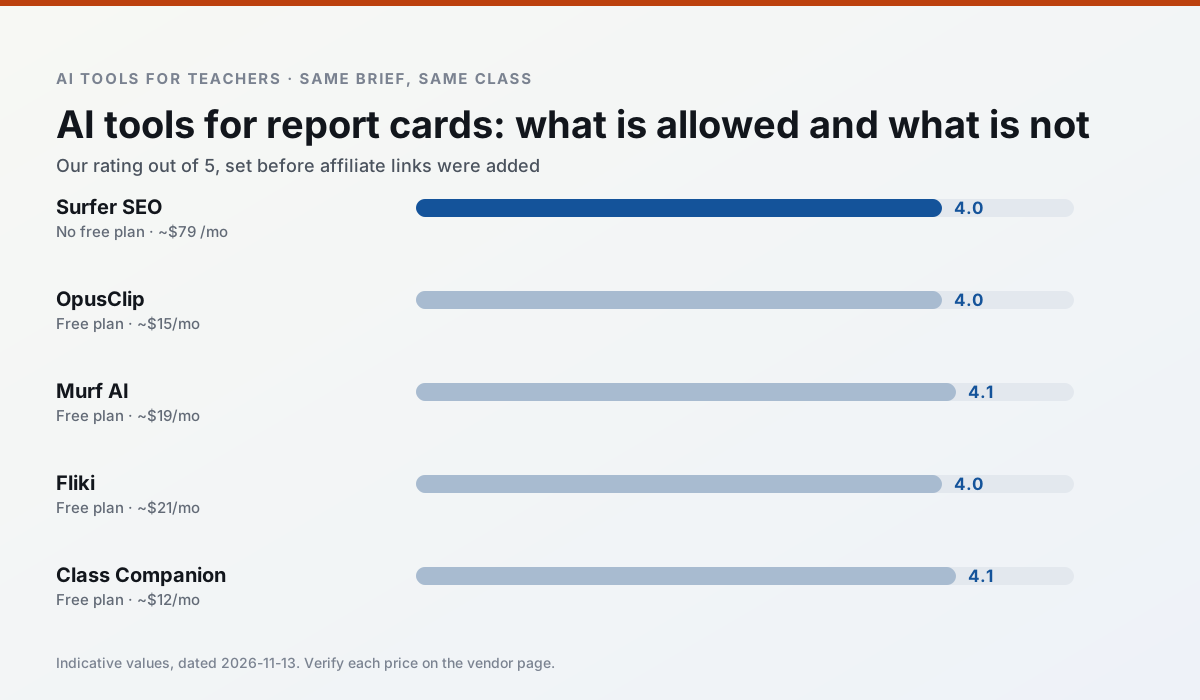
Ratings reflect our timed classroom workflow, not vendor claims. Prices are indicative — verify on the vendor site.
| Tool | Best for | Free tier | Indicative paid plan | Standout feature | Our rating | Verdict | Try the tool |
|---|---|---|---|---|---|---|---|
| Surfer SEO | teacher bloggers · resource sellers | No ongoing free plan | ~$79 /mo | Content Editor | 4.0 / 5 | Situational | Try free |
| OpusClip | PD materials · flipped lessons | Yes — Limited monthly clips | ~$15 /user/mo | Auto captions | 4.0 / 5 | Situational | Try free |
| Murf AI | audio lessons · accessibility | Yes — Trial-only output | ~$19 /user/mo | Voice fine-tuning | 4.1 / 5 | Situational | Try free |
| Fliki | video lessons · audio lessons | Yes — Watermarked, limited minutes | ~$21 /user/mo | Blog/text to video | 4.0 / 5 | Situational | Try free |
| Class Companion | grading · feedback on writing | Yes — Limited assignments | ~$12 /user/mo | Handwriting recognition | 4.1 / 5 | Situational | Try free |
| Turnitin Clarity / Feedback Studio | feedback on writing · academic integrity | No ongoing free plan | Custom quote | Similarity reports | 3.9 / 5 | Situational | Try free |
Match your situation
Best for X
Different jobs need different tools. Here is what we would open first in each case.
Setup cost is one login for Surfer SEO; everything else can wait until you know the tool is useful.
For a school rollout, OpusClip offers the paperwork and the admin console; the classroom features are standard by comparison.
Murf AI's free plan is the most usable in this comparison: a quota that survives a normal week. Not enough for a department, enough for one teacher to decide.
Fliki is the one we would open on a normal planning day because the first output is editable rather than restructurable, and the free plan covers a single teacher's routine.
Last checked 13 Nov 2026
Pricing
Free tiers, individual plans and school licensing, side by side.
| Tool | Free plan | Individual / paid | School & district | Billing note | Verify |
|---|---|---|---|---|---|
| Surfer SEO | No ongoing free tier | ~$79 /mo | Custom quote | Indicative — verify on vendor site | Vendor |
| OpusClip | $0 — Limited monthly clips | ~$15 /user/mo | ~$29 /user/mo | Indicative — verify on vendor site | Vendor |
| Murf AI | $0 — Trial-only output | ~$19 /user/mo | ~$39 /user/mo | Indicative — verify on vendor site | Vendor |
| Fliki | $0 — Watermarked, limited minutes | ~$21 /user/mo | ~$66 /user/mo | Indicative — verify on vendor site | Vendor |
| Class Companion | $0 — Limited assignments | ~$12 /user/mo | Custom quote | Indicative — verify on vendor site | Vendor |
| Turnitin Clarity / Feedback Studio | No ongoing free tier | Custom quote | Custom quote | LMS-wide deployment | Vendor |
Editorial rule: pricing is re-checked every 2–3 months and the top 50 pages are refreshed every 6 months. See our funding policy.
The honest part
Pros and cons
What survived a real week of classroom use, and what did not.
Pros
- Best-in-class on-page guidance
- Useful for TpT / resource-shop content
- Clear scoring
Cons
- Expensive for individual teachers
- Not a classroom tool
- Requires SEO basics
Pros
- Turns a recorded lesson into review clips
- Excellent captions
- Fast
Cons
- Optimised for social formats
- Not a lesson design tool
- Free plan is restrictive
Pros
- Very clean audio
- Good pacing controls
- Easy slide integration
Cons
- Commercial licensing rules matter
- Free tier is not usable long-term
- Single-purpose
Pros
- No avatar needed
- Good for explainer visuals
- Simple editor
Cons
- Minute-based limits
- Output can look generic
- Price jumps between tiers
Pros
- Useful where work is done on paper
- Fast, specific comments
- Good math support
Cons
- Scan quality affects accuracy
- Narrow use case
- Feedback still needs teacher review
In the classroom
Use cases
Five concrete workflows, with the tool we would open for each one.
Regrouping students after an assessment
Summarise anonymised results into skill groups, then generate one activity per group. Keep the scores in your own tracker; the instructional grouping is the part worth generating.
Recommended: Surfer SEOA weekly family newsletter from bullet notes
Newsletters fail on length, not tone. Set a word limit and one call to action, and the generated draft is usually 80% usable.
Recommended: OpusClipA parent email in two languages
Draft in plain, warm language with no names, translate, then back-translate the important sentences to check meaning. Keep specific incidents out of the prompt and add them yourself.
Recommended: Murf AIRubric and feedback comments in one pass
Reorder the workflow so the rubric is yours and the comments are generated. Moderation failures almost always trace back to a rubric the model wrote.
Recommended: FlikiThree reading levels from one source text
Paste a vetted text, ask for supported, core and extension versions, then check the vocabulary list by hand. Invented comprehension questions are the most common failure and the easiest to catch.
Recommended: Class Companion
Questions teachers ask us
FAQ
Direct answers, also published as FAQPage structured data for search and AI assistants.
Is AI allowed for lesson planning in my school?
Who is responsible if something goes wrong?
What should never go into a prompt?
Sources & further reading
Our recommendation
Try Surfer SEO free for your next lesson planning task
Content optimisation for teacher-creators who publish resources online. Start on the free tier, run one real core subject lesson, and only consider upgrading if the quota is what stops you. Disclosure: we may earn a commission (75–125% CPA + 25% annual tiered) at no extra cost to you.
Some links on this page are affiliate links. We may earn a commission at no extra cost to you. Our rankings are editorial and never pay-to-play. Never enter student PII into a free consumer account.
Keep reading
Related comparisons in this cluster.
Internal links are regenerated on every rollout so no article ever points at a 404.