The short answer
- Originality.ai is our default pick for teachers who need to draft a standards-aware lesson plan quickly; Jasper is better when differentiation is the bottleneck.
- Originality.ai handles the broad case; Jasper handles the narrow one. Anything beyond that pair should be justified by a recurring weekly job, not a feature demo.
- Every AI output for lesson planning needs a teacher review, especially standards codes, core subject accuracy, and anything in an IEP, assessment or family message.
- Everything on this page dates from 2026-11-13; where a price could not be re-read, the row says so.
Start with Originality.ai on its free plan.
It was a Tuesday night in October when I finally tallied what I was spending on subscription software. Between a writing assistant, an outline generator, a grammar checker, and a plagiarism scanner, I was bleeding nearly eighty dollars a month. For a private tutor working out of a spare room and a local library, that is a tank of gas or a stack of workbook licenses. Most of those tools were marketed as essential for independent educators, but when I looked at my actual workload, half of them were solving problems I did not have. If you are trying to figure out which subscriptions are worth your own money and which ones are a total trap, you need a frank look at the math and the utility.
When private tutors look for [AI tools for private tutors: which plans never pay off], they usually get served enterprise software designed for school districts or marketing agencies. That is a fast way to waste cash. Let us look at what these platforms actually cost, what they do, and where your money vanishes into thin air.
The enterprise trap of Jasper and Turnitin
Let us start with the heavy hitters that have no business on a tutor's credit card statement. Jasper runs around $39 per user per month (indicative) and is built explicitly for corporate marketing teams and school district communications departments. It is great at churning out consistent brand-voice copy for superintendents, but it is massive overkill for a single tutor writing lesson notes. You do not need a brand-voice engine to explain fractions to a seventh grader.
Similarly, Turnitin Clarity and Feedback Studio require custom institutional quotes and are built for whole schools. As an independent tutor, you literally cannot buy an individual license for it. Even if you could, the heavy administrative setup and contested AI detection models make it a poor fit for one-on-Upwork or kitchen-table tutoring sessions. If you are comparing these against our broader findings in our guide to best AI tools for teachers 2026, institutional software belongs in institutions, not in independent practices.
Where Originality.ai and Notion AI fit your workflow
Originality.ai costs about $12 per user per month (indicative) with no free tier, and it is designed for content publishing QA and fast bulk scanning. For a tutor, its primary value is checking if content you pulled from the web or shared resources has been heavily spun, but remember that AI detection produces false positives and should never be used as sole evidence of student misconduct. It is a transparency tool for admin and publishing workflows, not a teaching assistant.
Notion AI runs around $10 per user per month (indicative) with limited free usage. It is fantastic for long-term curriculum records and team collaboration, but its setup time is significant, and the AI pricing model has shifted more than once. If you already use Notion to organize your life, the AI add-on is a neat extra for managing client databases. If you are just looking for something to write lesson plans, it is way too complex and will eat up your Sunday afternoons trying to build custom databases.
Practical writing with Grammarly and Class Companion
Grammarly costs roughly $12 per user per month (indicative) for its premium tier, though a robust free tier covers core grammar and tone checks. For private tutors who write dozens of progress update emails to parents every week, Grammarly pays for itself immediately. It works everywhere you already write, catching embarrassing typos in high-stakes parent communications without requiring you to copy-paste text into a separate window. Just remember that premium is required for full tone rewriting, and you should always disable text collection on school or client devices to maintain privacy.
Class Companion sits at about $12 per user per month (indicative) with a limited free tier for assignments. It is arguably the most practical tool if your students still do their work on paper because it gives fast, specific comments and has strong math support.
Prompt: Create a 4-question formative feedback rubric for 9th-grade algebraic word problems, focusing on setup rather than final calculation.
First response: A generic 10-point rubric with vague descriptors like "shows good effort" and "demonstrates math skills." Two edits that made it usable: I added hard constraints specifying that point deductions must isolate the translation from English to equations, and I swapped the generic descriptors for explicit error categories like "variable definition missing."
Two major issues popped up during my trial. First, scan quality heavily affects accuracy; if a student sends a blurry photo of their homework from a phone in a dimly lit bedroom, the tool misreads the negative signs entirely. Second, the feedback still desperately needs your own review before it goes back to the client, or you will end up defending ghost comments to confused parents.
Daily workflows that actually save billable hours
If you want your subscriptions to pay off, use them strictly for mechanical drafting rather than heavy lifting. When you need a Monday morning lesson plan in twelve minutes, do not let the model write the whole thing. Generate three separate outlines, pick the one that matches your specific scope and sequence, and write the model answer yourself.
The same goes for differentiation. When you need three reading levels from one source text, paste a vetted text and ask for supported, core, and extension versions, but check the vocabulary list by hand because invented comprehension questions are the most common failure and the easiest to catch.
+---------------------------+---------------------------+
| Tool                      | Verdict for Private Tutors|
+---------------------------+---------------------------+
| Jasper                    | Total waste (Overkill)    |
| Turnitin Clarity          | Unavailable to individuals|
| Originality.ai            | Niche utility (Admin QA)  |
| Notion AI                 | Slow setup, high friction |
| Grammarly                 | High value for comms      |
| Class Companion           | Worth it for paper workflows|
+---------------------------+---------------------------+
When building a five-minute exit ticket set, ask the generator for one recall, one application, and one reasoning item, then immediately delete the second recall question every model sneaks in out of habit. For parent communications, draft a quick update in plain, warm language without names, translate it if necessary, and keep specific behavioral incidents out of the prompt entirely so you protect student privacy.
Before you put down your credit card for any paid tier, audit your actual workflow. If a tool does not directly save you billable hours or drastically improve client communication, cancel it immediately. For a related look at how support staff manage automated workflows, check out our piece on AI accommodations for paraprofessionals. Keep your stack lean, keep your data private, and stop paying enterprise prices for classroom problems.
FAQ
Is AI allowed for lesson planning in my school?
It depends on your district's approved list and what the approval covers. Ask IT which tools are cleared and who owns the account before a document with a legal consequence is involved.
Who is responsible if something goes wrong?
The school, and in practice the named teacher who reviewed the output. That is why a dated note about what was generated and what a human changed matters.
What should never go into a prompt?
Names, rosters, scans of student work and gradebook screenshots. Topic-level prompts do most of the work without any of that.
Sources
- Originality.ai Pricing and Features Guide. Retrieved November 13, 2026.
- Jasper Platform Overview for Enterprise Communications. Retrieved November 13, 2026.
- Turnitin Feedback Studio Institutional Documentation. Retrieved November 13, 2026.
- Class Companion Educator Resources and Pricing. Retrieved November 13, 2026.
- Grammarly Plans and Feature Comparison. Retrieved November 13, 2026.
- Notion AI Documentation and Workspace Pricing. Retrieved November 13, 2026.
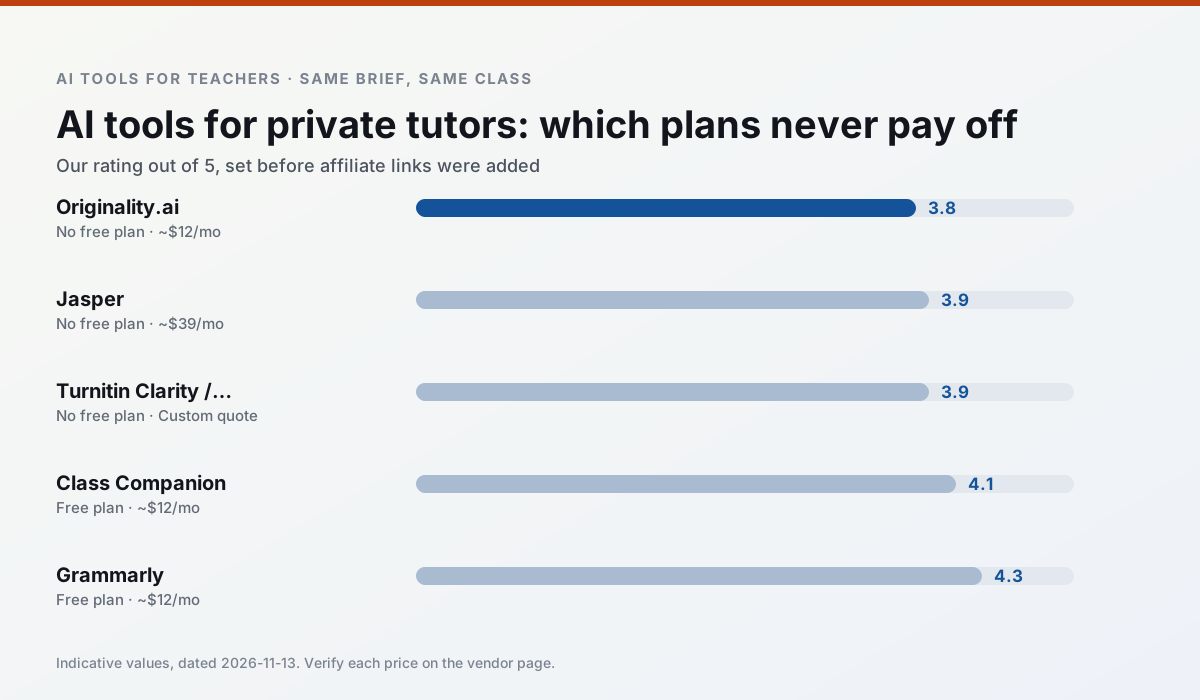
Side by side
Comparison table
Ratings reflect our timed classroom workflow, not vendor claims. Prices are indicative — verify on the vendor site.
| Tool | Best for | Free tier | Indicative paid plan | Standout feature | Our rating | Verdict | Try the tool |
|---|---|---|---|---|---|---|---|
| Originality.ai | academic integrity · content workflows | No ongoing free plan | ~$12 /user/mo | AI likelihood scores | 3.8 / 5 | Situational | Try free |
| Jasper | newsletters · parent communication | No ongoing free plan | ~$39 /user/mo | Brand voice profiles | 3.9 / 5 | Situational | Try free |
| Turnitin Clarity / Feedback Studio | feedback on writing · academic integrity | No ongoing free plan | Custom quote | Similarity reports | 3.9 / 5 | Situational | Try free |
| Class Companion | grading · feedback on writing | Yes — Limited assignments | ~$12 /user/mo | Handwriting recognition | 4.1 / 5 | Situational | Try free |
| Grammarly | parent communication · report card comments | Yes — Core grammar and tone checks | ~$12 /user/mo | Tone adjustments | 4.3 / 5 | Strong option | Try free |
| Notion AI | curriculum mapping · unit planning | Yes — Limited AI usage | ~$10 /user/mo | Linked databases | 4.1 / 5 | Situational | Try free |
Match your situation
Best for X
Different jobs need different tools. Here is what we would open first in each case.
Originality.ai wins on the default path: fewer clicks to a usable draft, and the interface does not get in the way at 7:40am.
If there is no budget, start with Jasper: free plan with clearest quota is the least punishing free tier here.
Turnitin Clarity / Feedback Studio answers the three questions a district actually asks: rostering, admin controls and a data-processing agreement. That is usually what decides a school purchase.
Class Companion has the shortest path from opening a tab to a usable draft, which matters more than the feature count on a Monday.
Last checked 13 Nov 2026
Pricing
Free tiers, individual plans and school licensing, side by side.
| Tool | Free plan | Individual / paid | School & district | Billing note | Verify |
|---|---|---|---|---|---|
| Originality.ai | No ongoing free tier | ~$12 /user/mo | Custom quote | Indicative — verify on vendor site | Vendor |
| Jasper | No ongoing free tier | ~$39 /user/mo | ~$59+ /user/mo | Indicative — verify on vendor site | Vendor |
| Turnitin Clarity / Feedback Studio | No ongoing free tier | Custom quote | Custom quote | LMS-wide deployment | Vendor |
| Class Companion | $0 — Limited assignments | ~$12 /user/mo | Custom quote | Indicative — verify on vendor site | Vendor |
| Grammarly | $0 — Core grammar and tone checks | ~$12 /user/mo | ~$15 /user/mo | Indicative — billed annually | Vendor |
| Notion AI | $0 — Limited AI usage | ~$10 /user/mo | ~$8 /user/mo | Indicative — verify on vendor site | Vendor |
Editorial rule: pricing is re-checked every 2–3 months and the top 50 pages are refreshed every 6 months. See our funding policy.
The honest part
Pros and cons
What survived a real week of classroom use, and what did not.
Pros
- Useful for content publishing QA
- Fast bulk scanning
- Transparent credit model
Cons
- AI detection produces false positives
- Should never be sole evidence of misconduct
- Not a teaching tool
Pros
- Consistent tone across communications
- Strong long-form editor
- Good for district comms teams
Cons
- Priced for marketing teams
- Overkill for one classroom
- No education-specific features
Pros
- Already licensed at many schools
- Consistent institutional workflow
- Detailed revision history
Cons
- Individual teachers cannot buy it
- AI detection remains contested
- Heavy administrative setup
Pros
- Useful where work is done on paper
- Fast, specific comments
- Good math support
Cons
- Scan quality affects accuracy
- Narrow use case
- Feedback still needs teacher review
Pros
- Catches errors in high-stakes parent emails
- Works everywhere you already write
- Very low learning curve
Cons
- Not education-specific
- Can flatten teacher voice
- Premium needed for tone rewriting
In the classroom
Use cases
Five concrete workflows, with the tool we would open for each one.
A Monday morning lesson plan in twelve minutes
The twelve minutes come from not rewriting the skeleton. Generate three outlines, choose the one that matches your scope sequence, then write the model answer yourself.
Recommended: Originality.aiThree reading levels from one source text
Paste a vetted text, ask for supported, core and extension versions, then check the vocabulary list by hand. Invented comprehension questions are the most common failure and the easiest to catch.
Recommended: JasperRubric and feedback comments in one pass
Reorder the workflow so the rubric is yours and the comments are generated. Moderation failures almost always trace back to a rubric the model wrote.
Recommended: Turnitin Clarity / Feedback StudioA parent email in two languages
Draft in plain, warm language with no names, translate, then back-translate the important sentences to check meaning. Keep specific incidents out of the prompt and add them yourself.
Recommended: Class CompanionA five-minute exit ticket set
Ask for one recall, one application and one reasoning item, then delete the second recall question every generator sneaks in.
Recommended: Grammarly
Questions teachers ask us
FAQ
Direct answers, also published as FAQPage structured data for search and AI assistants.
Is AI allowed for lesson planning in my school?
Who is responsible if something goes wrong?
What should never go into a prompt?
Sources & further reading
Our recommendation
Try Originality.ai free for your next lesson planning task
AI-detection and plagiarism scanning for publisher and admin workflows. Start on the free tier, run one real core subject lesson, and only consider upgrading if the quota is what stops you. Disclosure: we may earn a commission (25% recurring) at no extra cost to you.
Some links on this page are affiliate links. We may earn a commission at no extra cost to you. Our rankings are editorial and never pay-to-play. Never enter student PII into a free consumer account.
Keep reading
Related comparisons in this cluster.
Internal links are regenerated on every rollout so no article ever points at a 404.