The short answer
- Quizizz is our default pick for teachers who need to draft a standards-aware lesson plan quickly; Brisk Teaching is better when differentiation is the bottleneck.
- Free-tier reality for this shortlist: Quizizz: Yes — Core quiz creation; Brisk Teaching: Yes — Limited actions per month; SchoolAI: Yes — Limited seats. Treat every paid figure as indicative until you have read the vendor page; only the free quota is something you can test yourself this week.
- Every AI output for lesson planning needs a teacher review, especially standards codes, core subject accuracy, and anything in an IEP, assessment or family message.
- Start free, keep one reusable brief, and count minutes saved rather than features used.
Start with MagicSchool AI on its free plan.
By October, my reading intervention para, Marcus, was spending his planning period drowning in leveled passages, modified rubrics, and vocabulary lists. He did not have a district teacher account with administrative privileges, and our IT department guards login credentials like state secrets. He needed to build support materials independently, without waiting for me to provision a seat or clear a ticket. If you are looking at AI tools a paraprofessional can use without a teacher account, you already know that waiting weeks for district software approval breaks instructional momentum. Here is what actually works on the ground when support staff need to generate materials on their own terms.
Why Paraprofessionals Hit Accounts Roadblocks
District software provisioning is notoriously slow. Most enterprise classroom tools require a verified educator domain, a roster upload, or admin consent that leaves support staff stranded. Paraprofessionals often need quick-turnaround supports: a vocabulary match for a struggling reader, a modified exit ticket for a co-taught period, or a structured translation of a home-school note. Consumer-facing models and specific web utilities let paras bypass these administrative bottlenecks safely. The trick is knowing which platforms accept personal or general logins without requiring a formal classroom roster. When exploring the broader landscape of AI tools for teachers 2026, account tiers dictate who can actually touch the software without breaking district compliance rules.
Using General Assistants for Scaffolded Texts
When Marcus needs to turn a dense biology article into a three-way tiered reading passage, he relies on general-purpose consumer tools. ChatGPT (priced at roughly $20 /user/mo for paid tiers with a free limited option) and Claude (around $20 /user/mo with usage limits on the free tier) require zero district onboarding. They accept raw text pastes from any public domain source, meaning a para can generate a modified text variant in under a minute. The key rule here is scrubbing all student identifiers before pasting anything into a general consumer window.
Prompt: Act as a reading specialist. Rewrite this three-paragraph text about photosynthesis into a Lexile-appropriate 600L version for a fifth-grade student with a visual tracking accommodation, keeping key vocabulary bolded.
What came back: A cleanly rewritten passage with bolded terms, but the sentence structures remained somewhat convoluted and the paragraphs were too dense for a single page.
Two edits that made it usable:
- Added a strict constraint: "Limit every sentence to twelve words maximum and use bullet points for the process steps."
- Manually verified that the bolded vocabulary matched our district's mandatory science word wall rather than the AI's preferred synonyms.
Browser-Level Extensions for Quick Edits
Brisk Teaching operates as a browser extension (priced at approximately $10 /user/mo with a limited free tier) that brings AI assistance directly into Google Docs and Slides. Because it runs inside the browser layer rather than requiring a dedicated district portal, support staff can often use it on shared classroom Chromebooks without a heavy IT deployment. Marcus uses Brisk to generate parent emails in two languages and to draft quick feedback comments on student drafts.
Prompt: Draft a warm, plain-language email to a family explaining that their child is improving in small-group decoding, keeping the tone encouraging and avoiding all educational jargon.
What came back: A polite email template that still sounded a bit clinical and included placeholder tags that were easy to miss.
Two edits that made it usable:
- Instructed the model to "write at an eighth-grade reading level, remove all bracketed placeholder text, and leave blank spaces for specific dates."
- Ran the English draft through a translation utility, then back-translated the core sentences to verify the meaning remained intact before sending it home.
Gamified Assessment and Practice Banks
For low-stakes retrieval practice, Quizizz offers core quiz creation on its free tier, with paid plans running around $15 /user/mo. Students already know the interface, and paras can spin up a quick vocabulary check in minutes. The platform is best for student-safe deployments because the gamification keeps kids engaged on low-end devices without exposing them to open-ended chat interfaces. The catch is that writing high-quality AI questions still demands a careful human review, as numerical distractor items occasionally include mathematically impossible options. For more specialized intervention work, check out our guide on AI accommodations for paraprofessionals to see how targeted practice feeds into daily logs.
Safeguarded Workspaces and Tutoring Tools
When districts provide managed access, SchoolAI (priced around $15 /user/mo) and Khanmigo (around $4 /learner/mo) offer structured environments. SchoolAI is designed for district approval and mixed-ability classes, giving staff visibility into student interactions without letting kids wander into unrestricted web chats. Khanmigo relies on its education-first design and strong nonprofit trust signal to scaffold math problems step-by-step. While both usually require school-level setup, they represent the gold standard when a para needs to run a supervised small-group rotation where the AI acts as an interactive tutor rather than just a text generator.
Maintaining Privacy Without an Enterprise Seat
The golden rule for any paraprofessional using unvetted or consumer AI tools is absolute anonymity. Never paste a student's full name, IEP goals, disciplinary record, or medical diagnosis into a consumer chat window like ChatGPT or Claude. When Marcus drafts an IEP present-levels first draft, he uses aggregated, anonymized data only. He asks the system for observable, measurable statements, and then he replaces every generated number with his own physical clipboard data before handing the notes to a case manager. Keeping student data off consumer servers is non-negotiable, regardless of how convenient the workflow might seem during a hectic fourth-period support block.
FAQ
Is AI allowed for lesson planning in my school?
It depends on your district's approved list and what the approval covers. Ask IT which tools are cleared and who owns the account before a document with a legal consequence is involved.
Who is responsible if something goes wrong?
The school, and in practice the named teacher who reviewed the output. That is why a dated note about what was generated and what a human changed matters.
What should never go into a prompt?
Names, rosters, scans of student work and gradebook screenshots. Topic-level prompts do most of the work without any of that.
Sources
- Quizizz pricing and feature tiers: Quizizz Plans & Pricing
- Brisk Teaching browser extension capabilities: Brisk Teaching Overview
- SchoolAI safety and deployment framework: SchoolAI Safety Center
- Khanmigo educational design and nonprofit model: Khan Academy AI Tools
- Anthropic Claude usage models: Anthropic Pricing
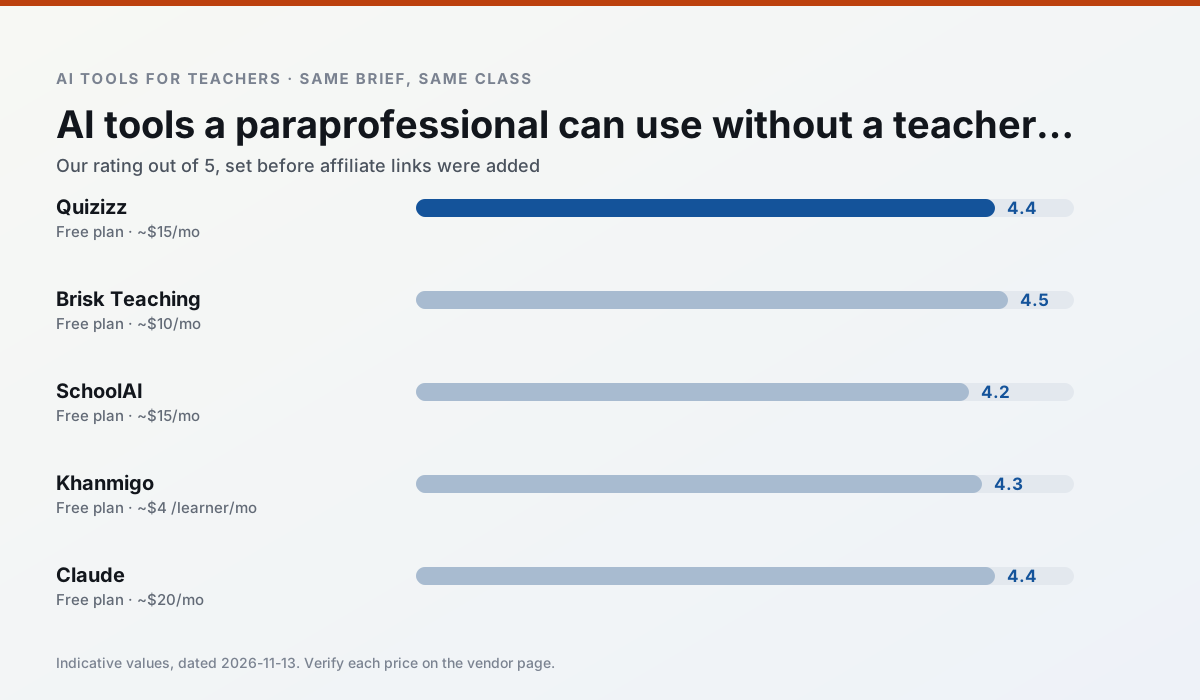
Side by side
Comparison table
Ratings reflect our timed classroom workflow, not vendor claims. Prices are indicative — verify on the vendor site.
| Tool | Best for | Free tier | Indicative paid plan | Standout feature | Our rating | Verdict | Try the tool |
|---|---|---|---|---|---|---|---|
| Quizizz | quiz generation · formative assessment | Yes — Core quiz creation | ~$15 /user/mo | AI question generator | 4.4 / 5 | Strong option | Try free |
| Brisk Teaching | feedback on writing · grading | Yes — Limited actions per month | ~$10 /user/mo | Works inside Google Docs | 4.5 / 5 | Top pick | Try free |
| SchoolAI | student-safe AI · differentiated instruction | Yes — Limited seats | ~$15 /user/mo | Teacher-monitored student chats | 4.2 / 5 | Strong option | Try free |
| Khanmigo | math practice · student tutoring | Yes — US teacher accounts, subject to eligibility | ~$4 /learner/mo | Socratic tutoring rather than answers | 4.3 / 5 | Strong option | Try free |
| Claude | rubric creation · feedback on writing | Yes — Usage-limited | ~$20 /user/mo | Very large context window | 4.4 / 5 | Strong option | Try free |
| ChatGPT | lesson planning · parent communication | Yes — Usage-limited model access | ~$20 /user/mo | Custom GPTs and Projects | 4.5 / 5 | Top pick | Try free |
Match your situation
Best for X
Different jobs need different tools. Here is what we would open first in each case.
Quizizz is the student-facing option here with boundaries a teacher can actually set and supervise.
Brisk Teaching is the steadiest of this set at plain, respectful language; names and specific incidents still belong in your draft, not the prompt.
SchoolAI keeps the same task across levels, which is what makes a differentiated set defensible in moderation.
Setup cost is one login for Khanmigo; everything else can wait until you know the tool is useful.
Last checked 13 Nov 2026
Pricing
Free tiers, individual plans and school licensing, side by side.
| Tool | Free plan | Individual / paid | School & district | Billing note | Verify |
|---|---|---|---|---|---|
| Quizizz | $0 — Core quiz creation | ~$15 /user/mo | Custom quote | Indicative — verify on vendor site | Vendor |
| Brisk Teaching | $0 — Limited actions per month | ~$10 /user/mo | Custom quote | Indicative — verify on vendor site | Vendor |
| SchoolAI | $0 — Limited seats | ~$15 /user/mo | Custom quote | Indicative — verify on vendor site | Vendor |
| Khanmigo | $0 — US teacher accounts, subject to eligibility | ~$4 /learner/mo | Custom quote | Indicative — verify on vendor site | Vendor |
| Claude | $0 — Usage-limited | ~$20 /user/mo | ~$25+ /user/mo | Indicative — verify on vendor site | Vendor |
| ChatGPT | $0 — Usage-limited model access | ~$20 /user/mo | ~$25+ /user/mo | Indicative — verify on vendor site | Vendor |
Editorial rule: pricing is re-checked every 2–3 months and the top 50 pages are refreshed every 6 months. See our funding policy.
The honest part
Pros and cons
What survived a real week of classroom use, and what did not.
Pros
- Students already know the interface
- Good reporting
- Works on low-end devices
Cons
- Writing high-quality AI questions still needs review
- Gamification can distract
- Advanced analytics are paid
Pros
- No copy-paste between tools
- Fast inline feedback on student drafts
- Gentle learning curve
Cons
- Chrome-first workflow
- Extension permissions need IT approval
- Free quota is tight
Pros
- Designed for district approval
- Teacher visibility into student use
- Good safeguarding defaults
Cons
- Requires school-wide buy-in
- Less flexible than general LLMs
- Pricing is mostly quote-based
Pros
- Education-first design
- Strong nonprofit trust signal
- Good math scaffolding
Cons
- Availability varies by region
- Less useful for admin paperwork
- Requires student accounts for full value
Pros
- Handles full unit plans and long rubrics
- Nuanced, less generic prose
- Good at structured document output
Cons
- No teacher-specific templates
- Fewer classroom integrations
- Consumer plan not suitable for student data
In the classroom
Use cases
Five concrete workflows, with the tool we would open for each one.
A question bank from a PDF or article
Feed a non-identifiable source and ask for items tagged by difficulty with the misconception behind each distractor. Spot-check every answer key; numerical items are least reliable.
Recommended: QuizizzA substitute folder that needs no context
The value here is structure, not creativity. Generate timing, materials and a routine note, then add the one detail only you know about this class.
Recommended: Brisk TeachingAn IEP present-levels first draft
Use aggregated, anonymised data only. Ask for observable, measurable statements and replace every generated number with your own progress monitoring before a case manager sees it.
Recommended: SchoolAIA five-minute exit ticket set
Ask for one recall, one application and one reasoning item, then delete the second recall question every generator sneaks in.
Recommended: KhanmigoA parent email in two languages
Draft in plain, warm language with no names, translate, then back-translate the important sentences to check meaning. Keep specific incidents out of the prompt and add them yourself.
Recommended: Claude
Questions teachers ask us
FAQ
Direct answers, also published as FAQPage structured data for search and AI assistants.
Is AI allowed for lesson planning in my school?
Who is responsible if something goes wrong?
What should never go into a prompt?
Sources & further reading
Our recommendation
Try MagicSchool AI free for your next lesson planning task
A large library of teacher-specific AI generators in one dashboard. Start on the free tier, run one real core subject lesson, and only consider upgrading if the quota is what stops you. Disclosure: we may earn a commission (30% recurring) at no extra cost to you.
Some links on this page are affiliate links. We may earn a commission at no extra cost to you. Our rankings are editorial and never pay-to-play. Never enter student PII into a free consumer account.
Keep reading
Related comparisons in this cluster.
Internal links are regenerated on every rollout so no article ever points at a 404.