The short answer
- Eduaide.Ai is our default pick for Middle school who need to write criterion-referenced rubrics quickly; Claude is better when differentiation is the bottleneck.
- Start with Eduaide.Ai on its free plan, keep Claude as the second opinion, and do not open a card until the quota, not the feature list, is what stops you.
- Every AI output for rubric creation needs a teacher review, especially standards codes, core subject accuracy, and anything in an IEP, assessment or family message.
- Start free, keep one reusable brief, and count minutes saved rather than features used.
Start with Jasper on its free plan.
It is 9:43 on a Tuesday night. I am staring at thirty-four seventh-grade argumentative paragraphs about whether cell phones should be banned during lunch. The kids poured their souls into writing them, but my grading rubric is a disaster. I wrote it in three minutes during third-period prep: "Four points for good arguments, three points for okay arguments, two points if you tried." That is not a rubric. That is a mood ring.
Building better assessment grids from scratch used to take an entire Sunday afternoon. Now, we have options for AI rubric creation for middle school that can draft a four-point scale in thirty seconds. The trick is knowing which platform handles the nuances of early adolescent writing without making every single description sound like a motivational poster. We need tools that build real criteria, not fluff.
Why Generic Rubrics Fail Middle School Writers
Middle schoolers live in the grey area between elementary reading checks and high school essays. A generic AI prompt spits out descriptors like "demonstrates exceptional mastery" or "fails to grasp the core concept." Those phrases mean nothing to a twelve-year-old trying to fix a run-on sentence. They need to know what a strong claim looks like versus a weak one. If you want to dive deeper into how technology is shifting our workflows, our guide on the best AI tools for teachers covers the broader landscape of planning software.
When we use AI for rubric creation, we have to push past the surface-level output. A good rubric needs to target specific cognitive shifts, like moving from a list of facts to a synthesized argument. Most standard writing assistants will give you a generic grid unless you feed them exact anchor texts or state standards. That is why choosing the right tool matters for your planning time.
Eduaide.Ai for Everyday Classroom Assessments
Eduaide.Ai is my go-to recommendation for student-safe deployments because its workflow fits right into standard lesson prep. It sits at around $10 per user per month with a free tier capped by daily generations. The interface is clean, uncluttered, and specifically built for teachers rather than corporate marketers. When you open the resource generator to build a rubric, you can dial in grade levels and specific curriculum tags without wading through menus designed for copywriters.
The catch is that its template set is smaller than some giant ecosystem tools, and export options can feel a bit bare-bones. You will not find dozens of fancy graphic design layouts here. What you get instead is functional, fast rubric creation that respects student privacy better than consumer-grade chatbots, though you should always confirm data retention settings before feeding in any identifiable student work.
Prompt: Create a 4-point rubric for a 7th-grade historical fiction narrative, assessing dialogue, sensory details, and historical plausibility, using Common Core standards W.7.3.
First Response: A standard grid with levels 1 through 4, using terms like "proficient" and "emerging," with vague descriptors about story flow and historical facts.
Two Edits:
- Added a constraint: "Replace all instances of 'proficient' with concrete behavioral actions, such as 'includes at least two lines of dialogue that reveal character tension.'"
- Added a distinct weight for historical plausibility so it did not get swallowed by the creative writing score.
Claude for Detailed, Nuanced Criteria
When I need a rubric that handles complex project-based learning or multi-step science investigations, I open Claude. At around $20 per user per month with a usage-limited free tier, it functions as a long-context assistant that excels at document-heavy planning. It does not have teacher-specific templates, but its prose is less generic than anything else on the market. It reads like an instructional coach wrote it.
Claude's real superpower is handling long rubrics that cross multiple domains, such as a STEM project assessing both coding logic and presentation skills. It captures subtle gradations in student performance without repeating the same phrases in every box. However, the consumer plan is not suitable for student data, so you must use an approved workspace tier if your district requires strict compliance. For related administrative tasks, check out our guide on AI classroom newsletters for administrators.
Two things went wrong last term when I relied too heavily on Claude for a science inquiry rubric. First, it generated criteria that assumed my students had access to advanced laboratory glassware we simply do not stock. Second, it made the point allocations uneven across categories, which would have broken my gradebook software when I tried to sync scores. I fixed both by explicitly stating our material constraints in the prompt and asking the model to balance all categories to a neat twenty-point total.
Gradescope for Mixed-Ability Classes and Grading
Gradescope takes a different approach by focusing on AI-assisted rubric grading for scanned and handwritten assessments. It uses custom pricing, and while it is definitely overkill for elementary classrooms, it shines in middle school humanities and science where grading piles threaten your weekends. You upload a batch of student papers, and the system groups similar answers together so you can apply rubric deductions across twenty papers at once.
The setup effort is real, and the institutional pricing can be opaque. You cannot just log in and drop a PDF in five minutes; scanning papers and mapping regions takes upfront time. Furthermore, because it handles actual student work, a full DPA and FERPA review is required by your district tech department before you scan a single page. When configured correctly, though, it keeps rubric application dead consistent from paper one to paper one hundred and forty.
Exploring Jasper, Originality, and Writesonic
Not every tool on the market belongs in your lesson planning folder. Jasper runs around $39 per user per month with no free tier. It is built as a brand-voice writing assistant for school communications teams and district PR departments. It is fantastic if you are writing a bond measure pitch, but it has no education-specific features and is wildly expensive for an individual classroom teacher.
Originality.ai costs around $12 per user per month and focuses on AI detection and plagiarism scanning for publisher workflows. While it has a transparent credit model, its AI detection features produce false positives and should never be used as the sole evidence of student academic misconduct. It is a QA tool for content publishing, not a teaching tool.
Writesonic sits around $16 per user per month with limited free credits. It offers plenty of writing templates, but its classroom output tends to lean generic, and the credit system can get confusing when you are trying to generate worksheets on a tight schedule. None of these three alternatives should replace Eduaide or Claude when you are sitting down to build a legitimate middle school assessment tool.
FAQ
Can AI do rubric creation at mixed-grade level?
It can produce a first draft and a structure. The level judgement, the standards check and the tone are teacher decisions.
Which tool is best for rubric creation?
Eduaide.Ai on the evidence in this article, with Claude as the second opinion. Neither replaces the review step.
What is the biggest risk?
A confident, plausible output that nobody checked. The five checks below exist for that reason.
Sources
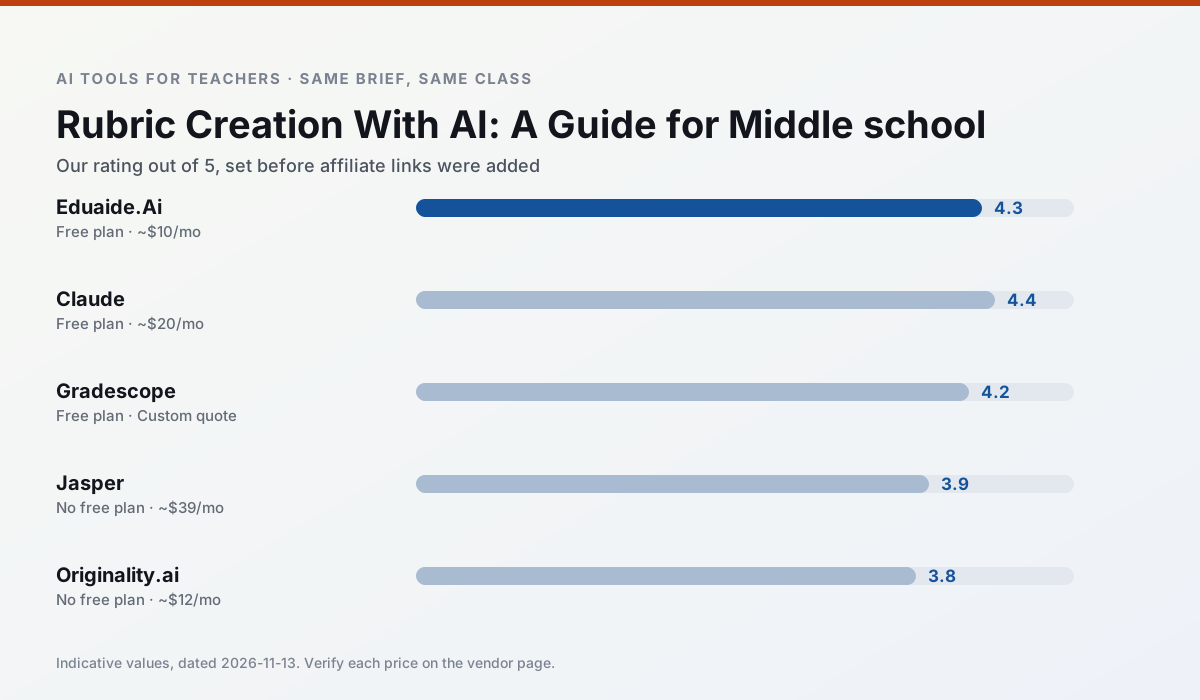
Side by side
Comparison table
Ratings reflect our timed classroom workflow, not vendor claims. Prices are indicative — verify on the vendor site.
| Tool | Best for | Free tier | Indicative paid plan | Standout feature | Our rating | Verdict | Try the tool |
|---|---|---|---|---|---|---|---|
| Eduaide.Ai | lesson planning · rubric creation | Yes — Daily generation cap | ~$10 /user/mo | Resource library | 4.3 / 5 | Strong option | Try free |
| Claude | rubric creation · feedback on writing | Yes — Usage-limited | ~$20 /user/mo | Very large context window | 4.4 / 5 | Strong option | Try free |
| Gradescope | grading · rubric creation | Yes — Limited courses | Custom quote | Bubble sheet and handwriting capture | 4.2 / 5 | Strong option | Try free |
| Jasper | newsletters · parent communication | No ongoing free plan | ~$39 /user/mo | Brand voice profiles | 3.9 / 5 | Situational | Try free |
| Originality.ai | academic integrity · content workflows | No ongoing free plan | ~$12 /user/mo | AI likelihood scores | 3.8 / 5 | Situational | Try free |
| Writesonic | newsletters · parent communication | Yes — Limited credits | ~$16 /user/mo | Article and email generators | 3.8 / 5 | Situational | Try free |
Match your situation
Best for X
Different jobs need different tools. Here is what we would open first in each case.
For anything students touch directly, Eduaide.Ai offers the supervision controls and logging that IT will ask about first.
Claude is the steadiest of this set at plain, respectful language; names and specific incidents still belong in your draft, not the prompt.
For three reading groups and one text, Gradescope needs the least manual relabelling of vocabulary and questions.
Jasper runs in a browser tab with no extension, no student accounts and no onboarding call, so you can test it in a free period.
Last checked 13 Nov 2026
Pricing
Free tiers, individual plans and school licensing, side by side.
| Tool | Free plan | Individual / paid | School & district | Billing note | Verify |
|---|---|---|---|---|---|
| Eduaide.Ai | $0 — Daily generation cap | ~$10 /user/mo | Custom quote | Indicative — verify on vendor site | Vendor |
| Claude | $0 — Usage-limited | ~$20 /user/mo | ~$25+ /user/mo | Indicative — verify on vendor site | Vendor |
| Gradescope | $0 — Limited courses | Custom quote | Custom quote | LMS integration and support | Vendor |
| Jasper | No ongoing free tier | ~$39 /user/mo | ~$59+ /user/mo | Indicative — verify on vendor site | Vendor |
| Originality.ai | No ongoing free tier | ~$12 /user/mo | Custom quote | Indicative — verify on vendor site | Vendor |
| Writesonic | $0 — Limited credits | ~$16 /user/mo | ~$49 /user/mo | Indicative — verify on vendor site | Vendor |
Editorial rule: pricing is re-checked every 2–3 months and the top 50 pages are refreshed every 6 months. See our funding policy.
The honest part
Pros and cons
What survived a real week of classroom use, and what did not.
Pros
- Very low entry price
- Good worksheet and rubric output
- Clean, uncluttered UI
Cons
- Smaller template set than MagicSchool
- Less polished export options
- Limited integrations
Pros
- Handles full unit plans and long rubrics
- Nuanced, less generic prose
- Good at structured document output
Cons
- No teacher-specific templates
- Fewer classroom integrations
- Consumer plan not suitable for student data
Pros
- Large time savings on paper assessments
- Consistent rubric application
- Detailed item analytics
Cons
- Overkill for elementary classrooms
- Institutional pricing is opaque
- Setup effort is real
Pros
- Consistent tone across communications
- Strong long-form editor
- Good for district comms teams
Cons
- Priced for marketing teams
- Overkill for one classroom
- No education-specific features
Pros
- Useful for content publishing QA
- Fast bulk scanning
- Transparent credit model
Cons
- AI detection produces false positives
- Should never be sole evidence of misconduct
- Not a teaching tool
In the classroom
Use cases
Five concrete workflows, with the tool we would open for each one.
Regrouping students after an assessment
Summarise anonymised results into skill groups, then generate one activity per group. Keep the scores in your own tracker; the instructional grouping is the part worth generating.
Recommended: Eduaide.AiA weekly family newsletter from bullet notes
Newsletters fail on length, not tone. Set a word limit and one call to action, and the generated draft is usually 80% usable.
Recommended: ClaudeA question bank from a PDF or article
Feed a non-identifiable source and ask for items tagged by difficulty with the misconception behind each distractor. Spot-check every answer key; numerical items are least reliable.
Recommended: GradescopeA substitute folder that needs no context
The value here is structure, not creativity. Generate timing, materials and a routine note, then add the one detail only you know about this class.
Recommended: JasperAn IEP present-levels first draft
Use aggregated, anonymised data only. Ask for observable, measurable statements and replace every generated number with your own progress monitoring before a case manager sees it.
Recommended: Originality.ai
Questions teachers ask us
FAQ
Direct answers, also published as FAQPage structured data for search and AI assistants.
Can AI do rubric creation at mixed-grade level?
Which tool is best for rubric creation?
What is the biggest risk?
Sources & further reading
Our recommendation
Try Jasper free for your next rubric creation task
Brand-voice writing assistant for school communications teams. Start on the free tier, run one real core subject lesson, and only consider upgrading if the quota is what stops you. Disclosure: we may earn a commission (varies) at no extra cost to you.
Some links on this page are affiliate links. We may earn a commission at no extra cost to you. Our rankings are editorial and never pay-to-play. Never enter student PII into a free consumer account.
Keep reading
Related comparisons in this cluster.
Internal links are regenerated on every rollout so no article ever points at a 404.