The short answer
- Notion AI is our default pick for teachers who need to sequence a three-week unit quickly; Originality.ai is better when differentiation is the bottleneck.
- Notion AI handles the broad case; Originality.ai handles the narrow one. Anything beyond that pair should be justified by a recurring weekly job, not a feature demo.
- Every AI output for unit planning needs a teacher review, especially standards codes, core subject accuracy, and anything in an IEP, assessment or family message.
- Trial one tool for a week of real unit planning work before any purchase conversation; the quota is the honest test.
Start with Notion AI on its free plan.
At 8:15 on a Tuesday morning, I was staring at a blank pacing guide while three eighth graders argued over who borrowed the glue sticks. My curriculum map for the next four weeks of civil rights literature was half-finished, my standards alignment was a messy post-it note, and I had forty-eight unread parent emails waiting in my inbox. Middle school unit planning is a grind of balancing three distinct reading levels, state standards, and the reality that my students will revolt if a text does not connect to their lives. That is why teachers started turning to AI unit planning for 6-8, looking for anything to trim the midnight prep hours.
The problem is that the market is full of software designed for corporate marketing departments or university admissions officers. Most tools advertised for education are either generic wrappers that spit out unteachable nonsense or heavy enterprise suites meant for district boards of education. If you teach middle school, you need tools that handle messy human logistics without creating more administrative work. We spent the last term testing what actually holds up under classroom conditions, and the results are not what the ed-tech brochures promise.
The Reality of Long-Term Curriculum Mapping
When you sit down to map a four-week unit on argument writing, you need a workspace that stays organized when your plans inevitably shift because the fire alarm drill ate second period. Notion AI has become our top pick for student-safe deployments because it combines relational databases with flexible note-taking. At about $10 per user per month with a limited free tier, it acts as a digital binder that actually talks back. You can link your state standards database directly to your daily lesson notes, which saves endless scrolling.
The setup time is significant, which is the main catch. You cannot just open it and expect a finished curriculum; you have to build your tables and prompt templates first. It is also not purpose-built for lesson generation, meaning you supply the pedagogical framework while the software handles the structural organization. Remember never to store student personally identifiable information in personal workspaces if you are using a district-adjacent account. For a broader look at how these tools fit into daily routines, see our guide on the best AI tools for teachers 2026.
Managing Mixed-Ability Reading Groups
Middle school classrooms are notoriously splintered. In a single seventh-grade English class, I have readers working at a fourth-grade level sitting right next to high school independents. Generating three versions of a source text used to take my entire Sunday afternoon. Now, we use AI to level texts and generate parallel question sets, but it requires strict supervision.
Prompt: "Take this 800-word article on local government budgeting and rewrite it at a Lexile level appropriate for a struggling sixth grader. Keep the core vocabulary words (ordinance, revenue, expenditure) but define them in parentheses. Generate three comprehension questions that map to the exact same anchor standards as the original text."
First Result: The model produced a leveled text, but substituted words like 'ordinance' with 'rules,' stripping away the civic vocabulary the standard explicitly required. The questions drifted away from standard RL.6.1.
Two Edits That Made It Usable:
- Added a negative constraint to the prompt: "Do not remove Tier 3 vocabulary; retain them and add context clues."
- Hardcoded the question stems into the prompt so the structural alignment remained identical across all three reading tiers.
Automatic leveling is always an estimate. Always read the supported version aloud to a colleague before it reaches a reading group to ensure the syntax does not sound like a jittery robot wrote it. For more specific differentiation workflows, check out ai accommodations for middle school classrooms.
Polishing Parent-Facing Writing and Communications
Weekly newsletters and sensitive parent emails require a tone that is warm, authoritative, and entirely free of corporate jargon. Jasper is priced around $39 per user per month with no free tier, making it heavily optimized for brand-voice marketing teams. It is massive overkill for a single classroom, and it features no education-specific guardrails. We found that Grammarly, costing about $12 per user per month with a robust free tier for basic grammar, fits classroom communication much better because it lives right inside your email client and browser.
Prompt: "Convert these raw bullet points about our upcoming field trip into a warm Friday update for parents:
- Permission slips due Thursday
- Sack lunch required
- Chaperones arrive at 8 AM"
First Result: The output read like a luxury travel brochure, complete with exclamation points and phrases about curated learning journeys that made my skin crawl.
Two Edits That Made It Usable:
- Set the custom tone constraint to "direct, friendly, and plainspoken middle school teacher."
- Stripped out all adjectives that did not relate directly to safety or logistics.
Grammarly catches errors in high-stakes parent emails before they leave your outbox, but watch out for its tone-flattening tendencies. Always disable text collection on school devices and check your district data privacy agreement before installing browser extensions.
Handling Paper Workflows and Assessment Data
Middle schoolers still do a mountain of work on paper, which makes digital feedback tools tricky. Class Companion runs about $12 per user per month with limited free assignments, offering AI feedback on handwritten and scanned student work. It is remarkably useful if your students write math proofs or short reading responses on physical sheets. The scan quality heavily affects accuracy, however, and the use case is narrow. Feedback still needs a thorough teacher review before you hand papers back.
When you finish an assessment and need to regroup students, you can feed de-identified spreadsheet exports into an assistant to find learning gaps. Treat the grouping as a strict hypothesis. The second look at any student cluster should always be a teacher's, not a model's.
Similarly, when you are building a question bank from an article, look closely at the distractor rationale.
Prompt: "Generate four multiple-choice questions for this article on ecosystems, each with four options. For every incorrect option, explicitly name the specific middle school misconception it tests."
First Result: The model generated plausible-looking distractors, but two of them were just random factual errors rather than logical student misconceptions.
Two Edits That Made It Usable:
- Instructed the tool to reference common science misconceptions from standard diagnostic lists.
- Deleted any distractor that failed to name a distinct conceptual error.
If the generator cannot name the exact misconception an option tests, delete that option immediately.
Assessment Integrity and Institutional Tools
District administrators often rely on Originality.ai, priced at about $12 per user per month with no free tier, for content publishing QA and plagiarism scanning. It features fast bulk scanning and a transparent credit model, but its AI detection produces false positives. It should never serve as the sole evidence of student misconduct. Never use detector scores to make a disciplinary decision on their own.
Turnitin Clarity and Feedback Studio offer institutional writing feedback and similarity checks at a custom quote price point. While it is already licensed at many secondary schools, individual teachers cannot buy it, and the administrative setup is heavy. AI detection here remains heavily contested, though its revision history tracking is genuinely useful for seeing how a student built an essay over three weeks.
When you need a substitute folder that requires zero context, skip the generic templates. Tell the model explicitly: "No prior context, no devices, 40 minutes, printable." Everything else about substitute plans follows naturally from those four strict constraints. AI unit planning for 6-8 is not about handing over your professional judgment. It is about clearing away the mechanical friction so you can actually teach the kids in front of you.
FAQ
Can AI do unit planning at 6-8 level?
It can produce a first draft and a structure. The level judgement, the standards check and the tone are teacher decisions.
Which tool is best for unit planning?
Notion AI on the evidence in this article, with Originality.ai as the second opinion. Neither replaces the review step.
What is the biggest risk?
A confident, plausible output that nobody checked. The five checks below exist for that reason.
Sources
- Notion AI Pricing and Feature Overview. Notion.so.
- Originality.ai Product Documentation and Detection Limits. Originality.ai.
- Jasper Pricing and Brand Voice Features. Jasper.ai.
- Grammarly Education and Privacy Standards. Grammarly.com.
- Turnitin Feedback Studio and Institutional Deployment Guides. Turnitin.com.
- Class Companion Features and Workflow Documentation. ClassCompanion.com.
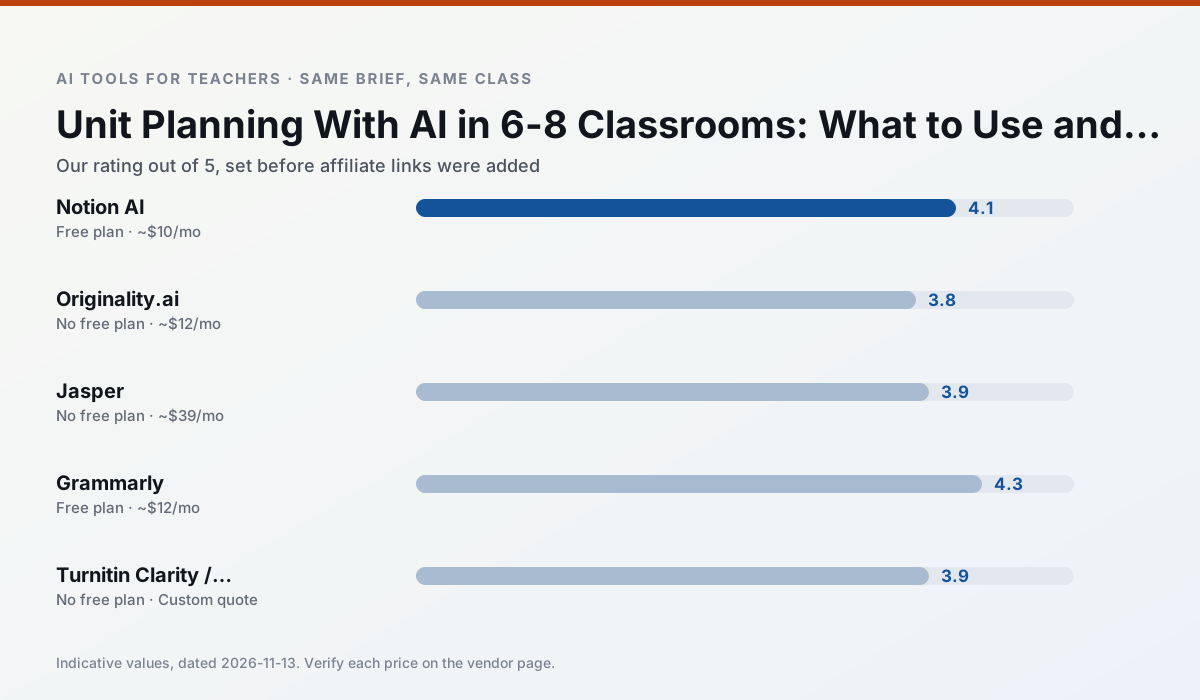
Side by side
Comparison table
Ratings reflect our timed classroom workflow, not vendor claims. Prices are indicative — verify on the vendor site.
| Tool | Best for | Free tier | Indicative paid plan | Standout feature | Our rating | Verdict | Try the tool |
|---|---|---|---|---|---|---|---|
| Notion AI | curriculum mapping · unit planning | Yes — Limited AI usage | ~$10 /user/mo | Linked databases | 4.1 / 5 | Situational | Try free |
| Originality.ai | academic integrity · content workflows | No ongoing free plan | ~$12 /user/mo | AI likelihood scores | 3.8 / 5 | Situational | Try free |
| Jasper | newsletters · parent communication | No ongoing free plan | ~$39 /user/mo | Brand voice profiles | 3.9 / 5 | Situational | Try free |
| Grammarly | parent communication · report card comments | Yes — Core grammar and tone checks | ~$12 /user/mo | Tone adjustments | 4.3 / 5 | Strong option | Try free |
| Turnitin Clarity / Feedback Studio | feedback on writing · academic integrity | No ongoing free plan | Custom quote | Similarity reports | 3.9 / 5 | Situational | Try free |
| Class Companion | grading · feedback on writing | Yes — Limited assignments | ~$12 /user/mo | Handwriting recognition | 4.1 / 5 | Situational | Try free |
Match your situation
Best for X
Different jobs need different tools. Here is what we would open first in each case.
Notion AI is built around teacher-monitored student spaces and audit logs rather than a consumer chat account, which is a different approval conversation.
Originality.ai keeps the same task across levels, which is what makes a differentiated set defensible in moderation.
Jasper has the strongest tone control for family emails and report comments, provided you still read the message aloud before sending.
Grammarly answers the three questions a district actually asks: rostering, admin controls and a data-processing agreement. That is usually what decides a school purchase.
Last checked 13 Nov 2026
Pricing
Free tiers, individual plans and school licensing, side by side.
| Tool | Free plan | Individual / paid | School & district | Billing note | Verify |
|---|---|---|---|---|---|
| Notion AI | $0 — Limited AI usage | ~$10 /user/mo | ~$8 /user/mo | Indicative — verify on vendor site | Vendor |
| Originality.ai | No ongoing free tier | ~$12 /user/mo | Custom quote | Indicative — verify on vendor site | Vendor |
| Jasper | No ongoing free tier | ~$39 /user/mo | ~$59+ /user/mo | Indicative — verify on vendor site | Vendor |
| Grammarly | $0 — Core grammar and tone checks | ~$12 /user/mo | ~$15 /user/mo | Indicative — billed annually | Vendor |
| Turnitin Clarity / Feedback Studio | No ongoing free tier | Custom quote | Custom quote | LMS-wide deployment | Vendor |
| Class Companion | $0 — Limited assignments | ~$12 /user/mo | Custom quote | Indicative — verify on vendor site | Vendor |
Editorial rule: pricing is re-checked every 2–3 months and the top 50 pages are refreshed every 6 months. See our funding policy.
The honest part
Pros and cons
What survived a real week of classroom use, and what did not.
Pros
- Great for long-term curriculum records
- Strong team collaboration
- Flexible structure
Cons
- Setup time is significant
- AI add-on pricing changed more than once
- Not purpose-built for lesson generation
Pros
- Useful for content publishing QA
- Fast bulk scanning
- Transparent credit model
Cons
- AI detection produces false positives
- Should never be sole evidence of misconduct
- Not a teaching tool
Pros
- Consistent tone across communications
- Strong long-form editor
- Good for district comms teams
Cons
- Priced for marketing teams
- Overkill for one classroom
- No education-specific features
Pros
- Catches errors in high-stakes parent emails
- Works everywhere you already write
- Very low learning curve
Cons
- Not education-specific
- Can flatten teacher voice
- Premium needed for tone rewriting
Pros
- Already licensed at many schools
- Consistent institutional workflow
- Detailed revision history
Cons
- Individual teachers cannot buy it
- AI detection remains contested
- Heavy administrative setup
In the classroom
Use cases
Five concrete workflows, with the tool we would open for each one.
Three reading levels from one source text
One source, three versions, same three questions in each. Automatic levelling is an estimate; read the supported version aloud to a colleague before it reaches a reading group.
Recommended: Notion AIA weekly family newsletter from bullet notes
Give the tool bullet notes only, never a class list. Ask for a short structure with one action item, then read it aloud once; canned phrasing is obvious when spoken.
Recommended: Originality.aiRegrouping students after an assessment
Use exported, de-identified data and treat the grouping as a hypothesis. The second look should be a teacher's, not a model's.
Recommended: JasperA substitute folder that needs no context
Say "no prior context, no devices, 40 minutes, printable" in the prompt. Everything else about substitute plans follows from those four constraints.
Recommended: GrammarlyA question bank from a PDF or article
The distractor rationale is the part worth keeping. If the generator cannot name the misconception an option tests, delete that option.
Recommended: Turnitin Clarity / Feedback Studio
Questions teachers ask us
FAQ
Direct answers, also published as FAQPage structured data for search and AI assistants.
Can AI do unit planning at 6-8 level?
Which tool is best for unit planning?
What is the biggest risk?
Sources & further reading
Our recommendation
Try Notion AI free for your next unit planning task
AI-assisted notes, databases and curriculum planning in one workspace. Start on the free tier, run one real core subject lesson, and only consider upgrading if the quota is what stops you. Disclosure: we may earn a commission (varies) at no extra cost to you.
Some links on this page are affiliate links. We may earn a commission at no extra cost to you. Our rankings are editorial and never pay-to-play. Never enter student PII into a free consumer account.
Keep reading
Related comparisons in this cluster.
Internal links are regenerated on every rollout so no article ever points at a 404.