The short answer
- Eduaide.Ai is our default pick for teachers who need to draft a standards-aware lesson plan quickly; Curipod is better when differentiation is the bottleneck.
- Eduaide.Ai handles the broad case; Curipod handles the narrow one. Anything beyond that pair should be justified by a recurring weekly job, not a feature demo.
- Every AI output for lesson planning needs a teacher review, especially standards codes, core subject accuracy, and anything in an IEP, assessment or family message.
- Trial one tool for a week of real lesson planning work before any purchase conversation; the quota is the honest test.
Start with MagicSchool AI on its free plan.
At 3:45 PM on a Tuesday in November, I had twelve minutes before parents started rolling in for back-to-back conferences, and my gradebook was a graveyard of missing assignments and vague percentage drops. I didn't need another generic edtech webinar telling me that communication is key. I needed a way to explain to twenty-seven families why their kids were drowning in missing homework without sounding like a broken record or writing emails until midnight. That is when experimenting with ai and parent conference season stops being a tech-forward hobby and becomes an act of self-preservation.
Conference season breaks us because the administrative weight scales faster than our planning periods. We are pulling data from spreadsheets, translating thoughts into parent-friendly phrasing, and trying to keep our patience intact. Over the past few terms, I have tested dozens of platforms to see which ones actually cut down the prep time. If you are trying to make sense of the current landscape, our review of the best AI tools for teachers 2026 covers the wider ecosystem, but right now, let us look at what helps you survive October and November.
The Newsletter That Families Actually Read
Newsletters fail on length, not tone. We try to cram every spelling list, field trip slip, and behavior policy into three dense paragraphs that end up in the spam folder. When you use MagicSchool AI, which we rank as the best overall for daily use, you can drop a messy bullet list of notes from your week directly into a generator and get something readable.
The trick is to set a rigid word limit and demand one clear call to action. If you leave it open-ended, the model will write a novel about project-based learning. Set the prompt to cap at one hundred words, and the generated draft is usually eighty percent usable right out of the box. You still add the specific dates and student anecdotes, but the framing is already done. For more strategies on administrative communication, take a look at our guide on AI classroom newsletters for administrators.
Grouping Students After an Assessment Without the Headache
Conference preparation often starts with a brutal Friday benchmark test. You are left staring at a spreadsheet of thirty scores, trying to figure out who needs small-group intervention on fractions and who is ready to move on. Doing this manually leads to fatigue-induced grouping errors where kids get stuck on the wrong tier simply because your brain stopped working at 5:00 PM.
Prompt: "Review these anonymized student math scores (12, 14, 18 out of 20) and group the students into three distinct instructional tiers based on conceptual errors in fraction addition, without including any student names."
First Output: The model generated three tiers with generic titles and suggested four different worksheet packets per group, referencing old Common Core standards from a different state.
Two Edits That Made It Usable:
- Added a constraint: "Align output strictly to current state math standards."
- Replaced the worksheet request with: "Generate one collaborative inquiry task for Tier 2 and one direct instruction scaffold for Tier 1."
By keeping the actual scores in your own gradebook and only feeding raw performance trends into the AI, you protect student privacy while letting the tool do the heavy lifting of sorting the instructional groups.
Rubrics and Feedback Comments in One Pass
Writing individual conference talking points is exhausting when you are trying to balance formative assessment data with qualitative observations. A common mistake is letting the AI write both your grading rubric and your parent-facing feedback comments at the same time. When the model invents the grading criteria and then grades students against it, your moderation checks fall apart immediately.
Instead, reorder the workflow so the rubric is strictly yours. Bring your own district rubric or your own assignment criteria into a tool like Eduaide.Ai, which we rank as best for schools and districts due to its low entry price around $10 per user per month and clean interface. Once your rubric is locked in, use the AI strictly to draft the growth commentary based on where the student fell on your pre-approved scale. Eduaide gives you solid worksheet and rubric output without cluttering your screen with unnecessary bells and whistles.
Translating Parent Emails Without Losing Your Meaning
Conference season means communicating across language barriers, and Google Translate often spits out formal, stilted phrasing that reads like a legal warning to families who just want to know how their kid is doing in reading. Using tools that let you draft in plain, warm English—keeping names entirely out of the prompt—is the safest workflow.
Draft your core message about classroom progress, translate it, and then back-translate the important sentences to check for semantic drift before you send it out. Keep specific behavioral incidents out of the prompt entirely. Write those custom sentences by hand to maintain an authentic teacher-to-parent voice, leaving the structural translation to the platform.
Surviving the Monday Morning Lesson Plan Crunch
The twelve-minute Monday morning lesson plan is real, but it only works if you stop rewriting the skeleton. When you are rushing to prep materials before the first bell rings on a conference week, you cannot afford to spend an hour tweaking objectives. MagicSchool AI and Curipod both offer rapid generation options, but Curipod shines when you need quick student engagement without complex setup. Curipod lets you turn a basic topic into an interactive lesson in minutes, and crucially, it does not require student accounts for basic use, which is a lifesaver when IT has not approved a new roster yet.
The secret to making this work is to generate three separate outlines, pick the one that matches your scope and sequence, and then write the actual model answer yourself. Do not let the AI build your entire unit. Use it for the pacing skeleton, then inject your own pedagogical expertise into the execution.
Choosing the Right Assistant for Your Workflow
If you are looking at enterprise options like SchoolAI, which offers strong safeguarding defaults and teacher visibility into student use for around $15 per user per month, make sure your district has a data privacy agreement in place. For leveled reading materials when differentiating for mixed-ability classes during conference prep, Diffit is a standout free option with paid tiers around $15 per user per month, letting you convert any text or video into leveled reading materials with minimal setup. Meanwhile, Khanmigo provides strong math scaffolding and a heavy nonprofit trust signal at roughly $4 per learner per month, though it leans heavily toward student-facing tutoring rather than teacher paperwork.
No matter which tool you pick, remember that AI is there to absorb the administrative friction of conference season, not to replace the professional judgment you bring to the classroom every single day.
FAQ
How long does this workflow take?
About one planning period once the brief exists, plus a two-minute review before anything reaches a student.
Which tool should I start with?
Eduaide.Ai on its free plan, on a real task, before any purchase conversation.
What if the output is unusable?
Rewrite the brief, not the output. In our logs an unusable draft almost always traced back to a vague brief.
Sources
- Eduaide.Ai. "Features, Pricing and Platform Overview." https://www.eduaide.ai
- Curipod. "Interactive Lessons and Engagement Tools." https://curipod.com
- MagicSchool AI. "Teacher-Specific AI Generators and Dashboard." https://www.magicschool.ai
- Diffit. "Differentiated Learning Materials and Text Leveling." https://diffit.me
- Khan Academy. "Khanmigo AI Tutor and Teacher Tools." https://www.khanacademy.org/khanmigo
- SchoolAI. "School-Safe AI Workspace and Teacher Controls." https://school.ai
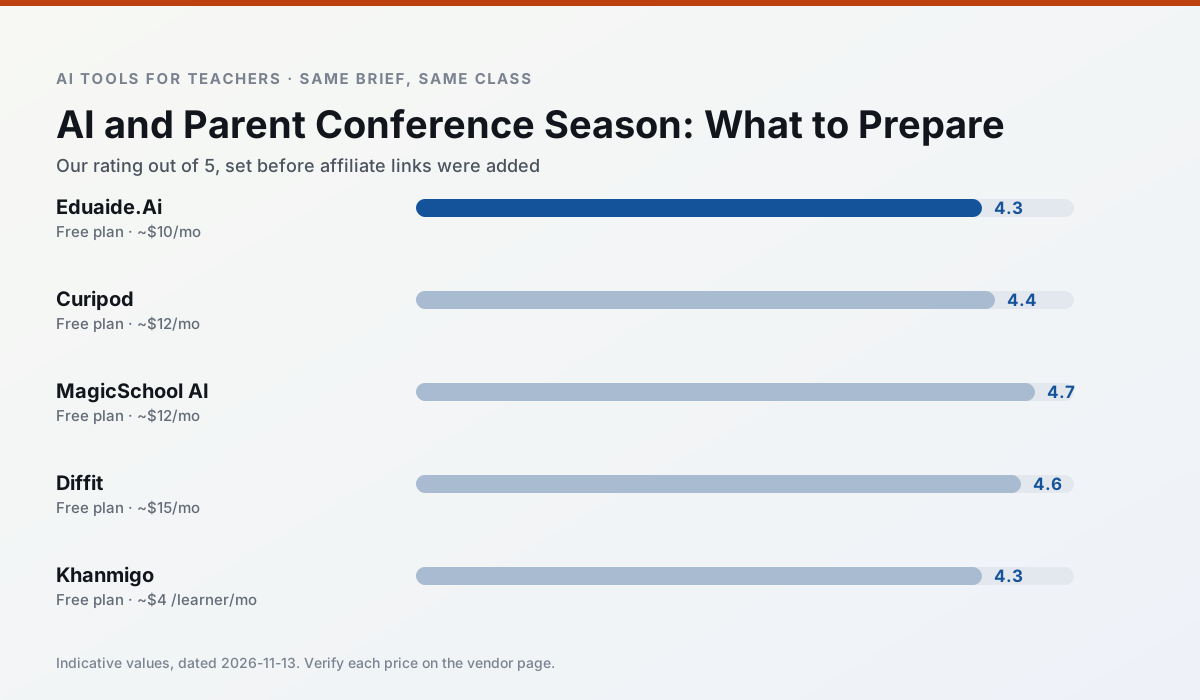
Side by side
Comparison table
Ratings reflect our timed classroom workflow, not vendor claims. Prices are indicative — verify on the vendor site.
| Tool | Best for | Free tier | Indicative paid plan | Standout feature | Our rating | Verdict | Try the tool |
|---|---|---|---|---|---|---|---|
| Eduaide.Ai | lesson planning · rubric creation | Yes — Daily generation cap | ~$10 /user/mo | Resource library | 4.3 / 5 | Strong option | Try free |
| Curipod | formative assessment · exit tickets | Yes — Limited lessons per month | ~$12 /user/mo | Live polls and word clouds | 4.4 / 5 | Strong option | Try free |
| MagicSchool AI | lesson planning · differentiation | Yes — Core generators with monthly usage limits | ~$12 /user/mo | 80+ teacher-specific tools | 4.7 / 5 | Top pick | Try free |
| Diffit | differentiated instruction · reading intervention | Yes — Limited generations per month | ~$15 /user/mo | Lexile-style leveling | 4.6 / 5 | Top pick | Try free |
| Khanmigo | math practice · student tutoring | Yes — US teacher accounts, subject to eligibility | ~$4 /learner/mo | Socratic tutoring rather than answers | 4.3 / 5 | Strong option | Try free |
| SchoolAI | student-safe AI · differentiated instruction | Yes — Limited seats | ~$15 /user/mo | Teacher-monitored student chats | 4.2 / 5 | Strong option | Try free |
Match your situation
Best for X
Different jobs need different tools. Here is what we would open first in each case.
Eduaide.Ai is the option IT is least likely to block: single sign-on, admin removal of AI features and an agreement on file.
Curipod has the shortest path from opening a tab to a usable draft, which matters more than the feature count on a Monday.
On the daily cycle, MagicSchool AI saves the most edit time per task; the paid tier mostly buys more runs rather than better ones.
Diffit's free plan is the most usable in this comparison: a quota that survives a normal week. Not enough for a department, enough for one teacher to decide.
Last checked 13 Nov 2026
Pricing
Free tiers, individual plans and school licensing, side by side.
| Tool | Free plan | Individual / paid | School & district | Billing note | Verify |
|---|---|---|---|---|---|
| Eduaide.Ai | $0 — Daily generation cap | ~$10 /user/mo | Custom quote | Indicative — verify on vendor site | Vendor |
| Curipod | $0 — Limited lessons per month | ~$12 /user/mo | Custom quote | Indicative — verify on vendor site | Vendor |
| MagicSchool AI | $0 — Core generators with monthly usage limits | ~$12 /user/mo | Custom quote | Indicative — verify on vendor site | Vendor |
| Diffit | $0 — Limited generations per month | ~$15 /user/mo | Custom quote | Indicative — verify on vendor site | Vendor |
| Khanmigo | $0 — US teacher accounts, subject to eligibility | ~$4 /learner/mo | Custom quote | Indicative — verify on vendor site | Vendor |
| SchoolAI | $0 — Limited seats | ~$15 /user/mo | Custom quote | Indicative — verify on vendor site | Vendor |
Editorial rule: pricing is re-checked every 2–3 months and the top 50 pages are refreshed every 6 months. See our funding policy.
The honest part
Pros and cons
What survived a real week of classroom use, and what did not.
Pros
- Very low entry price
- Good worksheet and rubric output
- Clean, uncluttered UI
Cons
- Smaller template set than MagicSchool
- Less polished export options
- Limited integrations
Pros
- High student engagement out of the box
- Great for quick checks for understanding
- No student accounts required for basic use
Cons
- Focused on delivery, not planning
- Requires reliable classroom devices
- Free tier is restrictive
Pros
- Widest purpose-built template library
- Strong free tier for individual teachers
- Fast to learn with almost no prompting skill
Cons
- Outputs still need standards review
- Best features sit behind the paid tier
- District approval can be slow
Pros
- Excellent for mixed-ability classes
- Produces printable and digital versions
- Minimal setup
Cons
- Narrower scope than all-in-one suites
- Leveling is approximate, not a formal assessment
- Heavy use burns through the free quota
Pros
- Education-first design
- Strong nonprofit trust signal
- Good math scaffolding
Cons
- Availability varies by region
- Less useful for admin paperwork
- Requires student accounts for full value
In the classroom
Use cases
Five concrete workflows, with the tool we would open for each one.
A weekly family newsletter from bullet notes
Newsletters fail on length, not tone. Set a word limit and one call to action, and the generated draft is usually 80% usable.
Recommended: Eduaide.AiRegrouping students after an assessment
Summarise anonymised results into skill groups, then generate one activity per group. Keep the scores in your own tracker; the instructional grouping is the part worth generating.
Recommended: CuripodRubric and feedback comments in one pass
Reorder the workflow so the rubric is yours and the comments are generated. Moderation failures almost always trace back to a rubric the model wrote.
Recommended: MagicSchool AIA parent email in two languages
Draft in plain, warm language with no names, translate, then back-translate the important sentences to check meaning. Keep specific incidents out of the prompt and add them yourself.
Recommended: DiffitA Monday morning lesson plan in twelve minutes
The twelve minutes come from not rewriting the skeleton. Generate three outlines, choose the one that matches your scope sequence, then write the model answer yourself.
Recommended: Khanmigo
Questions teachers ask us
FAQ
Direct answers, also published as FAQPage structured data for search and AI assistants.
How long does this workflow take?
Which tool should I start with?
What if the output is unusable?
Sources & further reading
Our recommendation
Try MagicSchool AI free for your next lesson planning task
A large library of teacher-specific AI generators in one dashboard. Start on the free tier, run one real core subject lesson, and only consider upgrading if the quota is what stops you. Disclosure: we may earn a commission (30% recurring) at no extra cost to you.
Some links on this page are affiliate links. We may earn a commission at no extra cost to you. Our rankings are editorial and never pay-to-play. Never enter student PII into a free consumer account.
Keep reading
Related comparisons in this cluster.
Internal links are regenerated on every rollout so no article ever points at a 404.