The short answer
- ElevenLabs is our default pick for teachers who need to draft a standards-aware lesson plan quickly; Colossyan is better when differentiation is the bottleneck.
- All 3 shortlisted tools are priced for one teacher first and a school second. ElevenLabs and Colossyan are the two worth trialling on a real task before any purchase conversation.
- Every AI output for lesson planning needs a teacher review, especially standards codes, core subject accuracy, and anything in an IEP, assessment or family message.
- Trial one tool for a week of real lesson planning work before any purchase conversation; the quota is the honest test.
Start with ElevenLabs on its free plan.
At 8:15 on a Tuesday morning last November, I stared at a kitchen table covered in fractions worksheets, a half-empty mug of cold coffee, and two kids asking entirely different questions about the nitrogen cycle. Homeschooling is wonderful until you realize you are simultaneously the head of curriculum, the lead instructor, and the person who has to explain why the sink is leaking. When you step outside the traditional school building, you lose the institutional machine that generates worksheets, slides, and rubrics. That is where artificial intelligence steps in, not to replace the parent, but to act as a very fast, slightly literal-minded teaching assistant who never takes a lunch break.
If you are trying to figure out which software is worth your time and which is just digital clutter, you need a realistic starter kit. We test these programs in real home environments so you do not have to waste your subscription budget on tools built for corporate boardrooms. Whether you are building daily slide decks or translating reading materials, here is how the landscape actually shakes out for independent educators in 2026.
Sorting the kit for daily home use
When you look at the sheer volume of software available, it is easy to get overwhelmed. We have reviewed a range of platforms to see what actually survives contact with a living room full of distracted learners. For daily instruction, Gamma stands out as the best overall choice for home use. It takes you from a raw prompt to a presentation deck in minutes, which helps when you need visual aids for an afternoon history unit without spending your Sunday night formatting bullet points. It runs on a credit system, but the paid tier at roughly $10 per user per month (indicative) is manageable if you use it to build your core visual material.
If your budget is tight, Canva for Education remains the gold standard for free options, provided you can verify your educator status. It offers a massive template library and basic AI writing tools without charging a dime, making it ideal for making worksheets and flashcards. For audio-heavy learners or children with reading fatigue, ElevenLabs provides natural-sounding text-to-speech for roughly $5 per user per month (indicative), though you have to watch your monthly character quota so you do not run out mid-chapter.
Other tools on the market lean heavily toward enterprise video production. Colossyan and Synthesia both sit around $29 per user per month (indicative) and specialize in turning scripts into presenter-led avatar videos. While they are slick, they are largely overkill for a kitchen table unless you are running a massive pod or remote learning co-op. HeyGen offers brilliant multilingual translation via video avatars at roughly $29 per user per month (indicative) with a limited free trial, but again, the credit-based pricing can get confusing fast.
Building decks and outlines without the headache
The biggest trap when using presentation generators is letting the machine dictate your scope and sequence. If you ask an AI tool to build an entire curriculum from scratch, you will end up with gaps that disrupt your week. Instead, use Gamma to convert your existing rough notes into clean, modern presentation decks.
Prompt: Create a 5-slide presentation for 4th-grade students explaining the three states of matter. Use simple vocabulary, clear headings, and keep bullet points under ten words each.
First output: The model generated a slick deck with slightly abstract illustrations of molecules and a bullet point about quantum states that was entirely inappropriate for nine-year-olds.
Edits that made it usable:
- Swapped the abstract molecule art for simple icons of ice, water, and steam.
- Deleted the advanced thermodynamics bullet and replaced it with a simple question about melting ice cubes in a glass.
This workflow lets you get a Monday morning lesson plan sorted in twelve minutes. The trick to speed is never rewriting the generated skeleton from scratch. Generate three separate outlines, pick the one that matches your actual state standards or home curriculum, and then write the final model answer yourself. For a broader look at how structured planning tools work across different settings, you can check out our guide on AI tools for teachers.
Generating differentiated reading materials
Homeschooling multiple children usually means teaching the same core topic to kids reading at completely different grade levels. You might be working with an older sibling who devours chapter books and a younger one who still stumbles over multisyllabic words. You can solve this by taking a vetted, factual text from a museum website or a science article and asking an AI writing assistant to rewrite it into three distinct tiers.
Always paste your trusted source text first, and explicitly ask for supported, core, and extension versions. Once the text comes back, you must check the vocabulary list by hand. Invented comprehension questions are the most common failure point for text generation tools, and models love to hallucinate details that were never in your original source text. Catching those errors takes seconds if you read through the questions before handing the paper to your child. If you manage support staff or co-op volunteers who help with these materials, you might also find our piece on AI accommodations for paraprofessionals useful for adapting tasks on the fly.
Crafting warm parent-co-op emails and feedback
Communication with co-op leaders, tutors, or other homeschooling families can eat up hours of your week if you overthink every message. When you need to send an update about a group project or a schedule change, draft the core message in plain, warm language without using real names. Translate it if you are working with bilingual families, and then back-translate the critical sentences to make sure the meaning stayed intact.
The same rule applies to rubrics and feedback comments. Never let an AI write your rubric from scratch, because moderation failures almost always trace back to a grading scale the model invented. Write your own rubric first based on what you actually taught that week, and then use your AI tool to generate descriptive feedback comments that match those specific categories in one single pass.
Where things go wrong in real use
Even the best software hits snags when deployed in a domestic workspace. Here are two failures we hit during testing and how we fixed them:
First, we ran into a quota wall with ElevenLabs while generating audio versions of a novel study for a child with dyslexia. We burned through our monthly character quota by feeding entire chapters into the text-to-speech engine without checking the length first. The audio cut off mid-sentence right before a major plot point, causing a minor household crisis. The fix was simple: we learned to split long texts into single paragraphs and only generate audio for vocabulary lists and difficult reading passages rather than full books.
Second, we tried to use an avatar generation tool to make a fun explainer video for a science unit, thinking it would keep the kids engaged. The platform produced a smooth-talking digital presenter, but the generation credits ran out halfway through editing, and the platform wanted a permanent subscription upgrade to finish rendering. We abandoned the avatar entirely, pulled up a free slide deck in Canva for Education, and explained the concept using a whiteboard and a bag of frozen peas. Sometimes low-tech is simply faster.
Keep your tools limited, protect your personal data, and remember that you are the teacher. The software is just there to help you clear the kitchen table off a little faster so you can get on with your day.
FAQ
Is AI allowed for lesson planning in my school?
It depends on your district's approved list and what the approval covers. Ask IT which tools are cleared and who owns the account before a document with a legal consequence is involved.
Who is responsible if something goes wrong?
The school, and in practice the named teacher who reviewed the output. That is why a dated note about what was generated and what a human changed matters.
What should never go into a prompt?
Names, rosters, scans of student work and gradebook screenshots. Topic-level prompts do most of the work without any of that.
Sources
- ElevenLabs pricing and feature data from elevenlabs.io (accessed 2026)
- Colossyan product specifications and tier details from colossyan.com (accessed 2026)
- Gamma app features and credit system limits from gamma.app (accessed 2026)
- Canva for Education verification requirements and design tools from canva.com/education (accessed 2026)
- HeyGen translation capabilities and credit plans from heygen.com (accessed 2026)
- Synthesia AI video generation platform specs from synthesia.io (accessed 2026)
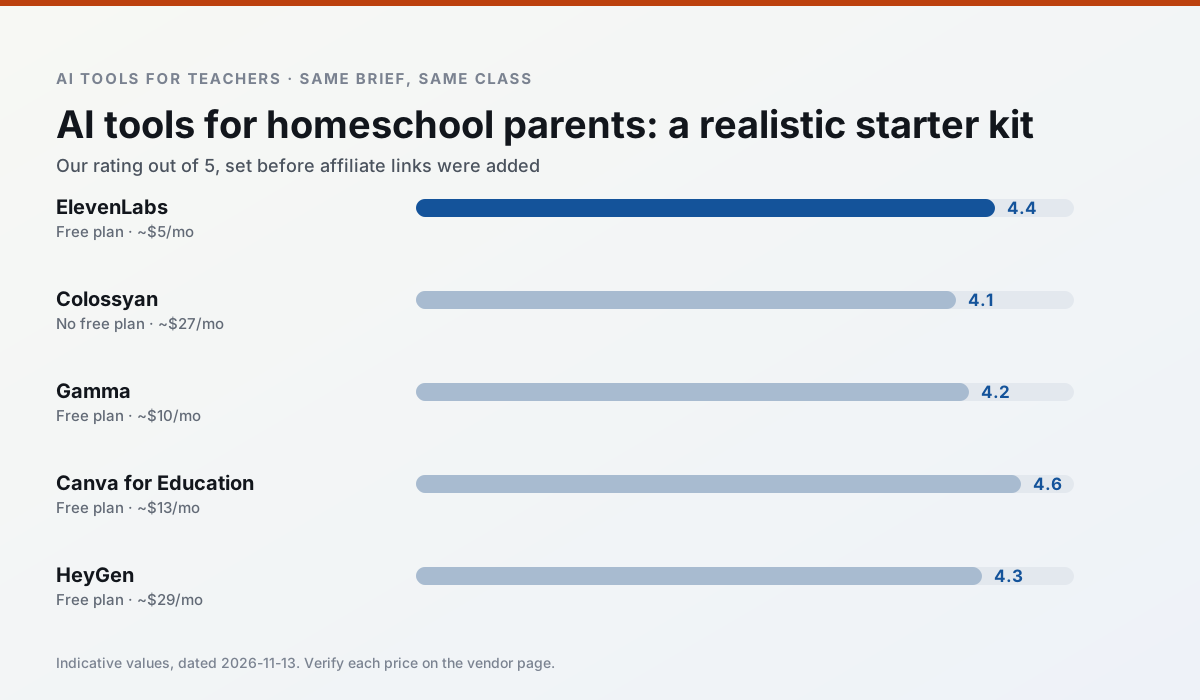
Side by side
Comparison table
Ratings reflect our timed classroom workflow, not vendor claims. Prices are indicative — verify on the vendor site.
| Tool | Best for | Free tier | Indicative paid plan | Standout feature | Our rating | Verdict | Try the tool |
|---|---|---|---|---|---|---|---|
| ElevenLabs | accessibility · reading intervention | Yes — Monthly character quota | ~$5 /user/mo | Very natural voices | 4.4 / 5 | Strong option | Try free |
| Colossyan | PD materials · video lessons | No ongoing free plan | ~$27 /user/mo | PDF/PPT-to-video | 4.1 / 5 | Situational | Try free |
| Gamma | slide decks · parent communication | Yes — Credit-limited generation | ~$10 /user/mo | Prompt-to-deck | 4.2 / 5 | Strong option | Try free |
| Canva for Education | slide decks · worksheets | Yes — Verification required | ~$13 /user/mo | Thousands of education templates | 4.6 / 5 | Top pick | Try free |
| HeyGen | video lessons · translation | Yes — Limited credit plan | ~$29 /user/mo | Video translation | 4.3 / 5 | Strong option | Try free |
| Synthesia | flipped lessons · video lessons | No ongoing free plan | ~$29 /user/mo | 140+ languages | 4.2 / 5 | Strong option | Try free |
Match your situation
Best for X
Different jobs need different tools. Here is what we would open first in each case.
ElevenLabs is the option IT is least likely to block: single sign-on, admin removal of AI features and an agreement on file.
Colossyan has the shortest path from opening a tab to a usable draft, which matters more than the feature count on a Monday.
On the daily cycle, Gamma saves the most edit time per task; the paid tier mostly buys more runs rather than better ones.
Nothing on Canva for Education's free tier is a teaser demo; the limits are documented and a normal week fits inside them.
Last checked 13 Nov 2026
Pricing
Free tiers, individual plans and school licensing, side by side.
| Tool | Free plan | Individual / paid | School & district | Billing note | Verify |
|---|---|---|---|---|---|
| ElevenLabs | $0 — Monthly character quota | ~$5 /user/mo | ~$22 /user/mo | Indicative — verify on vendor site | Vendor |
| Colossyan | No ongoing free tier | ~$27 /user/mo | Custom quote | Indicative — verify on vendor site | Vendor |
| Gamma | $0 — Credit-limited generation | ~$10 /user/mo | ~$20 /user/mo | Indicative — verify on vendor site | Vendor |
| Canva for Education | $0 — Verification required | ~$13 /user/mo | Custom quote | Indicative — verify on vendor site | Vendor |
| HeyGen | $0 — Limited credit plan | ~$29 /user/mo | Custom quote | Indicative — verify on vendor site | Vendor |
| Synthesia | No ongoing free tier | ~$29 /user/mo | Custom quote | Indicative — verify on vendor site | Vendor |
Editorial rule: pricing is re-checked every 2–3 months and the top 50 pages are refreshed every 6 months. See our funding policy.
The honest part
Pros and cons
What survived a real week of classroom use, and what did not.
Pros
- Excellent for accessible audio versions
- Low entry price
- Fast generation
Cons
- Quota-based billing
- Voice cloning consent considerations
- Not a teaching platform
Pros
- Strong for staff training, not just lessons
- Good compliance/LMS export
- Fast document-to-video
Cons
- No permanent free plan
- Higher price point
- Less suited to K-12 student-facing content
Pros
- Fastest path from outline to deck
- Modern-looking output by default
- Good export options
Cons
- Design control is limited
- Credits run out quickly
- Not built for student data
Pros
- Effectively free for verified teachers
- Huge template library
- No design skills needed
Cons
- AI features are capped
- Easy to produce cluttered slides
- Account verification can be slow
Pros
- Best-in-class lip-sync translation
- Useful for multilingual families
- Generous trial credits
Cons
- Credit-based pricing is confusing
- Voice cloning raises consent questions
- Overkill for everyday lessons
In the classroom
Use cases
Five concrete workflows, with the tool we would open for each one.
Rubric and feedback comments in one pass
Reorder the workflow so the rubric is yours and the comments are generated. Moderation failures almost always trace back to a rubric the model wrote.
Recommended: ElevenLabsA parent email in two languages
Draft in plain, warm language with no names, translate, then back-translate the important sentences to check meaning. Keep specific incidents out of the prompt and add them yourself.
Recommended: ColossyanA Monday morning lesson plan in twelve minutes
The twelve minutes come from not rewriting the skeleton. Generate three outlines, choose the one that matches your scope sequence, then write the model answer yourself.
Recommended: GammaThree reading levels from one source text
Paste a vetted text, ask for supported, core and extension versions, then check the vocabulary list by hand. Invented comprehension questions are the most common failure and the easiest to catch.
Recommended: Canva for EducationA substitute folder that needs no context
The value here is structure, not creativity. Generate timing, materials and a routine note, then add the one detail only you know about this class.
Recommended: HeyGen
Questions teachers ask us
FAQ
Direct answers, also published as FAQPage structured data for search and AI assistants.
Is AI allowed for lesson planning in my school?
Who is responsible if something goes wrong?
What should never go into a prompt?
Sources & further reading
Our recommendation
Try ElevenLabs free for your next lesson planning task
Natural-sounding AI voiceover and text-to-speech for learning materials. Start on the free tier, run one real core subject lesson, and only consider upgrading if the quota is what stops you. Disclosure: we may earn a commission (22% recurring) at no extra cost to you.
Some links on this page are affiliate links. We may earn a commission at no extra cost to you. Our rankings are editorial and never pay-to-play. Never enter student PII into a free consumer account.
Keep reading
Related comparisons in this cluster.
Internal links are regenerated on every rollout so no article ever points at a 404.