The short answer
- Diffit is our default pick for teachers who need to build levelled passages and word work quickly; ElevenLabs is better when differentiation is the bottleneck.
- Diffit handles the broad case; ElevenLabs handles the narrow one. Anything beyond that pair should be justified by a recurring weekly job, not a feature demo.
- Every AI output for reading intervention needs a teacher review, especially standards codes, ELA accuracy, and anything in an IEP, assessment or family message.
- Everything on this page dates from 2026-11-13; where a price could not be re-read, the row says so.
Start with ElevenLabs on its free plan.
At 8:15 on a Tuesday morning, I had a 10th-grade English class staring at me with six different reading levels, two unexcused absences from my intervention roster, and a photocopier that had just started smoking. That is the exact moment I stopped trying to write three versions of every single text by hand. Using AI reading intervention for ela teachers is not about replacing the hard work of teaching reading. It is about surviving the gap between what your students need and what your school stockroom actually provides.
When you have students reading anywhere from a 4th-grade level to freshman college prose, you need more than good intentions. You need tools that handle the mechanical grind of leveling, audio conversion, and feedback without eating your entire Sunday. We have tested the landscape extensively, and if you are building a modern workflow, you should start by reviewing our comprehensive breakdown of the best AI tools for teachers. Let us look at what actually works in a real classroom and where these systems fall flat on their faces.
Leveling Text Without Losing the Content
Diffit is the tool I reach for when I need to take a dense article on municipal zoning and make it accessible for my struggling readers without turning it into baby talk. It is our top pick for schools and districts because the setup is minimal and it drops straight into printable or digital formats. You paste a link or a text snippet, pick a target grade level, and it spits out vocabulary, summaries, and comprehension questions.
The catch is that leveling is approximate, not a formal Lexile assessment. If you rely on the machine to generate your comprehension questions without reading them first, you will find questions that test memory of trivia rather than actual textual analysis. The free tier will burn through your monthly quota fast if you use it for every lesson, so you have to be deliberate about what you process.
Prompt: Level this New York Times article on urban heat islands down to a 6th-grade reading level. Keep the core argument intact, but shorten the sentences and pull out five key vocabulary words with student-friendly definitions.
First output: The AI provided a decent three-paragraph summary, but the vocabulary list included words like "microclimate" without defining how it relates to asphalt, and two of the comprehension questions were factually disconnected from the source text.
Edits made:
- Manually swapped "microclimate" for "heat trap" to match the actual text we annotated in class.
- Rewrote the multiple-choice questions to focus on cause and effect rather than minor statistics.
Adding Audio for Struggling Decoders
Sometimes the barrier is not just comprehension; it is the physical act of decoding words on a page. ElevenLabs is our pick for quick setup when you need natural-sounding AI voiceover for learning materials. It gives you an incredible range of voices that do not sound like a GPS routing error, which matters immensely when you have dyslexic readers or English language learners who need to track the text while listening.
The limitations here are structural. It runs on a monthly character quota, so you cannot dump entire novels into it without paying for a plan. Furthermore, it is a voice engine, not a teaching platform. You have to bring your own text. Never try to clone a student or a colleague's voice without explicit written consent. That crosses an ethical line and creates massive liability for your classroom.
Managing Feedback at Scale
For writing intervention, Turnitin Clarity and Feedback Studio remains the heavy hitter for daily use in schools that license it. It is already integrated into many institutional workflows, giving you consistent similarity checking and detailed revision history. If your school has it, use it. The problem is that individual teachers cannot buy a standalone license out of pocket, and AI detection tools integrated into these suites still produce false flags that require careful human interpretation.
When your students are working on paper—which happens more often than ed-tech companies want to admit—Class Companion is our favorite free option. It gives fast, specific AI feedback on handwritten and scanned student work, and it handles diagrams and short answers surprisingly well. Scan quality dictates everything here. If a student writes in faint pencil on wrinkled notebook paper, the AI will hallucinate errors simply because it cannot read the pixels. You still have to review the feedback before handing it back.
Creating Safe Student Spaces
If you want students interacting directly with an AI tutor during an intervention block, general chatbots are a data privacy nightmare. SchoolAI is built precisely for this, offering teacher-controlled student spaces with strict safeguarding defaults and clear audit logs. It is designed for district approval, meaning you can set up a reading assistant that checks for comprehension at a specific Lexile band without letting students wander off into hallucination land.
The downside is that it requires institutional buy-in and lacks the freewheeling flexibility of open-ended models. If your district has not purchased a seat license, you are locked out. Always confirm your local data privacy agreement before letting students log in with their school accounts. If you are looking at other subject areas for similar workflows, check out our guide on AI essay feedback for history teachers.
Where the Workflow Breaks Down
Every AI tool vendor promises you will save ten hours a week. In reality, you save time in some places and spend it fixing mistakes in others. When drafting intervention materials, moderation failures almost always trace back to a rubric the model generated. Do not let the AI write your rubric. Write your own grading criteria first, then ask the AI to generate comments that match your established standards.
The same rule applies to parent communication and lesson planning. If you ask an AI to write a lesson plan from scratch, you will spend twenty minutes editing its generic suggestions. Instead, generate three structural outlines, pick the one that matches your scope and sequence, and write the actual instructional model yourself. AI is a fantastic sous-chef for reading intervention, but you are still the head cook. Keep your hands on the knife.
FAQ
Can AI do reading intervention at mixed-grade level?
It can produce a first draft and a structure. The level judgement, the standards check and the tone are teacher decisions.
Which tool is best for reading intervention?
Diffit on the evidence in this article, with ElevenLabs as the second opinion. Neither replaces the review step.
What is the biggest risk?
A confident, plausible output that nobody checked. The five checks below exist for that reason.
Sources
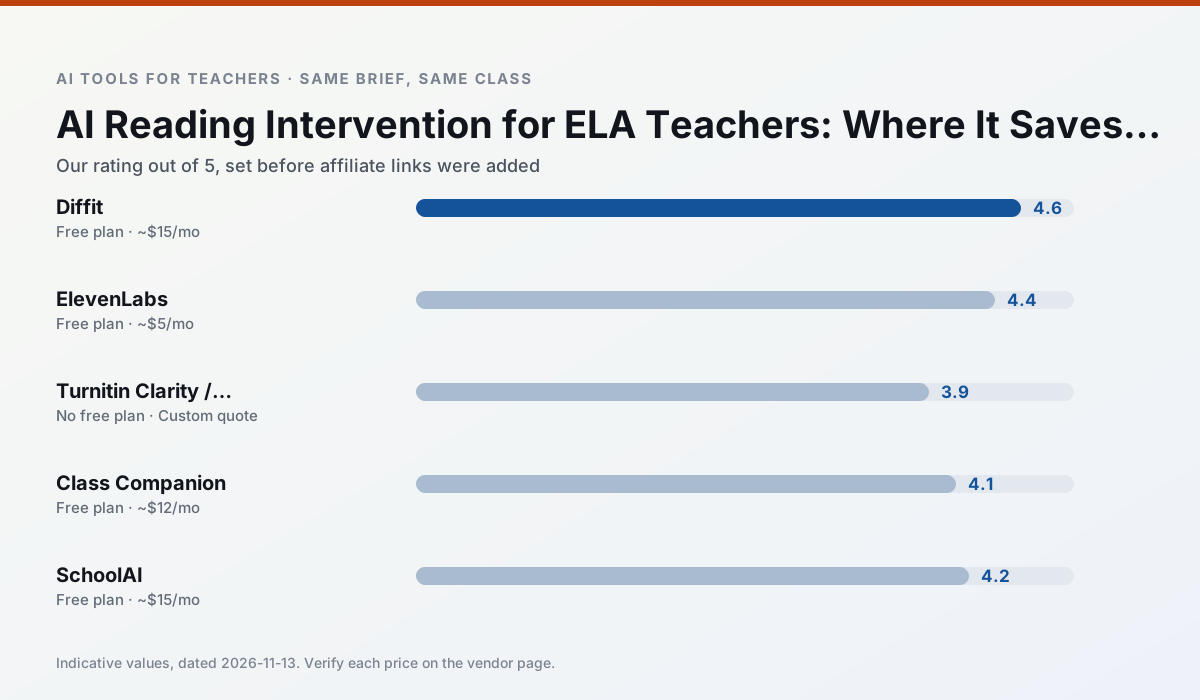
Side by side
Comparison table
Ratings reflect our timed classroom workflow, not vendor claims. Prices are indicative — verify on the vendor site.
| Tool | Best for | Free tier | Indicative paid plan | Standout feature | Our rating | Verdict | Try the tool |
|---|---|---|---|---|---|---|---|
| Diffit | differentiated instruction · reading intervention | Yes — Limited generations per month | ~$15 /user/mo | Lexile-style leveling | 4.6 / 5 | Top pick | Try free |
| ElevenLabs | accessibility · reading intervention | Yes — Monthly character quota | ~$5 /user/mo | Very natural voices | 4.4 / 5 | Strong option | Try free |
| Turnitin Clarity / Feedback Studio | feedback on writing · academic integrity | No ongoing free plan | Custom quote | Similarity reports | 3.9 / 5 | Situational | Try free |
| Class Companion | grading · feedback on writing | Yes — Limited assignments | ~$12 /user/mo | Handwriting recognition | 4.1 / 5 | Situational | Try free |
| SchoolAI | student-safe AI · differentiated instruction | Yes — Limited seats | ~$15 /user/mo | Teacher-monitored student chats | 4.2 / 5 | Strong option | Try free |
| Surfer SEO | teacher bloggers · resource sellers | No ongoing free plan | ~$79 /mo | Content Editor | 4.0 / 5 | Situational | Try free |
Match your situation
Best for X
Different jobs need different tools. Here is what we would open first in each case.
For a school rollout, Diffit offers the paperwork and the admin console; the classroom features are standard by comparison.
Setup cost is one login for ElevenLabs; everything else can wait until you know the tool is useful.
Turnitin Clarity / Feedback Studio is the one we would open on a normal planning day because the first output is editable rather than restructurable, and the free plan covers a single teacher's routine.
If there is no budget, start with Class Companion: free plan with clearest quota is the least punishing free tier here.
Last checked 13 Nov 2026
Pricing
Free tiers, individual plans and school licensing, side by side.
| Tool | Free plan | Individual / paid | School & district | Billing note | Verify |
|---|---|---|---|---|---|
| Diffit | $0 — Limited generations per month | ~$15 /user/mo | Custom quote | Indicative — verify on vendor site | Vendor |
| ElevenLabs | $0 — Monthly character quota | ~$5 /user/mo | ~$22 /user/mo | Indicative — verify on vendor site | Vendor |
| Turnitin Clarity / Feedback Studio | No ongoing free tier | Custom quote | Custom quote | LMS-wide deployment | Vendor |
| Class Companion | $0 — Limited assignments | ~$12 /user/mo | Custom quote | Indicative — verify on vendor site | Vendor |
| SchoolAI | $0 — Limited seats | ~$15 /user/mo | Custom quote | Indicative — verify on vendor site | Vendor |
| Surfer SEO | No ongoing free tier | ~$79 /mo | Custom quote | Indicative — verify on vendor site | Vendor |
Editorial rule: pricing is re-checked every 2–3 months and the top 50 pages are refreshed every 6 months. See our funding policy.
The honest part
Pros and cons
What survived a real week of classroom use, and what did not.
Pros
- Excellent for mixed-ability classes
- Produces printable and digital versions
- Minimal setup
Cons
- Narrower scope than all-in-one suites
- Leveling is approximate, not a formal assessment
- Heavy use burns through the free quota
Pros
- Excellent for accessible audio versions
- Low entry price
- Fast generation
Cons
- Quota-based billing
- Voice cloning consent considerations
- Not a teaching platform
Pros
- Already licensed at many schools
- Consistent institutional workflow
- Detailed revision history
Cons
- Individual teachers cannot buy it
- AI detection remains contested
- Heavy administrative setup
Pros
- Useful where work is done on paper
- Fast, specific comments
- Good math support
Cons
- Scan quality affects accuracy
- Narrow use case
- Feedback still needs teacher review
Pros
- Designed for district approval
- Teacher visibility into student use
- Good safeguarding defaults
Cons
- Requires school-wide buy-in
- Less flexible than general LLMs
- Pricing is mostly quote-based
In the classroom
Use cases
Five concrete workflows, with the tool we would open for each one.
Rubric and feedback comments in one pass
Reorder the workflow so the rubric is yours and the comments are generated. Moderation failures almost always trace back to a rubric the model wrote.
Recommended: DiffitA parent email in two languages
Draft in plain, warm language with no names, translate, then back-translate the important sentences to check meaning. Keep specific incidents out of the prompt and add them yourself.
Recommended: ElevenLabsA Monday morning lesson plan in twelve minutes
The twelve minutes come from not rewriting the skeleton. Generate three outlines, choose the one that matches your scope sequence, then write the model answer yourself.
Recommended: Turnitin Clarity / Feedback StudioThree reading levels from one source text
Paste a vetted text, ask for supported, core and extension versions, then check the vocabulary list by hand. Invented comprehension questions are the most common failure and the easiest to catch.
Recommended: Class CompanionA substitute folder that needs no context
The value here is structure, not creativity. Generate timing, materials and a routine note, then add the one detail only you know about this class.
Recommended: SchoolAI
Questions teachers ask us
FAQ
Direct answers, also published as FAQPage structured data for search and AI assistants.
Can AI do reading intervention at mixed-grade level?
Which tool is best for reading intervention?
What is the biggest risk?
Sources & further reading
Our recommendation
Try ElevenLabs free for your next reading intervention task
Natural-sounding AI voiceover and text-to-speech for learning materials. Start on the free tier, run one real ELA lesson, and only consider upgrading if the quota is what stops you. Disclosure: we may earn a commission (22% recurring) at no extra cost to you.
Some links on this page are affiliate links. We may earn a commission at no extra cost to you. Our rankings are editorial and never pay-to-play. Never enter student PII into a free consumer account.
Keep reading
Related comparisons in this cluster.
Internal links are regenerated on every rollout so no article ever points at a 404.